Cars We Love & Who We Are

More than the polished parts and hard to find pieces, the special interest vehicles people collect embody the character of each owner. “Cars We Love & Who We Are” profiles individual special interest vehicles and the proud owner committed to its preservation.

Cars We Love & Who We Are #22

What is it about a life that defines a person? I have come to believe that the world around us mimics how we define ourselves. While at a large regional classic car and hot rod event, I encountered a man showing a stunning 1912 C-Cab Ford truck hot rod. Knowledgeable, affable and friendly to all, he offered me a look at a gallery of photographs displaying vehicles he had designed and built as well as others he had modified after purchasing them for his collection. He possessed a visionary flair for bringing all types of mobile machinery to life. Clearly from his interactions and conversations with others that I observed, the world viewed him for the respected and gifted hot road visionary and fabricator that he is. Oh yeah and he was in a wheelchair. No big deal, certainly not for him. Meet Rory Sevajian.

A hot rod life defined by abundance not lack


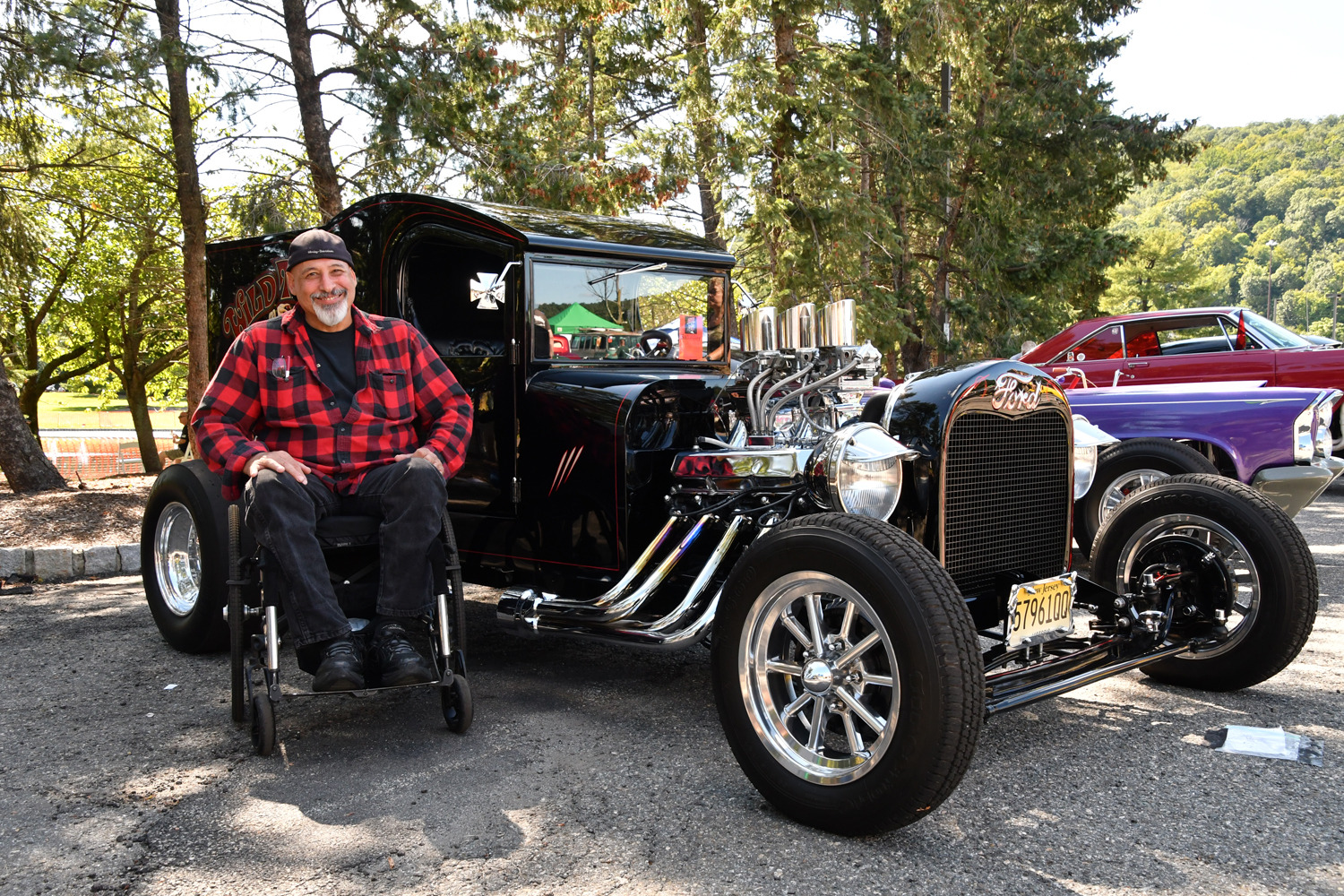
Rory Sevajian with 1912 Ford C-Cab

When Rory Sevajian flashes his ready and welcoming smile, you find yourself drawn in and comfortable in his engaging company. The fact that regardless of the event, he has brought some stunningly unique thundering eye candy that he designed makes him and his creations a magnet for interested observers and show trophies.

His passion for building unique performance and special interest vehicles came to life in Rory’s early teen years.

Rory says, “As a little kid, I was always interested in all these things. I hung around with all the older kids that had cool cars and learned from them.” Also, Rory’s father used to take him to the New York Auto Show at the New York Coliseum in the early 196os.  Rory recalls saying, “I was really young. The cars there were nothing like you’d ever seen before. Even to this day, today when you go to auto shows, there’s no comparison to what was done in the 50s and 60s.”

As a young guy without a lot of money, Rory developed a  philosophy that continues to guide his efforts today. Quote: “Start out with junk and make it into something special.” Almost as a design principle, even Rory’s most striking creations humbly start out as “junk. Then, benefitting from the magic of his transformative vision he brings to life something very special.

So for almost 30 years Rory had transformed “junk” into spectacular vehicles and motorcycles. Then “it“ happened, the accident.

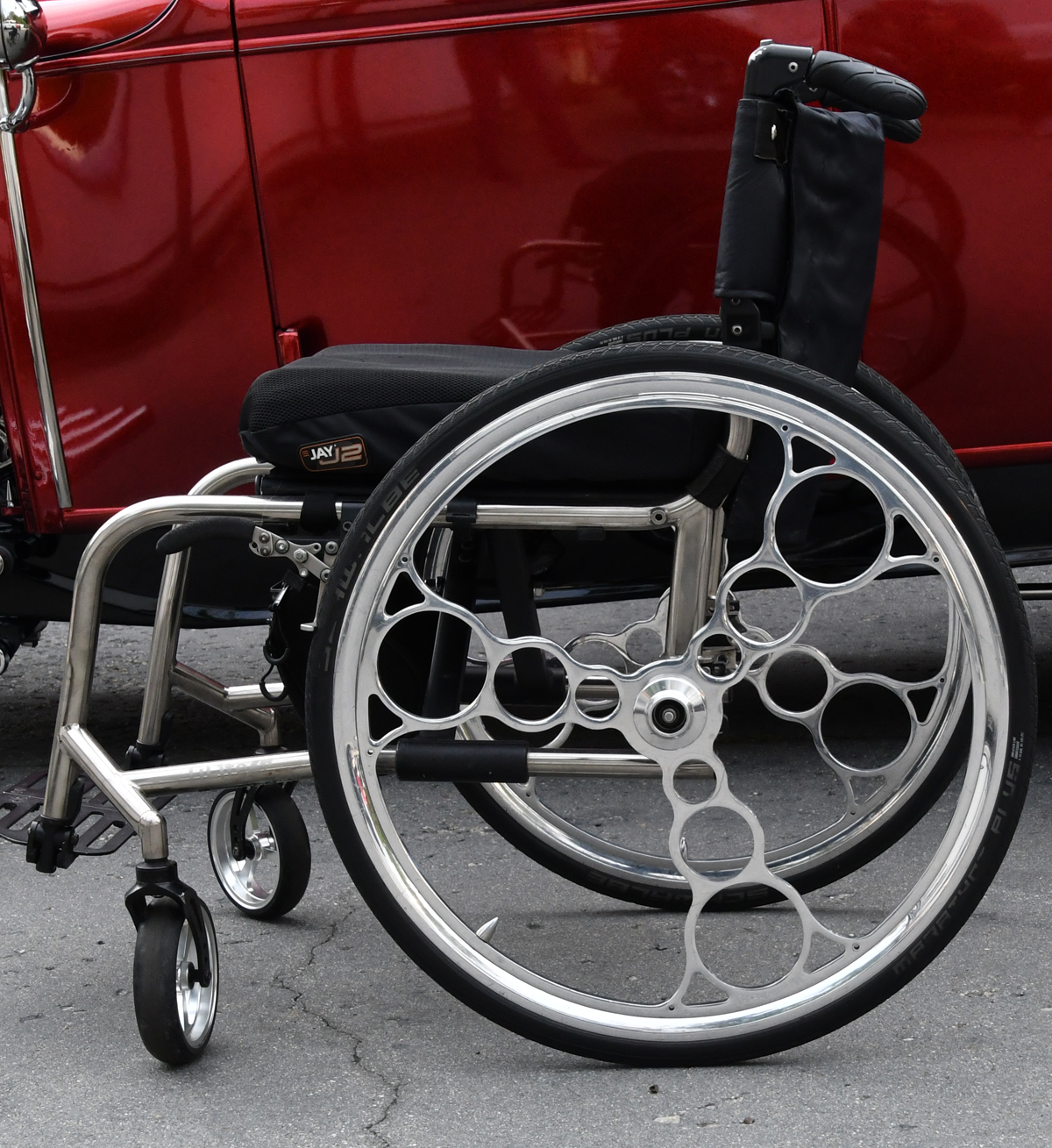
Billet cut rims for Rory’s wheelchair

Rory had, and still has, a tree service business. While on the job, one of his workers, the “saw man,” positioned himself to cut a limb leaning against a second tree. The saw man believed that the second tree was strong enough to hold the limb. It was not. The base of the second and very large tree gave way. Rory says, “The large tree got me from behind. It crushed me on top of a rock garden and exploded my body.” At the hospital doctors told him he was lucky to be alive, but that he would never walk again. As others have related the story, Rory responded saying, “That’s fine with me”. He would not dwell on his loss. It would not stop Rory from building spectacular vehicles and having cool toys.

To continue in the pursuit of his lifetime pleasure of building eye popping vehicles, Rory did have to adapt.

Rory says, “The only thing where I really have a problem is with the body work and paint.” In the old days he would do all of that himself, however with the limitations of the chair, he now sends it out to be done. He concedes that his only other limitation is faced when trying to get things down from the high shelves. As before his accident, anything he does not know how to do, he has friends who do.

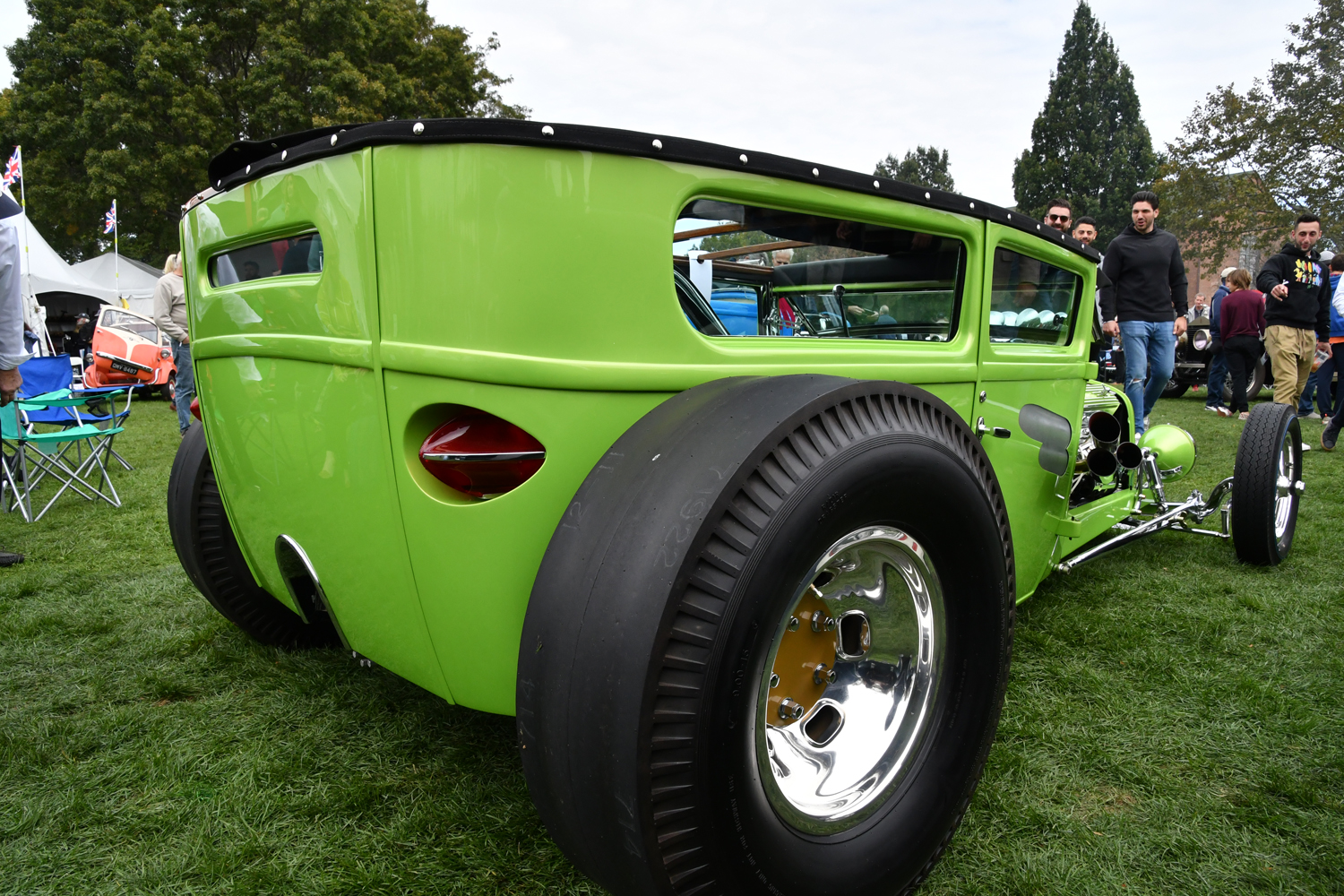
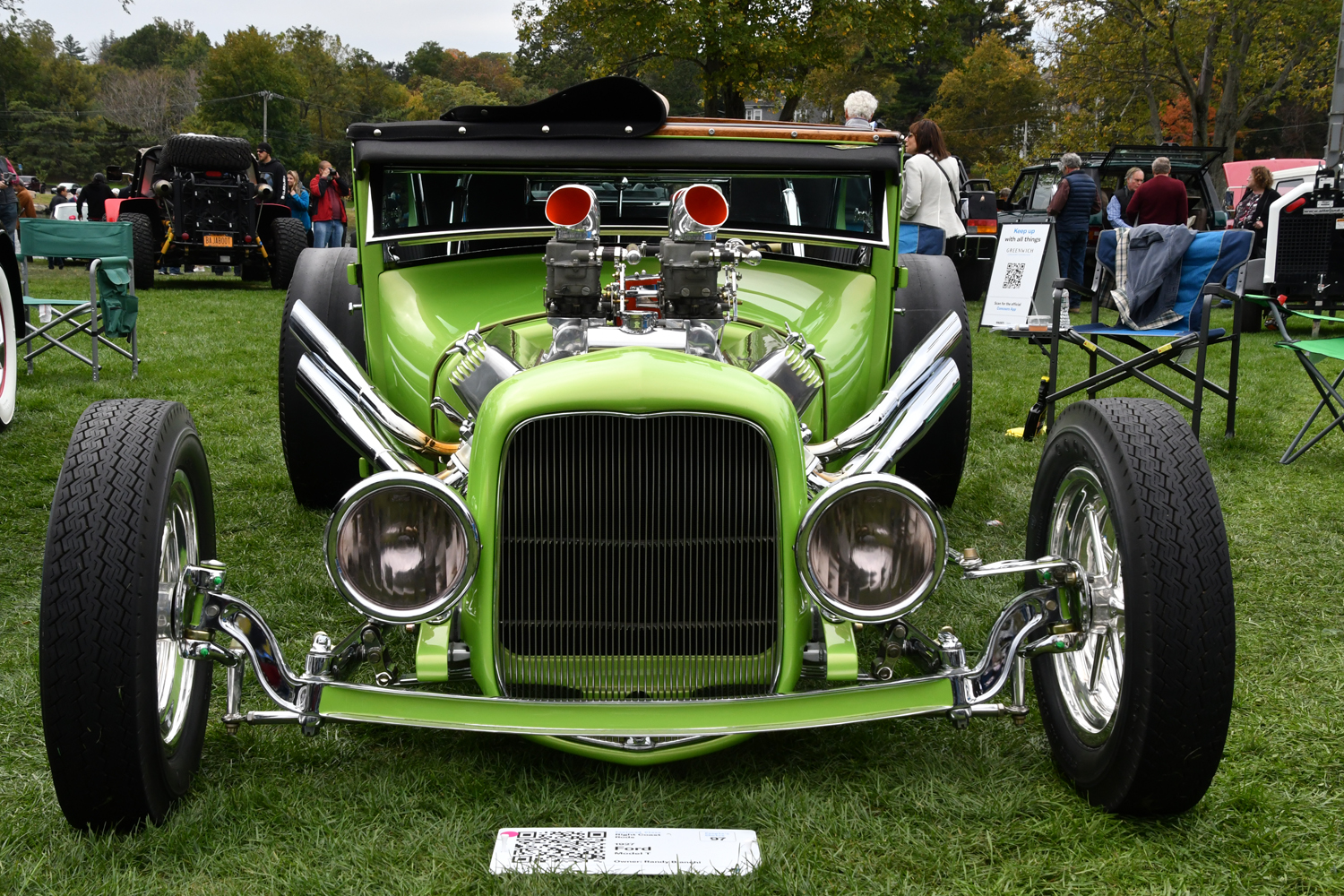
When it comes to fabrication and building, Rory designs, creates and assembles most of the pieces that give his creations their unique character. Rory says, “The visual magic resides in the details and the execution.” He will spend months refining an idea to enhance a creation and then seamlessly integrate it into the design. Emblematic of Rory’s creativity and attention to detail evidences itself in his 1912 Ford C-Cab hot rod.

“I always wanted a C-Cab. I love the way they look, “Says Rory. Over the years Rory always had his eye out for a steel body not a fiber glass repro. Then about six-years ago, one surfaced in upstate New York. He could not resist the siren’s song of an available steel body C-Cab. He drove upstate. Taking one look, love filled his heart and a vision stirred his soul. Rory says, It was rough and the suspension was falling out of it.” Undaunted he negotiated a deal and trailered the truck home. Rory smiles as he repeats his mantra, “Remember, start with junk end up with something very special.” He certainly did.

Job one had Rory totally dismantle the vintage truck. With the truck apart, his vision took hold. With a chassis rebuild that included a totally new suspension completed, his attention turned to the power train.

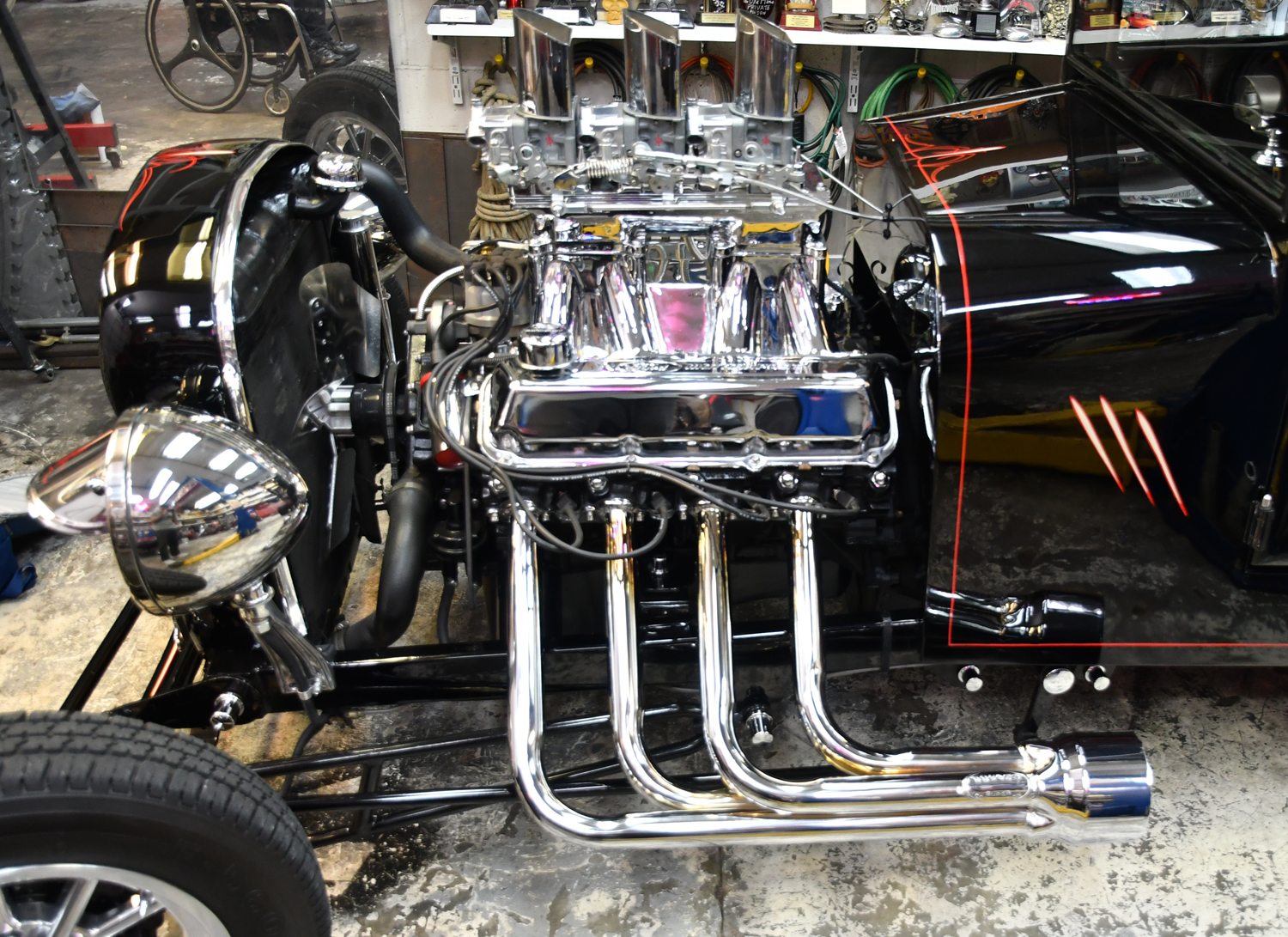
The big block 460 cu. in. V8 that came with the truck had side pipes. “Rory says, “I chopped them off because I couldn’t get in and out of the truck with my wheelchair.” Historically Rory always liked the gasser look with headers sporting a big bell on the end. Why not on the C-Cab he thought. He had the stripped down pipes, the flanges and the bell. Rory says, “It took me five hours to heat up and bend the contour and complete welding the pipes to the Bell, but it came out perfect. I sent it out for chroming. Once back I put some motorcycle baffles in it. And that was it.”
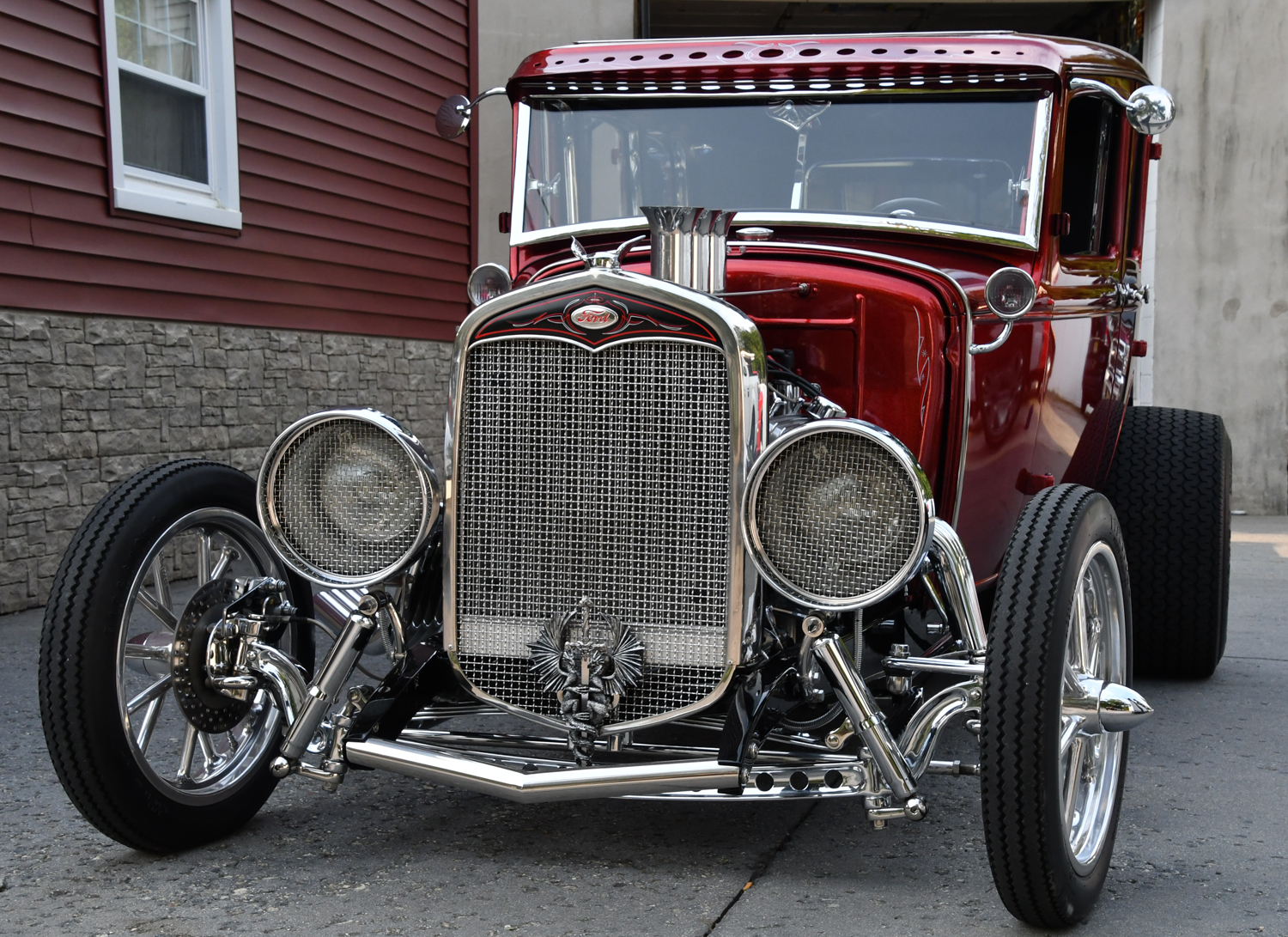
For carburetion the name of Drivin’ News fave “Carburetor Steve” plays a significant role. Rory took off the old four-barrel and installed a rare one-of-a-kind tunnel ram designed by a NASA engineer with a manifold that accepted three Holly 550 two-barrel carburetors. Carburetor Steve played a significant role in fine tuning the system.

Throughout the completed execution, Rory’s signature jeweler’s eye for detail and visual impact is in evidence from the unique wheels to the paint and pin striping.

Looking at his creation Rory says, “I love that truck. I love the truck. It’s more of a driver than something for really racing. However, see it coming down the road, it’s spectacular. It snaps necks.” He continues, “It has that, you know. Sex appeal.” He just smiles. But for generating bystander smiles nothing outdoes Rory’s “Train.”

The Train story begins with Rory’s custom motorcycle that he transformed from a two–wheel bike to a three-wheel “trike” after his accident. The story concludes years later with a custom articulated train of four trailered vehicles and a custom tow car that Rory drives to hot rod shows.

After his accident, Rory, a died-in-the-wool motorcyclist, looked at his custom personally designed two-wheel creation and knew he must transform it into an even more outrageous three-wheel “trike.”

Rory admits his final creation is more about looks than ridability, but oh how it looks!

Rory does acknowledge that a lot of money has been spent in places no one can see. Rory says, “All the real money hides inside the engine on this trike – S&S flywheel and rods, S&S oversized barrels, a really nasty Leineweber cam, Manley tulip valves and Manley triple valve springs.” Then he decided that he wanted more juice. So he went with 80-inch heads and drilled them for four spark plugs and put a Dyna III Electronic Ignition in it. Rory says, “I’m running dual coils to deal with the four plugs. The trike also has an open belt drive and high performance clutches.

When it came time to make it a trike, Rory simply pulled out a Sawzall and cut the back off. Rory’s first attempt grafted on a servi-car rear end. Police trikes and ice cream trikes used them. However, they did not suit Rory’s three-wheeled beast. Rory says, “When I let the clutch out it was idling at 50 mph. It was not a good thing.” Rory found a good solution in mixing and matching rear axle parts and tire sizes. Now, he can cruise down the highway at 60 mph without the motor screaming. Above and beyond traditional upgrades Rory has innovated some very special adaptations so that he would be able to ride the trike since he was paralyzed from the ribs down.

Rory says, “When I got hurt, I had to figure a way to ride since I couldn’t put my foot down.” Rory‘s solution provided for a handbrake on the handlebars and his own custom made shifter and clutch on the shifter. To do this he needed to incorporate a big bore master cylinder to compensate because the hand does not have the power of the foot necessary to squeeze the dual piston brake caliper on the rear wheel. Other than that the only other adaptation required was floorboards because he has to strap his feet down. Rory says, “When you’re paralyzed like me, you have to strap your feet because if your foot falls off, you don’t know it. You then can run over it like I did with my trike. I shattered my ankle. I learned the need for that adaptation the hard way.”

Which brings the story back around to the Train. Some years back Rory brought his trike to the Waldwick New Jersey Car Show. He says, “It all started when I took the trike to the show. I didn’t even enter and they handed me a trophy. I thought that’s pretty cool.” Rory really liked the people at the show. Since he was building a hot rod that would be done next year he thought  maybe he would do something special for next year’s Waldwick Show. The following year he brought his custom 1931 Ford sedan towing the trike. After winning at that show he realized that he wanted to bring something new each year. Thus, the idea of the Train came to life. Now, for seven years he has brought something different every single year. He just keeps adding on. All vehicles share an eye grabbing red metal flake, black and chrome theme enhanced with tasteful pin striping and bold graphics.

1931 Ford sedan hot rod tow car   

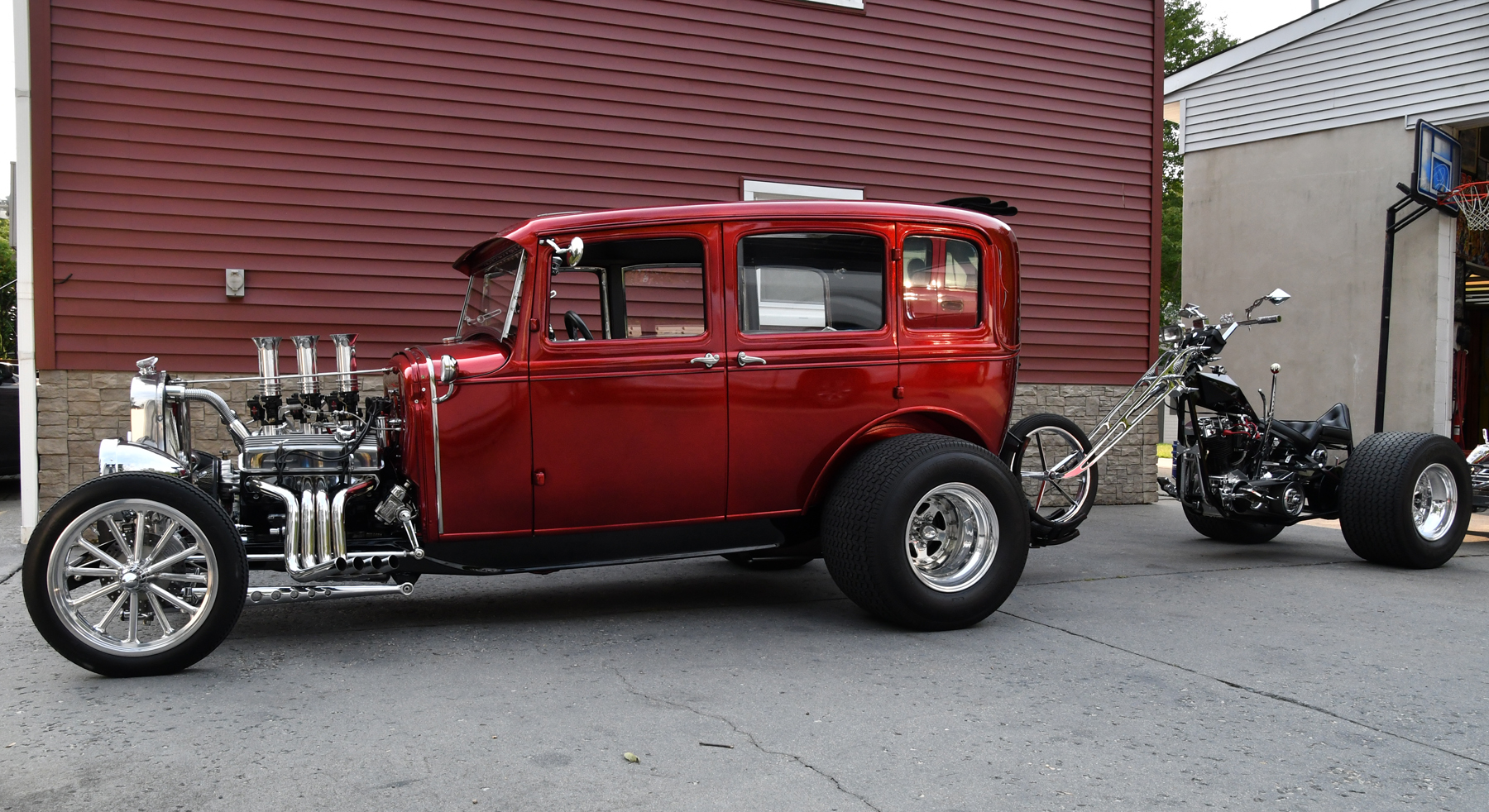
Rory says, “Some years back a friend of mine says, you need a four-door car so you can put your wheelchair behind the seat.” The search began.  Soon another friend found a suitable sedan in California. It was in rough condition. Perfect! Start with junk. Rory says, “ It was a little bit twisted, a little banged up, could use a floor. Sold! It turned out to be an unusual 1931½ Murray bodied Ford sedan made in Canada. Rory especially liked some of the more refined details on the Murray body. He says, “I just loved it. I thought I gotta have this.”

An enormous amount of time and hand crafting proved well worth the effort with the end result being a unique red metal flake hand crafted sedan with sunroof, custom stitched interior and a Chevy small block with a radical cam, Sanderson headers and three deuces set up by “Carburetor Steve.”

For the rear, Rory hand shaped a custom tow hitch for the trike’s front wheel.

THE TRAIN

All elements of the TRAIN started as discards in a state of disrepair better known as “junk”. Each vehicle’s exquisitely finished form shares a red metal flake, black and chrome color scheme with pin stripe accents, bold graphics and a name.

1931 ½ Ford sedan hot rod tow car –  (DRAGIN’)

Custom trike – Assembled from pieces collected over the 45 years (MOVING VIOLATION)

1964 Chaparral go-kart – Resurrected from North Carolina junk yard (OUTCAST)

1981 Mini Bike – Rusty castoff (JUVENILE DELINQUENT)

1965 Speed boat – Battered hull found in Mays Landing, NJ (MISS BEHAVIN)

The greatest surprise for most people comes when hearing Rory explain how easy the Train is to maneuver. Rory says, “It is the most comfortable thing to drive. I could turn around in a 20-foot area.” Unlike a tractor trailer, all trailers in the train are short trailers. Each individual axle simply follows. Rory says, “You can make unbelievable, tight turns, as tight as you could turn the car.

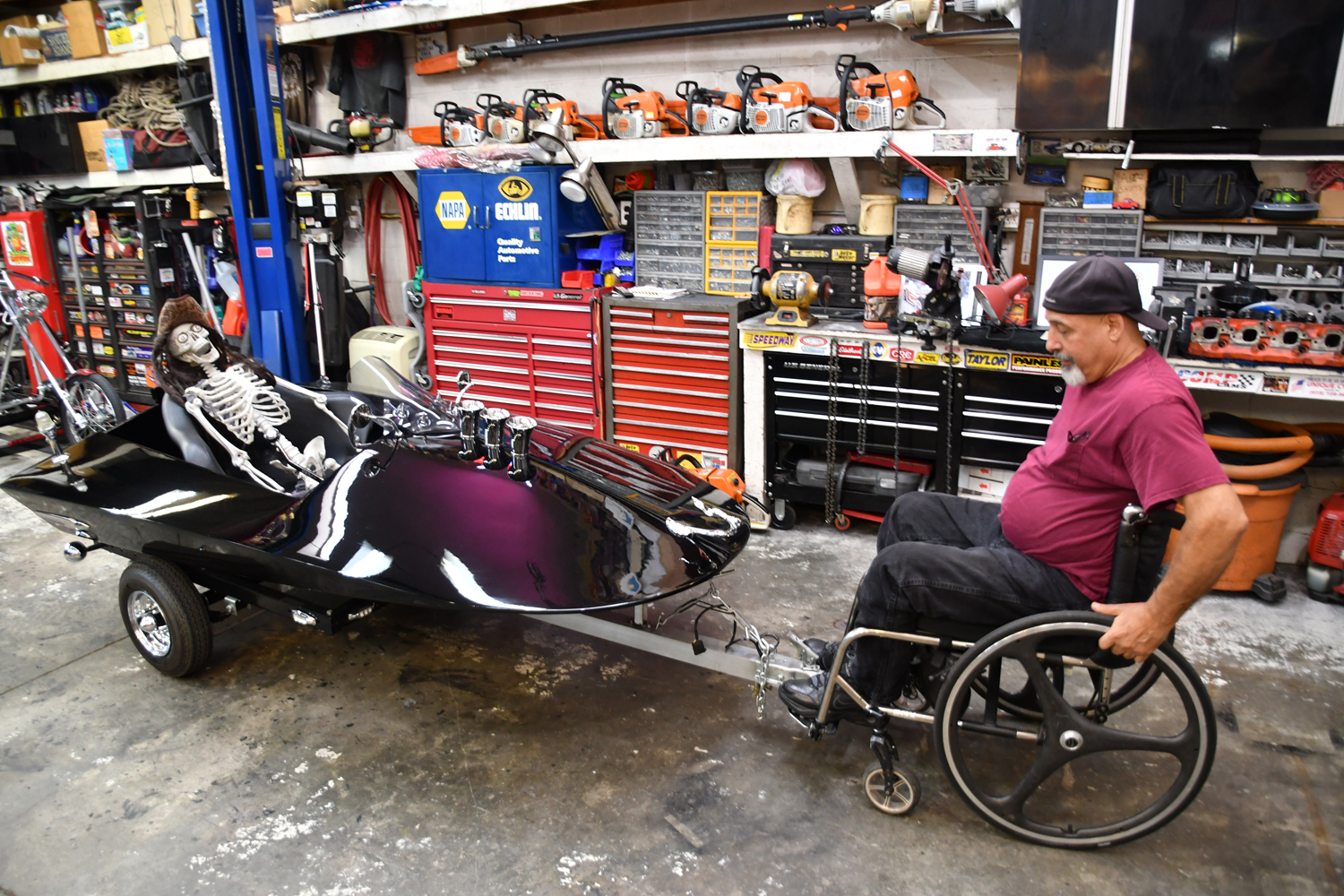
Rory setting up the Train

Even more unbelievable? Rory can set up the whole train by himself. His sedan with a back seat for his wheelchair makes him totally self-sufficient. He can hook up all these trailers himself and with no problem because they’re all lightweight trailers. He can pick up the trailer tongue by himself and use his wheelchair like a yard tug to maneuver each trailer. Rory says, “I put it on the footrest between my legs, right? And I can actually maneuver around and roll them around. They go where I want them to go.”

In reflecting on his life as a hot rod designer and fabricator Rory says, “You got to love what you do. You got to be able to sit there and make your own parts and be resourceful. You have to seek solutions that look cool that you can transfer to enhance the vehicle that you are making.”

When it is pointed out that some people, maybe most people, would not have such a great attitude as he, Rory says, “I hear that all the time. You know, I was always a crazy kid, always doing something wild and having fun and enjoying myself. You know, okay. I got hurt. I’m still alive. I’m still breathing. I’m just going to keep having fun till I die.


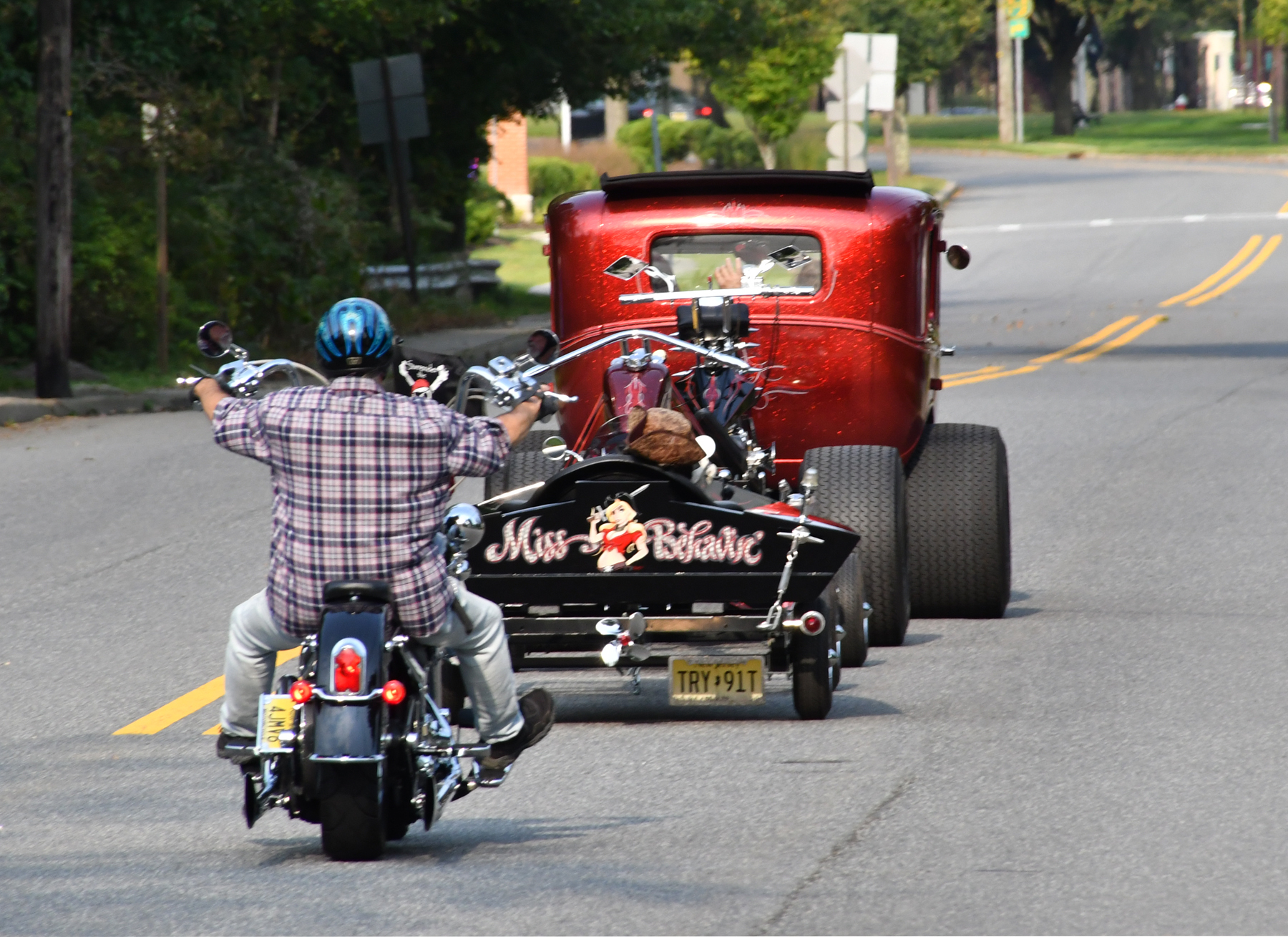
The “Train” with Rory’s friend Vinny Polina watching out

At the large regional Hot Rod Show that Rory can be seen driving to in the above photo he returned with trophies for:

  • 1st PLACE PRE-39 MODIFIED

  • BEST PRESENTATION

  • BEST IN SHOW


By |2021-09-16T12:13:34+00:00September 16th, 2021|11 Comments

Cars We Love & Who We Are #21

Crossing from New Jersey and meandering north on old Route 17 surrounds one with a picture of a region that for decades lived frozen in a faded past but recently began experiencing a quantum leap into the now. Still very much a work in progress, the scene along Route 17 features stretches of old buildings tightly snugged up against a patchwork paved narrow four-lane. Safely navigating the bumps, twists and turns demands a firm hand on the wheel and a steady eye on fellow drivers often found wandering about the narrow lanes.

Clearly, this trek offers a decidedly unglamorous journey on the way to enjoying an extraordinary classic car experience. Today the grounds of an architectural pearl of the Gilded Age will feature a delightfully understated concours.

Approaching the handsomely crafted stone guard station, I am waved though. I have entered an enclave of aesthetically integrated architectural and natural beauty born in the 1880s. I have entered a world worthy of a modern day Gatsby. Navigating the winding country roads leads me to the manicured grounds of the Tuxedo Club in Tuxedo Park, NY.

Bring what you love

Tuxedo Club “Field of Driving Dreams” registration


Gordon Borteck with his Pantera

Raising its German voice with the elevated revs courtesy of a downshift, my BMW descends the hill. As my trusty sports sedan hugs the curve of the narrow West Lake Road, the Tuxedo Club comes into view. Surrounded by a finely groomed lawn, overlooking Tuxedo Lake and set against a forested hillside, the grounds offer a spectacular backdrop on which to display priceless automobiles.

Pulling off to the side of the circular driveway at the club entrance, I am greeted by Gordon Borteck, the driving force behind the Tuxedo Concours officially titled “The Tuxedo Club Field of Driving Dreams.”

Borteck a Tuxedo Club member and guiding force behind the Tuxedo Park event conceived of the idea about eight years ago as a great Father’s Day celebration. Its instant popularity proved Borteck possessed 20/20 foresight. As with such good ideas, they exhibit a dynamic character that seeks to expand to ever greater proportions. Borteck has felt the pressure to expand which he has resisted.

Here comes a Ferrari La Ferrari. There goes a Lamborghini Countach. Step aside for the Chaparral race car. Make room for the Bentley Continental Coupe. Make way for the BoCar. As an amazing array of predominantly iconic German, Italian, English and American rolling artwork begin to populate the lush green hillside, I had the chance to ask Borteck about his unique event.

“I have sought to emphasize a theme of ‘bring what you love,” says Borteck, he continues, “I am not looking for the fanciest, the fastest or the oldest.” To realize his objective, Borteck has striven to achieve a feeling similar to that of an invitation only art exhibit. Borteck says, “My goal is to keep the show relatively small.” Eighty some cars comprised those invited to complete the field this year. He wants the owners to share the cars they love with the other car owners and guests. Much like one artist discussing his work with others. He says, “I strive for the event to be both a learning experience for viewers and a teaching experience for the dedicated owners. Here, people can share with each other without crowds or craziness.”
Despite a promise of showers, the sun has come out to stay. Borteck admits he would have sold his soul to the devil for this weather. After cancelling because of Covid last year, missing a second year in a row loomed as a crushing disappointment.

The colors of the assembled “Field of Driving Dreams” entrants pops off against the verdant lawn. Colorful as well could describe many of the car Owners.


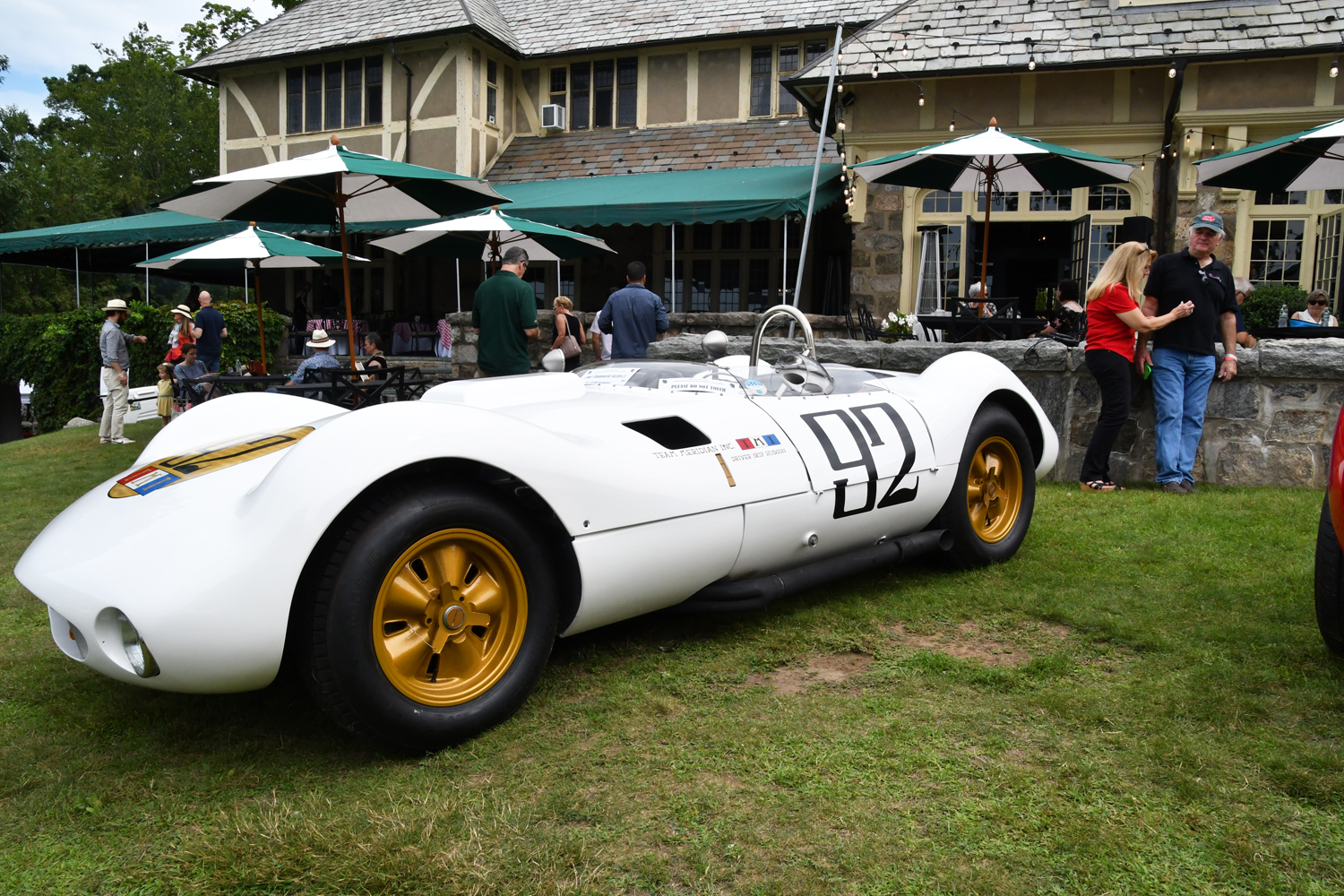
Bruce Amster – 1961 Chaparral

1961 Chaparral

Bruce Amster a classic car aficionado is no stranger to the Tuxedo event. He consistently delights with the unique entrees he brings. This year he did not disappoint by bringing a 1961 Chaparral race car. Amster says, “This Jim Hall developed Chaparral is a real race car. Race cars that look perfect and have always been perfect are not real race cars. A real race car has got to have gone through hell driven by a driver who has gone through hell.” This Chaparral truly qualifies by that standard. Built in 1961 by Troutman and Barnes, it was first driven by 2-time Indy 500 winner Roger Ward. Powered by a stroked Chevy small block with 4-wheel disc brakes and fully independent rear suspension the Chaparral presented an able competitor for facing the potent Maseratis and Listers of the day. Amster says, “The car has a great history. It was crashed by Roger Ward. Totally rebuilt it would be campaigned by a new owner and would set a lap record at Laguna Seca in 1962.” The car is still raced heavily overseas at Goodwood and Silverstone. It will be returning to England to campaign next season.


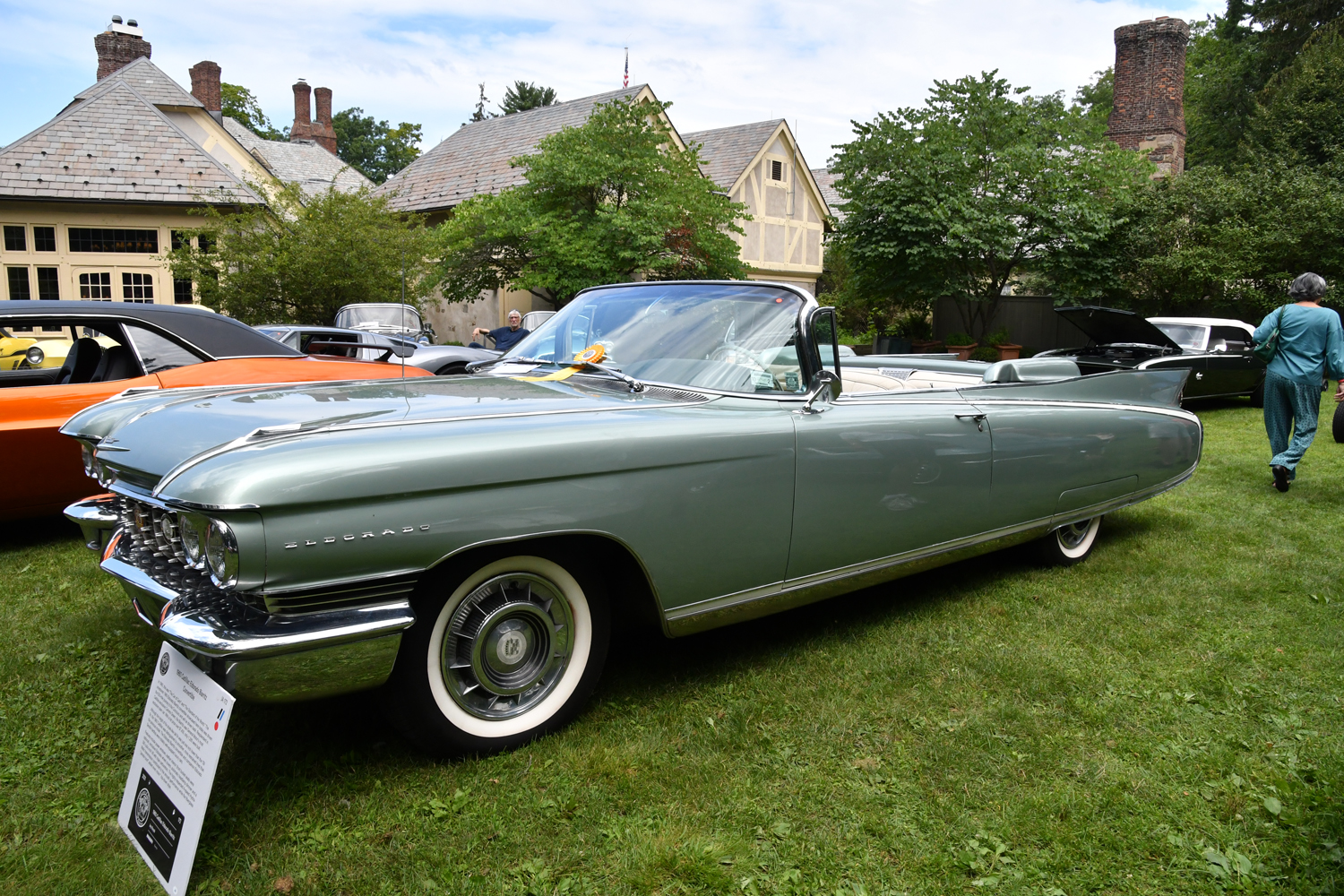
Jay Hirsch – 1960 Cadillac Eldorado Biarittz convertible

1960 Cadillac Eldorado Biarritz Convertible

Like recalling Howard Cosell at a boxing match, sighting world renowned automotive photographer and journalist Jay Hirsch at a car event goes without saying. A fixture at any meaningful classic car experience, the genial and engaging Hirsch not only photographs classic cars for calendars and books but collects them as well. At Tuxedo this year Jay brought his original Carrera Green 1960 Cadillac Eldorado Biarritz Convertible. Truly “The standard of the world” when it meant something, this stunning period piece rolling sculpture featured a 390 cu. in. V8 with three deuces and a 4-speed Hydra-Matic transmission.

For Jay his Cadillac’s story goes back to the day a family friend bought the car new. Jay says, “It was 1960 and my father bought a Fleetwood. At the same time a family friend bought this car. Years later he sold it to a friend who ran the Cyclone in Coney Island.” Back in the 1980s that friend asked Jay if he would he be interested in the Cadillac should the friend ever decide to sell it? Absolutely, came Jay’s reply. Fifteen years later Jay got the call and Jay bought the car.

Jay says, all through the years it was never driven in winter, only in the summertime on weekends. It has never been restored. Not afraid to drive it, Jay recently drove it 630 miles to Plymouth Michigan to show the car at the Concours d’ Elegance of America at St. Johns where it won “Most Original Car.”

Jay put over 1500 miles on the Cadillac for his trip. Jay says, “I cruised all day across a good stretch of America in this glorious piece of automotive history at 80 miles per hour averaging 17 miles per gallon for a 5,000 pound car. I’m happy.”


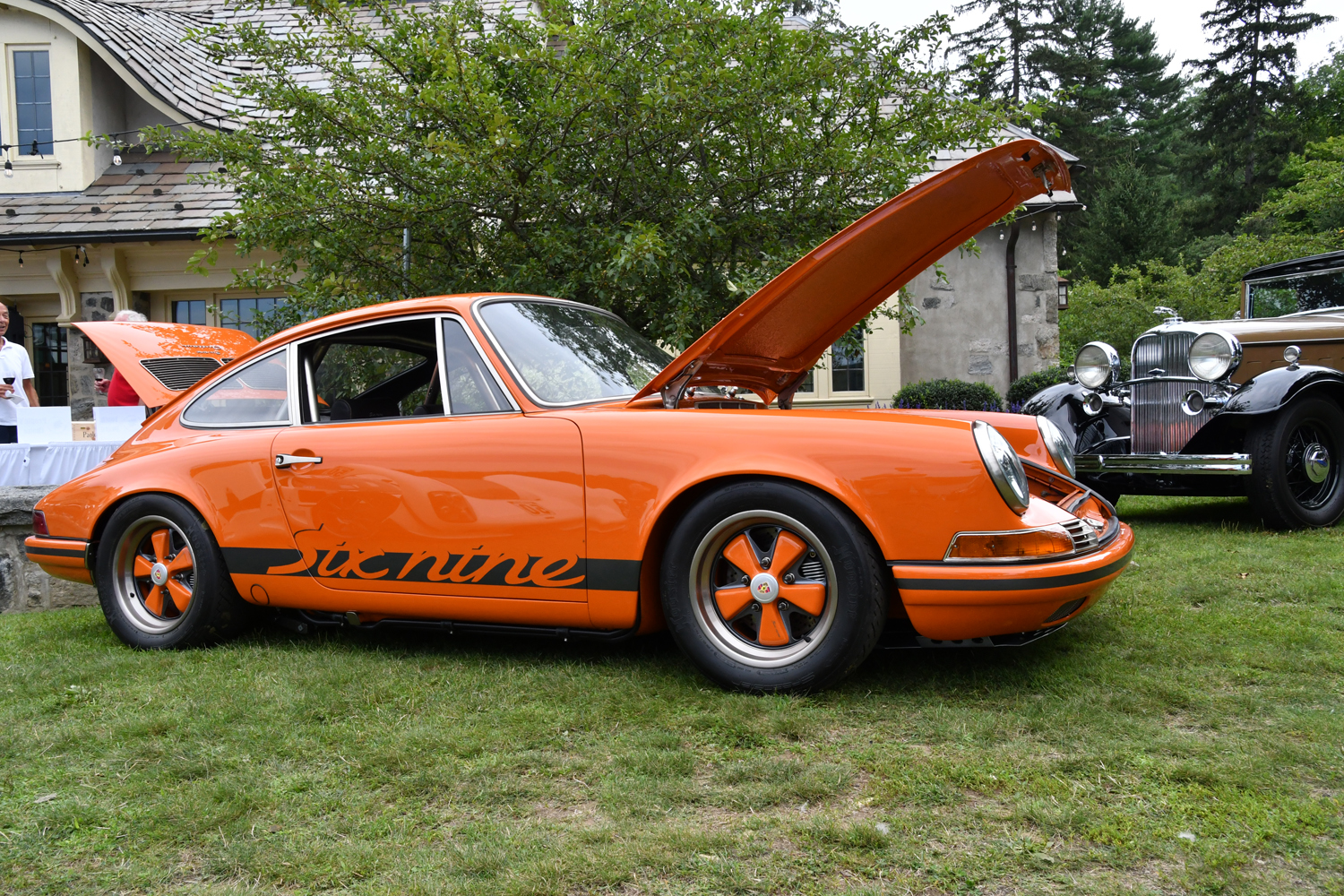
Dr. Charles Lennon – 1969 Porsche 911 Outlaw

1969 Porsche 911 Outlaw

Dr. Charles Lennon’s place in the Pantheon of vintage Porsche crazies was concretized when he chose to rebuild his house to provide for five working bays in the basement to accommodate 356 and 911 Porsche restoration. For Tuxedo, Dr. Lennon brought a 1969 911 Outlaw on which he has been working for the past four years. Just looking at the quality of work and attention to detail tells you all you need to know about how he approaches his vocation as a prosthodontist (specialist in dental restoration).

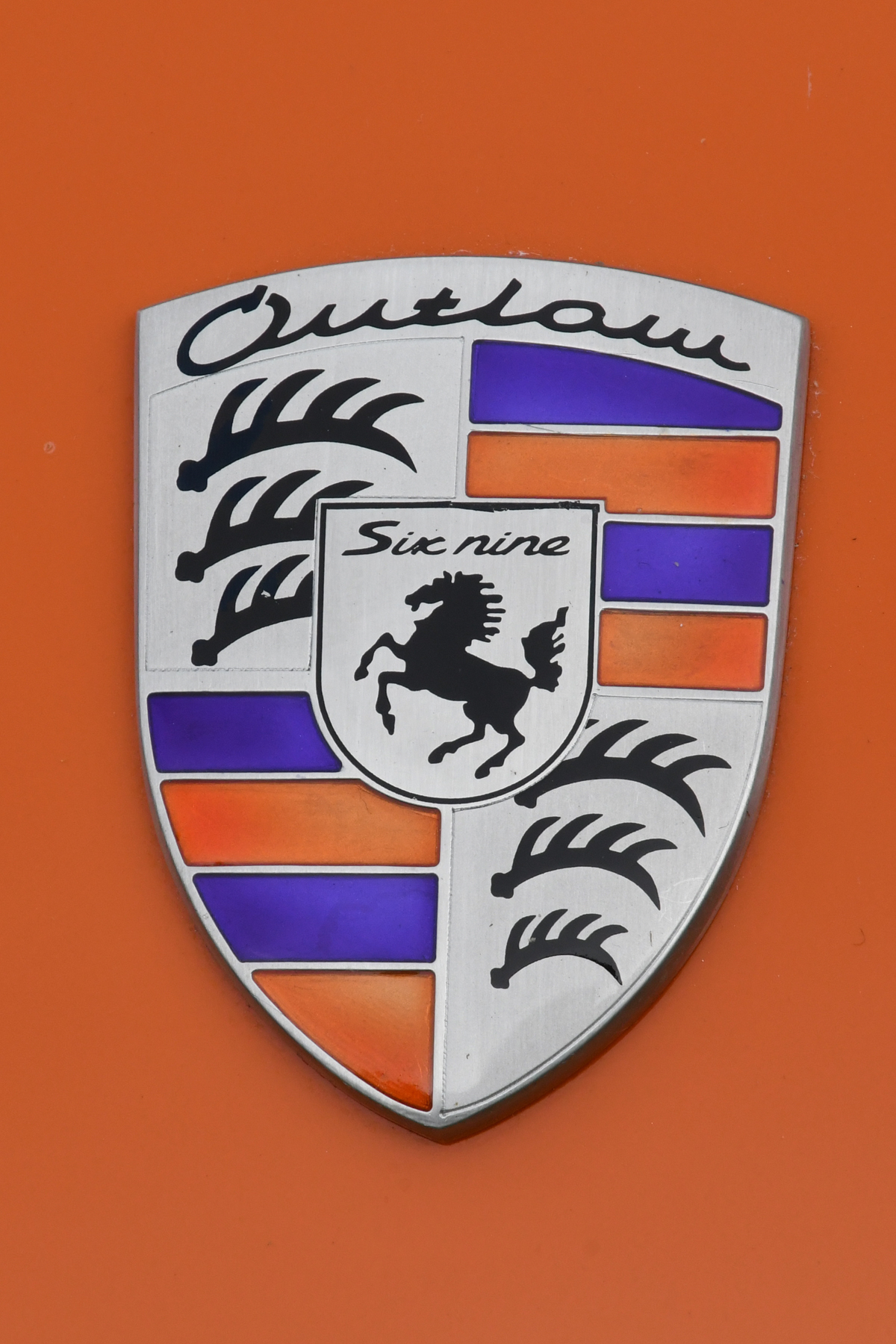
1969 Porsche Outlaw custom badge

In explaining the Porsche Outlaw concept Dr. Lennon says, “It started with John Von Neumann and his 356 Porsches back in the 1950s. Von Neumann would show up at the track with modifications such as better brakes and bigger motors. Stuff beyond factory spec. These upgraded non-factory spec’d cars became known as Outlaws.”
Dr. Lennon goes on to say that he likes to build Porsches that scare him. He loved the idea of building an Outlaw and he had the perfect subject, a 1969 911. He set his heart on building a better Porsche. He says, “Bigger brakes, bigger motor, better suspension. It would be a Porsche Plus.”
He also wanted his outlaw to honor the basic shape of his subject 911. Dr. Lennon says, No front air dams, no flares, no tails, nothing just the original shape.” Just about everything else would wear this surgeons touch. He says the brakes are 917 units that took him two years to get. The original motor swept two liters. His outlaw gets its push from a naturally aspirated twin plug 3.4 liter engine with mechanical fuel injection. Dr. Lennon says it puts out roughly 315 horsepower with a vehicle weight of 2,160 pounds. He acknowledges that remaining faithful to the body originality limits the size tire which certainly elevates the scare factor.

The detail that Dr. Lennon has put into the smallest features including the badging clearly shows it has been a labor of love. He says, for me in my lifetime this has been the best creative experience I’ve ever had.”


Rich and Chris Varjan – 1972 Dodge Challenger

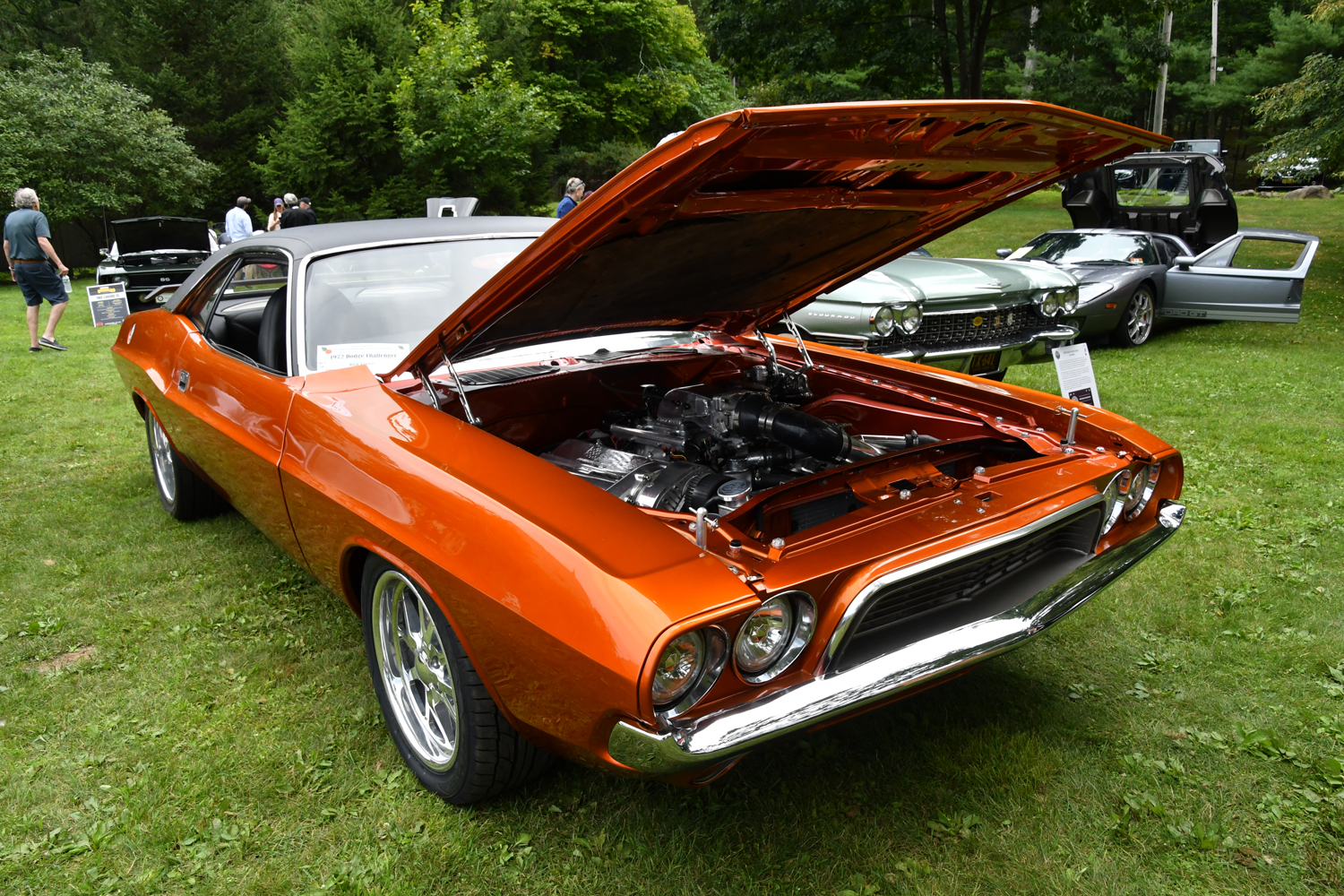
1972 Dodge Challenger

Rich Varjan’s R-M three-stage orange over silver 1972 Dodge Challenger began as a project car that he found in Toronto Canada for his 14-year old son, Chris. Today, standing by the car that has experienced numerous rebuilds as the Varjans have pushed it up the performance ladder one sees Chris who is now 34 years old.

Both gregarious and genial, father and son banter back and forth as they describe the adventure in engineering that their Challenger represents. Basically its present iteration represents an eight-year trial and error journey that has culminated in a 900 horsepower well mannered beast. Well mannered that is unless, as the senior Varjan says, “You put your foot to the floor? The you buy new tires.” “But it tracks straight as an arrow,” adds son Chris Varjan, remarkably straight for what it is.”

Rich Varjan explains that at the heart of his beast of the street resides a worked 422 cu. in. low compression race block with a Procharger supercharger and electric fuel injection.

Rich Varjan speaking about the suspension says, “Front suspension is Riley with four link coilovers on all four corners and tubular control arms. It’s all Riley Motorsports.”

When asked if the project was worth the eight years, both father and son just smile.


Hank Bernstein – Zipper lakes tribute hot rod

Zipper Lakes tribute Hot Rod

“It’s a lakes modified roadster,” says owner Hank Bernstein. He has built it to pay tribute to the early post WWII southern California dry lakes racers. Before drag strips, even before Bonneville, people would bring their Model Ts and Model As out to El Mirage, take off the fenders and race all weekend. Bernstein says, “They built these cars with skills they mostly learned in the military during WWII, primarily aircraft.”

Bernstein’s tribute roadster which he built himself features some unique attributes. The strikingly handsome body and frame feature a design by Darrell Zip who used to work for Revell, the model company. Power comes from the Alfa Romeo V6 introduced in the early 1980s with the GTV6. Bernstein’s familiarity with Alfa Romeo power plants comes from his years with the Alfa Romeo engineering group.

Carburetion comes from Holley 94 carburetors found on Ford flatheads. Rather than using Strombergs that had a reputation for leaking, Bernstein travelled through four states to find five Holley 94s from which he could make three good ones. When he built the car reproductions of Holley 94s were not available. Bernstein even designed the engine turned dash. For the machining he located a retired and skilled machinist.

When asked about his creation’s top end, Bernstein says it is faster than he will ever drive it. He says, “To put it in perspective, in the 3,200 lb. Alfa GTV6 the top speed peaked around 130 mph. My roadster weighs 1,880 lbs.” The fastest Bernstein has gone in his roadster is 95 mph. Bernstein says, “ I am an old drag racer. I don’t have anything to prove.”

When asked for any final thoughts Bernstein smiled and said, “Life’s too short. Build a hot road.”

“Field of Driving Dreams” registration

While the objects of their affection differed, the prevailing sentiment at Tuxedo that day spoke with one voice and it said “Find what you love and drive it.”

By |2021-08-19T11:58:21+00:00August 19th, 2021|4 Comments

Cars We Love & Who We Are #20

Visual acuity of eagles to site targets at great distances far exceeds any capability possessed by man. However, one select group of homo sapiens demonstrates an extraordinary ability to utilize their peripheral vision. That subset would, of course, be Car Guys.

Car Guys possess the ability to be weaving through a chaos of bouncing steel scrap unleashed from the back of a poorly stacked semi while still checking out from the corner of their eye the contents of an old barn behind a rickety farmhouse in a distant field.

Locating a barn find resides on a pedestal in the pantheon of Car Guy dreams. However, for one Car Guy in search of storage in garage starved New Jersey, his sharp eye caught site of a barn that would soon house his collection.

Meet Carl Grady.

When the find is the barn


Born and raised in Sydney Australia, Carl Grady emigrated to the United States right after 9/11. Always a car guy even as a young boy, Carl says, “On family rides in the countryside outside of Sydney, I’d be sitting in the back of the family sedan. I’d look out at the farms and the garages and barns and hope I’d get a sneak peek of something. You know, something sitting out there waiting to be discovered. I loved doing that.”

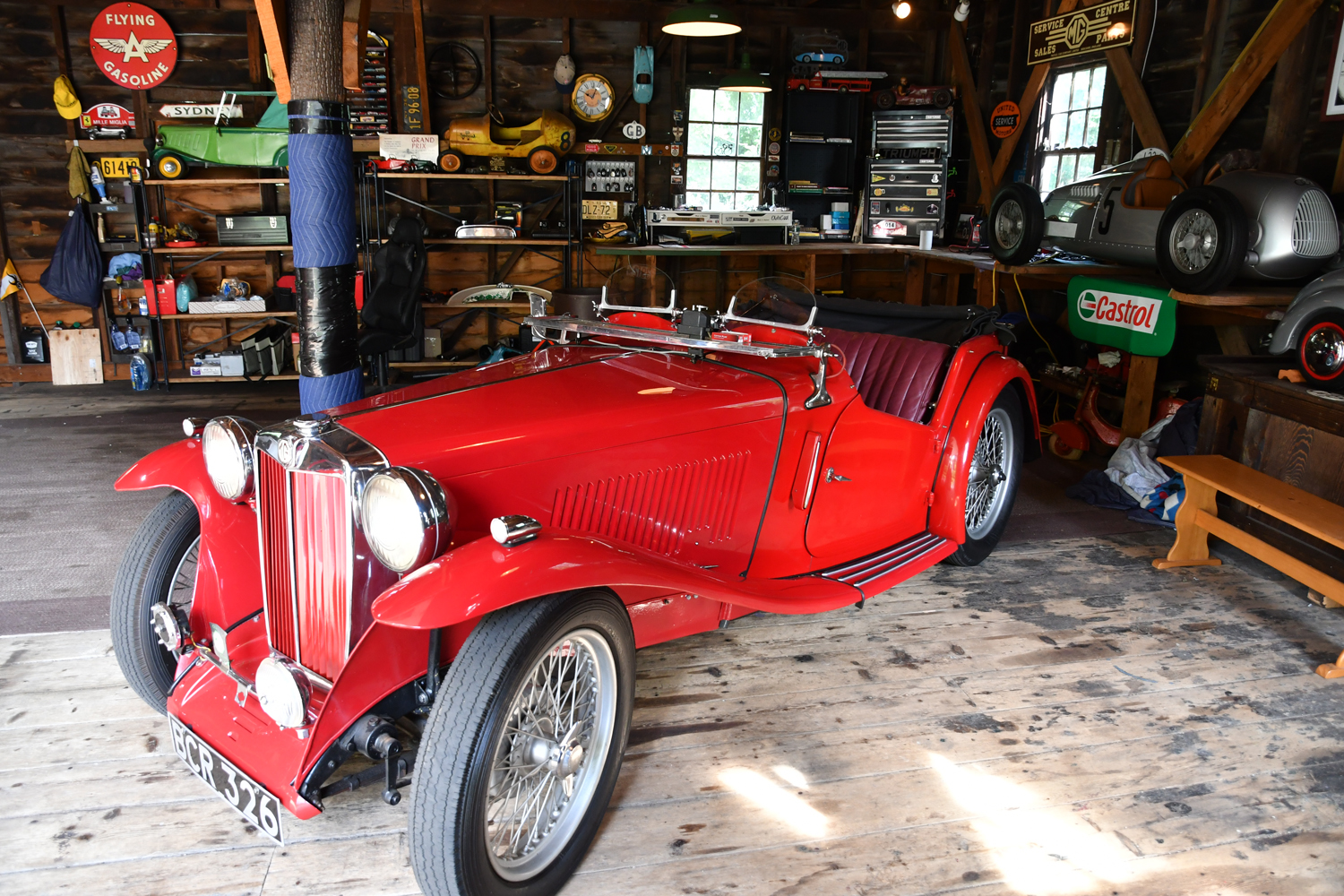
1937 MGTA

Once in America, Carl enjoyed and took advantage of vintage car prices considerably more reasonable than those for comparable British and American cars in Australia. As a result he began to build a collection. However as all Car Guys know, when building s collection, space is the final frontier.

Carl’s “barn” find did not demand a long journey to the back country. Carl actually had a home in walking distance from where he found the barn three years ago. He says, “At the time I had a few cars. Unfortunately, I only had a single-car garage.” This resulted in his eclectic collection of American and British vehicles being strewn about the grounds of his home. He had cars parked in the driveway and around and about under covers. Then, Carl says, “We had a pretty bad winter. I knew I had to do something about protecting them.”

In the midst of a Google search for available garage space, a reference to a house with a four-car garage close to his home popped up. He laced up his sneakers and strolled from his home to take a look.

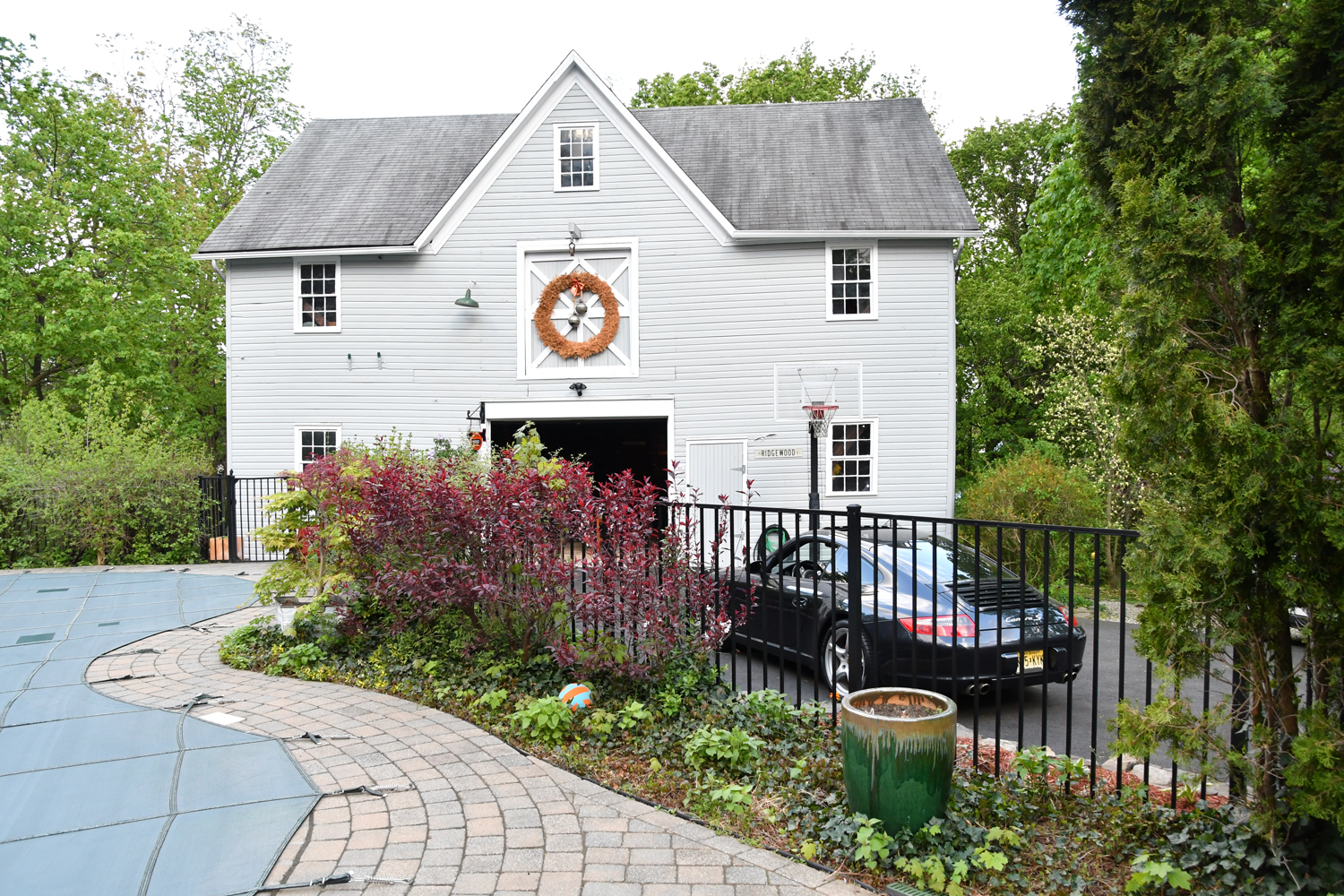
Hidden away behind the home being sold stood a 3 1/2-story barn built into sloping property with vehicle access on two levels. Carl says, “I told my kids to meet me for a look.” He did not even look at the house. When his kids got there he simply told them “We are moving.” Carl says, “It was just too good to pass up.”

Built in 1902, the barn served as a kind of parking garage for the horses and carriages that transported people around the town of Ridgewood, NJ when they came by train from New York to visit.

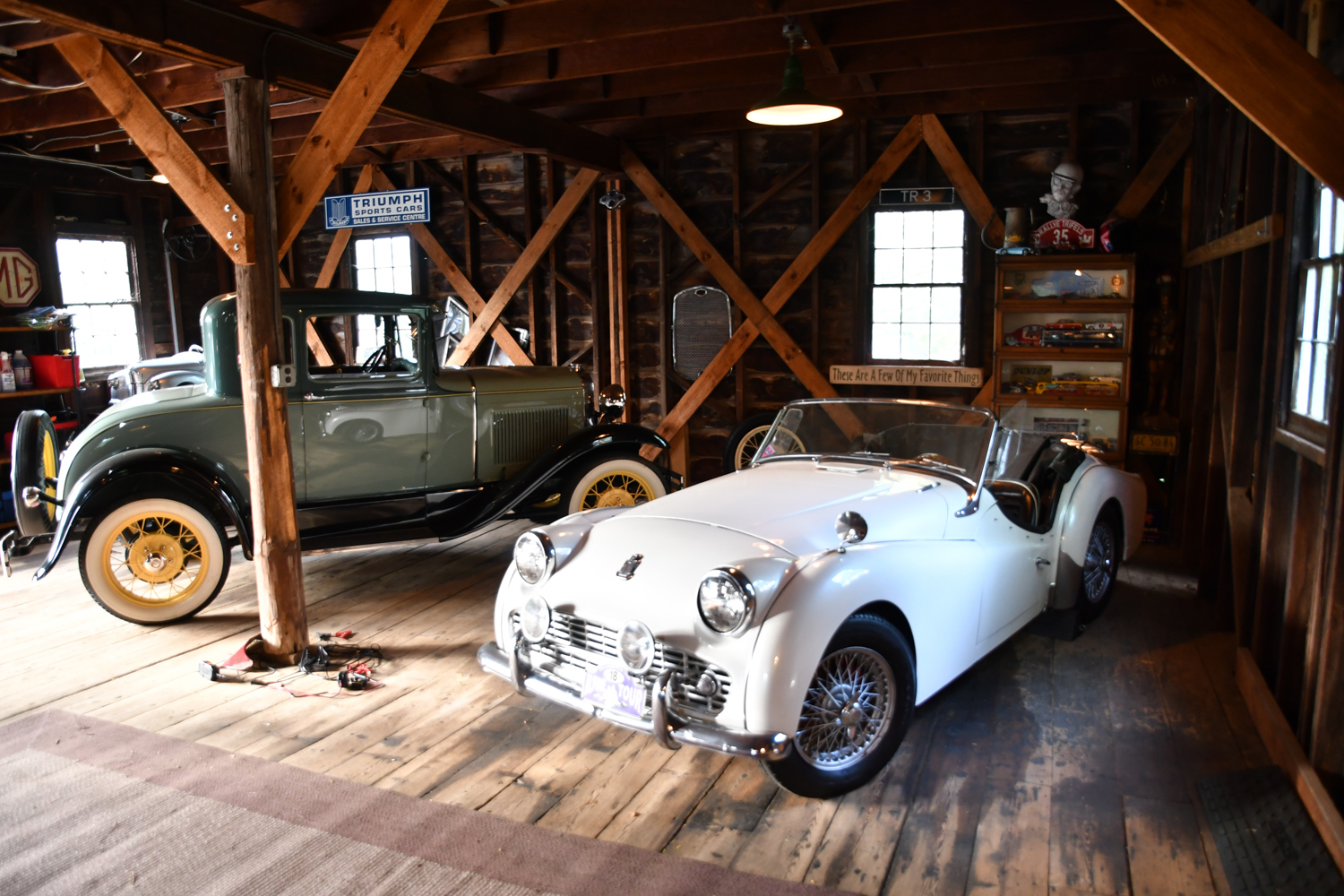
Model A and TR3

The barn’s second floor that opens to the driveway actually served as the main level providing the area where the wagons would be parked. The gravel path leading down and around brought the horses to stables on the first level in the rear.

Carl says, “It’s still pretty much the original barn. You can see the tree trunks that hold it up. I’ve tried to keep it as rustic as possible. If you go downstairs, you’ll even see some of the horse stalls and some of the original harness paraphernalia.” In fact a buggy that was built in 1902 is still on the ground floor in its original unrestored condition.” Until Carl the barn had never housed a vehicle.

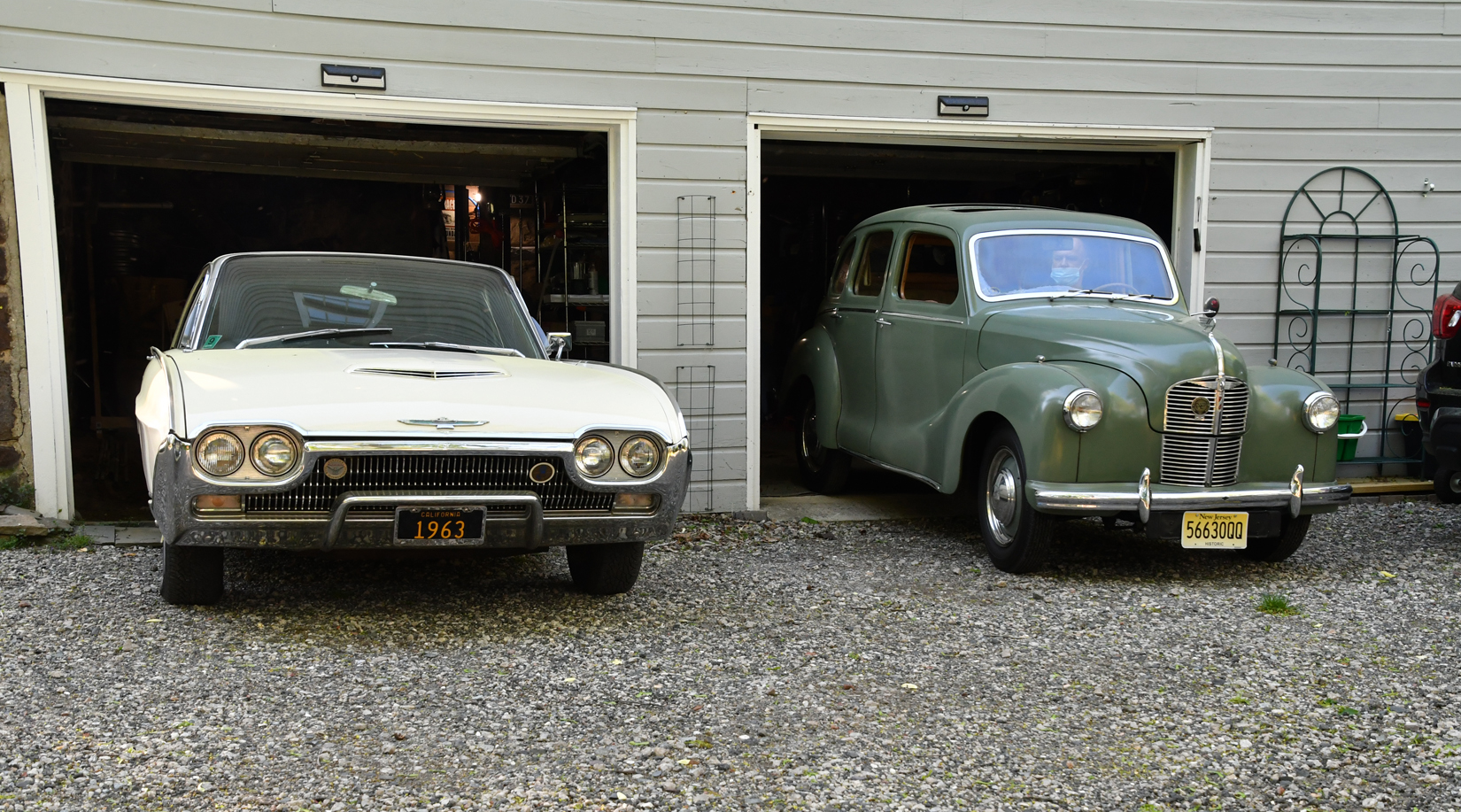
As all Car Guys know, there is no such thing as an empty garage bay, its more accurate description is that of a place holder for the vehicle yet to be purchased. In Carl’s case his spacious barn quickly filled. With the recent sale of his 1960 MGA fixed head coupe and TR6 and the addition of a 1930 Ford Model A coupe and 1948 Austin 840 Devon Sedan his collection consists, together with the Model A and Austin, of a 1937 MGTA, 1960 Triumph TR3, 1960 Triumph Herald Coupe, 1960 MGA roadster and a 1963 Ford Thunderbird.

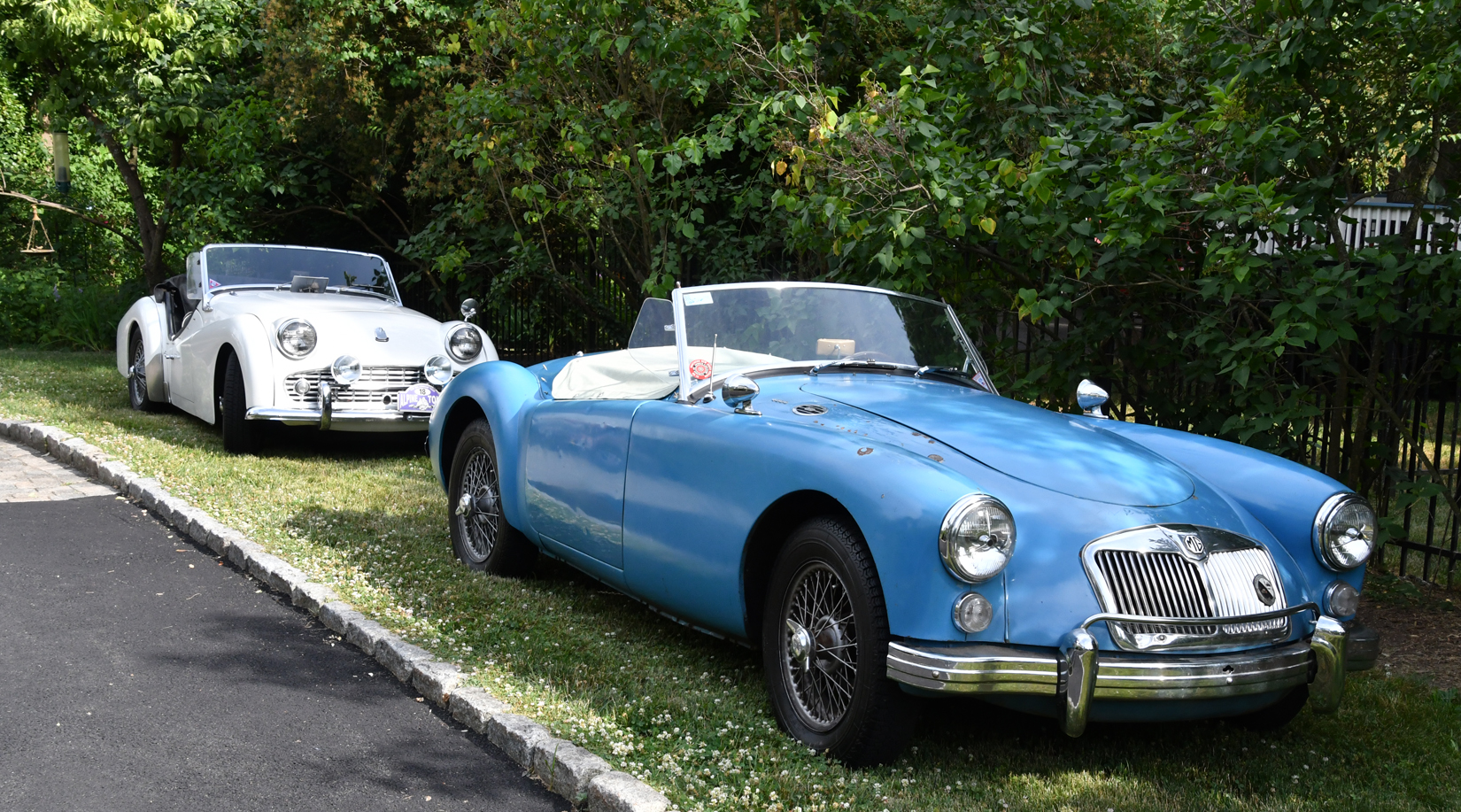
Carl admits his passion resides with American and English makes based on his youthful exposure in Australia where English makes provided the majority of road traffic with American models enjoying the stature of almost an exotic. His passion for Anglo Saxon brands accompanies an equal passion for using the cars in his collection as they were intended and that means his cars are driven. Carl says, “While I view them all as pieces of art, I believe their beauty stands out best when in motion.” For Carl the best part of car shows comes with driving to them and back home. He says, “I’m not interested in concours shows that demand hours of cleaning. It’s just not my deal, I don’t care necessarily about a hundred point car. I just like a car to look neat and original without getting too carried away.” He feels his blue 1960 MGA roadster displays his philosophy perfectly. Like battle scars, the nicks and dings acquired through spirited driving on real roads enhance the spunky blue MGA’s well earned patina.

When asked about his favorite ride, Carl falters a bit in committing saying, “The MGA roadster was my favorite, but now it competes for attention with the MGTA and the TR3. Last summer, I drove the TR3 more than any of the other cars.”

Carl says, “I have  always liked the MGA. It has the MGB engine in it. It goes. It moves. It’s just noisy. It has a 4-speed and is just a lot of fun to blast around. Carl with a self-deprecating smirk goes on to say, “It’s broken down so many times on the road, but hey that too represents a signature quality of the British sports cars motoring experience.”

TR3 and MGA

Carl’s affection for the TR3 begins with the cut down doors and the feeling that it delivers a more relaxing and less intense driving experience than the noisy MGA. Comparing the two, Carl says, “The TR3 is just as enjoyable but instead of delivering the intensity of a sprint, the TR3 delivers the more relaxing experience of a long leasurely run.”

In speaking about the 1937 MGTA Carl says, “Just the novelty of driving a pre-war vehicle in itself is cool. Plus it’s right-hand drive. It’s a beautiful car. Granted, you don’t drive fast, but with the windscreen and windows all down the driving experience transports you with a stirring time behind the wheel of a time machine. It really delivers a cool nostalgic drive.”

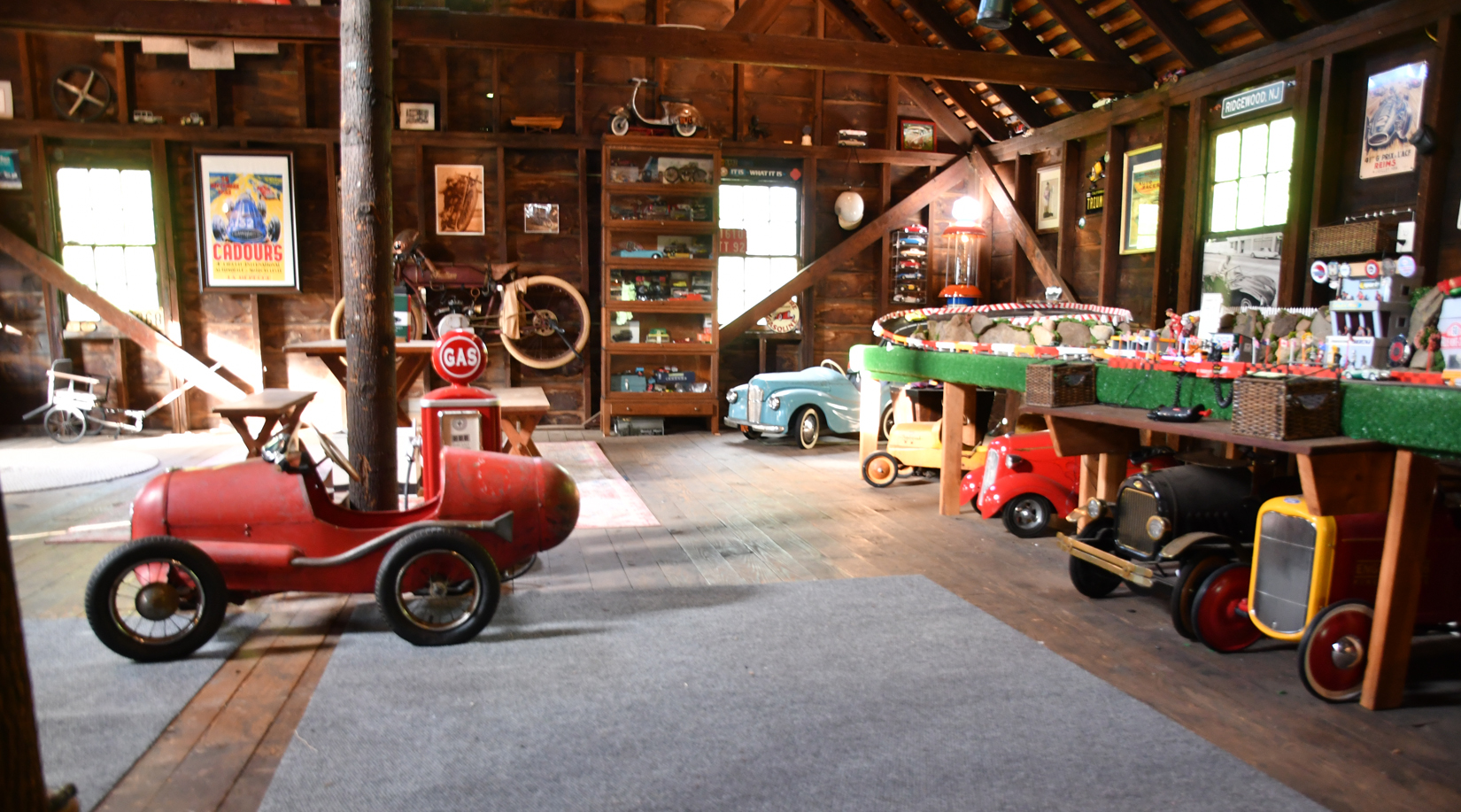
Again demonstrating the powerful draw presented by open and readily fillable space, Carl’s barn features an extraordinary array of pedal cars and automobilia.

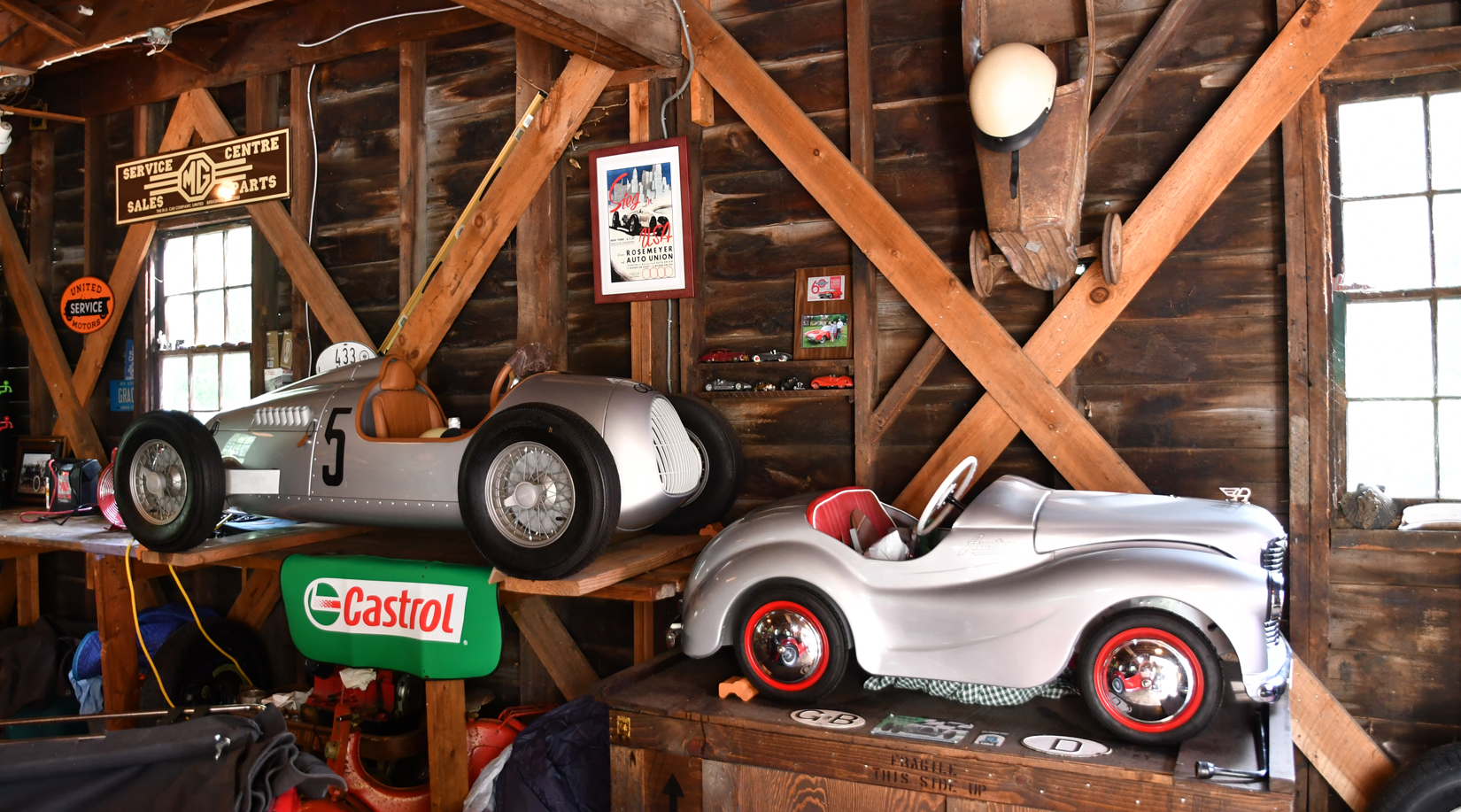
While always attracted to pedal cars Carl never thought about collecting them. However, under the constant urging of his friend Buz Korn, a skilled and dedicated collector of all things automotive, Carl took the plunge. After buying a French pedal car that had caught his eye, Carl’s pedal car pursuits were off and running. As Carl says, “I just started to look and then got a little crazy.” Two of his favorite pedal cars are an Austin J40 and an Auto Union Type C pre-war Silver Arrow Grand Prix.

Auto Union and J40 Pedal Cars

Like it drove out of “Who Framed Roger Rabbit” its curvy voluptuous body style makes the J40 a kid and collector favorite. Carl says, “There is an event every year at Brooklands. The kids run to the cars, jump in and race down the track to win a prize.”

The original concept for the pedal came as an act of the British Parliament in 1943. The act recognized that coal miners were being struck down with the black lung disease. The plan for providing work for these stricken miners was to have them build a toy pedal car based on the Austin Devon and made from the scrap metal left over from the production line. Production ran from 1950 to 1971 with 32,098 models being produced.

Carls’s Auto Union Grand Prix pedal car plays to his strong interest in the Grand Prix cars of the pre-WWII era.

1963 Thunderbird and Austin 840

Commissioned by Audi in 2007 as a promotional item with a limited run of 999, it provides full racing bicycle mechanics and rear wheel drive gearing. Anyone who can fit in it can pedal it.

On a far more altruistic plane, Carl envisions his barn offering the opportunity to gather far more than interesting vehicles, he sees it as a meeting place to foster camaraderie among people of like interests. Carl says, “I would love for the barn to serve as a welcoming venue to promote the gathering of car enthusiasts.” He would have it become a casual arena for the sharing of stories, information and friendship.

As we come out of the age of Covid, Carl’s vision offers a wonderful inspiration to escape the no longer forced isolation.

By |2021-05-06T10:49:55+00:00May 6th, 2021|10 Comments

Cars We Love & Who We Are #19

The Drivin’ News theme of “Cars we love and who we are” invites the reader into experiencing great cars and learning about the interesting people associated with them. Normally the motivation behind the “why” that inspires the great affection is taken as a given considering the desirability, beauty and provenance of the classic cars in question. However, some times the “why” leads us down an even more interesting path revealing a vehicle made beautiful by a patina of sweet memories. Such stories rooted in personal history often involve love, loss, salvation and heartwarming resolutions.

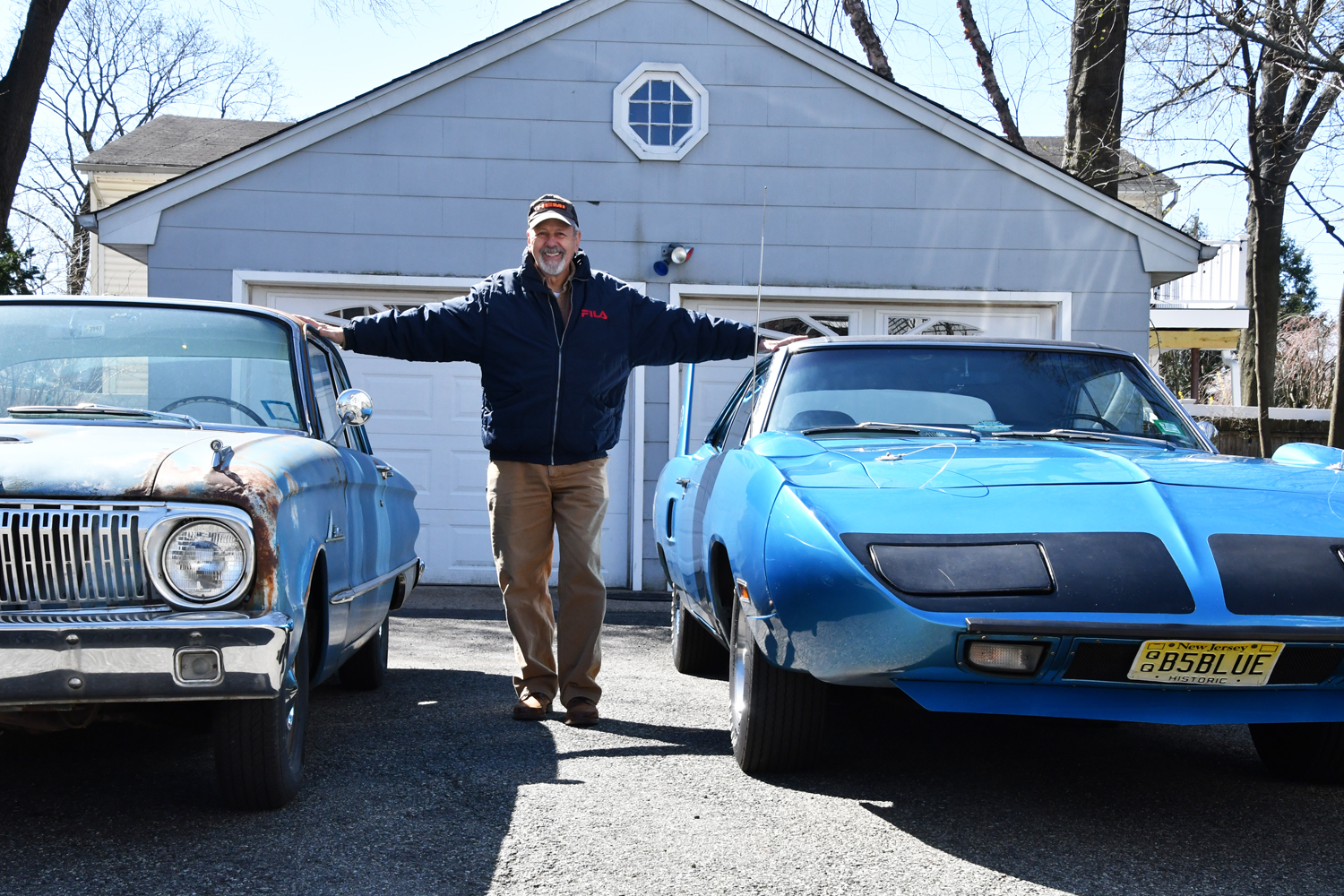
In the garage of Vinny Plotino resides an incongruous pair of treasured vintage cars with very different “whys.”

The odd couple in Vinny Plotino’s garage


Vinny Plotino and his “Odd Couple”

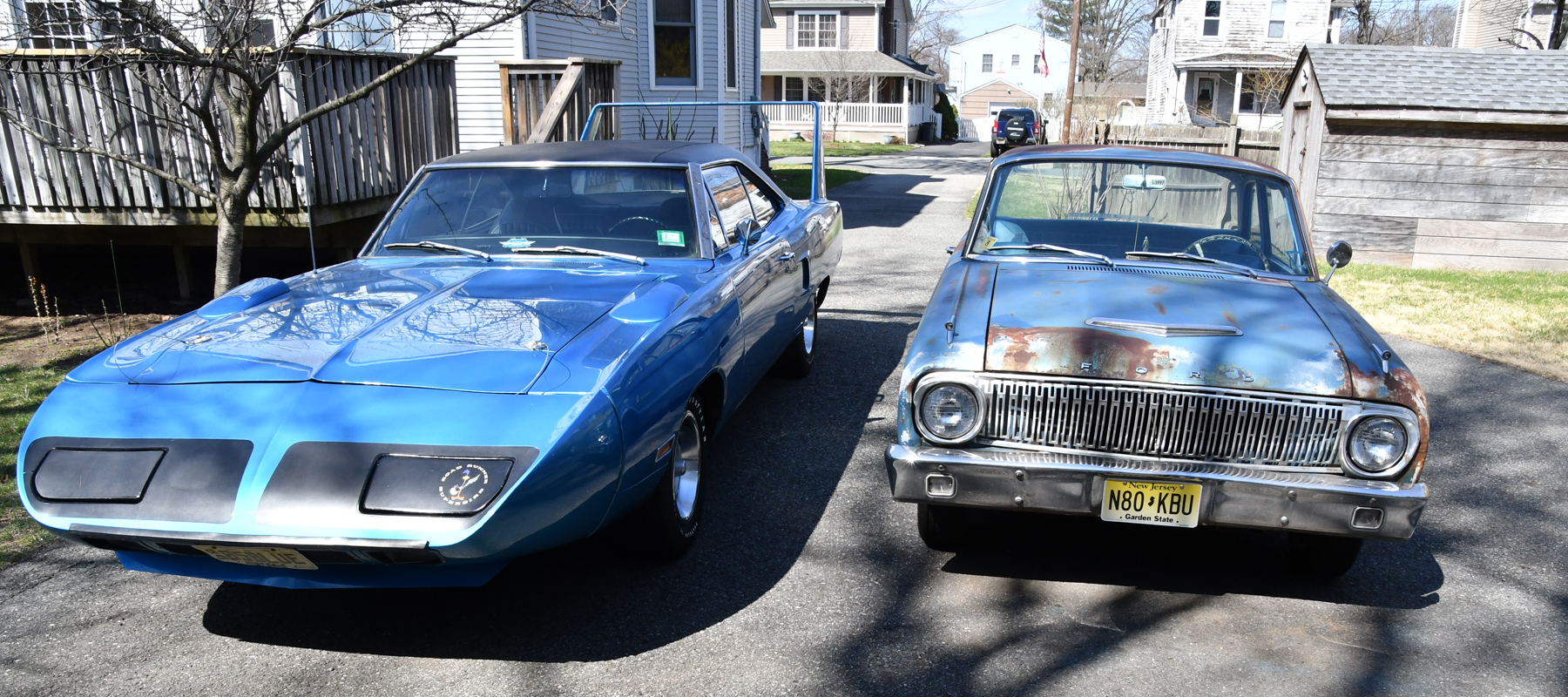
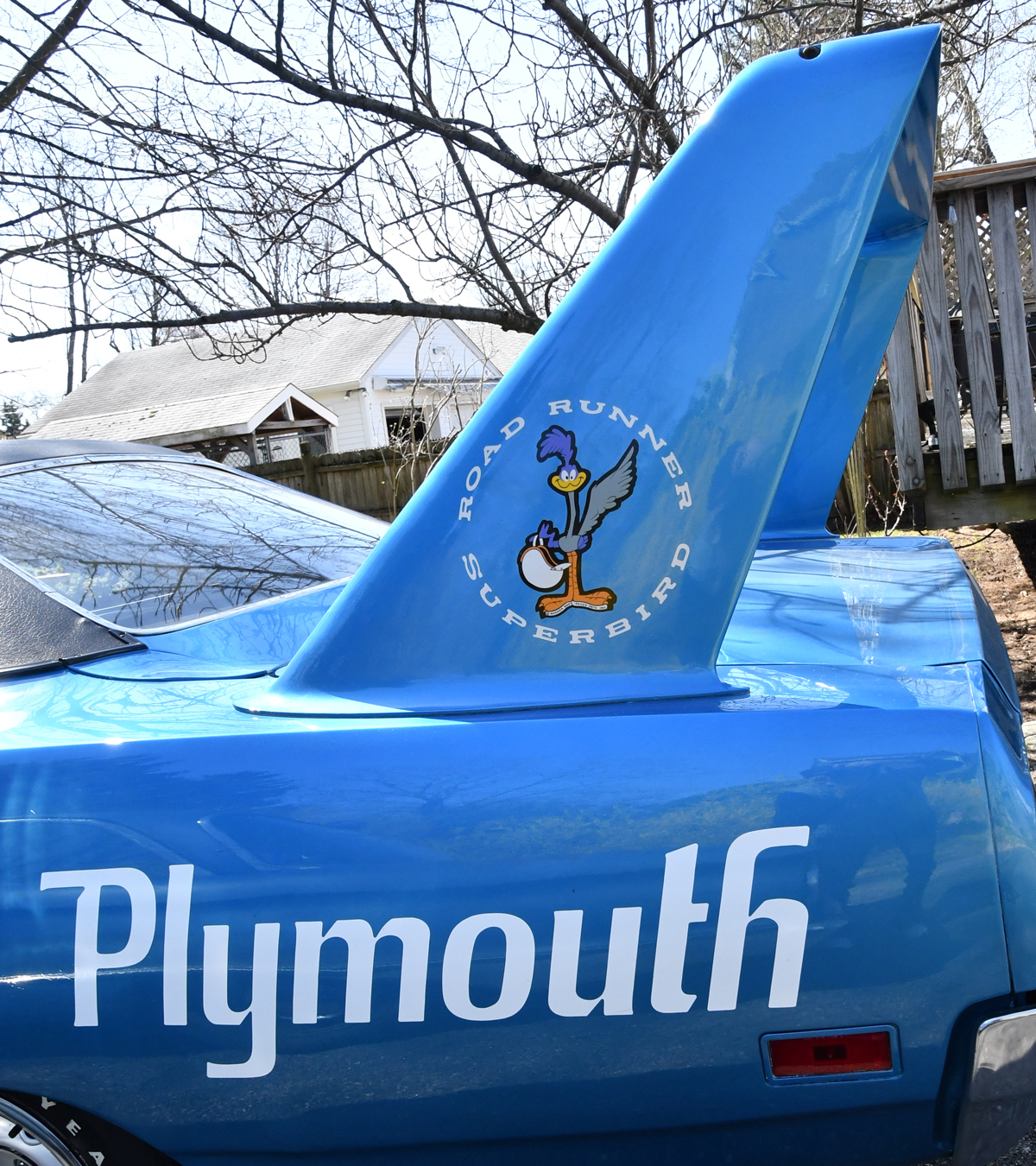
Housed in an orderly and well equipped 2-bay garage both cars make a statement. For the 1970 Plymouth Superbird on the right, the “why” screams at you, for the other, a quite pedestrian and weary 1962 Ford Falcon the “why” softly asks “why?”

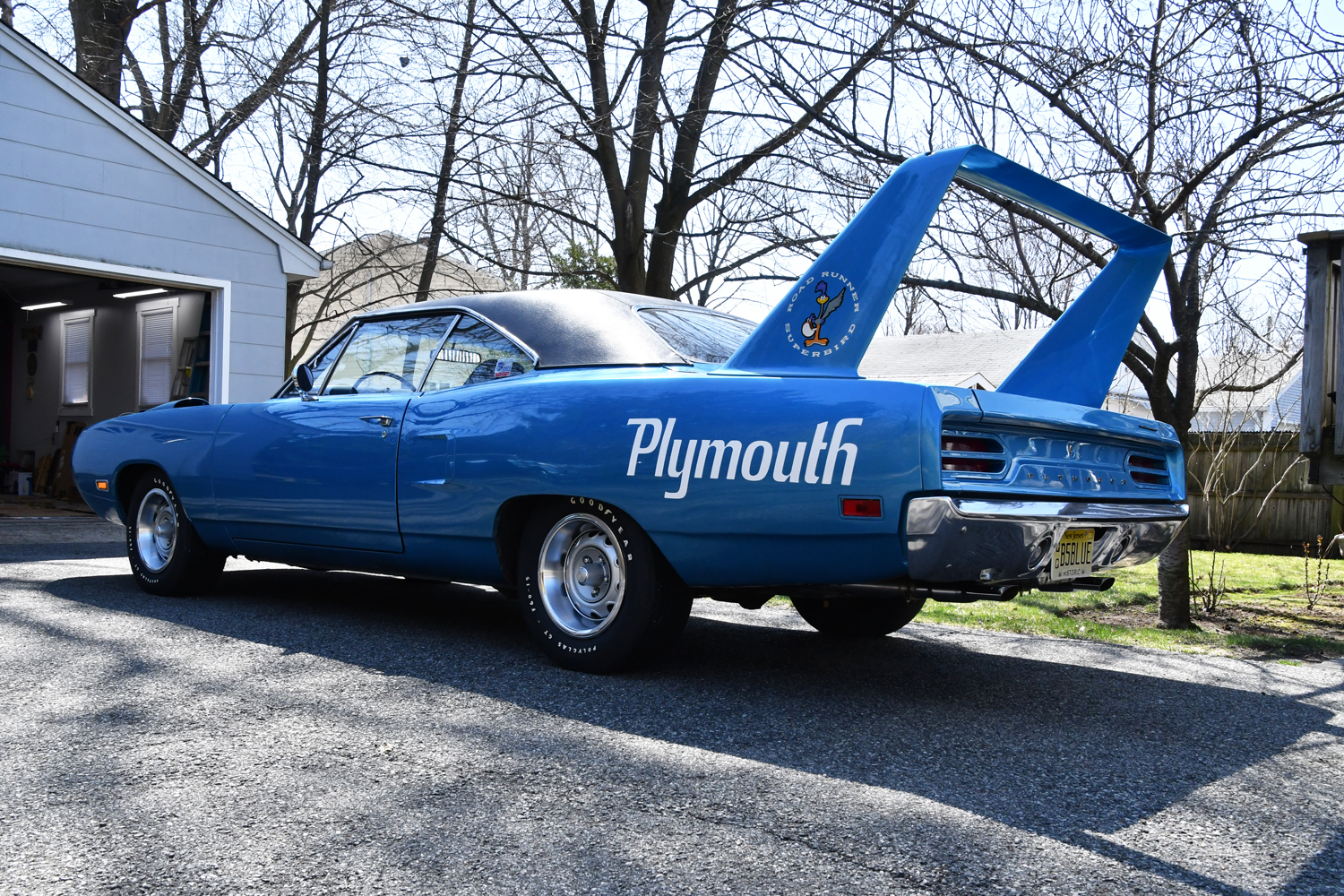
Indeed, screamingly obvious in its attraction, the Superbird sports a nose cone front end and outsized rear spoiler with signature “Roadrunner” graphics. Resplendent in 1970 Plymouth Blue Fire Metallic or B5 Blue (color code) as it is known throughout Mopar circles and among collectors, Vinny Plotino’s Plymouth Superbird leaves no doubt as to what inspires the love. With the original 440 cu. in. V8 fed by a single 4-barrel and delivered through a 4-speed manual trans Vinny’s Superbird delivers 375 horsepower. It reigns as an iconic presence in the pantheon of muscle cars of the golden age.

Created by Chrysler corporation purely as a means to dominate NASCAR racing for the 1969-1970 season, the Superbird with its 19-inch extended bullet nose and car wash nightmare, outsized rear wing did not move especially well out of the showroom as a retail money maker. For homologation purposes 1,920 Superbirds came from the factory for retail sale. It did, however, achieve its intended dominance by exceeding 200 mph at Talladega Superspeedway to set a NASCAR record. In NASCAR race trim, powered by a 426 Hemi V8 with a 0 – 60 mph time of 4.8 seconds and a drag coefficient of 0.28 (still an impressive level of slipperiness 50-years later) the Superbird with Richard Petty at the wheel won eight NASCAR races and finished high in others.

Right around that time as a 16-year old teenager pedaling his bike past Frey Chrysler in Bergenfield, New Jersey, young Vinny fell under the spell of the new Superbird in the showroom window. He would just stop and stare at the outrageous Roadrunner on Steroids and dream. One day Vinny knew he would own one.

History would prove Vinny right, twice. He found a B5 Blue Superbird in 1979 and grabbed it. However with the birth of his daughter Vinny’s first Superbird left to feather the nest for the expanding Plotino family. While appreciating the necessity for the move, Vinny immediately regretted it.

It would be another ten years before the second opportunity arose when Vinny could again own his dream car. In 1989 a B5 Blue Superbird appeared on his radar and shortly thereafter arrived in his driveway and with 36,000 original miles rolled into his garage. Today, 30 plus years later that B5 Blue numbers matching Superbird now with 40,000 miles, receives with great frequency the same loving gaze that first inspired the dreams of a teenage boys heart.

When asked for any stories of interest relating to the Superbird, Gina Plotino, Vinny’s wife, offered a small story that spoke volumes about relationships, priorities, love, friendship and understanding, not necessarily topics one immediately associates with iconic muscle cars. Gina recalled when Vinny faced a challenging task that involved replacing the Superbird’s exhaust system.

Gina said, “I watch him at car shows when a father and son or daughter come by his car. It is so important to him that he provides an opportunity for the father to engage with his children. Vinny really cares about others. He is such a good person. Now, I always take good care of myself and I love my nails, but, Vinny needed help with the exhaust system. I cut my nails off so we could do the job together. I love him.” They have been married 40 years.

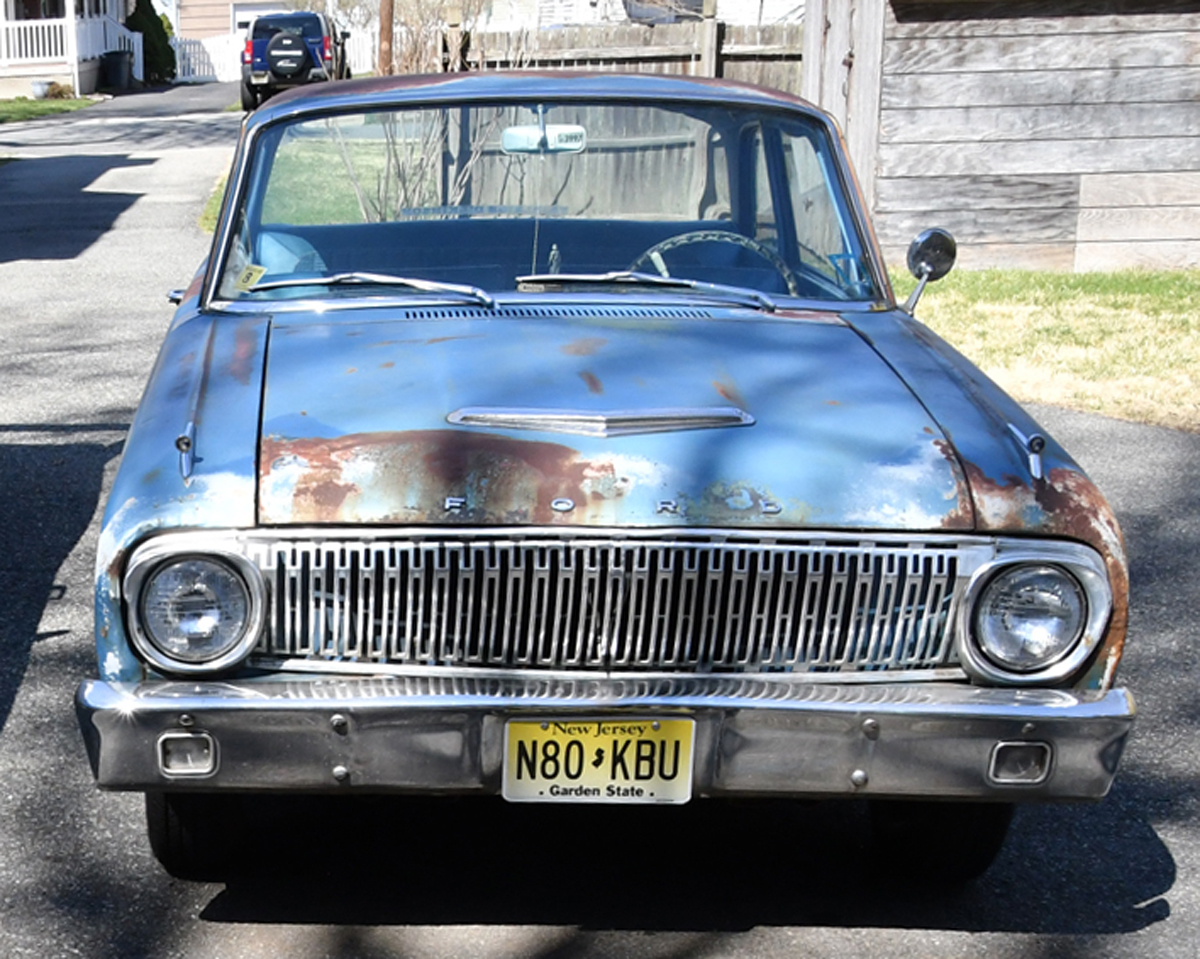
Worthy of inspiring a softly quizzical “why”?, a fairly forlorn 1962 2-door Ford Falcon with a level of patina edging ever closer to crossing the line to perforated corrosion nobly plays the role of sidekick to the bigger than life hero Superbird.

Told with warmth and feeling, Vinny lovingly shares the story behind his deep affection for “Mrs. Olesko’s Falcon.”

“I grew up in Bergenfield, New Jersey, says Vinny, “I was 9-years old when my friend Ron Olesko’s mother bought a 1962 Falcon.” From the day she took delivery until today, it has never left Bergen County. Ron was the only child and the car serviced all the family needs by going to church, the grocery store and taking Ron to and from school. Vinny says, It probably never took a longer ride than 20 miles.”

Since in years later Mrs. Olesko had a concern about mice getting into the car inside the garage, the Falcon stayed outside exposed to the elements from around 2002 to 2017. After Mrs. Olesko turned in her driver’s license due to poor eye sight, the Falcon sat idle for a few years. Despite Vinny’s most passionate pleas she refused to sell the car. She wanted it out in front to let potential burglars know that someone was always home. Son Ron Olesko says, “Despite my best efforts I could not persuade her that a rusty car with four flat tires would not fool anyone.”

After taking a fall Mrs. Olesko moved into a nursing home. Her first thought expressed when she moved was, “Give the car to Vinny.” When contacted by Ron, Vinny asked how much Ron’s mom wanted for the beloved Falcon. Ron said, “All she said was maybe Vinny could get it running and someday ride it in a parade.” Mrs. Olesko passed away in 2017.

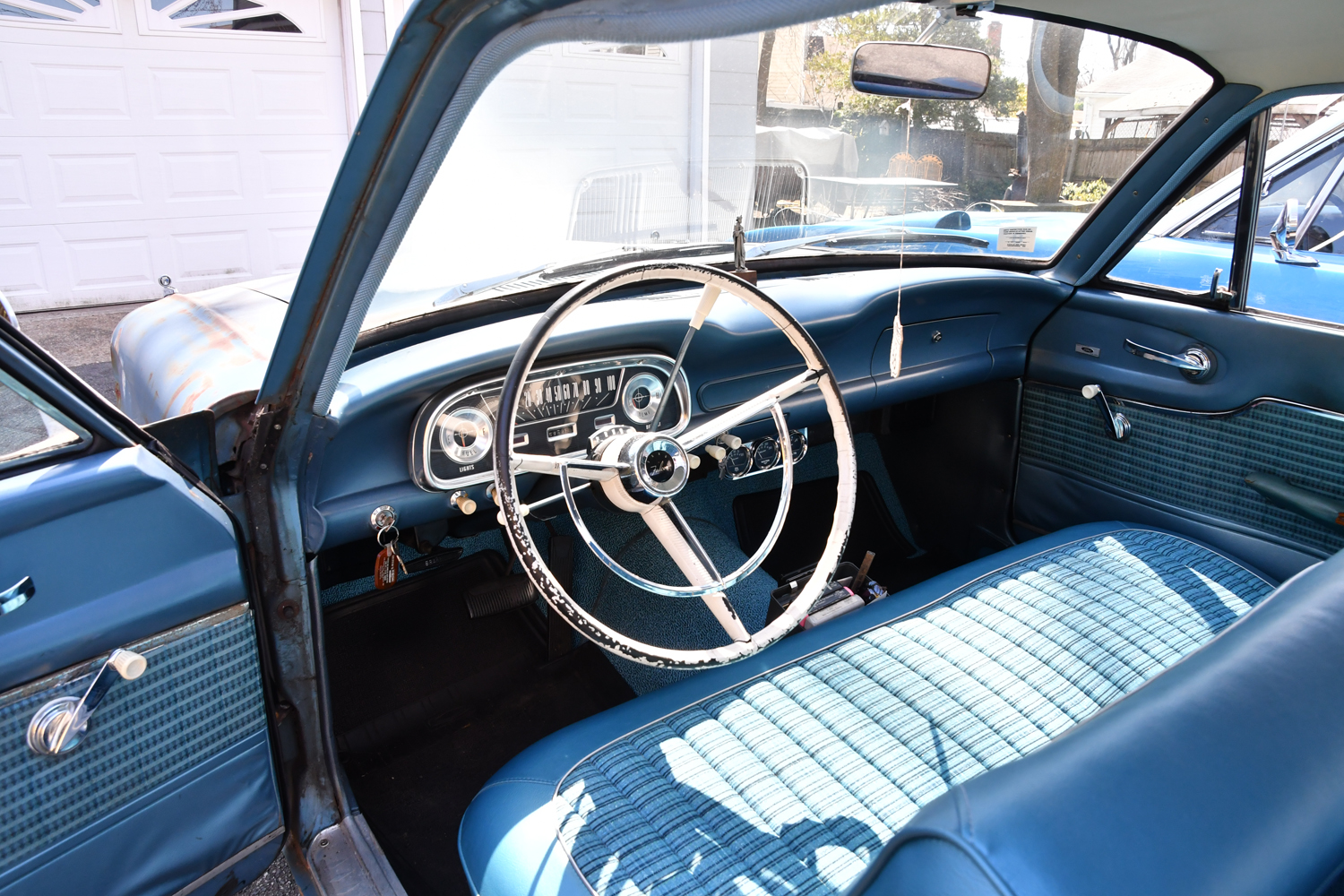
1962 Falcon refurbished interior

Interestingly the original purchase paperwork and window sticker accompanied the car. As displayed on the window sticker, the Olesko family purchased a 2-door model with the 85 horsepower 6-cylinder engine and 2-speed Ford-O-Matic automatic transmission. Vinny says, “The only option it had was the deluxe package which gave you some chrome trim on the sides and behind the wheels and those little guys on the top of the fenders. No radio (Vinny still has the little radio opening block-off plate). No power steering. No power brakes.“ The paperwork indicates a payment of $45.99 a month for 36 months.

Transporting the Falcon to Vinny’s garage posed some major challenges. Wheels had bonded to brake drums and would not turn. Vinny finally freed up the wheels and with the help of his Cousin Frank rolled the Falcon onto Vinny’s trailer. Changing all fluids and replacing all brake lines allowed the Falcon to slowly rise like the Phoenix from its past as a dead rusted hulk. Inspired by a ,now running car, Vinny found NOS 1962 Falcon upholstery and installed it.

When Mrs. Olesko passed away Vinny drove the refurbished faded blue Falcon to the church and followed the hearse as they drove one last time past her house.

Vinny says, “I do not want to remove the rust and repaint the car. I want to retain the patina that represents the loving life of Mrs. Olesko. While some may look at it and see only rust, I see a big part of a person’s life and memories that can never be replaced.”

Son Ron Olesko is quoted as saying, “Thanks Vinny, you do fine work. My mom got her parade.”

Loved for very different reasons but with equally heartfelt affection, Vinny Plotino’s odd couple sit side by side emblematic of the very human connection bonding people, the cars they love and the emotional charge that seals that bond and expresses human values far deeper than the attraction of horsepower and chrome.

By |2021-04-08T11:31:38+00:00April 8th, 2021|12 Comments

Cars We Love & Who We Are #18

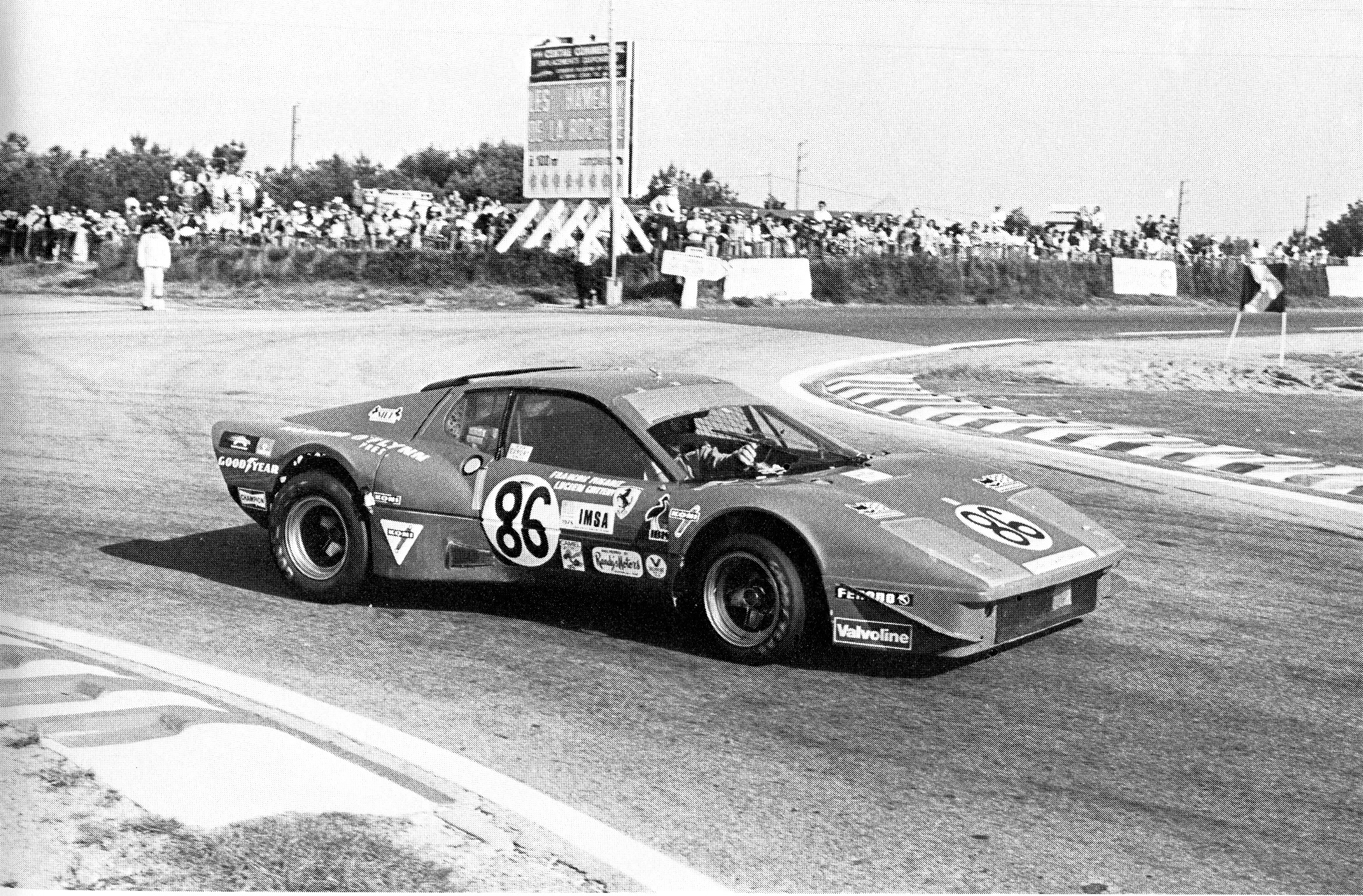
So it’s late summer of 1977. A bright eyed blonde haired young man just out of his teens with a gift for things automotive had become known for his accomplishments while working with his father restoring vintage Jaguars. One afternoon a customer approached him mentioning knowledge of a Ferrari being prepped for IMSA class endurance racing. He asked if the young man would be interested in interviewing for the team? With his father’s blessings, young Bryan Maletsky left work at closing and headed off to meet the Ferrari 512 Berlinetta Boxer (512BB) that would ultimately bring him to the 24-hours of LeMans in 1978.

LeMans 1978, a young man’s memories

Bringing the Ferrari to the starting grid

Bryan Maletsky entered the workshop of Randy’s Motors in Clifton, New Jersey. Surrounded by the Ferraris, Maseratis and Lamborghinis in which Randy’s Motors specialized, Bryan arrived to meet the IMSA class Ferrari’s Chief Mechanic, Randy Randazzo, owner of Randy’s Motors.

After Bryan acknowledged to Randy that he had little experience on Ferraris but had considerable electrical troubleshooting experience Randy said, “Good, you can start tonight. Let’s see how you do.” “Do what?” asked Bryan. He was directed to rewire the Berlinetta Boxer’s instruments and dashboard, put in new connections and correct all the wiring that had been improperly done previously, re-solder all the connections and secure all the wires. At the end of the night Bryan had earned Randy’s respect and a place on the racing team.

Randy’s 512BB began life as a NART (North American Racing Team) car built and campaigned across America by famed Chinetti Motors for the 1975 and 1976 seasons.

Acquired from Chinetti in 1977 by new owner Howard O’Flynn the 512BB shipped from Connecticut to Randy’s where the car would be prepped for the 1978 season with hope but no guarantee of going to LeMans.

As a new team member Bryan’s days filled up quickly. Still committed to supporting his father’s East Rutherford, New Jersey Jaguar restoration business Bryan would leave there around 5:30 and head straight to Randy’s where the team worked into the wee hours of the morning focused on getting the Ferrari sorted out and ready for the 1978 IMSA endurance race season.

Born to run and bred to run fast, this 512 BB got life from a seriously worked 5-liter, flat 12-cylinder with 12 Webers. It far exceeded the stock 340 horsepower delivered through the 5-speed manual transmission.

“Swiss cheesed” rear panel

Running fast not only meant adding power but equally critical it demanded losing weight. Weight reduction meant anything that did not contribute to structural integrity or performance would be lightened or removed. With the interior already gutted, attention turned to any flat piece of steel that had no structural purpose. It would immediately be “swiss cheesed” using an array of different size hole saws to remove as much metal as possible. The lightening process got down to stripping paint from any part that did not need to be painted. It got to the point where any bolt that extended needlessly far past the nut would be replaced with a shorter bolt. Lightening efforts resulted in a weight reduction of 70 Kg.

With the Ferrari ready and the season upon them, the O’Flynn team faced an IMSA endurance race schedule that included Daytona, Watkins Glen, Road Atlanta and Talladega. Now, late nights would be spent making the car ready for each subsequent race.

The road to LeMans for a prospective competitor must be paved with high levels of competitive performance at major endurance races. The O’Flynn Berlinetta Boxer proved its mettle on the track and earned an invitation to LeMans. The car was going and So was Bryan.

The invitation put all hands on deck and all things in crates. As Bryan recalls, “Tool chests, tools, no matter what you thought you had was enough, it was always doubled or tripled.” All needs, every contingency had to be accounted for.”

Then in what Bryan says, “Felt like a blink,” the prepped Ferrari, parts, tools and team found themselves high over the Atlantic headed for touchdown at La Sarthe the small regional airport convenient to LeMans.

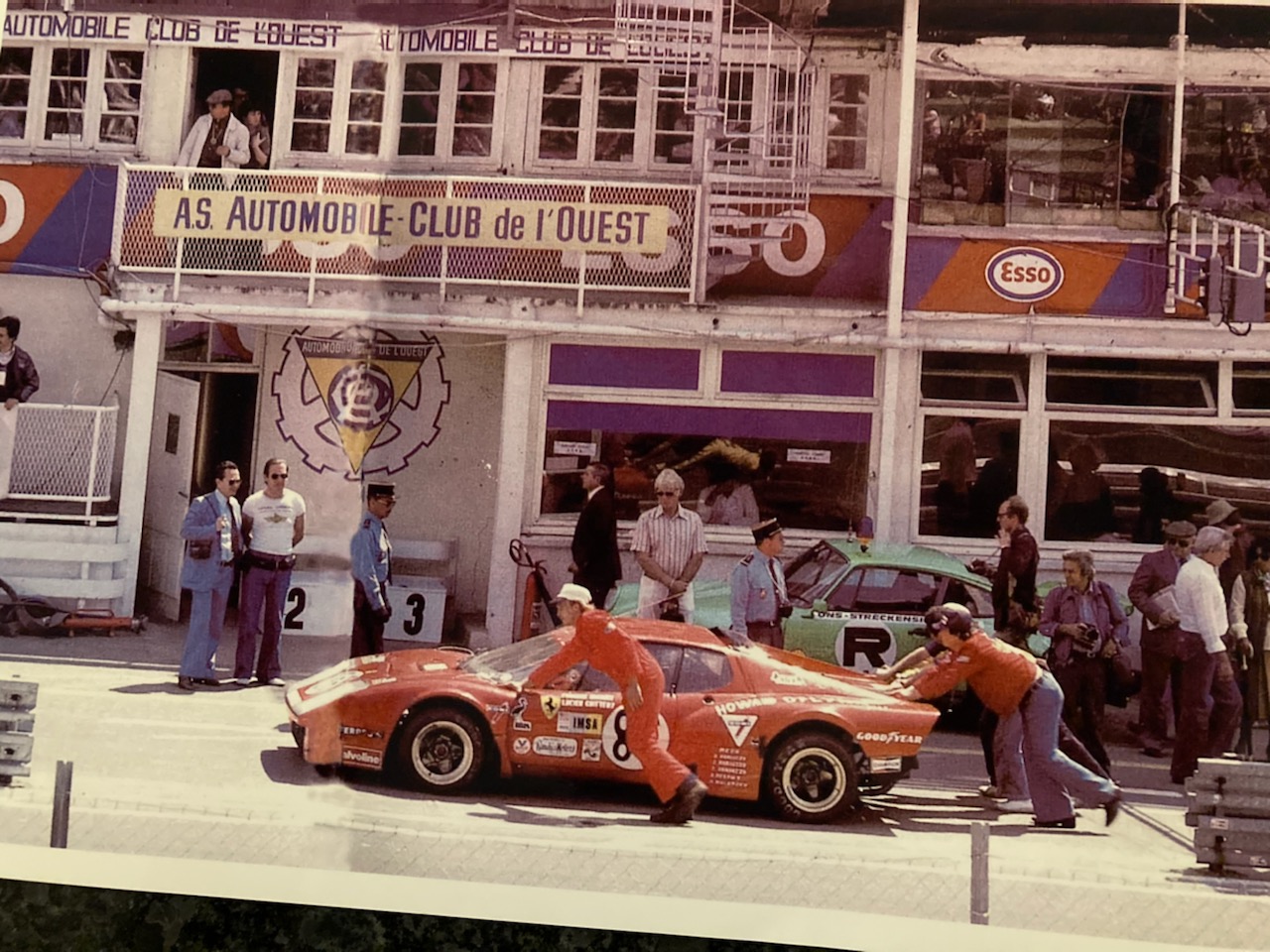
Bryan Maletsky at driver’s door pushing 512BB to starting grid

With the Ferrari on a separate plane the team focused on getting to their accommodations. They would be staying at the home of lead driver Francois Migault’s parents. Work on the car would be performed at a local Renault dealership.

For Bryan and the rest of the team, hitting the ground sent them into a whirlwind of car support activity that would not subside for the coming week and half right through race day.

Bryan says, “We really didn’t even have time to think about the race except to make sure that the car benefitted from everything being done and done properly.” “By properly” means that every nut and bolt tightened would be marked with the specific personal color identifying the team member who secured the nut, bolt or fitting.

In preparing the car, a serious problem arose when lead driver Migault took the Ferrari out on a local airfield to shake the car down and run it at some race level speeds.

When Migault pulled in and exited the car after a number of runs, he clearly lacked enthusiasm for the 512BB’s engine’s ability to deliver the goods. He felt the engine, one of three the team had brought, could not deliver the power needed to be competitive. Interestingly this engine had been provided by Ferrari in Italy. Acting to rectify the problem the team swapped out the Ferrari built engine to be replaced with the engine that had been prepped back in the States at Randy’s. After some serious testing, Migault returned to announce that this engine had the guts to chase the glory.

The 512BB running at Daytona

While Bryan’s lack of French fluency for the most part served as a hindrance, it did offer a few key benefits particularly during questioning by the scrutineers (French judges who determined if a car complied with all rules and requirements). Anything that the team did not want discussed became a troublesome language issue that would frustrate the French officials to the point that it would usually result in the judges simply walking away.

As well, a little theatrics came to the rescue when the team realized that their rear end body dimensions fractionally exceeded the width limit. As the scrutineers approached, Bryan got into a boisterous shouting match with a fellow team member. French officials wanted nothing to do with the crazy Americans and simply walked on by. Disqualification averted.

At last, race day arrived bringing a confluence of spectacular cars, world class drivers, iconic signage, thunderous engine noise, screaming crowds and the pungent smells of high octane auto racing in the air. Drivers for the O’Flynn team would be Francois Migault and Lucien Guitteny. Bryan says, For me it was an event of a lifetime.”

Strong and nimble the 512BB attacked the course. It effortlessly clocked over 200 mph on the Mulsanne straight. Tire swapping played an important role in a strategy designed to promote the survival of the car to the end of the race. Taller tires would provide a higher top end. Shorter tires would provide quicker acceleration. So depending on day or night and the car’s position in the race tire choice played a major role.

Disaster would strike midway through the race when the Ferrari’s driveshaft broke away from the pits. When a car breaks and does not make it to the pits, LeMans rules demand that any repair must be performed by the driver. The only thing a team mechanic can provide is verbal direction. With a replacement driveshaft in hand a team member took a service road out to the broken Ferrari’s location and stood by the driver providing point by point instruction which Driver Guitteny carried out flawlessly.

With no further problems destined to occur, the Ferrari roared back to complete the race third in class and 16th overall. No Ferrari finished higher in the standings. Actually no other Ferrari, factory sponsored or otherwise, even finished the race.

To the nationalistic displeasure of some competing European teams, Bryan and his team members draped an American flag on the car as they toured the track.

In reflecting on the experience 40 plus years later, Bryan says, “Simply to be part of that international racing experience was an honor and then to be competing and finishing? Oh my God. That we finished, made us feel like we won the race.”

By |2021-03-25T11:31:07+00:00March 25th, 2021|Comments Off on Cars We Love & Who We Are #18

Cars We Love & Who We Are #17

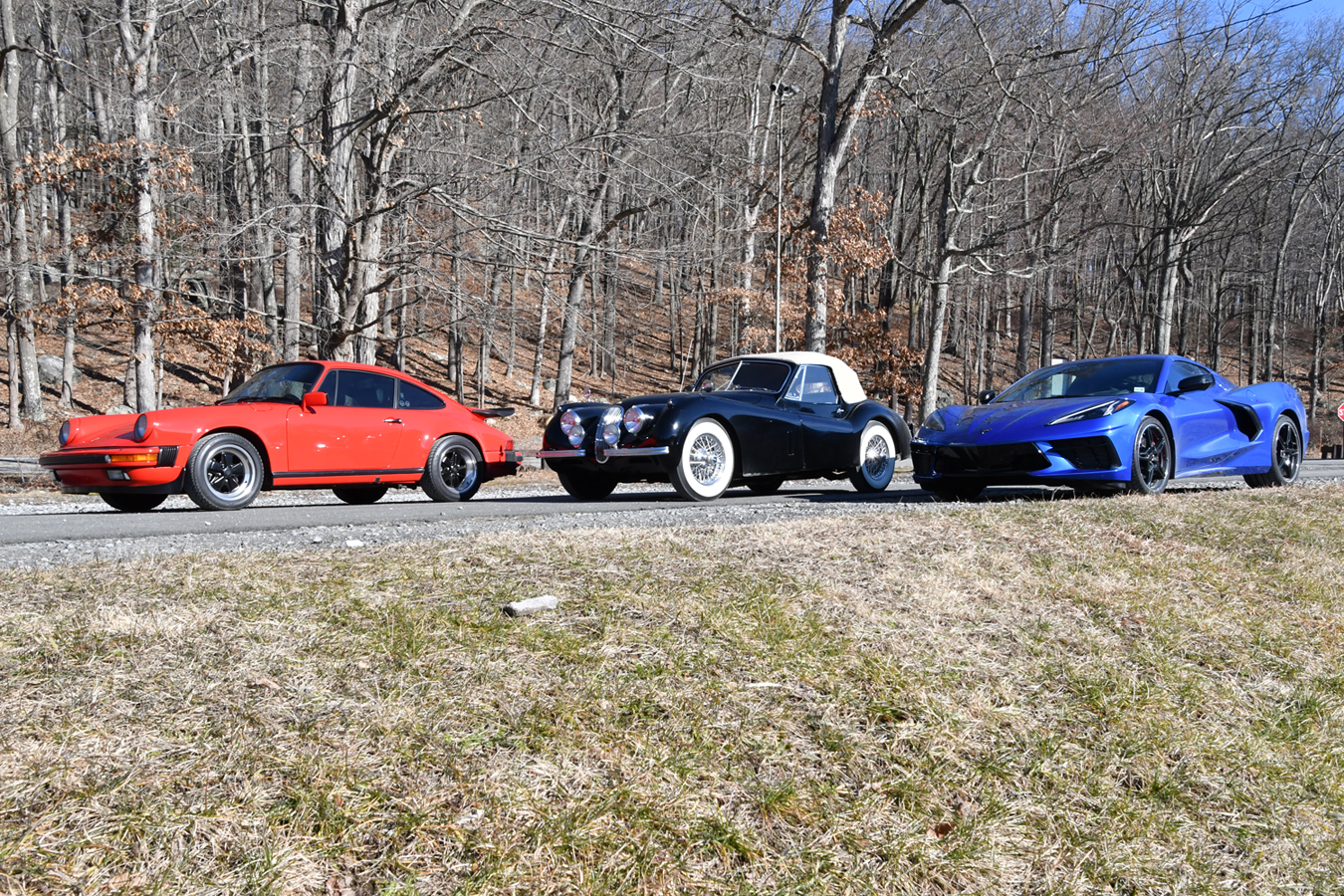
Cold but not bitter. It is a quiet winter’s day on Seven Lakes Drive in Harriman State forest. Ranked high on the short list of favorite local roads, it rewards the driver with a well paved two-lane that snakes through dense woodlands and past picturesque lake panoramas. This day few takers appear interested in sampling its pleasures. Then, faintly at first distinctive exhaust notes announce the arrival of a small but decidedly interesting trio of sports cars.

Behind the wheel of a time machine


Displaying a vibrantly rich and original Guards Red paint, the 1986 Porsche 911 grabs your eye as it flashes across the winter gray brown forest backdrop. Downshifting, it takes Kanawauke circle in its stride emitting the distinctive Porsche flat-six engine timbre and moves east.

Close behind sounding like a Spitfire going up over the English Channel to shoot down “Jerry,” a black 1953 Jaguar XK120mc approaches the circle. Seeking to purchase a firm grip with its slender 6.00X16 bias ply white walls, it exhibits decidedly more caution than the 911 as it downshifts into the curve then barks defiantly as it exits the circle.

Lastly, a Rapid Blue 2020 Corvette, the extroverted long awaited mid-engine high value performance beast, simply proceeds through the circle with a rumble and unruffled nonchalance, then, like that, It’s gone.

Jaguar XK120, Porsche 911 and the new Corvette, a visually striking threesome of iconic sports cars spaced decades apart. Clark Gable posed with a Jag, Steve McQueen with a 911 and today, eager buyers wait for their new Stingray.

It took little coaxing to motivate my friends and lifetime “car guys” Peter Desbets with his Porsche and Bill Whited with his new Corvette to join me in accepting mother nature’s gift of clear, dry roads and a sunny 40 degree day in January.

Framing each of these iconic sports cars in their period of dominance reveals a striking kinship in their perceptions by the public in general and automotive enthusiasts in particular. Each embodies a high level execution of refined engineering for their time. Their strikingly handsome designs made all three highly admired and desired. However, their ability to deliver winning performance served to position each in the public eye as far more than a pretty face. In their time all raced and won at Lemans, Sebring and in myriad competitions around the world. Each projected proven athleticism. Thus defined, they offered the opportunity to purchase an object of general desire and bask in the aura of its attributes and reputation regardless of whether the owner ever took advantage.

The chart comparing their specifications affords a window into the evolution of production sports car design and technology over the last 70 years.


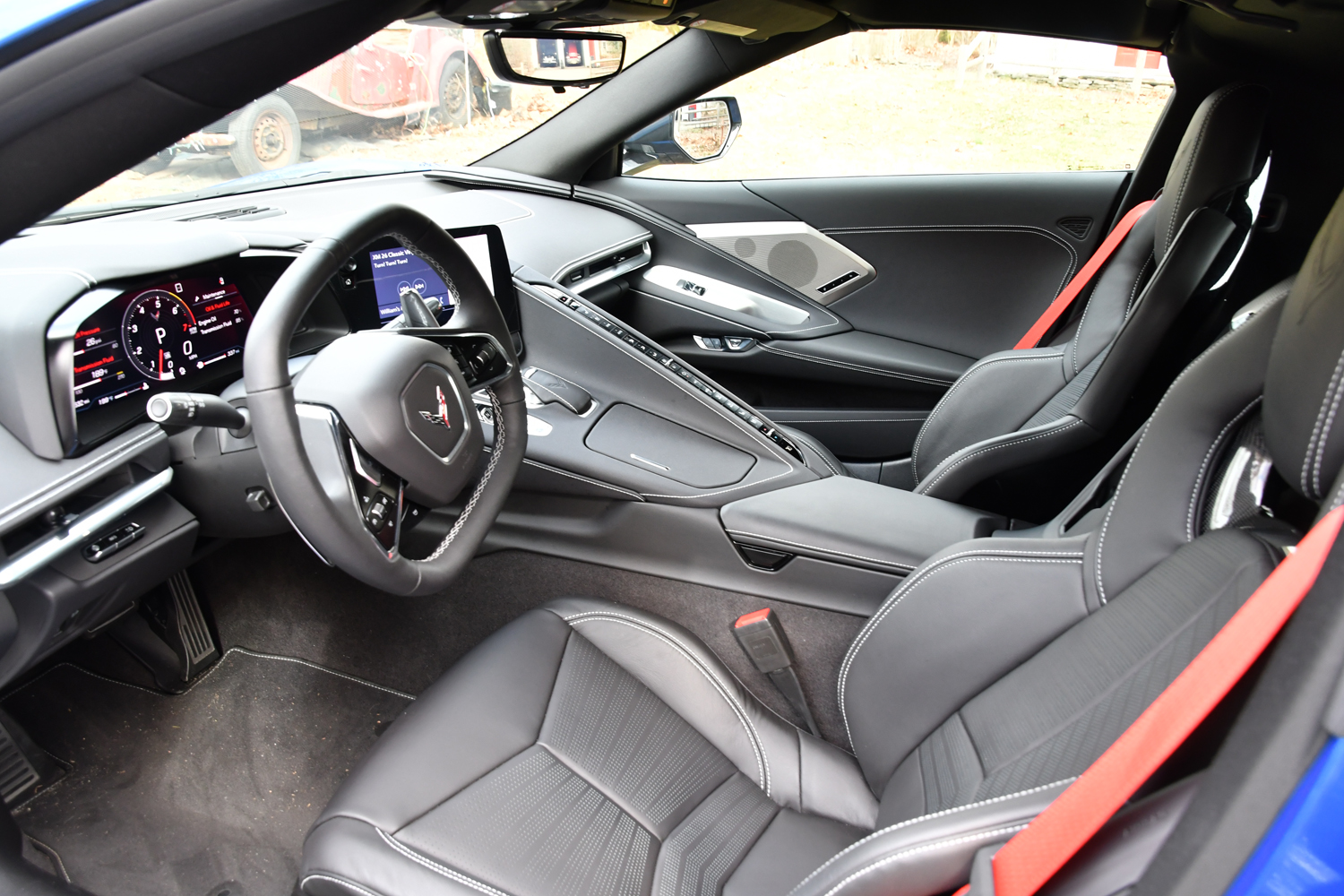
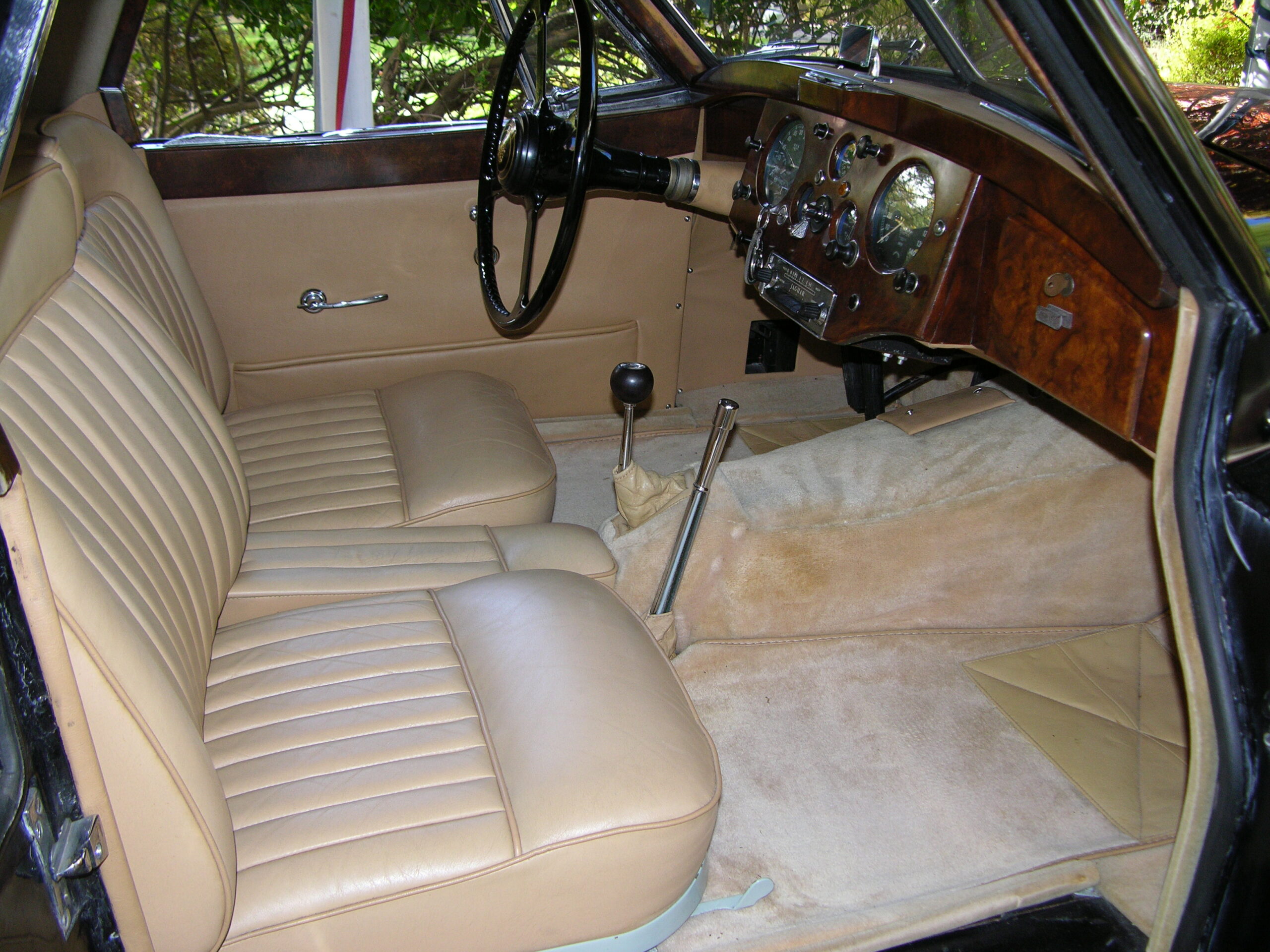
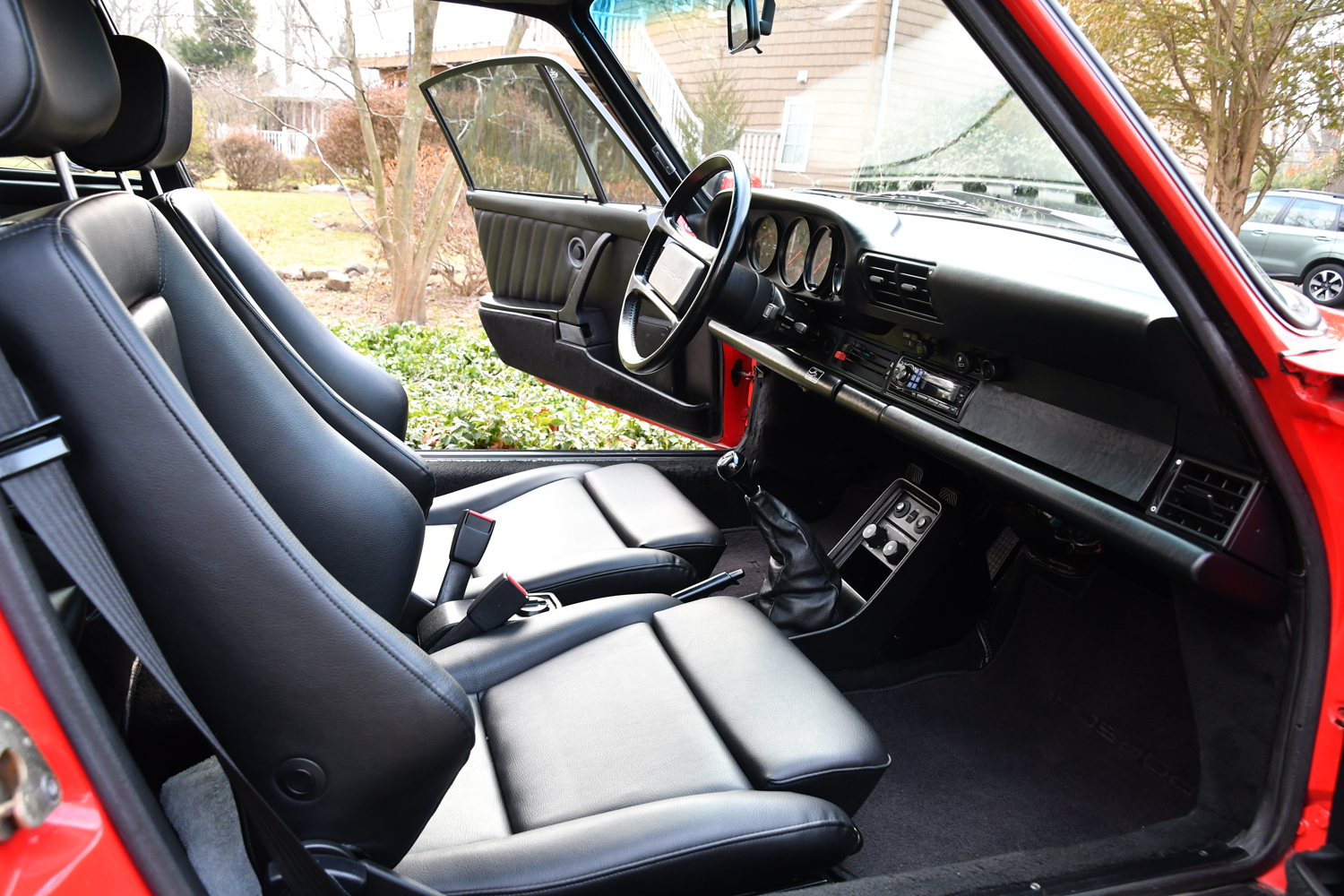
In evolving from analog to digital the march to the electronic future of sports car character and refinement evidences itself in stark fashion when comparing our trio. Door panels and dashboards speak volumes.

Corvette interior

Porsche interior

For some long-time classic car owners it comes as a jolt when a youth enters your classic car for the first time, looks at you with a tilted head and, then, looks back to the door panel. “What’s that,” an inquiring mind asks while staring at the window crank. And now the question will extend to the door handle as evidenced in Bill’s Corvette. Not new to the 2020 Corvette, but emblematic of the total reliance on electronics, the door handle has yielded to the door button.

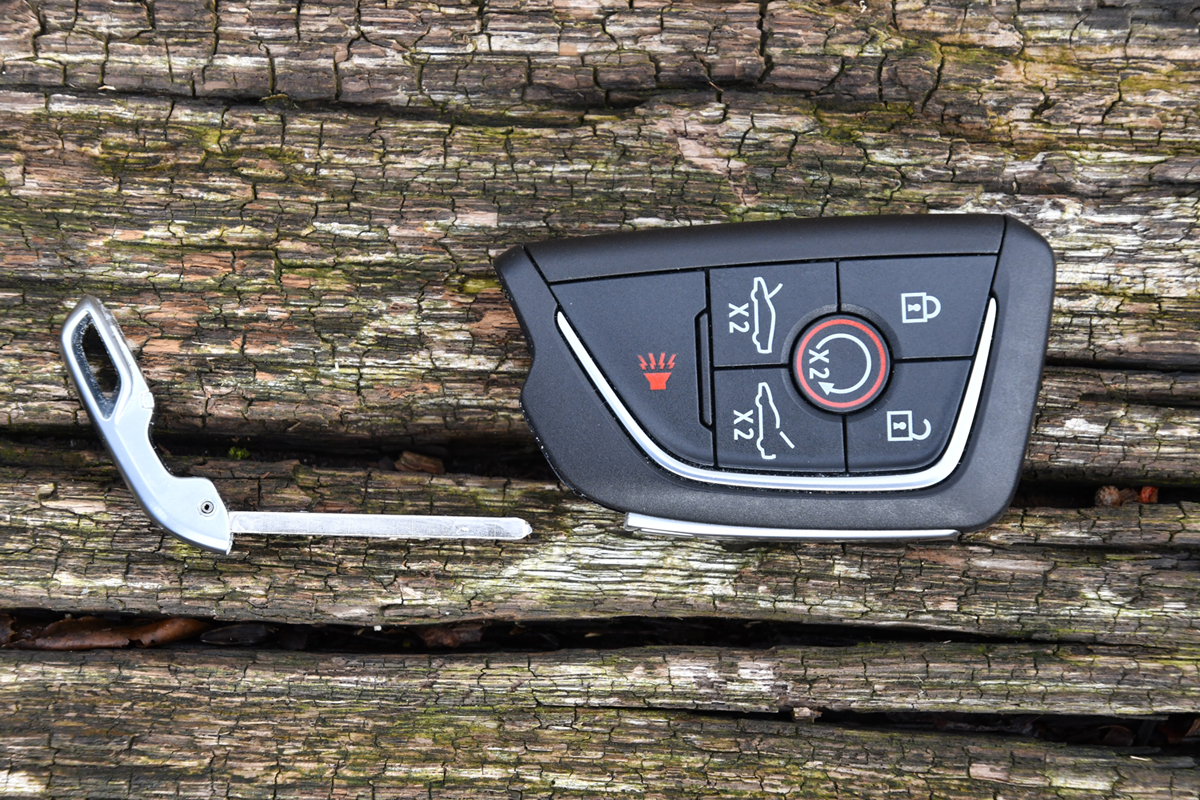
Corvette Fob

Deserving of mention in recognizing the profusion of electronic “conveniences,” looms the question, “What happens if the battery dies while you are in the car?” No worries mate, a mechanical lever hugging the sill can be manually pulled up to release the door. What if you find the battery dead when returning to the car? A mechanical key has been squirreled away in the key fob. The matching key slot lurks inside the quarter panel air scoop.

Dashboards once an array of handsome gauges in a stately setting have been replaced by a thin film transfer screen that can provide a varied array of different looks.

Harriman’s empty roads offer the trio an inviting opportunity to explore the character of their respective rides. Twisting and narrow, the roads also provide a blank canvas against which to assess the degree of driver attention necessary to drive safely.

Jaguar’s XK120 basically came to life on a drawing board during WWII. In today’s world, many drivers operate three-ton battering rams while distracted. For a 70-year old sports car in that environment, the primary safety feature is the driver. If a driver does not understand how to correctly operate this cross between a sports car and a Faberge egg, the car will not last very long and neither will the driver. It is not a one-hand on the wheel while resting your elbow on the door driving experience. It demands two-hands on the wheel and your head on a pivot. Sitting upright on narrow tires, with a strong engine and  a twitchy suspension, everything feels immediate and edgy.

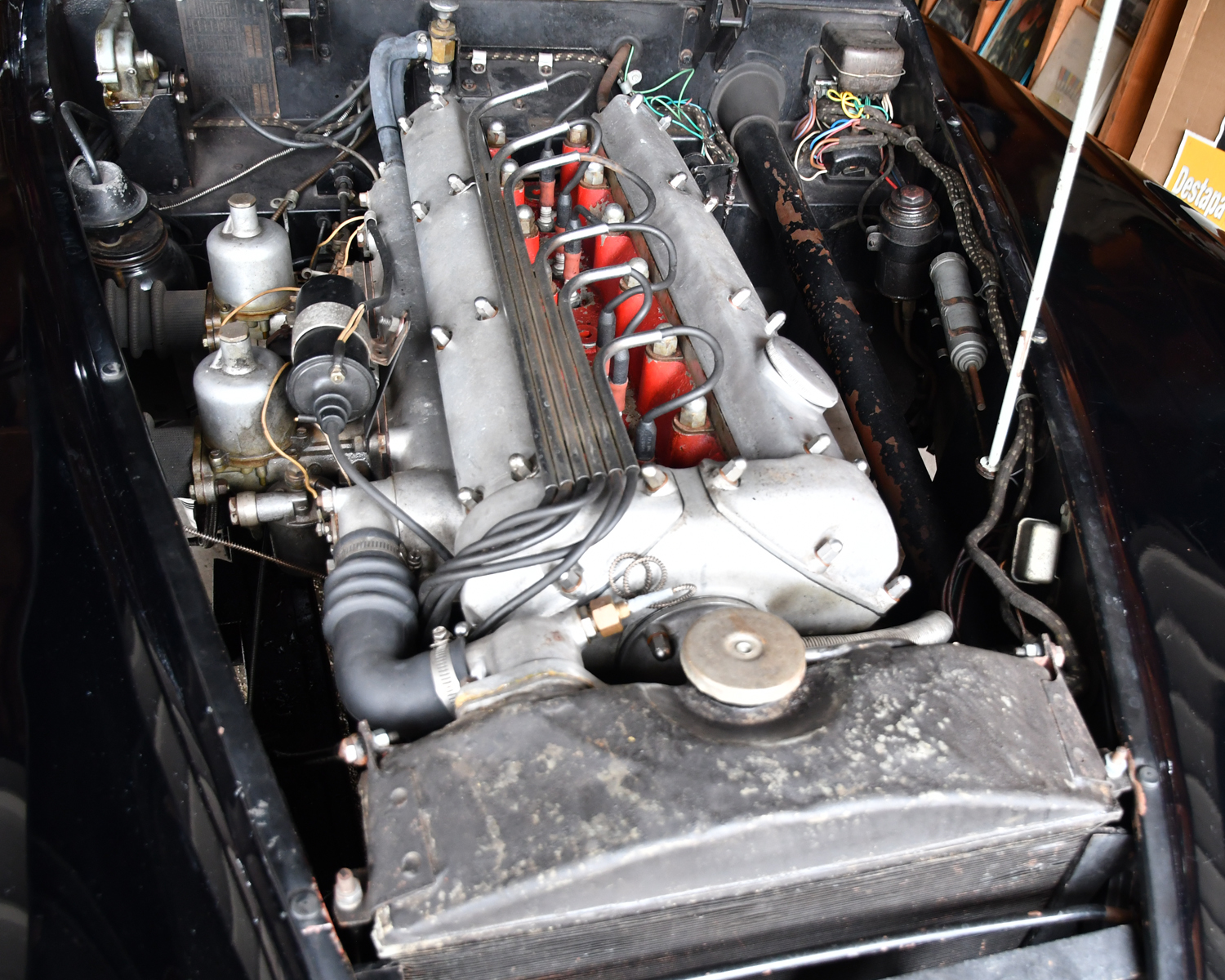
Jaguar engine

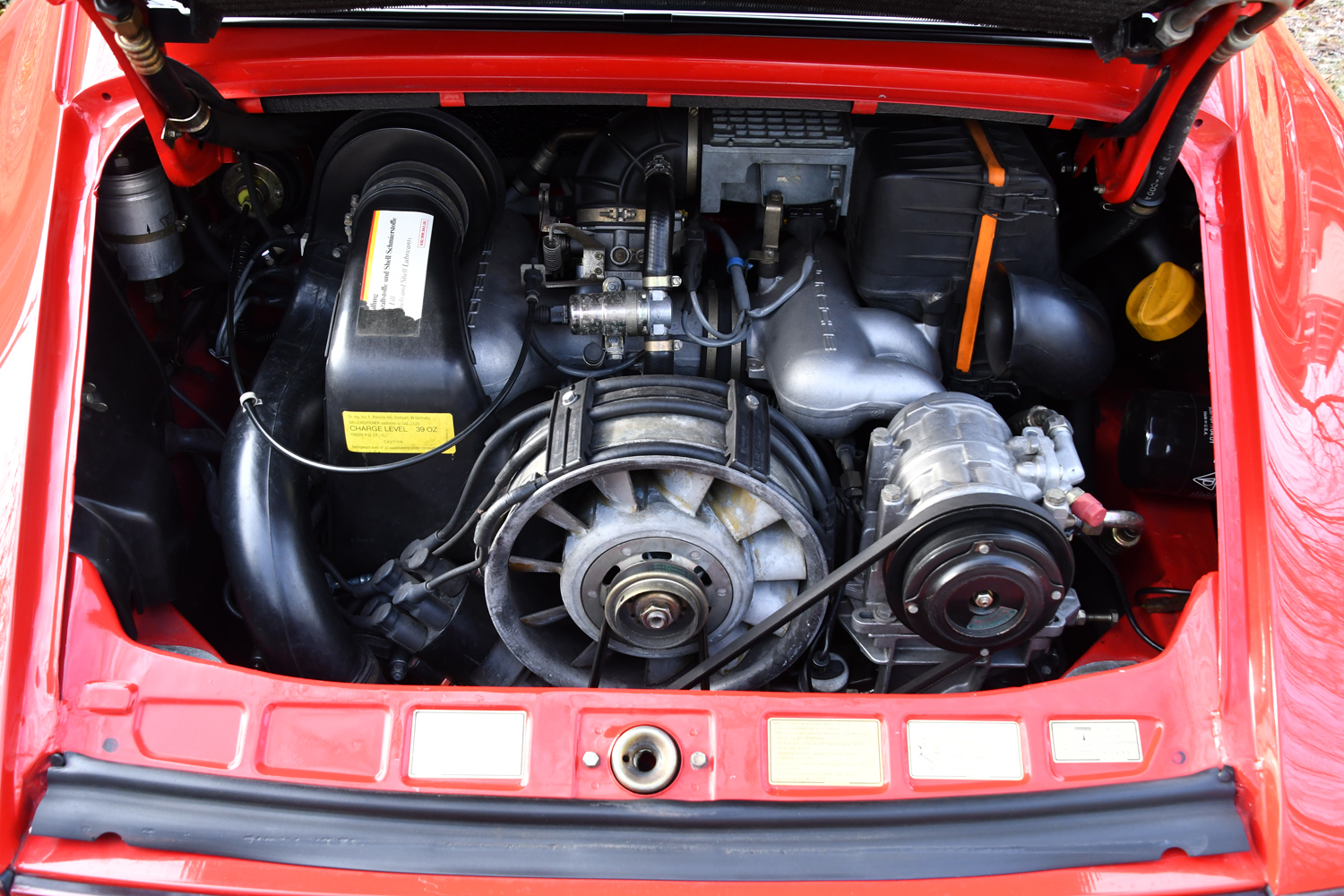
Porsche engine

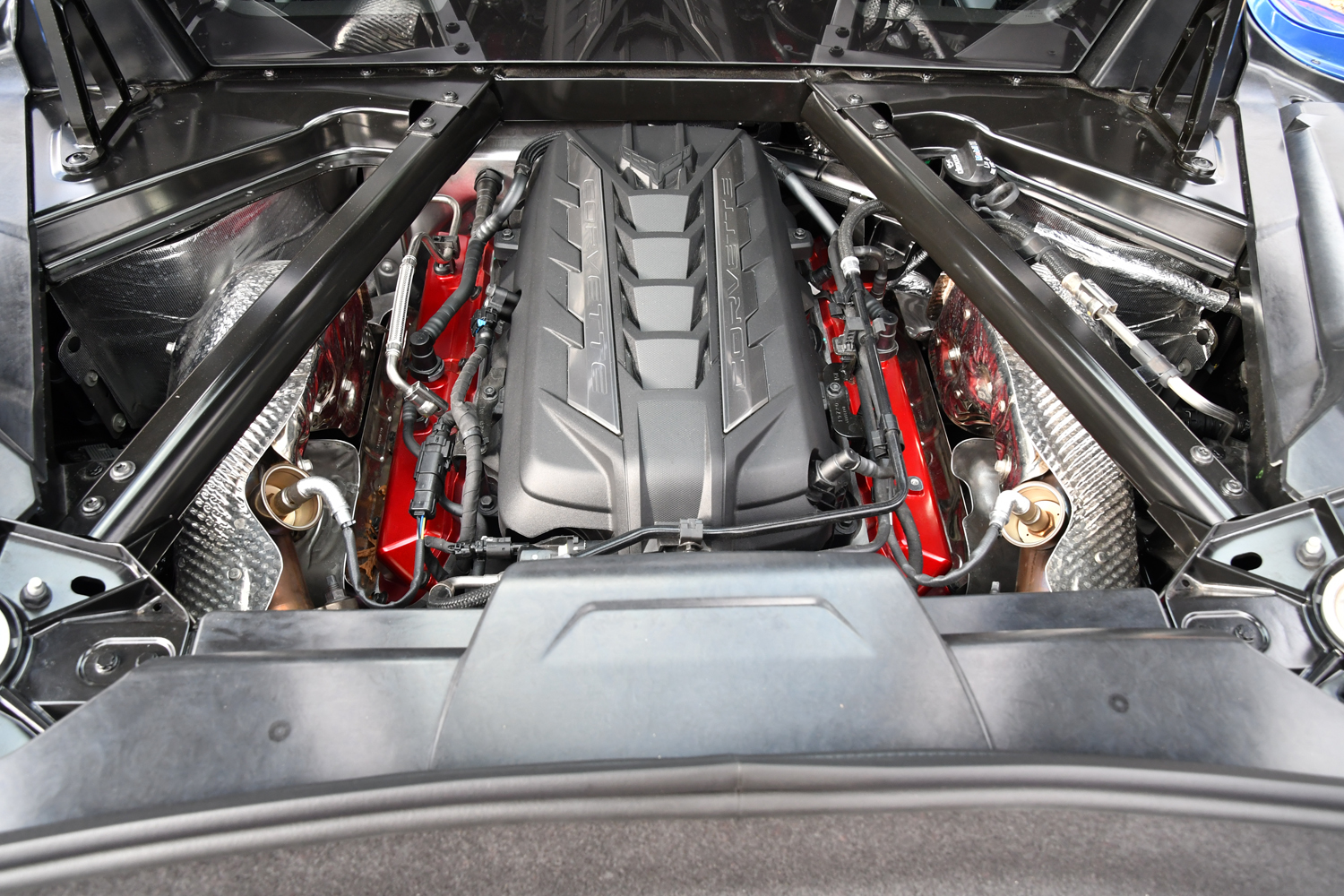
Corvette engine


The Corvette on the other hand has a threshold of urgency quantum levels beyond that of the Jaguar. To achieve an urgency twinge would require having passed through the “I know what I am doing is dangerous and stupid zone.” Unlike the Porsche that feels light and tossable, the Corvette conveys the sensation of a great mass yet responds with brilliant agility and ease all the while communicating a reassuring solidity. It communicates an extraordinary ease. Though on today’s roads, driving the Corvette requires attention, though it does not demand it. Bill says, The car stays in its lane. Stops immediately. Reacts quickly and smartly, all with one foot.

However, as we move through an age where technology often exceeds man’s ability to assimilate it, the Corvette possesses the ability to frighten. Bill tells the story of his experience taking his Corvette to redline. Having passed the 500-mile break-in period, Bill decided to give it a shot. He finds himself on a familiar backwoods straightaway.

Bill says, “I have the radio on. I’m kind of relaxed and laid back. No one is around so I stop. Check again. No one. I nail it. The G-force made me dizzy. I was looking to go 0 – 60. I hit the brakes around 50.” Bill, who has had a lot of fast cars in his life including a big block ’67 Corvette he still owns, says, “I was going to pass out. The traction and acceleration was unbelievable.”

However, the automatic and all of the adaptive technology afford some detachment. It certainly lack the engagement of the 911. Peter who has also driven Bill’s Corvette says, “My 911 offers far more engagement with a whole lot more road feel.” Pete contends that the 911 demands the driver’s attention. The pedal location demands precision in engaging the clutch. With no ABS, it demands braking modulation.

Response to the road condition truly separates the three. The Corvette just tracks straight regardless of undulations or road imperfections. The Porsche yields slightly to the mind of the road requiring minor correction. With its WWII suspension design and bias-ply tires, the XK120 will pretty much go where the road directs without continuous corrective input from the driver.

Completing the day at Harriman, everyone pulls over to take the traditional “drive” photo. The fairly unusual collection draws considerable attention and sparks a discussion of how people react differently to the cars.

It is agreed that the 911’s iconic shape resides in the consciousness of the general population. That said Peter calls out two groups that respond viscerally to his car. First. being true Porschephiles who will come up and tell him about his car. Young males of Asian descent fill out the second group. Peter says, “If they pull up next to you regardless of what they are driving. They give you the thumbs up. Walking by, they will most often stop to ask about it.”

Bill says, “Seeing the Corvette, even if they don’t know it is a Corvette, they know it holds some kind of special place in the fast car Ferrari world. Ferrari being the only other brand name they may know.”

Peter says, “I think when people look at your Jaguar they think it is older, say from the ‘30s. People who don’t really know cars think Great Gatsby.”

In a curious way while we shared a common road, we experienced the day driving in three different decades.

By |2021-01-21T12:10:36+00:00January 21st, 2021|4 Comments

Cars We Love & Who We Are #16

Especially for guys alive when the Jets last won a Super Bowl, identifying future stewards of car enthusiast culture represents a real concern. There exists a certain uneasiness as they straddle the intersection of history and hope.

From time to time Drivin’ News enjoys exploring exciting and positive examples of the hope. Some weeks ago teenage demolition derby driver Christian Farquhar spoke about his passion for smashin’.

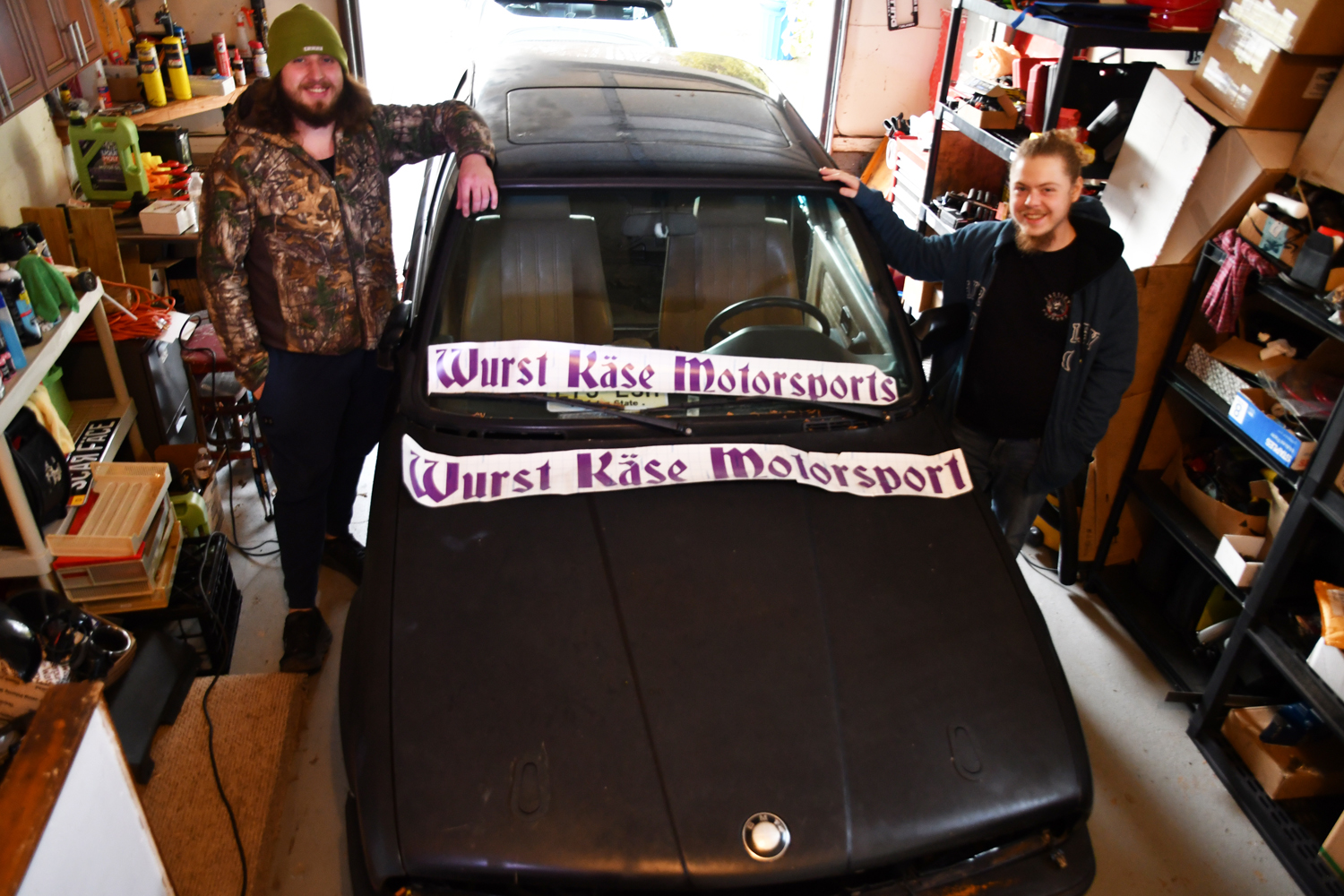
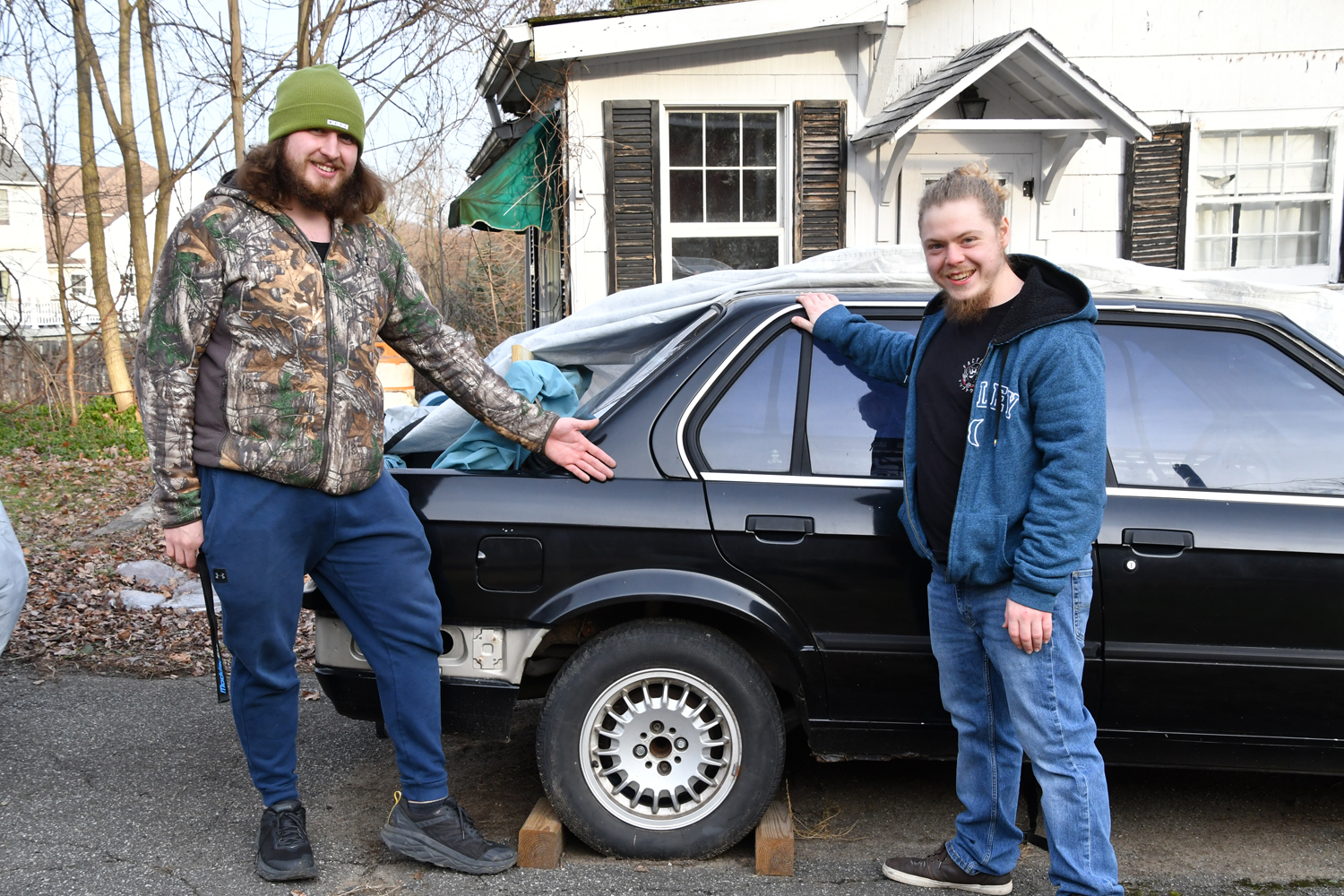
Now, comes the story of two inspired and talented young racing enthusiasts. Partnering in a shared unconventional vision with a shoestring budget, these BMW aficionados plan to intrude on the local JDM (Japanese Domestic Market) dominance in drifting with a worked 1990 BMW E30 coupe.

Meet Dominick Carluccio and Jamie Cooper.

Wurst Käse Motorsports


Left: Jamie Cooper      Right: Dominick Carluccio


In their mid-twenties, whip smart and quick to laugh, both Dominick and Jamie speak fast car fluently with a distinct euro-performance accent.

The whole drifting thing had not been the inspiration for their initial 1990 E30 coupe project. Dom bought the car simply because he liked it. However, the car itself inspired the drifting dream. Dom says, “We were amazed by how well it handled and the power from that 2.5-liter inline 6.” Clearly they felt the E30 had the bones to make a hell of a drift car. Seeing is believing and what they were about to see set their smoking wheels in motion and gave birth to their joint venture, Wurst Kase Motorsports.

Jamie says, “It all came together about a year or so ago, Dom and I went to a drifting event at Virginia International Race Track and by chance connected with drifting team “Insane Wayz.” “Insane Wayz” campaigns on the Professional Formula Drift (Formula D) circuit with a BMW E30 powered by the original M20 engine hooked up to a turbo diesel Cummins turbo. Accepting a generous offer from an “Insane Wayz” team member, they received a full tour of the car. Both Dom and Jamie took notice of how well everything fit together and functioned.

Rear clip of E30 4-door

Dom says, “We’re just sitting there reviewing all the modifications and we are going ‘we could do that and we could do that. Yeah, we could do it!” Returning home they immediately bought two 1990 E30s with a vision of turning them into one badass drift car. One, a coupe, suffered from a damaged rear clip. The second, a four-door would donate a perfect rear clip to complete the coupe.

A little history can help better understand the attraction of drifting as a motorsport. Born in the mountains of Japan, drifting grew out of a driving technique used in the very narrow uphill and downhill tandem-type races unique to these Japanese mountain road courses in the 1980s.

When tandem racing on narrow roads, an often successful way to get in front of the other car demands pushing more power forward towards the entrance to a turn.

Such techniques quickly caught on with drivers who recognized that not only were these techniques really cool but they could actually be used to win races by drifting past their opponent then regaining control. This gave the drifter the significant advantage of being in front on a very, very narrow road.

Dom says, “Drifting exploded on the Japanese driving scene in the early 1990s with everybody and their mothers learning how to drift.” Interestingly Dom adds, “It became enormously popular as an element of Japanese motorsport but also as a tool for everyday safer driving. It showed people how to handle a car when they don’t have traction on any of the tires.”

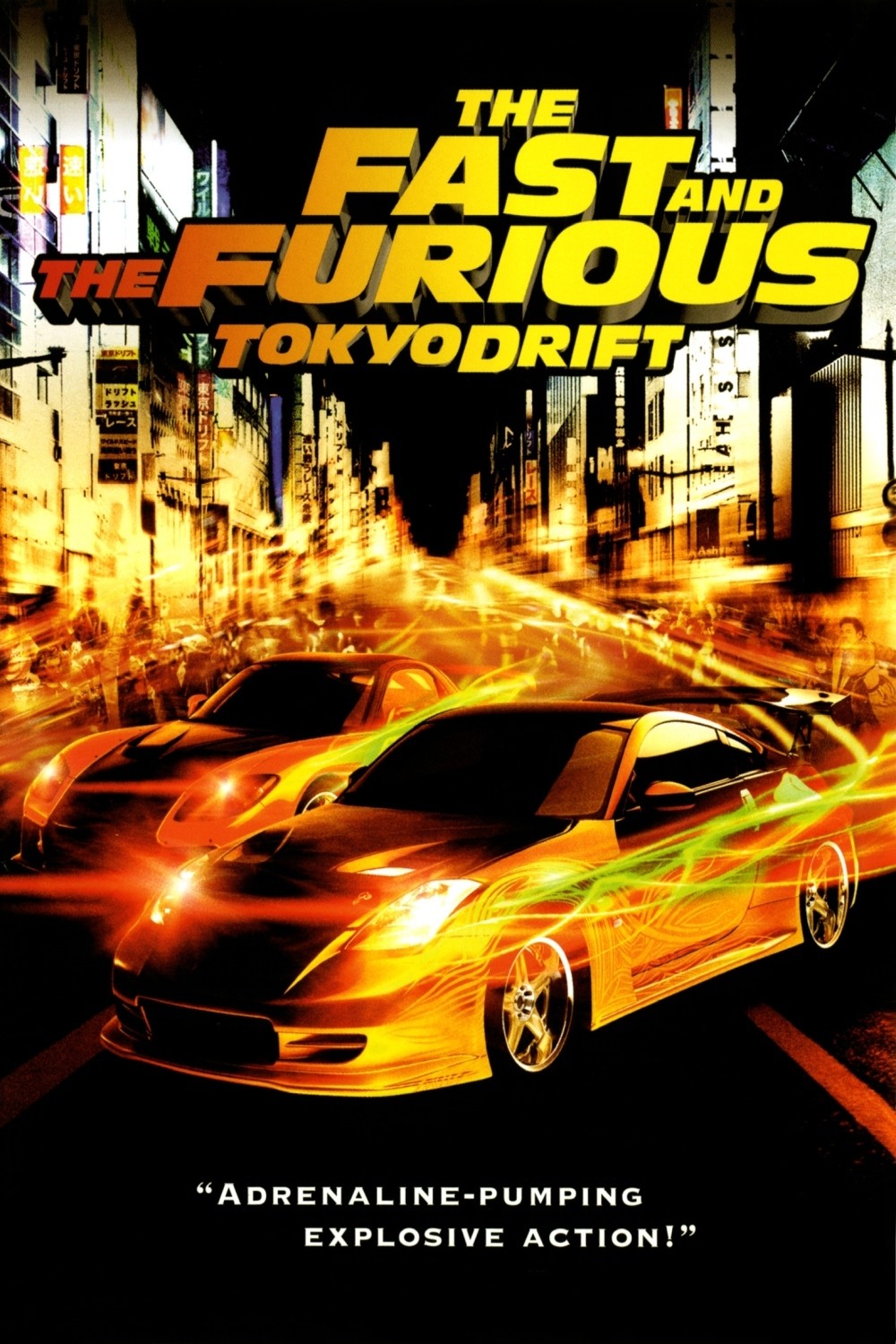
While drifting tentatively poked its nose into American consciousness around the end of the 1990s, according to Dom and Jamie drifting slid into the broad public awareness around 2006 with the release of “Tokyo Drift” from the Fast and Furious franchise of films.

Now, in 2020 with two donor cars and a vision, a 2-year plan quickly took shape. Dom and Jamie would create and sort out the E30 drift car while simultaneously developing the necessary  drifting chops.

Dom says, “We’ll be starting in Class C which is basically bare-bones straight beginner. We won’t be running tandem with anybody and we’re subject to fewer regulations.”

Their focus targets getting the Frankencar drifter sorted to the point where it gets accepted into the entry class. Jamie says, “Then we race it, see how we like it and all the while sort out the car as we go.” With a laugh Dom says, “Fundamentally for the first year we’ll be up in the air learning to fly in a plane still being built.” Achieving a level of success in their first year would put a move up to class B in their crosshairs.

Interestingly, they intend to have two seats in the car. They will run together as a team with both driver and passenger seat occupied. They figure their understanding of the dynamics of their car will benefit significantly from the two perspectives.

When asked if the added weight of a passenger will negatively impact speed and handling, Dom’s response revealed the joyous spirit, raucous pleasure and camaraderie built into the fabric of the E30 Frankencar 2-year plan. Dom said, “Yes, I guess so, but it’s also about having fun. Bringing the other guy along for the ride just makes the experience better.” With attitudes like this the future of the car enthusiast culture will be in great hands.

Clearly Dom and Jamie savor the personal challenge of competing with a 30-year old car. They relish the idea of personally creating a unique and competitive drift car that does not employ the latest and greatest “just write a big check” factory technology.

While Japanese cars enjoy an enormous testing and tuning reference library, very little detailed information exists to help Wurst Kase Motorsports in its mission to excel. Don and Jamie agree saying, A lot of the tweaks and engineering nuances will be our own. But we kinda’ like that.” Dom says, “With the E30 we’re taking a far less refined chassis that, counter intuitively, differs from newer ones in a lot of good ways. We intend to develop those advantages, bring it to the track and accomplish things that we haven’t seen a lot of people do.” “Amen,” says Jamie.

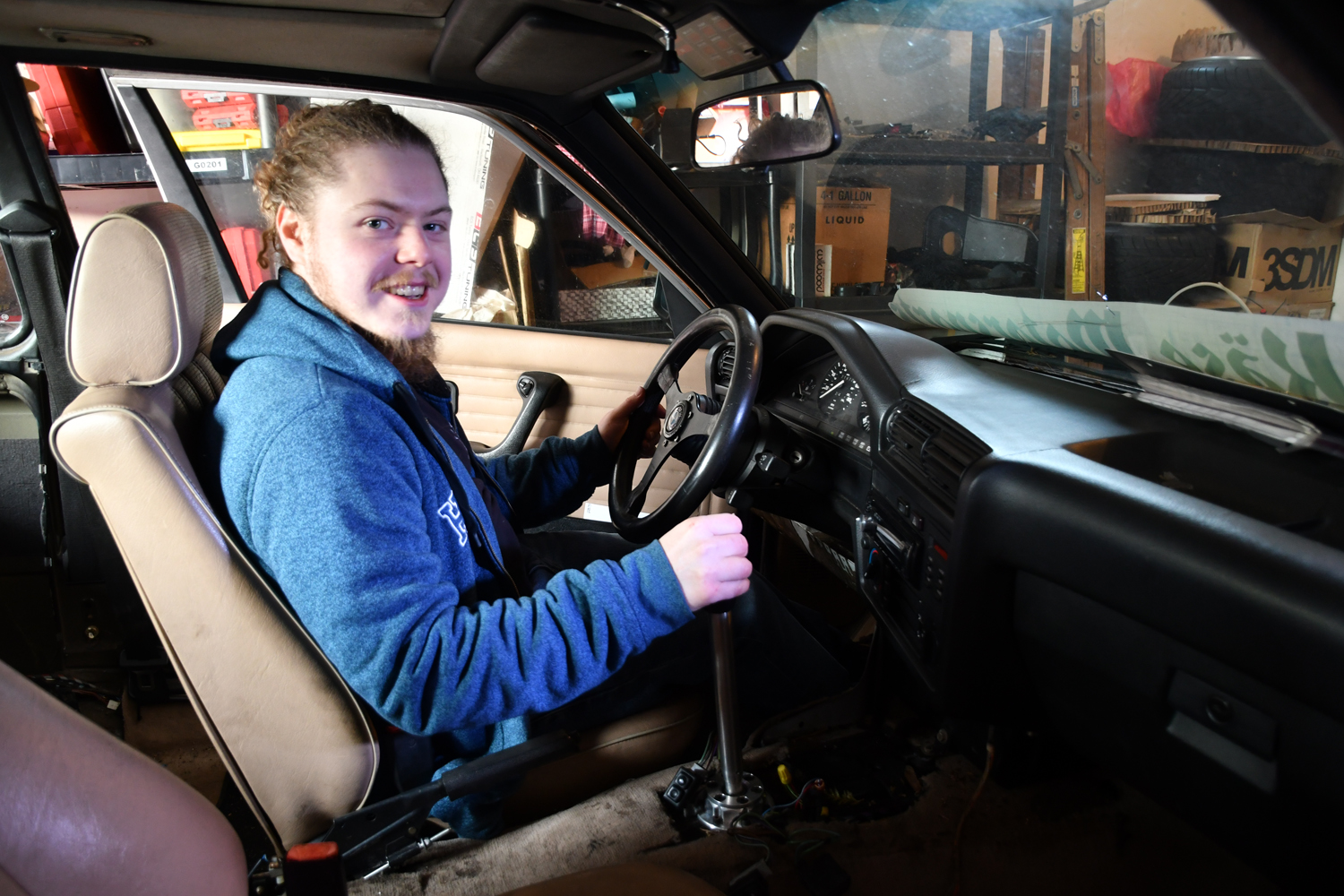
Trying the new steering wheel and gearbox on for size

With completion of the stock E30’s significant capability upgrade, Frankencar will head straight to the track where Dom and Jamie intend to explore its new athleticism. The E30’s sorting process will coincide with Dom’s and Jamie’s progress along the drifting learning curve. Necessity demands achieving a level of mastery that allows them to finesse Frankencar at the boundary of its limits for maximum performance.

Formula D sees cars drifting through turns at 80 to 100 miles per hour. In the lower classes cornering speeds fall into the 40 to 60 mph range.

With their sights set on early spring of 2021, Dom and Jamie exuberantly anticipate the unknown when, finally, the rubber smokes the road.

Dom says, “Drifting is something I’ve always wanted to learn. This is the perfect experience for me to further develop my driving skills and better understand the vehicle dynamics when operating at the limit.” Dom believes wholeheartedly that mastery of drifting as a driving skill could save your life.

In anticipating the coming race season Dom says, “Honestly, this is something we haven’t done before, but it’s something we both have dreamt of doing. We can’t wait to just get on the track.”

Jamie pretty much sums up the Wurst Kase Motorsports mindset saying, “I think no matter what, even if it goes up in a blaze of fire, I’ll be happy and smile at the end of the day if we can get it out there for the season.”

By |2021-01-14T12:17:25+00:00January 14th, 2021|Comments Off on Cars We Love & Who We Are #16

Cars We Love & Who We Are #15

Even before Covid, the internet expanded the scope of car enthusiast interactions to a global scale. BaT, blogs, forums, etc. profoundly extended our reach. At times far beyond our grasp. Covid simply doubled down on our reliance on the Web as our personal intermediary in conducting transactions especially those involving purchasing things like vintage cars. What could go wrong?

“A lot,” says friend of Drivin’ News, Tom LoRusso.

Singing the CarGurus no title blues

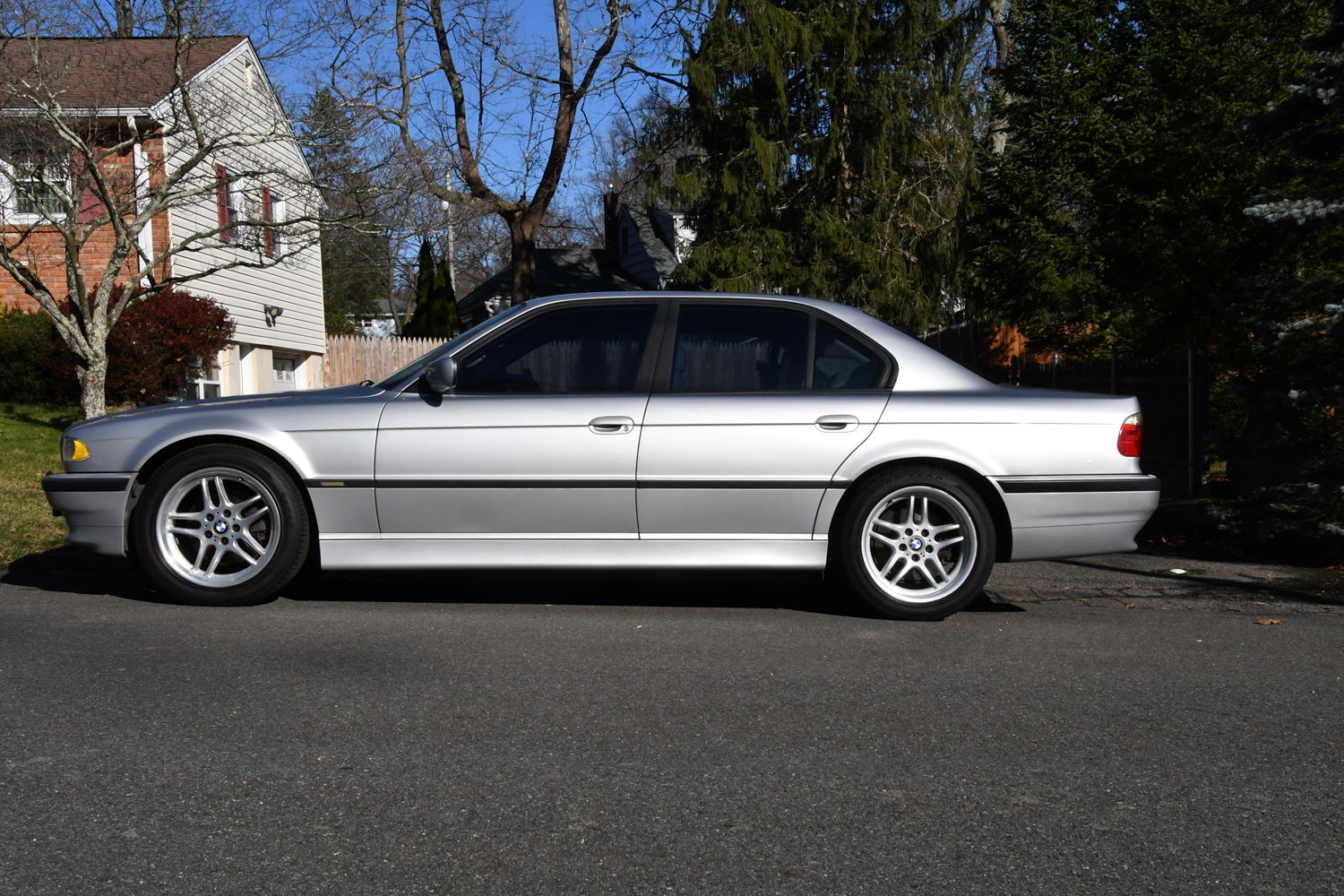
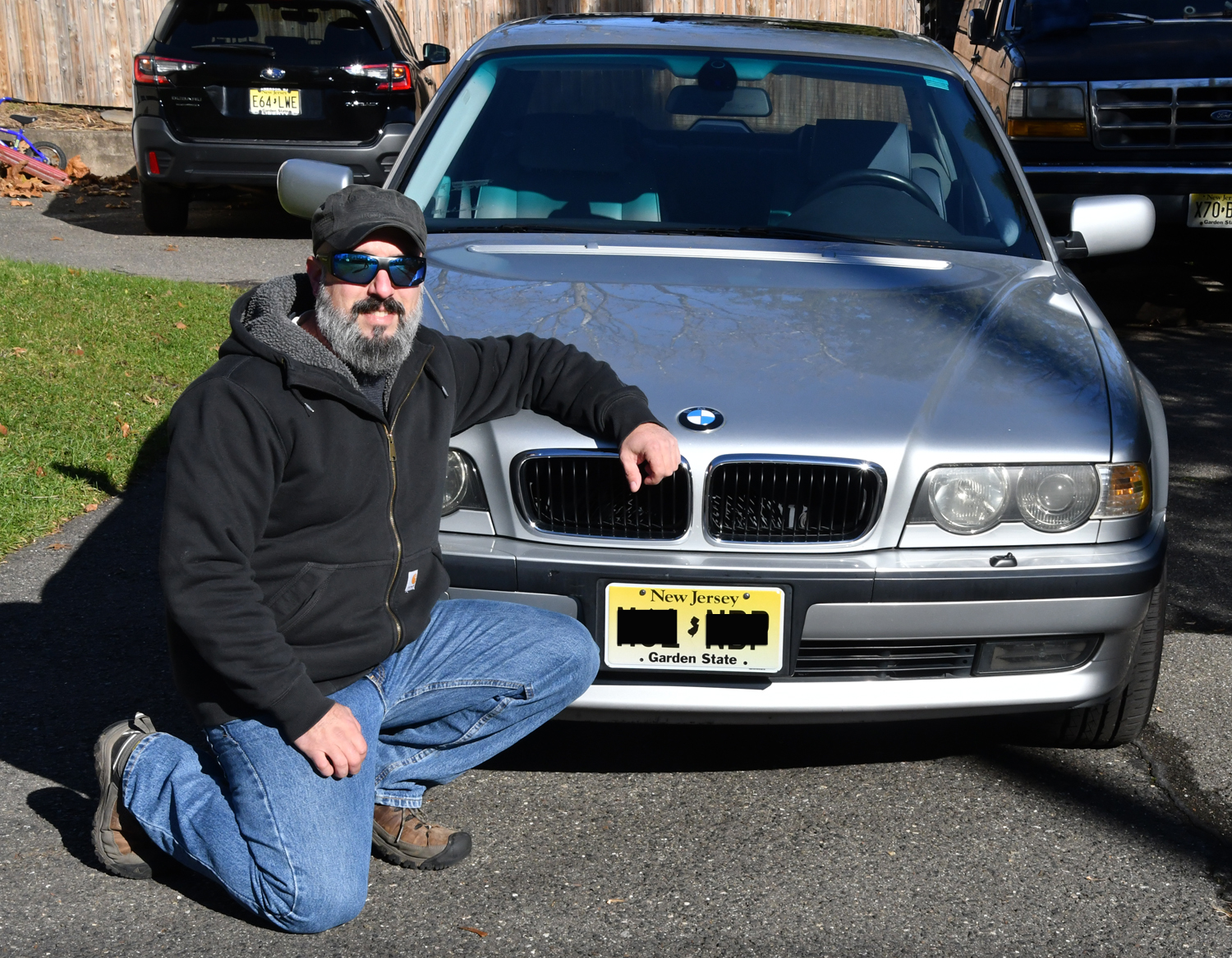
Tom LoRusso with his untitled 2001 BMW 740i Sport

Titanium Silver Metallic 2001 BMW 740i Sport with Gray leather interior, Tom LoRusso knew exactly what he wanted. Over time he had missed a couple of opportunities. Undeterred, he soldiered on. In late February of 2020 an apparently beautiful example popped up on Cargurus.com. It was a California car. Tom, an experienced mechanic in a earlier life, conducted his due diligence. Photos looked great. Carfax produced no red flags. Next step would put him in touch with an experienced BMW mechanic in California to do an onsite PPI (Pre-Purchase Inspection). The report back confirmed that Tom had found a sweet example of his heart’s desire. Tom pulled the trigger.

With a price agreed, and the broker’s confirmation of title, Tom arranged shipping and transferred the money.

Before shipping, the broker emailed all the paper work for Tom’s electronic signature. He confirmed the title would be coming. Tom had emphasized that he would not take the car without a title.

It took a week or so to ship the car to Tom’s home in New Jersey. A brilliant spring sun gave life to the well preserved silver metallic paint as the BMW eased down the carrier ramp. It displayed the condition and quality Tom had expected. Two days later the ownership paperwork came in the mail. Right about this time Covid-19 became news and went viral, so to speak. Tom accepted that Covid would complicate matters and prepared to patiently await his opportunity to register the BMW in New Jersey. During that time he would drive using the temporary California tags. As the lockdown dragged on past the 30-day limit of his California tags, Tom felt significant relief with news that, due to Covid, New Jersey had extended the legal life of temporary tags. Then, in July, long awaited relief arrived.

News reports announced that the New Jersey DMV would be opening for business the following Monday. Tom committed to being at the Wallington office on Monday before the doors opened.

Unfortunately, so did hundreds of other people. Equally unfortunate for everyone waiting, an official came out saying that despite the announcement the Wallington office would not open that day. Grumbling swept across the amassed crowd like the wave at a 1980s baseball game. Undeterred Tom confirmed the office would be open the next day. Taking no chances Tom arrived two hours before the scheduled 8:00 am opening.

As the sun came up on that clear July morning, The line extended from the front of the Wallington DMV office down the length of the block completely around the block and started to lap the original line. Tom simply turned and left. Disappointed but not defeated, he had a plan.

Two days later, cruising through the quiet streets of late night Wallington, Tom reached the office just as the clock struck midnight. He joined a sleepy line of about 200 people quietly basking in the moonlight. Then, shattering the dark stillness, the empathetic voice of a cop announced that those on line after the designated cutoff point where he stood would not get inside the next day. Tom, sadly, found himself on the “not today” side of the line. Tom took a midnight journey home.

Not unlike Wiley Coyote, Tom, undaunted, set about hatching another plan to get to a desk inside the Acme DMV.

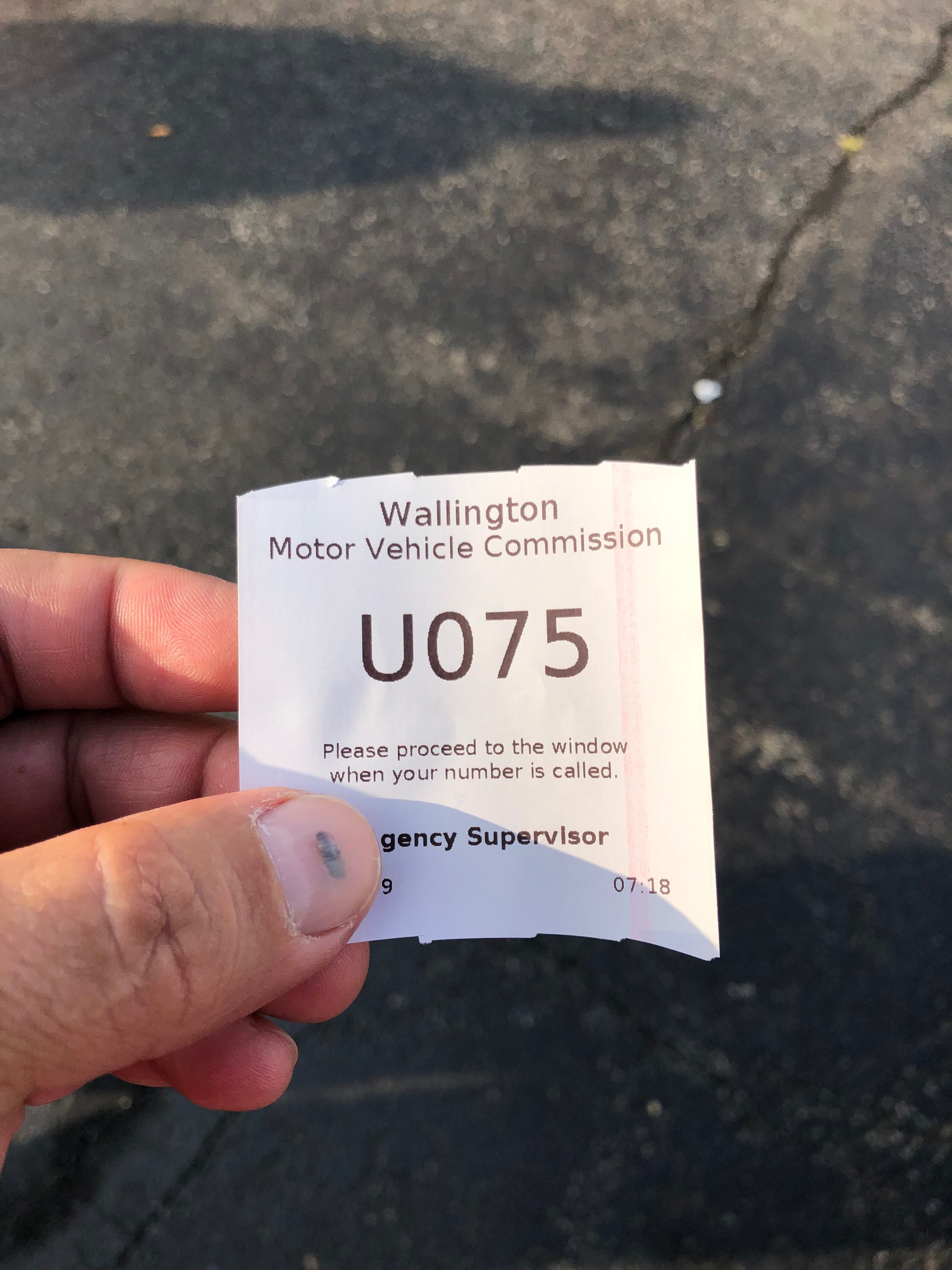
Two weeks passed. Tom’s plan had his brother drop him off by the Wallington office at around 9:30 pm the night before for what would be his fourth attempt. Arriving properly provisioned with food and blanket, he cracked the top 100. Tom’s tenacity had earned him position number 75 on the line. He described the long wait as a big party attended by people wearing masks standing 6 feet apart on a hot summer night. Tom felt confident though uncomfortable as his butt flat-spotted like an old tire as he reclined on the concrete pavement.
A hot July sun came up with a vengeance and blistered the waiting crowd like hotdogs under a broiler. Luckily, by this time, the line’s slow crawl had carried Tom into the shelter of the DMV building’s shadow. And then, finally, mission accomplished. The DMV greeter steered Tom to the specialist who, the greeter assured, would know exactly what could be done. And he did. Nothing could be done!

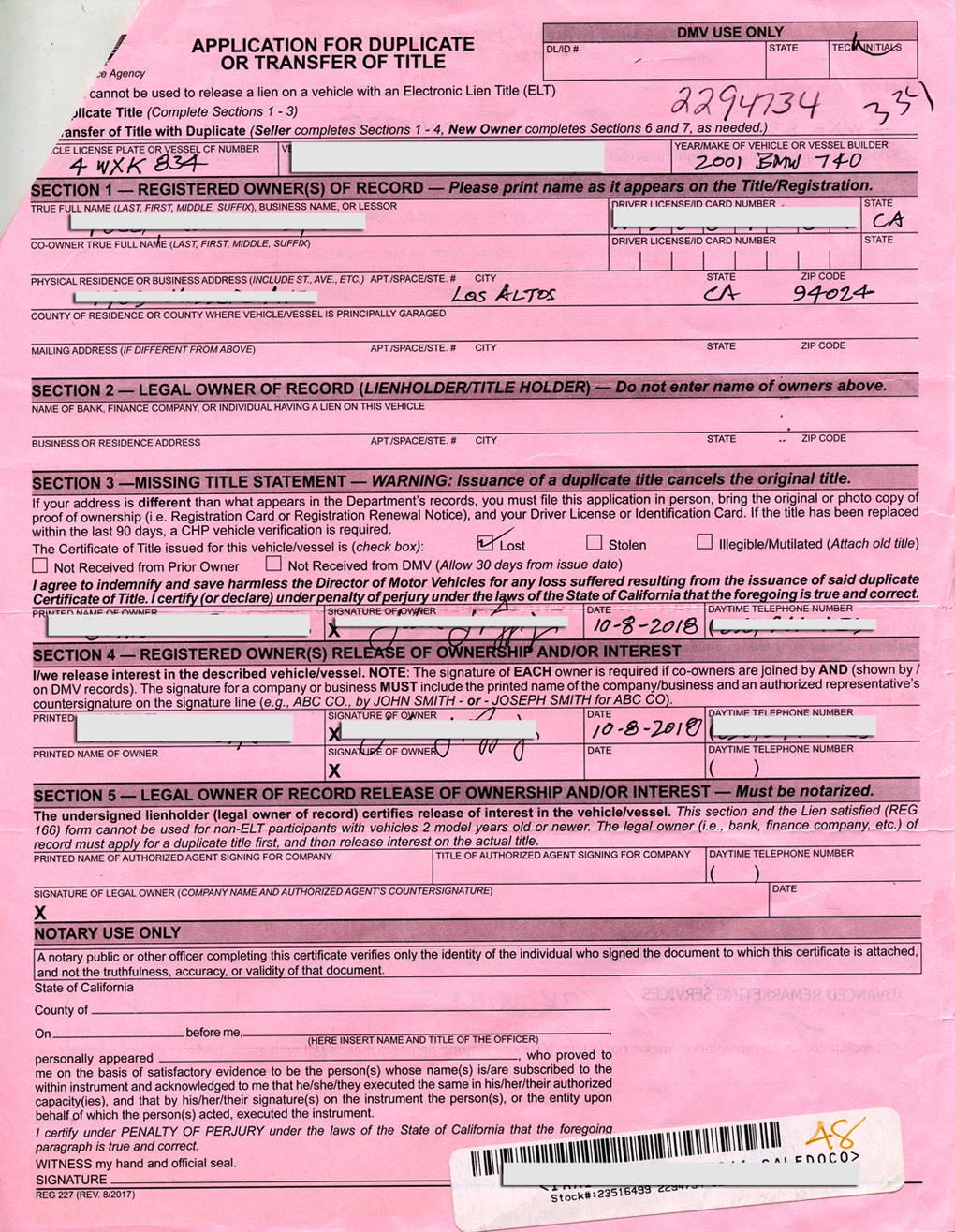
Basically Tom learned that the broker had sent paper work that would require a Herculean bi-coastal effort on Tom’s part to get a title. In reviewing the paperwork Tom found that he had overlooked a tiny box that indicated “Missing Title.” The box contained a check mark. Getting a title would require waiting on line at the California DMV. All of a sudden the west coast seller seemed strangely unavailable. Tom wanted the car. He resigned himself to taking on the task of getting a clean New Jersey title.


Clearly in character with the Chinese designation of 2020 as the “Year of the Rat,” Tom’s turd in the punch bowl day had yet more in-store.

In summing up the specifics of his situation with the knowledgeable DMV specialist, Tom took solace that, at least, because of the New Jersey extension, he would be able to drive his BMW during his efforts to connect with California DMV. That would be correct confirmed the specialist if his BMW had a New Jersey temporary tag. “However, it is a California car. You can’t drive it,” said the specialist.

The checked “Missing Title Statement” box

Tom’s heart slowly sank like a heavy Jeep in a soft bog. He had been driving all over the state with no acceptable proof of ownership. If he got pulled over the car would be impounded until he got the title straightened out. Tom says, “The storage and towing fees would have exceeded what I paid for the car.”

Tom drove home resigned to parking his prize BMW until he had a real NJ title. For three weeks he attempted to reach California DMV many times every business day. He groans and says, “Every time it went straight to voice mail.” Seemingly at a veritable dead end, Tom acted on a tip from a friend and reached out to Recovery Title Solutions, a company specializing in titling issues. Speaking with owner Mike Sassano, Tom realized that he had come to the right place. Now early October, Tom’s BMW had already been sitting for over a month.

Sassano explained that certain states had Motor Vehicle Departments with which Sassano could work to straighten out legitimate titling issues such as Tom’s. In Tom’s case, Vermont would afford the fastest turnaround, about seven weeks.

Almost seven weeks to the day, Vermont plates and temporary registration card arrived. Now, Tom intended to insure his long dormant 740i and get it back on the road while pursuing the transfer of his Vermont title to New Jersey.

Vermont Plates get BMW registered but not insured

Not so fast there Tom. The “Year of the Rat” prepared to take another bite out of his plans. Since Tom lived in New Jersey and his BMW had a Vermont registration no one would insure him.

With time now rolling into November, Tom locked a laser focus on getting his New Jersey plates. Then Tom got a break, he believed. Instead of returning for another DMV sleepover at Wallington sleepover. Tom found that the Newton, NJ DMV office had no lines and did not require an appointment.

Borrowing his mother’s car he gladly drove the hour to Newton. Arriving about a half hour before opening, Tom jubilantly took his place on a line of fifteen. Home free at last. Nothing could go wrong now. Ah but the “Year of the Rat” was not done with Tom.

“Good morning sir. Do you have an appointment?” said the smiling greeter. “No Ma’am,” said Tom, “Your website says I don’t need one.” “Well you do,” she responded. Accompanied by a chorus of groans from a dozen people behind him, Tom, showed her the DMV website which earned him a sympathetic shrug.

Returning to the parking lot, Tom opened his phone to schedule the first available appointment. It would be ten days later on the Friday after Thanksgiving.

Tom ate turkey as the anticipation ate him.

White noise and shuffling feet in the Newton DMV office provided a listless soundtrack to accompany just another routinely unremarkable day. But for Tom his excitement could barely be contained. For him and his prize 740i, six months in “no-title hell” had concluded. After twenty anti-climactic minutes on November 26th, Tom departed the Newton DMV office with his New Jersey registration.

With plates and title in hand, Tom LoRusso’s put “The Year of the Rat” in his taillights.

Tom, BMW and New Jersey title, together at last


By |2021-01-07T12:20:15+00:00January 7th, 2021|8 Comments

Cars We Love & Who We Are #14

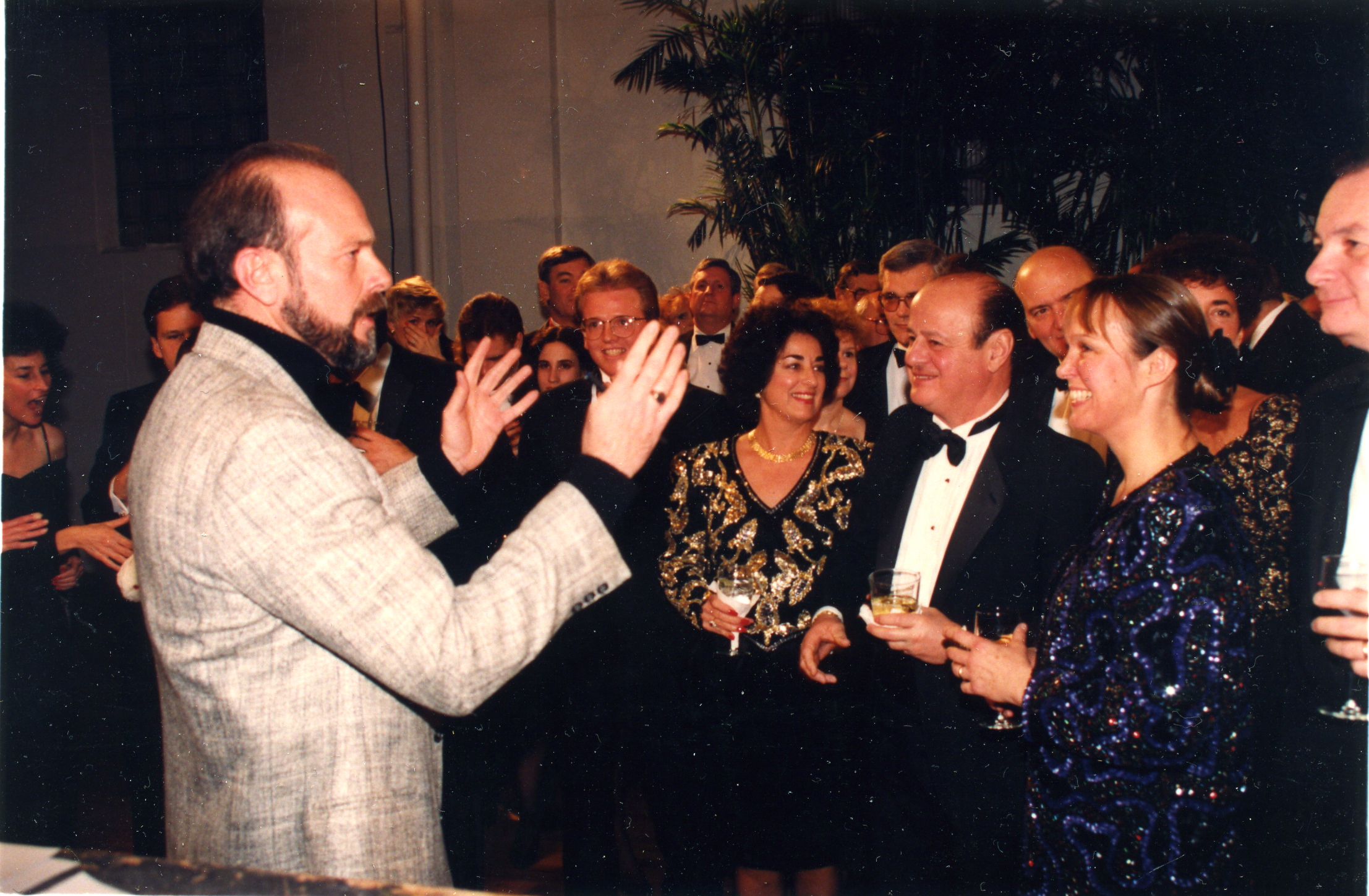
While it had the potential for disaster, I was confident we could pull it off. My crew had arrived at the Silvercup Studios in Astoria Queens hours before the black tie crowd of VIPs would begin to gather on the evening of December 16th 1992. Famous in later years as the site for shooting Sex and the City, Mad Men, the Sopranos and numerous major films, on this particular night the huge top floor studio resplendent in Christmas trappings would host a dinner honoring the President and CEO of Volvo Cars of North America. Tonight would be his gala retirement dinner. My responsibility would be to deliver a special gift as part of the entertainment. Hours before delivery it remained a work in progress. No worries.

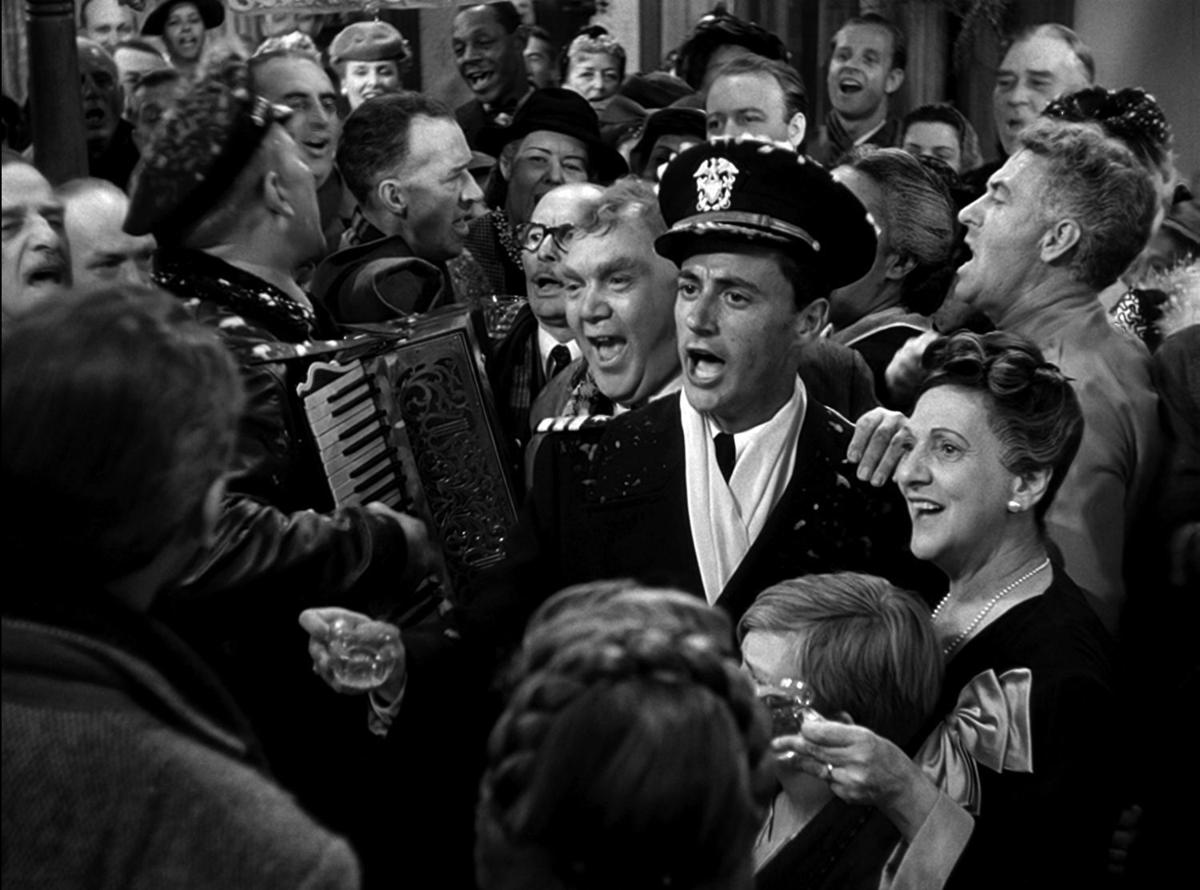
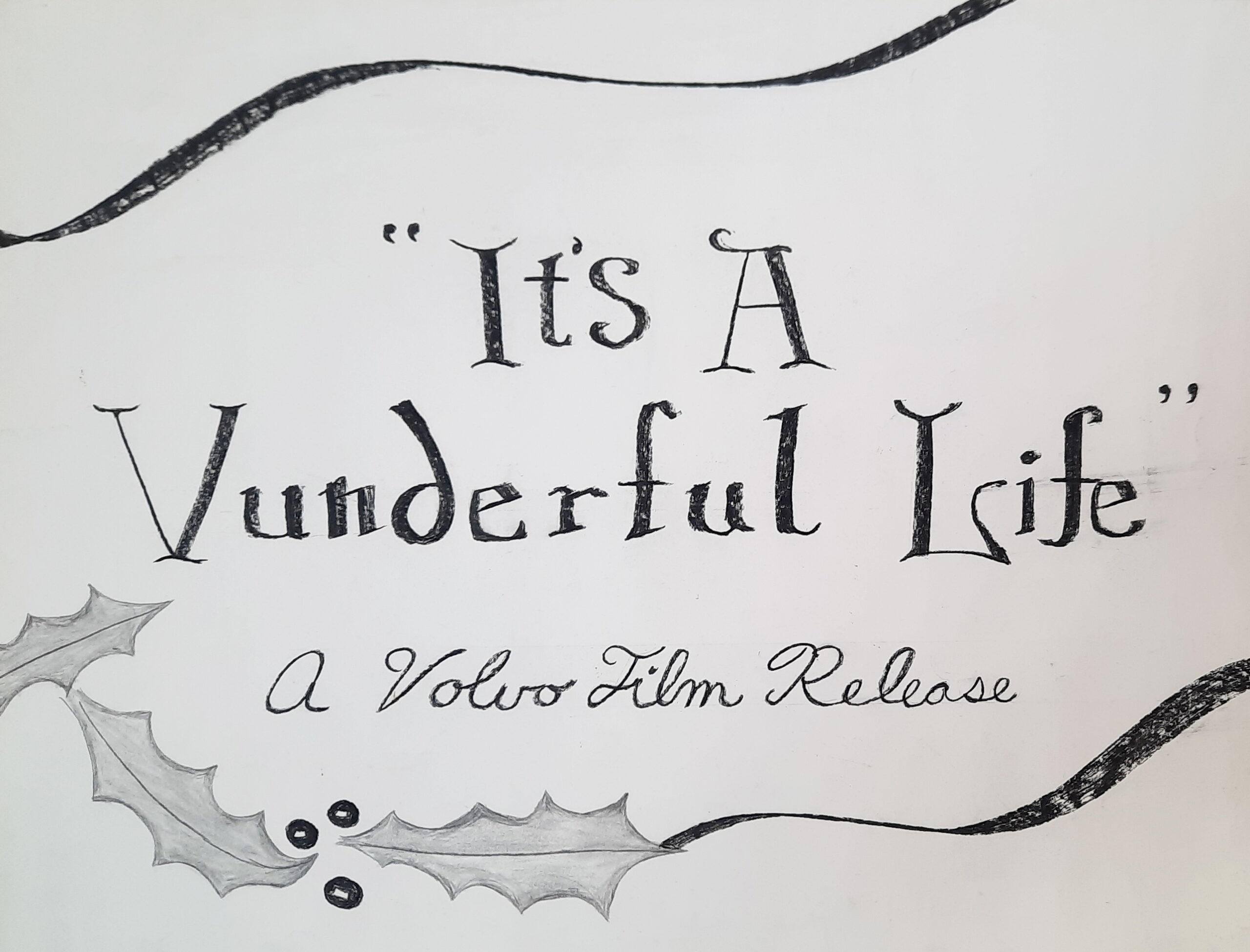
A Volvo Christmas Classic – “It’s a Vunderful Life”


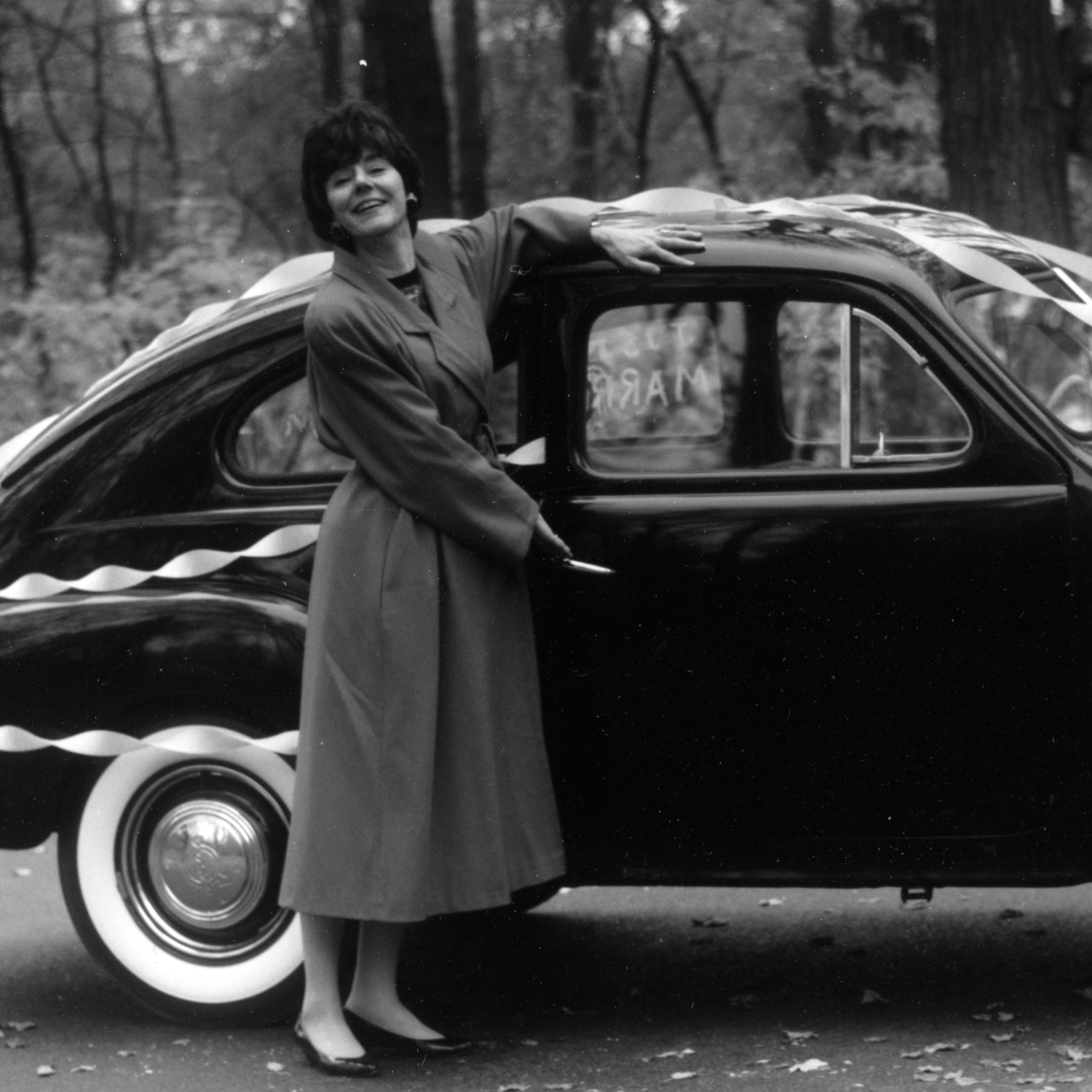
Cheery, bright, in the midst of her career and utterly fearless if she believed in the mission, her name was Nancy Fiesler. Fiesler was part of the Volvo North America Holding Company Communications Department at a time when the Volvo name in North America adorned trucks, marine engines, construction equipment, buses and sports equipment in addition to automobiles. Fiesler had been assigned many of the responsibilities involved in planning the retirement dinner of CEO Mr. Joseph L. Nicolato.

“Fearless” Nancy Fiesler

Nicolato a retired Marine had started working for Volvo in 1958 as a Volvo parts representative in the New York area. By 1981 Nicolato had reached the heights as President and CEO of Volvo Cars of North America. He had been my boss when I had worked for Volvo. A savvy, no nonsense guy with a keen understanding of the automobile business, Volvo customers and Volvo dealers, Nicolato could be tough but was always fair.  And Nicolato loved Volvo. It used to be said, “If you cut Joe, he’d  bleed Volvo blue.”

As part of the evening’s entertainment Fiesler wanted something unique, Christmas themed and memorable for ”Joe.” My phone rang. As a one-time Volvo employee and life-long “friend of Volvo” well grounded in Volvo lore, I was delighted to be given the opportunity to make Fiesler’s vision a reality. We brainstormed and despite many thunderclaps of creativity we kept returning to a ridiculously funny and inspired concept that made no sense for such an important occasion except that the thought of it simply made us laugh. God bless Nancy Fiesler. She had guts. She pulled the trigger.

We would produce a film portraying the origins of Volvo based on the iconic Christmas movie, “It’s a Wonderful Life.” CEO Nicolato and Volvo senior management, family and friends from Sweden and North America would be entertained by a Volvo Christmas classic, It’s a Vunderful Life.” The challenge would consume me and in the process afford me one of the best single afternoons in my professional life.

Right out of the box this daunting task benefitted from a motherload of serendipity. “It’s a Wonderful Life” had been allowed to slip into the public domain. With a copy in hand, I set about to whittle, twist and script Frank Capra’s 130-minute American Classic into a cogent, entertaining and humorous 10-minute feature overdubbed in “Swenglish” dialect.

Two requirements stood as personal non-negotiable issues in my undertaking the creation of “It’s a Vunderful Life”. First, though intended to be funny, it had be faithful to critical facts pivotal in the birth of the iconic Swedish car company so that loyal Volvophiles in attendance would feel good and this great brand would not be disrespected. Second, I would not let my adaptation spoil or diminish in any way my ability to enjoy this truly wonderful movie.

Cutting, shaping and subtracting scenes while scripting dialogue to match the new storyline was not rocket science but it sure felt frustratingly close. However, slowly Capra’s masterpiece shrank to a manageable collection of scenes that when strung together formed a buck around which a story could be beaten into shape.

With concept and copy finalized, I sought to hire the voice-over talent to overdub the video. Through my years as a Volvo employee a few of my Volvo cohort and I had developed this zany faux Swedish banter which just became part of our natural conversation. Think, Muppets Swedish Chef. Now, I would hire professionals to really nail it. Surprisingly, I could not find anybody who could do it. Everyone was too professional and polished. Of all the problems I never saw this one coming. Then it dawned on me. As the saying goes, shop your own store.

Unbeknownst to my Volvo friends, we had been rehearsing for years in preparation to do this project. We would perform all of the voices. Two dear friends Peter Desbets a Marketing Manager at Volvo and Scott Cheesman who now worked at Mercedes-Benz and I gathered at the sound studio of my brilliant recording engineer Cliff Hahn. We would do a running dialogue and synchronize it to the visual movie track playing in front of us. That afternoon, to this day, remains one of the single most nose-run funny experiences in all my working life.

As the concept came to life, a creative itch I needed to scratch demanded a way to truly engage all to be in attendance.

Final scene followed by singing Volvo VIPs

With Fiesler and me, already well out on the limb, climbing a little further would not make the fall any worse. My intention would be to leave “It’s a Vunderful Life” without an ending until the night of the dinner. Then at cocktail hour I would herd all the VIPs into a studio set up off the ballroom where they would be filmed singing a Swedish drinking song. Once done the freshly shot footage would be run down to one of the Silvercup Studio editing suites. There my crew would edit the new ending as the concluding scene of the movie. Thus, when George Bailey with Zuzu in his arms looks back to the gathering of friends the scene would show the singing Volvo attendees. What could go wrong? Probably a hundred things.

As December 16th fast approached “It’s a Vunderful Life” had become a pleasing reality for Fiesler and Me. However, “potentially looming debacle” might better describe what some senior Volvo executives began to manifest in their corporate consciousness. For some reason at this late hour they experienced misgivings about an outlaw version of a classic American Christmas film re-cut to tell the story of their Swedish founding fathers in a humorous manner employing bad Swedish accents before an audience of VIP Swedish and North American Volvo executives. Really? What’s the problem?

In advance of the dinner, senior management decided to “test” the film. Volvo invited a small focus group of Swedish executives to preview “It’s a Vunderful Life.” Our good luck held. The Swedish Siskels and Eberts shared a great sense of humor and came out laughing. Home free, so far. We, however, had farther to go.

Commencing to sing Helan Gar

Night fell on a chilly New York City. As the VIPs filled the wonderfully festive ballroom, we waited till everyone had at least one drink. Then, on cue, two attractive women in black clingy evening gowns gently directed the guests off to a brightly illuminated area facing a film crew. Employing a technique similar to that used by police to initiate compliance from disoriented people during a raid, I gave specific and confident directions to the somewhat unsure attendees. The Swedish executives in attendance lifted my efforts on the wings of their firm determination to party hearty.

In jubilant stentorian voices the Swedish execs lead a spirited rendition of Swedish drinking song Helan Gar. It was great. Then, not giving their sing-a-long another thought, everyone retreated to dinner as the video made its way to final edit.

With dessert a delicious memory the audience turned its attention to the large screen. Show time at last. Fiesler and I took a deep collective anticipatory breath. They laughed! Everything after that stands as a blissful blur.

Much like the last stagehand exiting the theater to the sound of his own lonely echoing footfalls, I departed the empty great room for the elevator. As the elevator doors parted there stood retiring CEO Joe Nicolato and his lovely wife Marylou. They too had just put a big night behind them and for the Nicolatos a proud career as well. A brutal critic if displeased, Joe Nicolato flashed a large and unusually warm smile.

A wonderful life indeed.


Watch “It’s a Vunderful Life”

Click on the link to watch “Its a Vunderful Life”

By |2020-12-10T11:56:20+00:00December 10th, 2020|2 Comments

Cars We Love & Who We Are #13

This past Saturday a large number of the local Drivin’ News (drivin-news.com) community gathered at Paul’s Motors in Hawthorne, NJ for Carnucopia II. Many brought their favorite classic car, the one they love to drive and that others love to see. They also brought a generous spirit intent on supporting the Tri-Boro Food Pantry’s efforts to meet the growing Covid driven need of individuals for food assistance.

Carnucopia II, Classic Car Food Drive

Tri-Boro Food Pantry Director Janelle Larghi accepting donations with Burton Hall from Drivin’ News

Thanksgiving weekend’s Carnucopia II represented the second effort this year by the Drivin’ News community of automotive enthusiasts to support the efforts of the Tri-Boro Food Pantry.

Tri-Boro Food Pantry Photo credit: Julia Chang

Pantry Director Janelle Larghi explains that since Covid came to town demand on the Pantry’s resources has increased five-fold. Janelle makes it clear that the Pantry couldn’t do it without everybody’s help. She says, “We really appreciate what the Drivin’ News folks have done.”

Larghi’s connection to the food pantry runs deep. Her grandfather co-founded it in the early 1980s. Larghi says, “the Tri-Boro Food Pantry’s mission calls for providing food to anyone in need who comes here for help. Plain and simple”

Serving primarily Bergen County, Tri-Boro Food Pantry clients  represent a large cross section of people including working class families, senior citizens, immigrant families and handicapped residents from local facilities.

Housed in the auditorium behind the Pascack Reformed Church in Park Ridge, the Tri-Boro Food Pantry describes itself as a place where hungry people are fed. From soup to cereal, eggs to milk, diapers to dish soap, this food pantry is committed to helping people live. Hunger isn’t something that only happens in other places. It happens here.

Packages readied for pick-up                    Photo credit: Burton Hall

An impressive operation to witness, Janelle, her husband Dave, and her small dedicated team of volunteers function with a seamless blend of wartime military logistical efficiency and a caring personal warmth expressed with an upbeat energy. Janelle seems to know everyone’s name. Her welcome never lacks a smile or a kind word. While assembling and distributing hundreds of parcels of food there is always time to stop and enjoy the signing voices of two recipients who always serenade the staff when making their pick-up.

Forced to operate at a level far beyond what was once normal, each day is a challenge for the Pantry. However, Janelle pointedly emphasizes that anyone who needs food assistance should come to the Pantry for help. She says, “That’s why we’re here.”

Photo credit: Ben Raser

Photo credit: Ben Raser

With no rain and temperatures in the 5Os, an eclectic and striking array of classic automobiles gathered at Paul’s Motors on Saturday afternoon November 28th. Spanning the gamut from muscle cars and European sports cars to RestoMods and pre-war sedans, the gathering served as a celebration of the automobile as both art and dynamic experience.

Amazingly 2020 marks Paul’s Motors 100th year in the automobile business. Starting in 1920, Paul’s Motors has built a reputation as a highly respected resource for classic cars and quality pre-owned cars especially pre-owned Volvos.

Great friends to the classic car community, owners Diane Korzinski and Paul Korzinski Jr. opened up Paul’s Motors to host Carnucopia II as well as personally providing assistance in soliciting donations. They could not have been more supportive.

Photo credit: Jason Raser

Photo credit: Ben Raser

It is the second time this year that the Drivin’ News community has stepped to the plate to help support the Tri-Boro Food Pantry. Coming from all walks of life, the interests and values of the participants clearly extend well beyond the throw of their headlights. They are happy to support the efforts of Janelle and the Tri-Boro Food Pantry volunteers who work so hard to help people in need during this difficult time. Carnucopia II participants collectively donated $1000 and a car load of food parcels.

There are more than enough “feel bad” stories coming at us each day like rocks at our windshield. The importance of calling attention to things that remind us of what “good” feels like cannot be overstated.

The tireless dedication of the Tri-Boro Food Pantry, Janelle Larghi, her volunteers and the community that supports them clearly represents just such a “feel good” story.

By |2020-12-03T12:30:41+00:00December 3rd, 2020|2 Comments
Go to Top