Shiny and red as a ripe apple and half the width of a Smart Car, it silently split the lane between two SUVs and sailed off down the highway. Witnessing this, friend of Drivin’ News, Dr. Chuck Berg, fueled by a high octane “need to get a better look” took off in determined pursuit. Thanks to a stoplight, Chuck finally caught up to what can best be described as a high performance transportation pod for two. It was then that Chuck would meet the vehicle’s driver and creator Rick Woodbury.
Meet Rick Woodbury and his creation, the Tango high performance commuter electric microcar.
The Tango Electric Microcar – Little Tykes Cozy Coupe reborn as a Dodge Demon
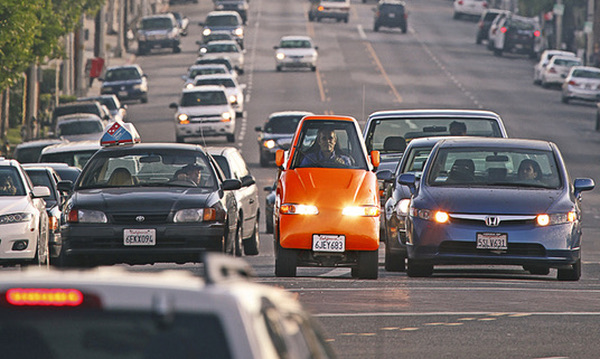
While faster from 0 to 60 mph than a 2026 911 Carrera, Rick Woodbury’s Tango also protects occupants with a chrome-moly steel roll cage construction that exceeds FIA (Fédération Internationale de l’Automobile) racecar standards. Not bad work for a man who quit high school to live in Mexico, retreated to a Zen Monastery, worked as the Sales Manager at Beverly Hills Porsche Audi, raced Porsches in IMPSA and SCCA events, worked as an electrical engineer for Northface garments, spent all his spare time in machine shops, considers himself a master fabricator and, oh yes, an accomplished ice dancer. In so many ways Rick Woodbury’s unique creation, the Tango electric microcar, not unlike his life, defies categorization. In the case of the Tango this confusion has proven to be both a blessing and a curse.
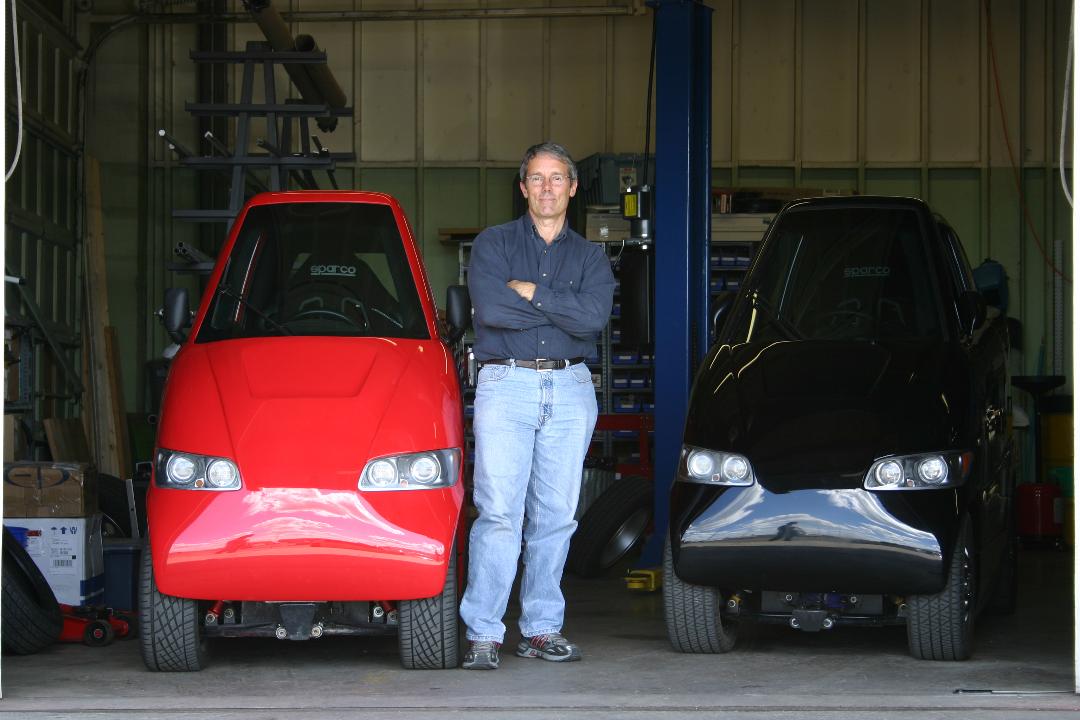
Rick Woodbury and the Tango
The Tango idea sprouted during conversations with his young son. A very passionate Rick says, “By the time my son was in 5th grade around 1998 we had enjoyed many discussions about the future of highway travel.” Dating back to when he worked with Porsche Rick would be exasperated by commuting to work behind the wheel of a 911 and poking along in freeway traffic at 10 mph. Rick says, “It would drive me nuts. And I thought, you know, we need narrow cars just for commuting.” He envisioned a future with highways hosting a plenitude of narrow cars providing more efficient use of road space for expedited commuting. How narrow? Rick says, “You have to get a car less than 40 inches wide to solve the traffic problem. You know, it’s just an absolute fixed line that you can’t change. It has to be that, or you have to change the infrastructure and that’s not going to happen.” Rick felt a width of thirty nine inches would work just fine. He observed that nearly 90% of the cars driven by his fellow commuters had a single occupant. To Rick it seemed really stupid to waste a whole lane for a single person. He surmised that with narrow commuter cars a single lane could carry twice the people. Rick says, “There’s 140 million workers in the US or at least there were at that time with 107 million of them being single occupant drivers. And how is the government trying to address this? They want to stick us in public transit.” Rick has strong feelings about that idea saying, “Stick us all in public transit? I don’t think so. You know, it’s not happening. People want to go where they want to go, when they want to go.” With the inspiration to revolutionize the driver commuting experience Rick began his pursuit of a solution. As to why the Tango name, Rick’s tenure as an ice dancer found him to be a big fan of that particular passionate Argentinean dance. Tango actually provides a quite catchy name. Hey, it sure beats Gremlin.
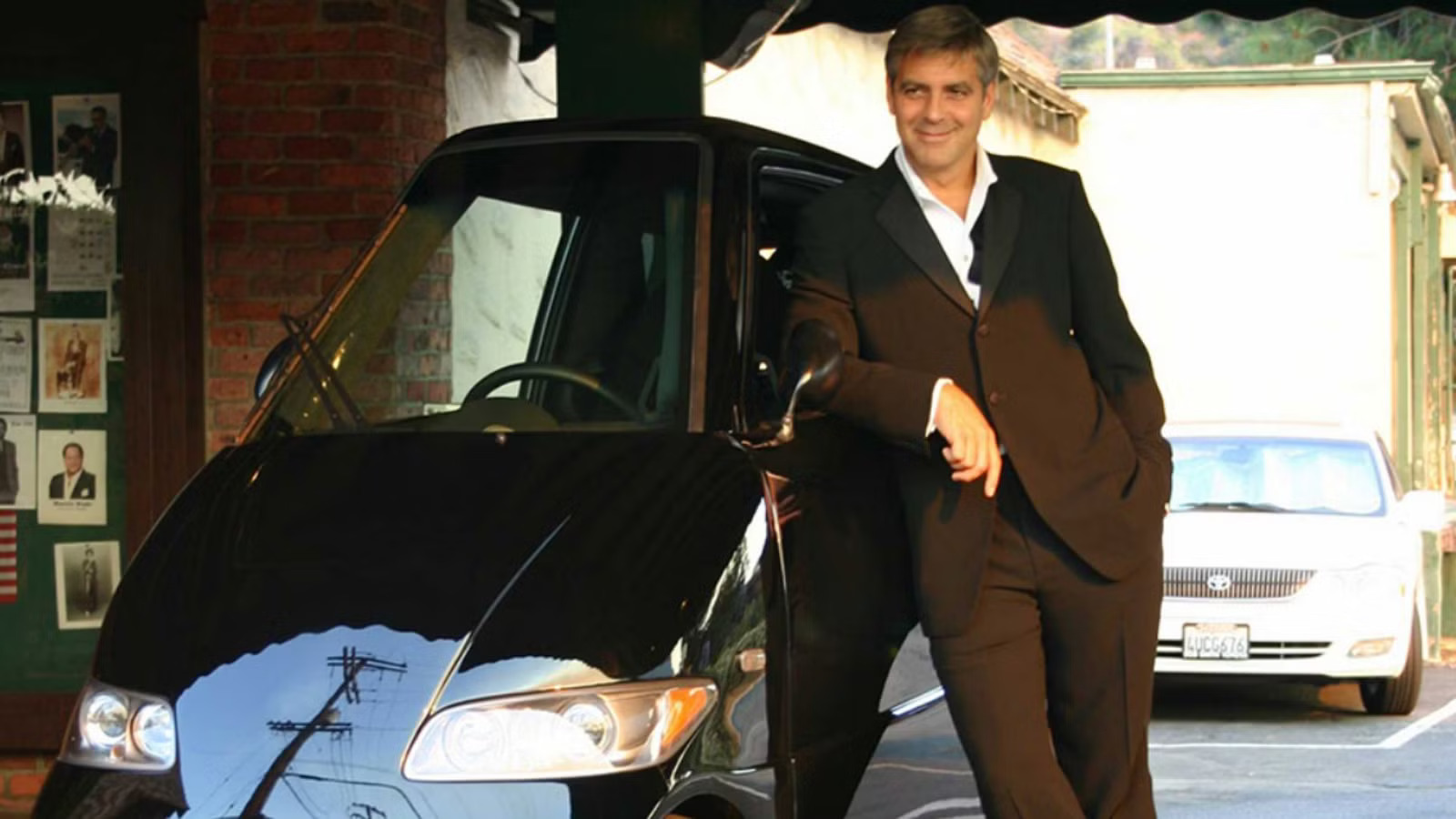
George Clooney and his Tango
Subsequent to his narrow commuter car epiphany, Rick dedicated his life and $50,000 of his own money to making the Tango a reality. To get it on the road in his home state of Washington he registered the Tango as a home built car. Rick says, “Back then in the state of Washington you just had to abide by eight pages of regulations. It was pretty simple to register the car at that time. Later on that would change.” Then, for the next three decades he has worked diligently to refine his concept. By 2005 with the Tango employing an Odyssey lead-acid battery Rick made his first sale, to actor George Clooney. Rick says, “Clooney drove it for a couple of years. Though his Tango had all blacked out windows it still drew throngs of gawkers even without people realizing that it had George Clooney at the wheel.” Having the Tango zipping around the film community generated a great deal of publicity. Rick says, “It increased awareness significantly. It helped us a lot.” Unfortunately Clooney’s Tango driving stopped when he departed Warner Brothers and, with that, eliminated his need to commute.” After the first sale to Clooney in 2005, late 2006 witnessed the Tango leap forward with Google founders Sergey Brin and Larry Page purchasing Tangos and promoting the use of lithium batteries to power Rick’s commuter pocket rocket.
Before reviewing the rocky path the Tango has faced in achieving acceptance much less success it makes sense to review its present day specifications. The Tango body, constructed from lightweight, high-strength carbon fiber, can accommodate two adults seated in a tandem, “I” formation. It weighs in at a robust 3,326 pounds with a width of 39 inches, a length of 102 inches (8 ft. 6 inches) and a height of 61 inches.
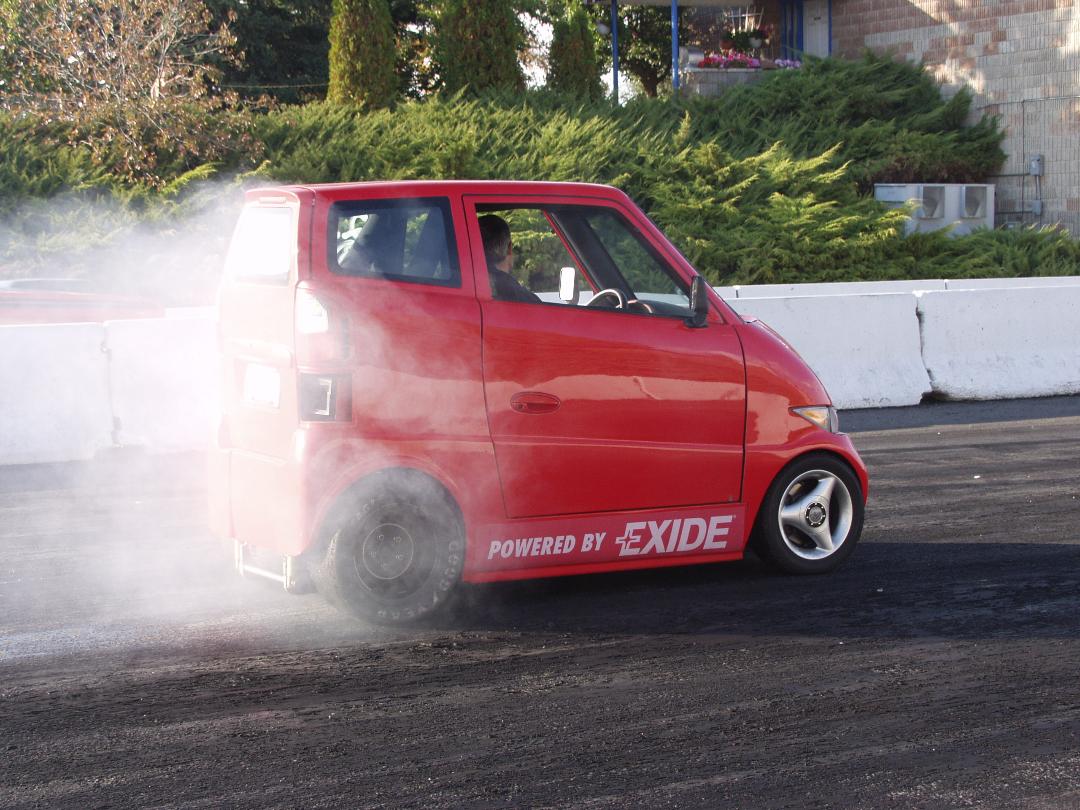
12.2 second 1/4 mile
The awesome power driving this commuter mini-beast comes courtesy of 2 Advanced DC heavy duty DC electric motors with each one driving a rear wheel. The two motors together produce a combined starting torque of 3000 ft.-lbs. With an 8000 rpm redline the Tango’s 600kW output translates into 805 horsepower. The Tango turns 12.2 seconds in the 1/4-mile at 106 mph. Steering is rack and pinion. Front suspension features unequal length A-arms with coil-over shocks while the rear suspension offers a trailing arm design with coli-over shocks. Front and rear disc brakes employ Mazda Miata calipers. While the Tango equips both passenger positions with four aircraft style seat harnesses, it must be noted that the present Tango lacks numerous requisite safety features required to meet crash test standards. Its status as a kit car allows some leeway to excuse the absence of such features as a supplemental restraint system and an energy management structure that provides for the redirection and diffusion of the force of an impact. The Tango also lacks ABS braking. That said government agencies and private companies have taken a look at the Tango and walked away impressed but still walked away. While numerous global transportation experts have been awed by the tango many, at the same time, find it difficult to categorize.
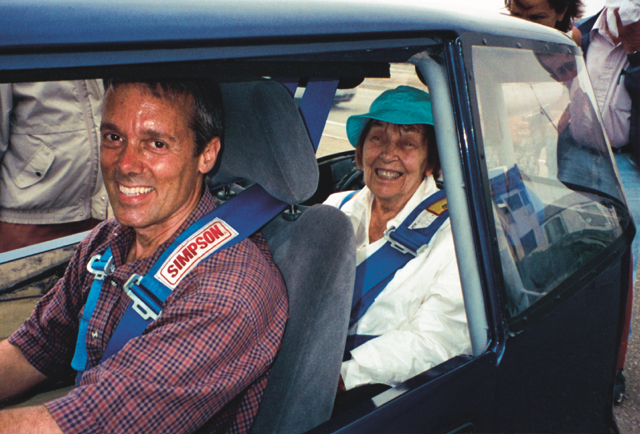
Tango two-seater
One limiting factor that deserves to be addressed rears its very expensive head when the topic of production cost surfaces. Costs involved in hand building one Tango today top out at $420,000. That said, as Rick wants no interference with the production of his Tango dream, he rejects investors seeking involvement. He, thus, currently relies primarily on self funding. Over the years prices charged to Clooney, Brin, Page and others range in the area of $120,000 to the latest lithium ion powered unit with a 300-mile range costing $300,000. These prices clearly do not conform to Rick’s vision of an affordable dedicated commuter car.
What then is his vision? Would he consider looking for funding from some angel and create his own factory? Rick says, “That’s preferable, but I am 76. I’m getting up there. I may not be able to pull that off. I’ll have to see how it goes, but I will strive to guide the company forward to revolutionize the world of Transportation. When asked about the ideal environment to test the feasibility of the Tango, Rick ever the optimist says, “I think you can take any crowded city like San Francisco or anywhere in the Los Angeles area. There you have people spending literally hours commuting with half their time consumed creeping along because of the traffic congestion.”
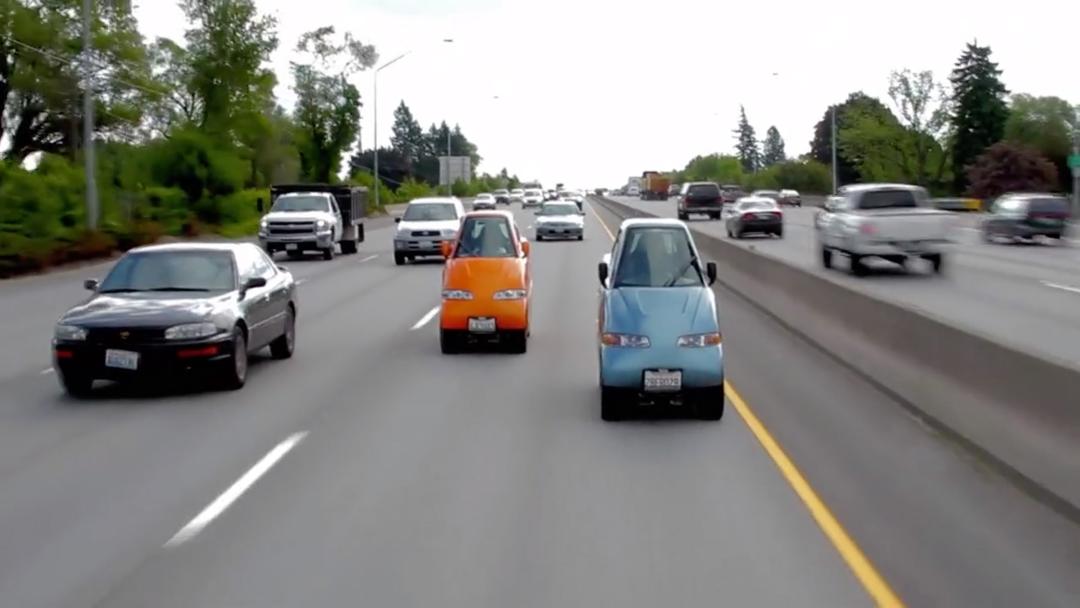 Rick says. “Let’s say it is a government project. I would suggest they focus on select zip codes. A person living in one such zip code could rent a Tango for an affordable rate per month. I see the Tango being a no frills highly mobile form of transportation; something really bullet proof. The Tango commuter car would not be something to show off.” Reflecting on that comment he laughs as he says, “Though the Tango can back in between two full size parked cars.” He believes the Tango delivers a higher level of mobility than public transportation. He says, “It just gets people where they want to go. At some point an autonomous driving feature including autonomous driving lane splitting would be available. That’s my idea for the future.” He concedes that for the Tango concept to make a difference it would need a lot of people in Tangos. Rick says, “To do that the Tango solution has to be affordable. Right now, the car costs four hundred and twenty thousand dollars each to build. That’s not affordable to anybody. Not even billionaires want to pay that much. This does not mean interest from government and business has not been expressed.
Rick actually met with Caltrans (California Department of Transportation) in 2001. Recalling the meeting Rick says, “I gave them a test drive in the first Tangos and they said, we’re not going to build the lanes until you build the cars and you’re not going to build the cars until we have the lanes so you know we’re not going anywhere with this. That was 25 years ago. Undeterred, Rick soldiered on buoyed by his observation that motorcycles can be seen cruising legally as a group side by side. His belief in the Tango concept remained unwavering.
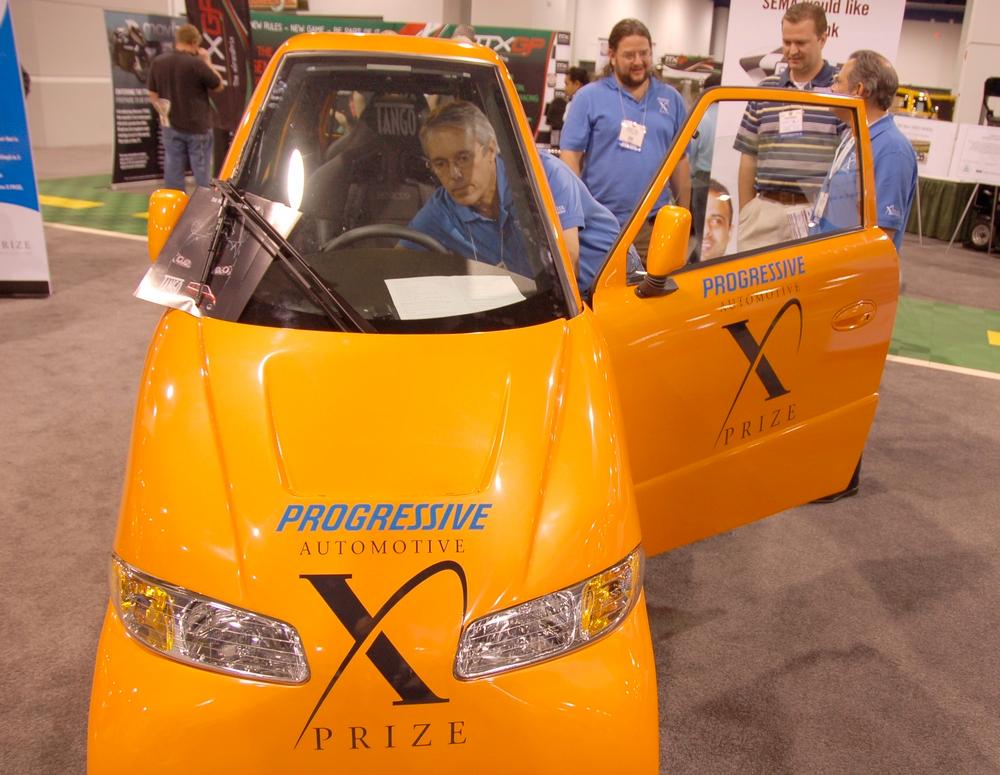
XPrize competition
The year 2008 witnessed the announcement of the Progressive Automotive X-Prize. Launched by the XPrize Foundation and sponsored by Progressive Insurance its intent was to inspire the creation of safe, affordable, and “super-fuel efficient” vehicles capable of achieving at least 100 MPGe (Miles per gallon of gasoline equivalent). Winners would share in a $10,000,000 pool of prize money. Rick entered the Tango.
The competition concluded in September 2010 with three winning teams sharing the prize purse. The Tango did not win. Rick with no bitterness says, “We did not win the $2.5 million purse for our special category of tandem seating. An electric enclosed motorcycle with training wheels that extend when stopped called the Zero Tracer won the purse and then promptly went out of business. We ran air conditioning as it was 106 degrees that day, so we came up just short of the 100 MPGe that was required. Some of the competitors used ice blocks instead of A/C to keep the cabin under 95° which was the requirement. Seems like cheating, but the organizers approved it. One final comment in referring to practicality, Rick says, “The winner vehicle in my category was so unstable it fell over on its side when parked on a slope by the oval test track. That would have seemed to be worthy of disqualification, as these cars were supposed to be functional for daily use. I mean how many people would it take to upright an enclosed motorcycle weighing over 1,000 pounds in a San Francisco intersection? And so it goes. The Tango checked so many boxes; they just were not all on the judges’ sheet.
Rick Woodbury’s thoughtful Tango EV microcar concept may be a very fast, highly maneuverable and effective solution to a question no longer of much interest to the institutions in a position to promote it. His home state of California made it clear to him of its desire to be rid of cars all together.
The ingenuity and dedication demonstrated in Rick’s passionate desire to reduce traffic congestion suffers from the absence of a location supporting the necessary critical mass of refined Tangos necessary to realize its advantages; not unlike having an iPhone in a landline world but no cell service.