Cars We Love & Who We Are #74
Brought by restorer extraordinaire Bruce Amster to Redline Restoration, this visual echo of mid 20th century sports car design called to mind other striking Pininfarina creations. However, despite common design cues, no other car looked exactly like this one and for good reason, none existed.
In 1948 Italy, with the war in the past and the future in question, Pininfarina in collaboration with Lancia had created a strikingly forward thinking sports car design called the Lancia Aprilia Spider 2 Posti Pininfarina Special. Completed, it would honor a renowned Italian cyclist Gino Bartali whose war-time heroism and post-war patriotism made him a most deserving owner.
Who was Gino Bartali?
Pininfarina’s One of One Tribute to an Unsung WWII Hero
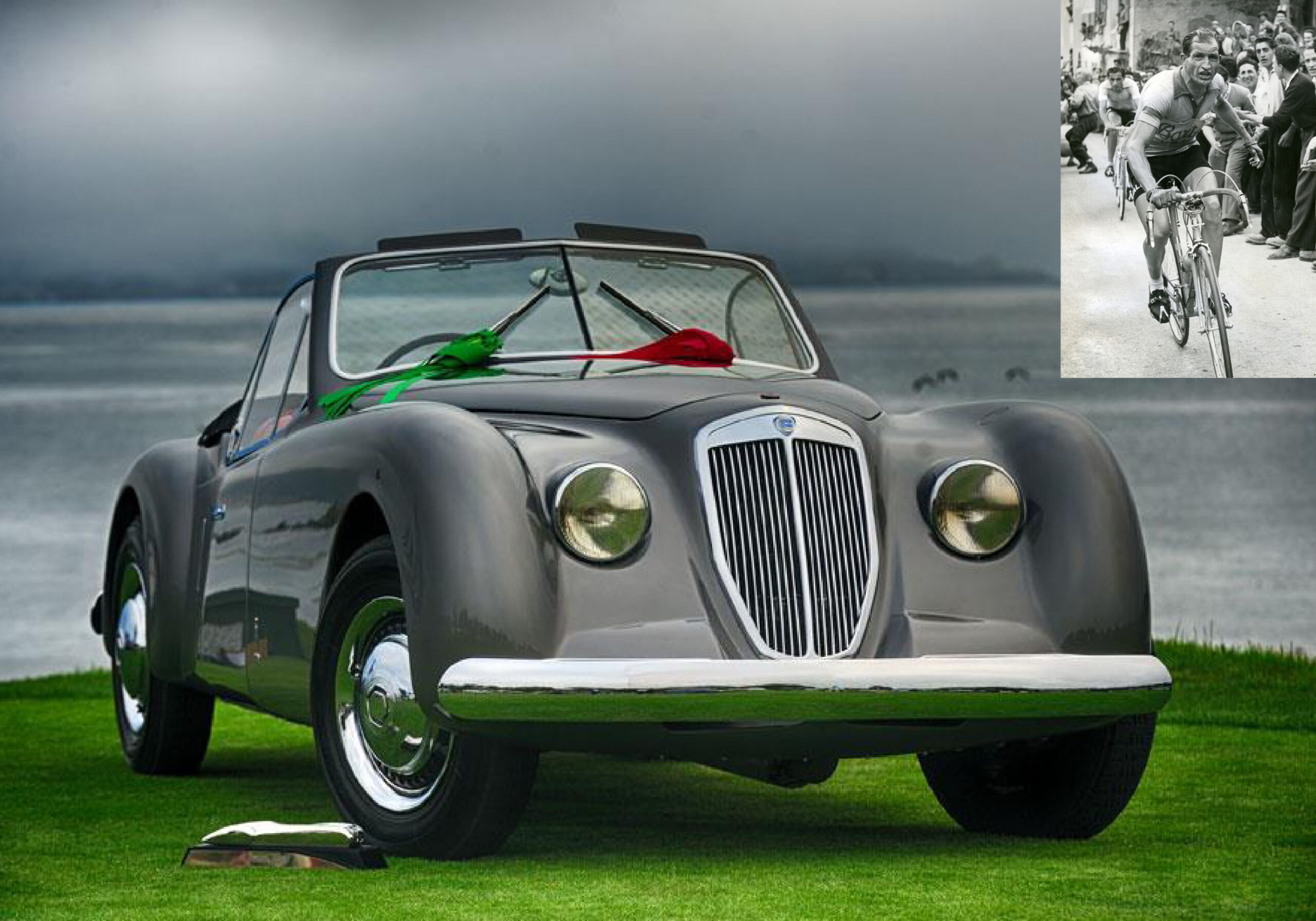
Lancia Aprilia Spider 2 Posti Pininfarina Special and Gino Bartali
Squirreled away in a decrepit garage deep in one of Detroit’s lesser neighborhoods it would seem to be the last place to find a mid 20th century Pininfarina designed one-of-one Italian sports car. This once sleek pewter metallic Postwar Italian stunner had traveled a long distance over many years to find itself ingloriously stashed in a forgotten corner of a tired inner cityscape. Then, after its decades long journey into oblivion it had been unearthed by seasoned classic car collector Bruce Amster. Now, like the Phoenix, it would one day rise to the heady heights of the awards ramp at Pebble Beach. However, an even more interesting story would be that of the man for whom Pininfarina had created this classic car, famed Italian cyclist and WWII hero Gino Bartali.
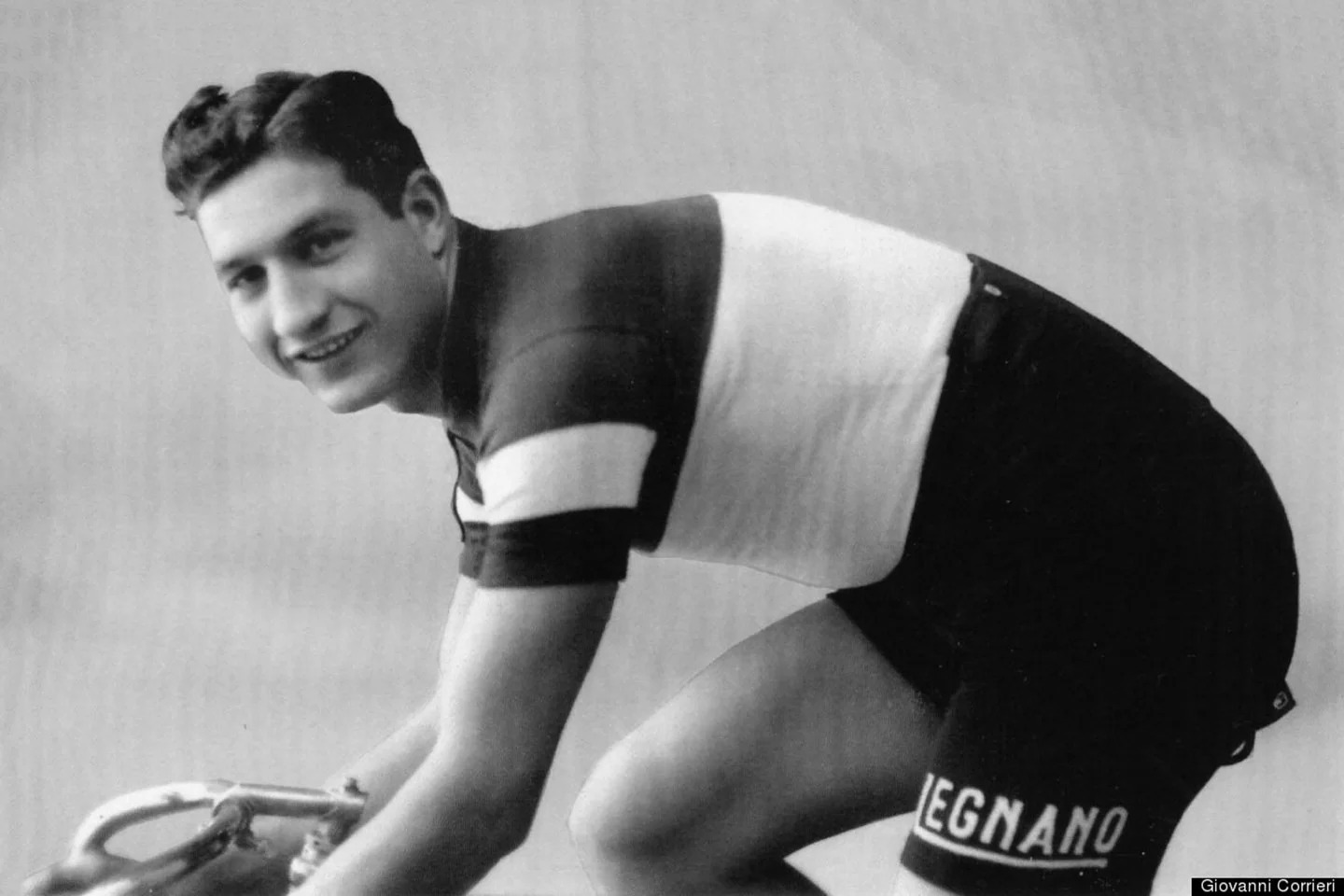 For the Italian nation in the 1930s cycling reached its peak of popularity. It served as Italy’s most popular spectator sport until the 1950s. It was a mass cultural phenomenon that unified the country, shaped the national identity of its citizens, and up to WWII became a central tool for fascist propaganda under Benito Mussolini. Cycling stood above all other sports as did baseball in America. For Italians cyclist Gino Bartali towered as their Babe Ruth maybe with a little Charles Lindbergh mixed in.
A devout Roman Catholic and ardent anti-fascist, Bartali, born into poverty achieved legendary status with his cycling exploits. Described as tough, feisty, outgoing with a gravelly voice, broken nose and reputation as an aggressive cyclist, Bartali though only 5 ft 7 inches tall carried the nickname “Ironman”. He competed across Europe in hundreds of races from the 1930s till the 1950s. He won the Tour de France twice (1938 and 1948) and the Italian Giro d’Italia three times (1936, 1937 and 1946). Yet while a legendary athlete, Bartali’s two greatest accomplishments, achieved while cycling but not racing, resulted from selfless acts of courage, strength and moral fortitude. The first, unheralded till after his passing in 2000 at the age of 85, saved over eight hundred Jews from Nazi death camps. The second, claimed by many of his fellow Italians, averted an Italian civil war and communist coup that preserved Italy as a free nation.
Conscripted into the Italian army at the start of WWII as a bicycle messenger, Bartali’s duties as a messenger together with his rigorous training regimen made him a common sight on local roads. With Italy’s surrender in 1943 and the subsequent Nazi occupation, nearly 10,000 Jews suffered deportation to Nazi death camps. In this darkest hour Bartali’s familiar cycling presence over long distances would facilitate saving the lives of hundreds of Jewish men, women and children.
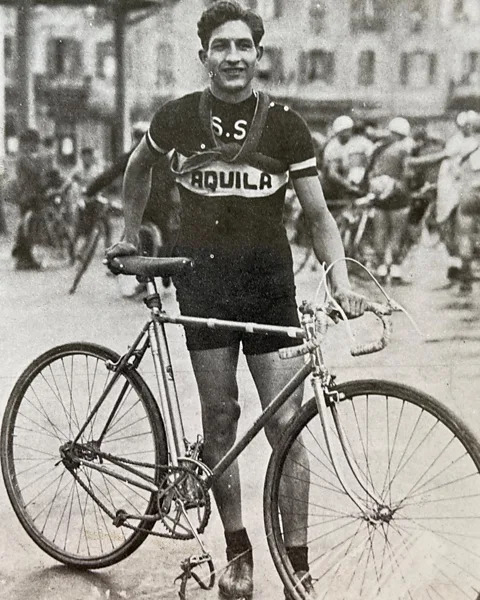 Based on research conducted by Yad Vashem, the World Holocaust Remembrance Center, Bartali, in 1943, responded to a request by the Archbishop of Florence, Cardinal Elia Dalla Costa to volunteer his cycling skills. The Archbishop in collaboration with Rabbi Nathan Cassuto established a clandestine network to hide Jews in convents and monasteries while producing forged documents to help them escape. Bartali’a role called for him to transport the counterfeit identity documents to points comprising the underground network bounded by Florence, Assisi and Genoa, an area of considerable size. He also would pick up money from a Swiss bank account in Genoa for distribution to Jews hiding in Florence. Bartali employing equal measures of courage, brazen ingenuity and chutzpa (Yiddish for audacity) would hide the documents in the frame and handlebars of his bicycle. Never taking the shortest route, to better avoid checkpoints, his clandestine rides, and he took many, could exceed 200 kilometers. When stopped and searched at German checkpoints, the famous Bartali would warn the guards not to touch the bicycle as he had it set just right to deliver optimum performance. However, as the war progressed the frequent sighting of a cyclist training for races that no longer occurred began to raise questions. In July of 1944 Bartali found himself being interrogated at the infamous Villa Triste (Sorrow House) in Florence where fascist officials practiced forced imprisonment and torture. With luck and possibly God on his side, one of Bartali’s interrogators happened to be his army CO who promptly vouched for the cyclist’s innocence. Not to be satisfied with his good works as the conduit by which Jews could escape the Nazis, he, at the same time, hid a Jewish family in his home until the allies entered Florence.
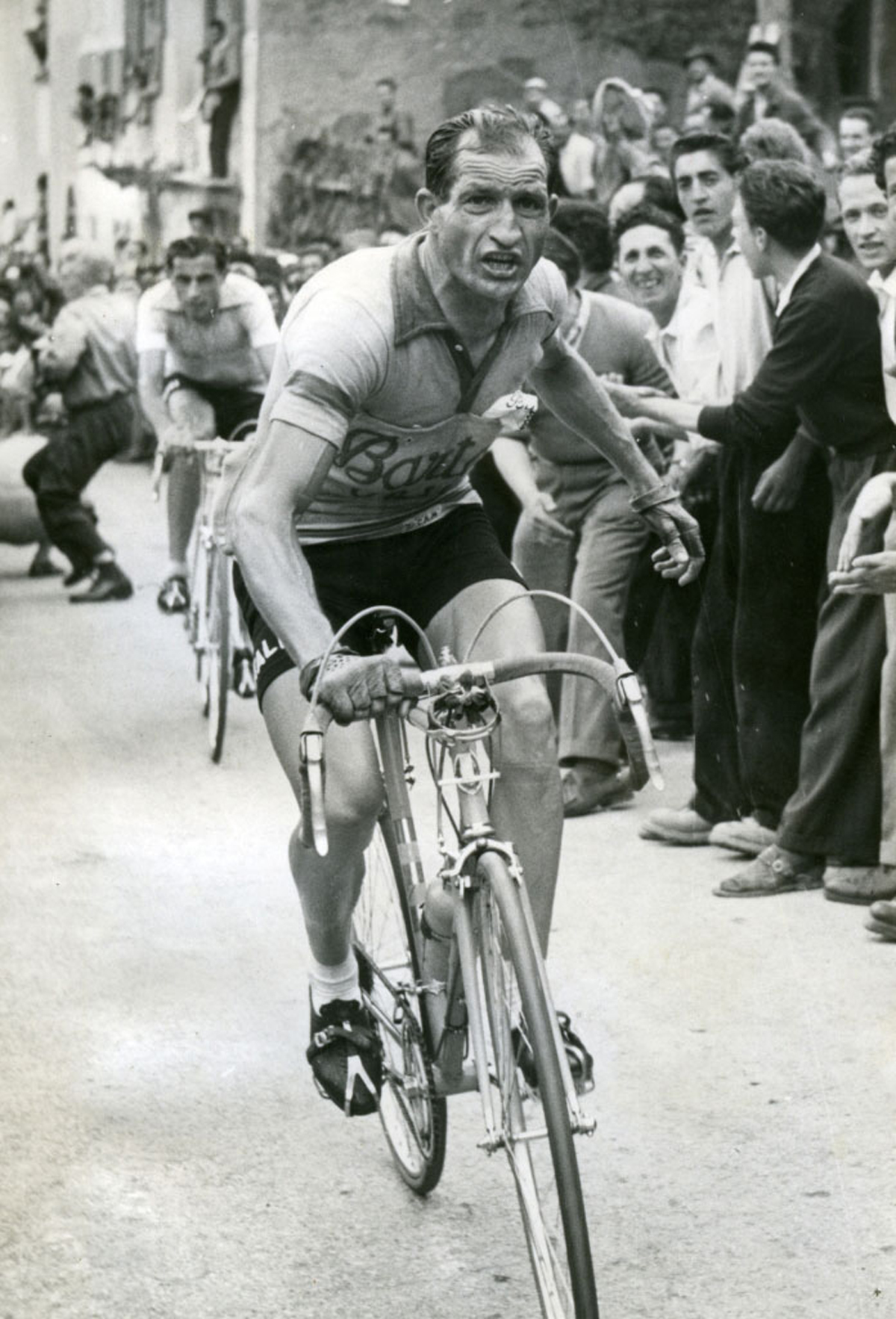
In 1948 during one of the mountain stages on his way to winning the Tour de France, French fans pelted him with rocks, snowballs and calls of “Dirty fascist.” He never responded by revealing his heroism. Only upon his death did details of his courageous exploits come to light. In 2010 the World Holocaust Remembrance Center honored Bartali by declaring him “Righteous Among the Nations.” And then there is the matter of preventing an Italian civil war and saving the nation.
 Bartali’s role in preventing an Italian civil war and saving the nation again finds a parallel in the lore of American icon Babe Ruth. In this case the fabled story of Babe Ruth’s “Called shot” comes to mind. The story takes place in the 1932 World Series. In that game “The Babe” being mercilessly heckled by the opposing Chicago Cubs pointed to the centerfield bleachers and promptly hit the next pitch for a home run into the centerfield bleachers. Though still debated, it stands firmly anchored as baseball lore.
In the case of Bartali, he has been credited with preventing a communist led civil war by way of his historic and courageous come from behind victory in the 1948 Tour de France. His electrifying victory during a period of mounting political conflict and unrest in Italy had distracted and unified a fractured nation. It released the mounting pressure for insurrection and with that the threat to civil order subsided. Like the Babe’s “Called shot,” Bartali’s role as “savior of Italy” though questioned by some, stands as a truth. Now, let’s return to the future and a flatbed truck gaining undesired attention as it winches a sad memory of Gino Bartali’s one-of-one Lancia Aprilia Spider out of a ramshackled garage in a trashed Detroit neighborhood.
No prima donna he, Bruce Amster while a da Vinci of classic car restoration is not above driving a flatbed to Detroit to rescue a long abandoned rolling treasure he had discovered.
In recalling the experience Amster says, “The car had been left in the, now, rundown garage for decades and not in a good area. Much of the neighborhood had been abandoned or leveled. Backing in, I succeeded in snaking the flatbed through an overgrown back yard. Now, as I’m winching the car out of the garage. People start appearing out of nowhere. Junkies start peppering me with questions like ‘What’s in there?” “What’s that?’ I start talking fast explaining that it’s just an old car that I’m picking up for scrap.” Laughing, he says, “I strapped that load down with the speed of a NASCAR pit crew and headed out of town with my precious barn find.”
In 1948, years before Giovanni Battista “Pinin” Farina changed his name to, simply, Pininfarina, he, together with Lancia, created a beautiful forward thinking cabriolet called the Lancia Aprilia Spider 2 posti Pininfarina Speciale (Try saying that without taking a breath). Displayed at the Paris Salon of 1948, he had produced the beauty as a special order for Italian cycling hero Gino Bartali. Combining beauty and performance the sculpted curved lines emphasized the cabriolet’s graceful character. Technologically, its bespoke light weight aluminum construction, four-wheel independent suspension, Aluminum overhead cam V4 engine and a platform chassis that paved the way for the wider application of unibody construction positioned this Lancia as a forerunner in the coming age of sports cars.
Owned by Bartali into the early 1950s when his need for a larger vehicle necessitated its sale. As best as can be figured, it first went to a dealer in Italy. The 1960’s saw it purchased by iconic classic car broker Ed Jurist at his Vintage Car Store in Nyack, New York. Amster says, “From then until I picked it up for my present client in the early 2000s it had been in the old owner’s hands. During that 30-year period the old owner tried to do the restoration work himself as he apparently couldn’t find a qualified mechanic who would take the project on.” Sadly he could not get it done before he died.
In the late 1990s with the old owner’s death the car and the house in Detroit where it was stored passed into his estate. Over the next number of years both house and car deteriorated. Finally, with resolution of the estate in 2000, Amster flatbedded the car back to Redline Restoration and a waiting buyer. Once at Redline, Amster had the opportunity to probe the mysteries of the unique sports car that he would be commissioned to restore in 2001. Recounting a very pleasing discover, Amster says, “The car had maintained much of its originality. In researching the car, broker Ed Jurist back in the 1960s must have realized he had gotten something special. For that time, he had gotten good money for it.” Amster found the doors of the car especially fascinating. He says, “This car basically was unique in many ways; One being how the doors were built. They were spring-loaded. So you pushed a button and the door would open up for you.”
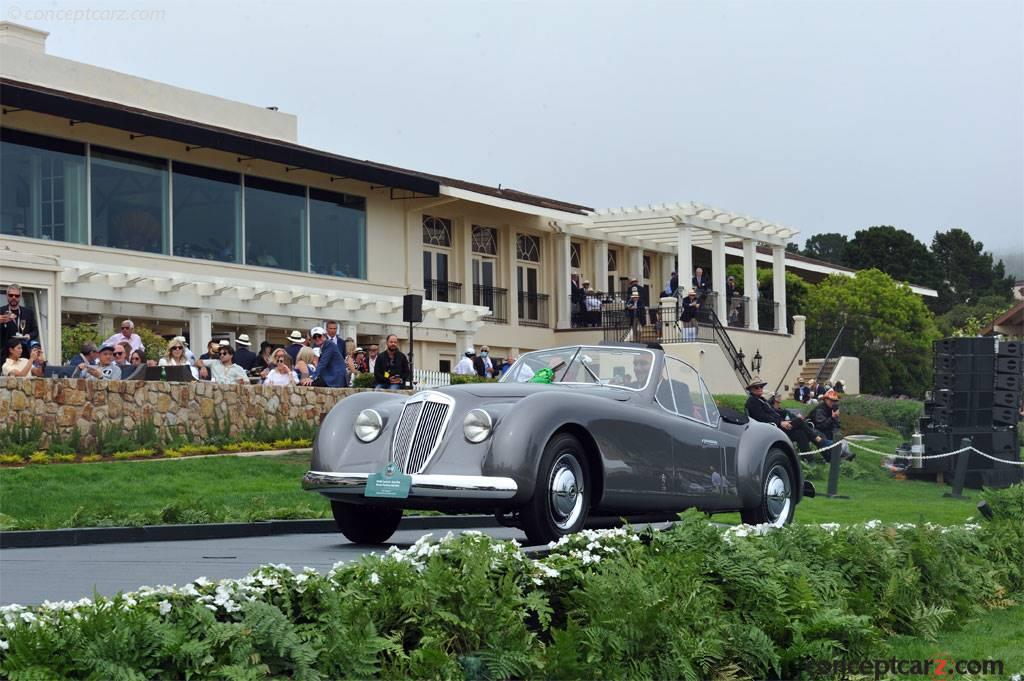
Bartali Lancia at Pebble Beach 2021
Aware that this Lancia held a unique and significant place in automotive history, the new owner directed Amster to restore the Bartali Lancia to concours standards, which Amster did. The completed restoration rolled out of Redline in 2003. It would not be until eighteen years later that the same owner would decide to show the car at Pebble Beach. August of 2021 saw the Bartali Lancia depart from Redline for California. Widely considered the most prestigious car show in the world, Pebble Beach stands as the pinnacle Concours d’Elegance competition. There on Sunday August 15, 2021 the Bartali Lancia took an amazing 2nd place in its class.
Once again the Bartali name held its head high. Even Babe Ruth never took a trophy at Pebble Beach.