Conversations With People We Value

Talking with the skilled professionals who support our passion for collectible automobiles.

Conversations With People We Value #60

Herb Benkel loves cars. Herb loves driving. Herb loves Susan whom he married on November 9, 1968. All would be impacted one week after the wedding when he was diagnosed with cancer. Though ultimately losing his right leg to osteonecrosis Herb never wavered in his commitment to leading a full life that would include a highly successful career as an endodontist, mentoring for the  Amputee Coalition and an undiminished enthusiasm for driving.

Meet Herb Benkel

A Car Guy Offers Life Lessons in Taking Misfortune in Stride


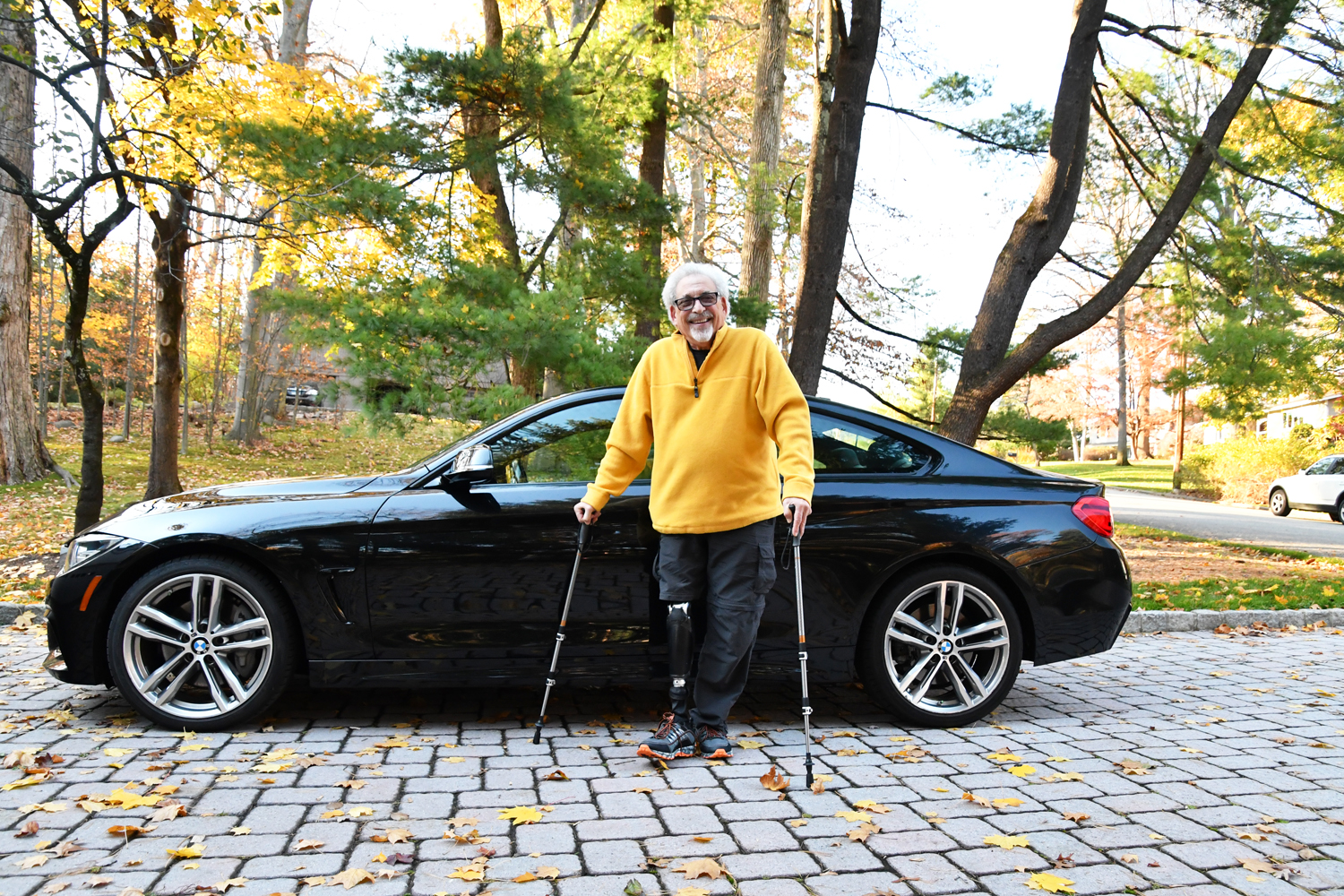
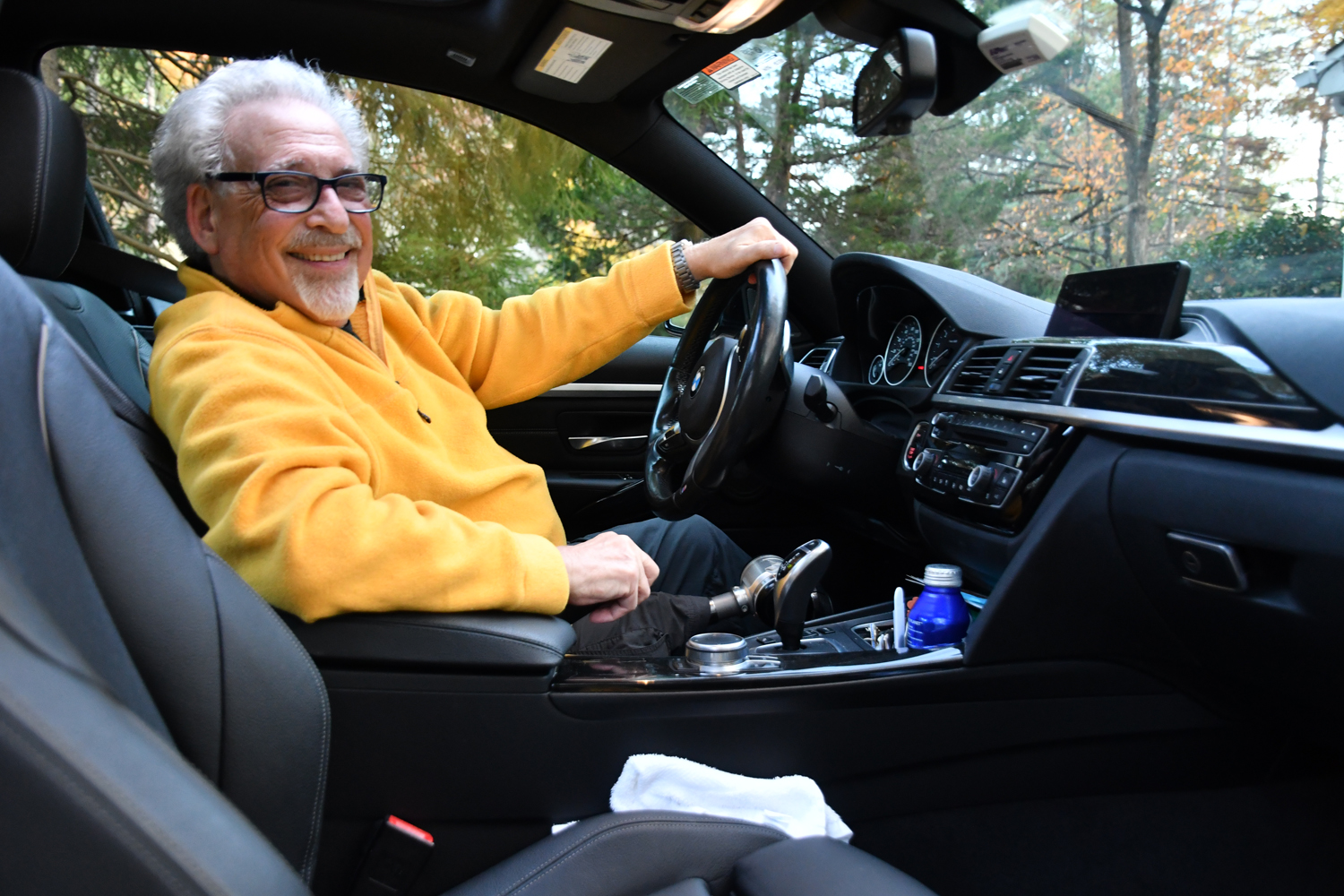
His handsome and immaculate triple black BMW 440i pulls into the parking lot. The driver’s door swings open filling the added space available in the handicap parking spot. Slowly and deliberately Herb Benkel swings his left leg out of the car. With his left leg firmly planted on the ground, he spins his body to the left and manually guides his prosthetic right leg from the car. A marvel of medical technology, it features the world’s first motor-powered microprocessor knee and cobalt chrome construction. It boasts a level of technical advancement on a par with the BMW he drives.

Using two canes for stability as he stands, Herb greets me with a broad smile and laughing eyes. He authentically projects the visage of a man who never has a bad day. In this case the day offers a festival of autumn glory.

Herb’s prosthesis leaves Long John Silver far in the dust with a mobility solution sporting a heavy dose of Schwarzenegger’s Terminator cyborg. He says, “You can hear the device when I am approaching. If you watch the original Terminator movie with Arnold Schwarzenegger, you hear the Terminator machinery going Zip, Zip, Zip, Er, Er, Er. Now that’s me. You can hear the motor when I walk. At first, it was really annoying but then I got used to it.”

The leg’s microprocessor delivers a powered motion to actively replicate lost muscle function. State-of-the-art sensors detect his movement thus equipping the knee to anticipate his needs. A powerful motor delivers active extension when standing and controlled resistance when rising. Herb says, “The sophistication of the Ossur Prosthetic is a blessing.” With the Ossur unit, a motor responds to provide active bending and straightening of the leg when walking. Thus the unit automatically returns the lower leg to the natural stance position to promote a more natural gait. Herb explains the challenge faced with his leg amputated up to just below the hip saying, “Without the motor facilitating the normal motion of the lower leg it would be hell for me to try to move just with the small stump. It would be like, trying to write your name with a full-sized pencil, just holding the eraser.” Just like other electric conveyances the leg needs to be charges every night. Because of Herb’s needs, his driving experience demands a greater integration of man and machine. Yet for the most part a simple solution provides an ideal interface connecting Herb and his BMW.

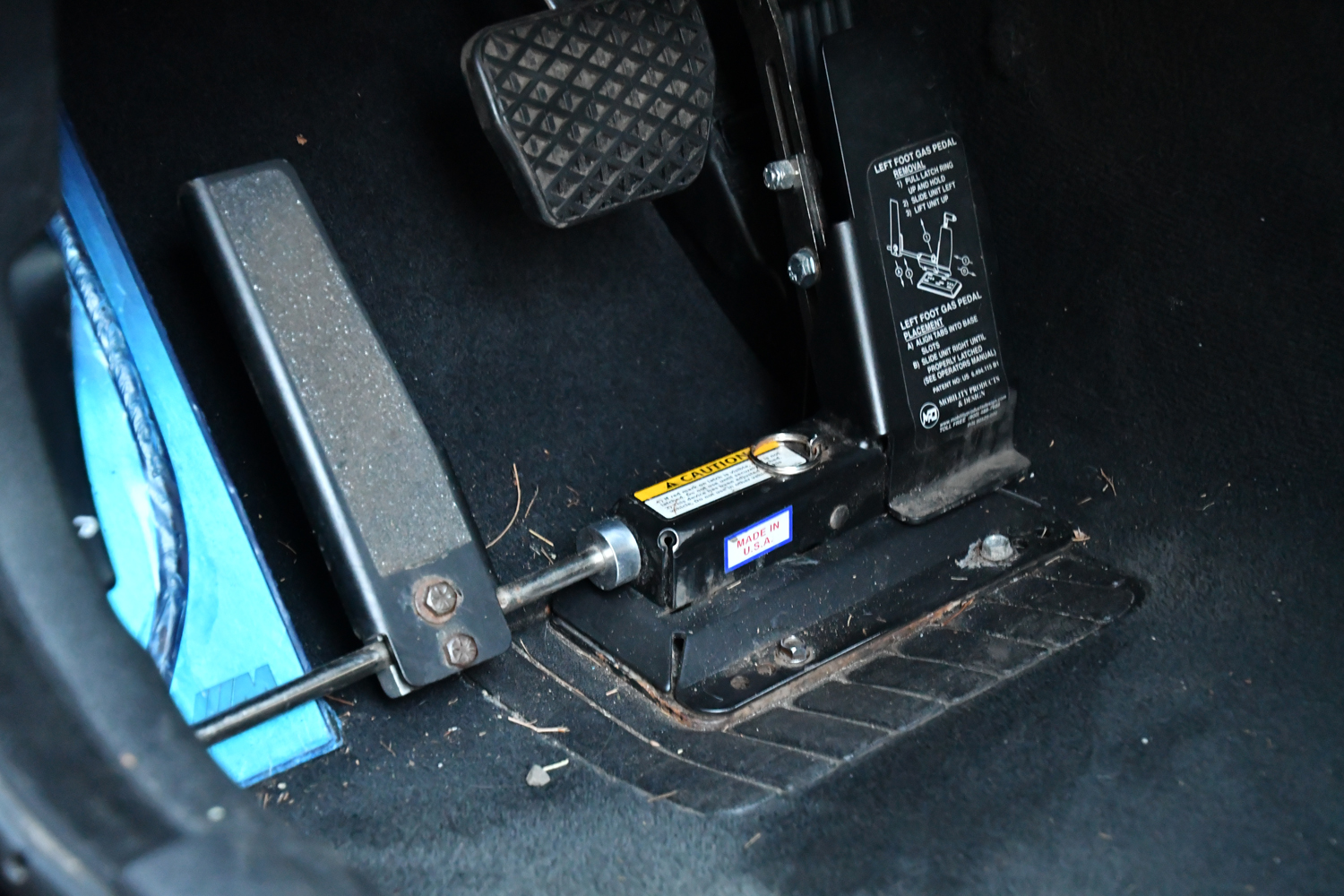
Herb says, “I discovered that there are companies that do adaptations for amputees. When they took off my leg I had first intended to get rid of my 440i and buy something else. But then, I learned I could drive my BMW using my left foot with a device available locally. What a great device.
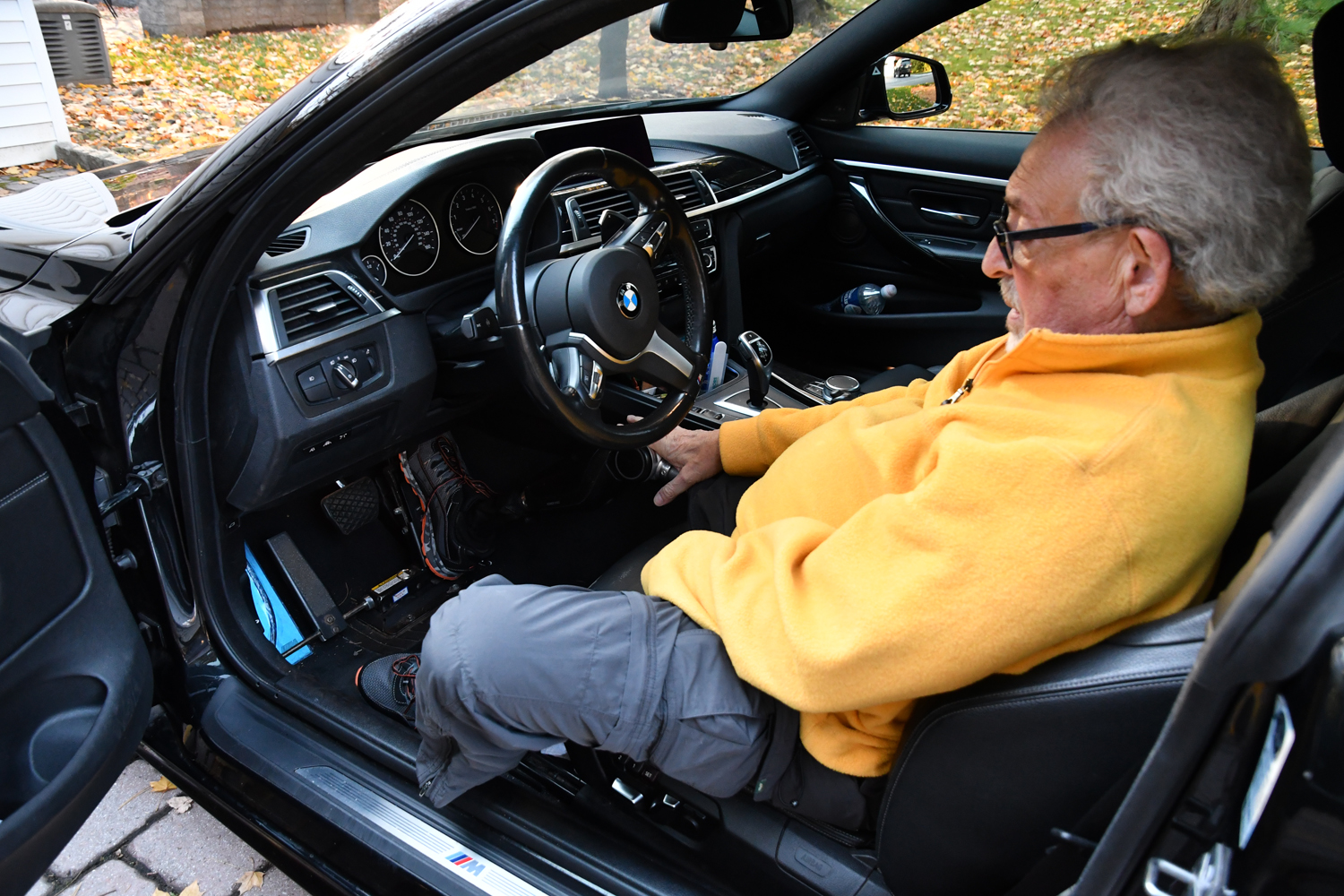
Herb says, “My right leg is amputated and the gas pedal is on the right. That is a problem demanding a solution.” The solution starts with a shield that covers the gas pedal. Herb rests the right foot of his prosthetic leg against the shield thus rendering the right leg immobile. A roller assembly affixed to the back of the shield and connected to the gas pedal attaches by way of a rod to a gas pedal on the left side of the foot well. Motion initiated on the left gas pedal translates by way of the connecting rod to motion on the real gas pedal on the right. Herb says, “My left leg has no problem reaching the relocated gas pedal and I can easily move my foot to the right to get to the brake.” Herb took three classes at Kessler Rehabilitation to become comfortable, He says, “Now it is second nature just like the way everybody else drives with the right foot. History has shown that Herb has significant experience with the go-pedal. He has earned tickets for doing 120 mph on both coasts: Highway 1 in California and Route 17 in New Jersey. With a glint in his eye Herb says, “Those tickets were before the amputation. I don’t speed like that anymore. If they took me to court I wouldn’t have a leg to stand on.” A final and important consideration concerns the car that Herb prefers to drive. For the last 40 years the answer has always been the same, a BMW.” With the amputation the choice is more specific.

“I have to have a 2-door coupe, like my 440i,” says Herb. He explains why saying, “You need a big door when you have a prosthetic leg. In my case, it’s my right leg, and I’m sitting on the left side of the car. I have to lift my right leg with my hand, slide it out and then slide my body. In order to do that, I need a big door and automatic seat settings.” To exit the car requires Herb to have the seat all the way back. Herb says, “I couldn’t drive a car that didn’t have electric seats because without a memory seat, it would be a nightmare every time I got in and out of the car.”
While a stretch of 50 years spanned the period between Herb’s bout with cancer and the amputation of his right leg, an extricable link connected the two events.

Herb says, “One of first things I gave my wife after a week of marriage was a diagnosis that I had osteosarcoma, bone cancer.” In the 1960s the choice of treatments consisted of radiation or amputation. Chemotherapy did not exist. They made the decision to treat it with radiation. Herb says, “Unfortunately in those days radiation treatment was poorly delivered.”

Decades later, on the coldest day in New Jersey in 35 years, while walking up his driveway, Herb’s right leg simply crumbled. He collapsed in a heap. No one could see him from the street. He feared freezing to death. Luckily, he could find his cell phone and called Sue. She placed the 911 call. The ambulance took him to the hospital. While the damage had had its roots in 1968, 2019 saw him lose his leg up to the hip.

In reflecting on this difficult time Herb says, “The job of getting through an amputation is the job of taking one moment at a time and trying to find something decent in that one moment and then starting to link those individual moments together. It’s easier said than done, but it’s the only way I got through it when I was in the hospital and I lost the leg before they made the prosthetic, I found Exercise bands. And I started doing exercises in the bed that gave me a sense that I had some control over my body; with everything else that was going wrong. I had control.”

When asked if the driving experience changed with the prosthetic device, Herb says, “Yes and no. I have always loved driving, however, all my cars had been stick. However, because of what happened I can no longer drive stick. But considering that pretty much all brands have stopped making them, it seems an inevitability. I don’t like the paddles. Not the same, not even close. So that’s where it’s changed. But I got used to it and I still love to drive. I mean, I get relaxation. I love being surrounded by my music. I love the quickness and toss-ability of my BMW. I rejoice in tracking on a serpentine back road. Yeah, I still take exit ramps at 60 miles an hour, you know, just to feel how the car holds the road.”
In discussing driving as an amputee Herb notes that one terrible problem plagues all amputees to some degree. That problem is phantom pain. He says, “Phantom Pain can attack you at any time and that’s a little nerve-racking. No one can really explain it adequately, that’s why they can’t treat it, but phantom pain is your body feeling that your foot is still there and sending pain signals to that foot.” In describing phantom pain Herb says, “So I don’t feel the pain in any part of my body. My stump is not irritated. Nothing is irritated, but there’s a horrific burning feeling and shocks of electricity that go to my toes and my foot. The sensation makes me feel like that foot is fully there and being tortured or ripped apart or burnt. Sometimes it feels like it is being put in hot oil. Phantom pain attacks can last between four hours and four days.”

I asked Herb what role Susan, his wife, played in dealing with his misfortune. Herb with hesitation says, “I would never have gotten through this without her. This goes all the way back to when we married in 1968 and I was diagnosed with bone cancer. She could have stayed, she could have left. I mean, the marriage could have been annulled in a minute but she didn’t do that. She stuck through it all. It was a crazy time, but we did it together.

When asked his greatest challenge Herb’s says, “To make the best of the one life God gave me.”

By |2025-11-12T16:55:34+00:00November 12th, 2025|4 Comments

Conversations With People We Value #59

You never know what you will discover at the Fall Carlisle Swap Meet. In the case of this year’s event, Elaine and I stumbled across a real find. While seated for breakfast at the historic Carlisle House B&B we found ourselves across the table from Jim Freda and his wife Kim. In a matter of moments Jim and I were confirming a lengthy list of common acquaintances populating the list of respected members of the tri-state classic car community.

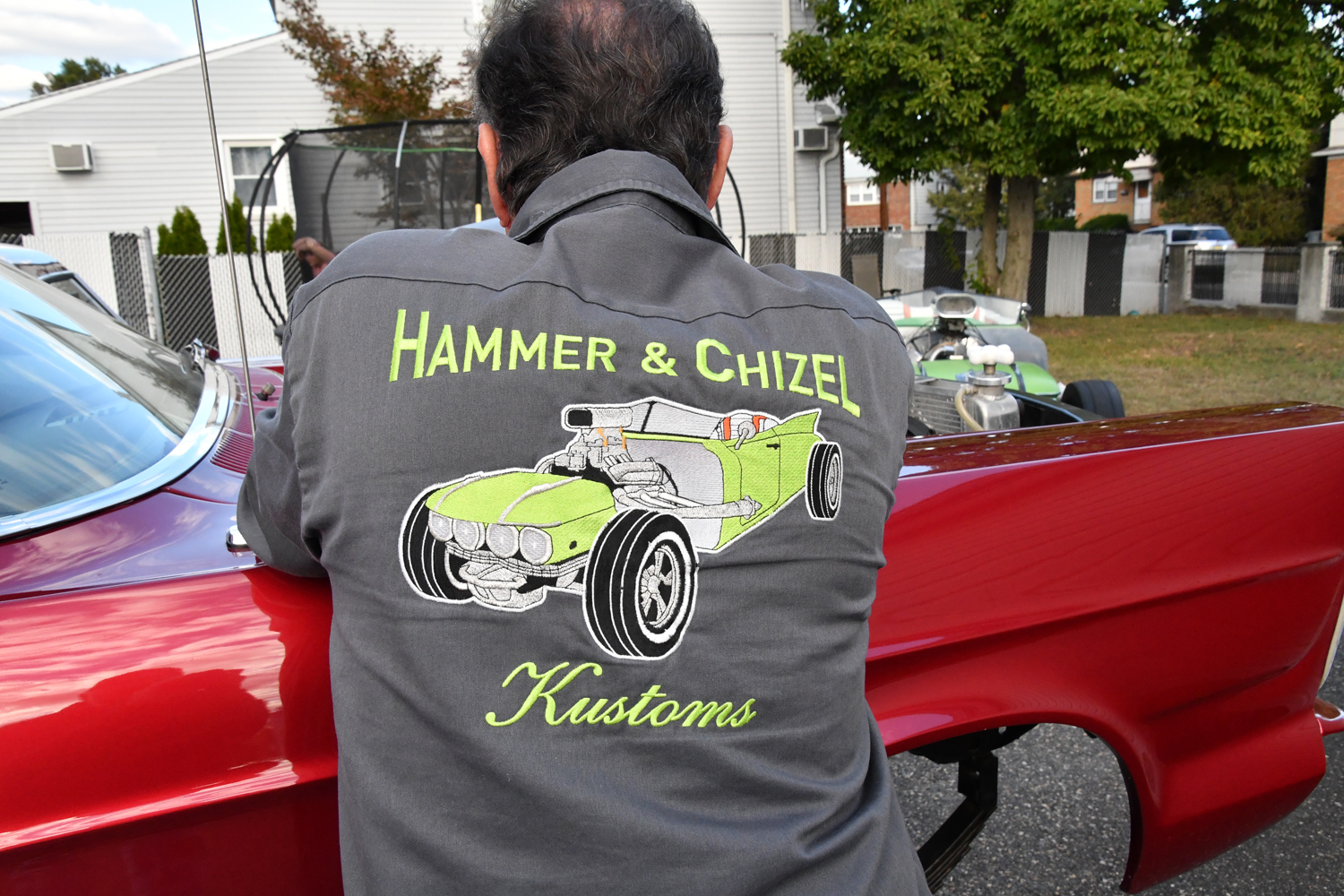
Over breakfast in sharing images of custom vehicles he created in his off hours, I recognized both a possible friend and a visionary artist worthy of a Drivin’ News story.

Meet Jim Freda.

Intuitive Genius Wielding a Hammer and Chisel


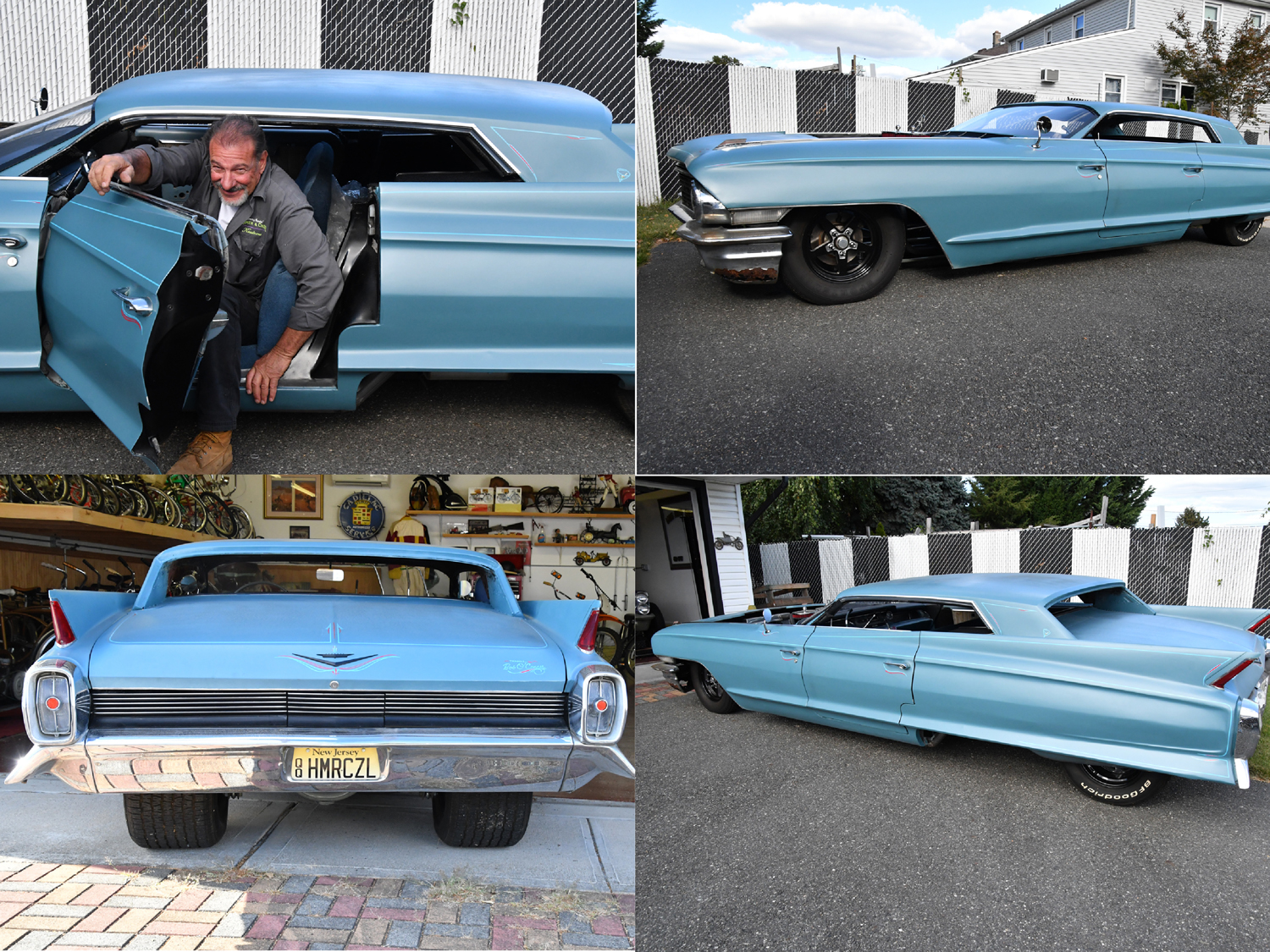
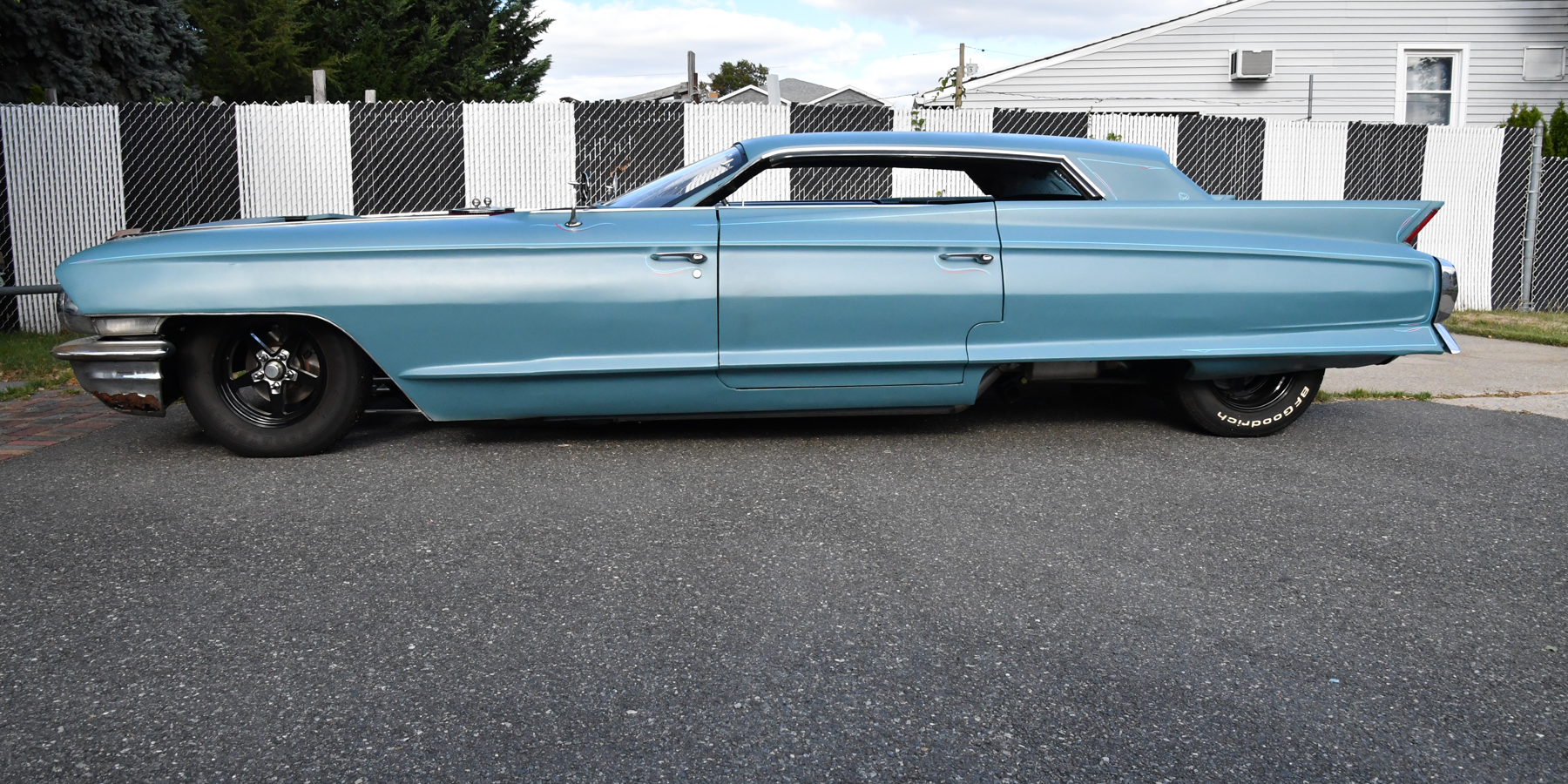
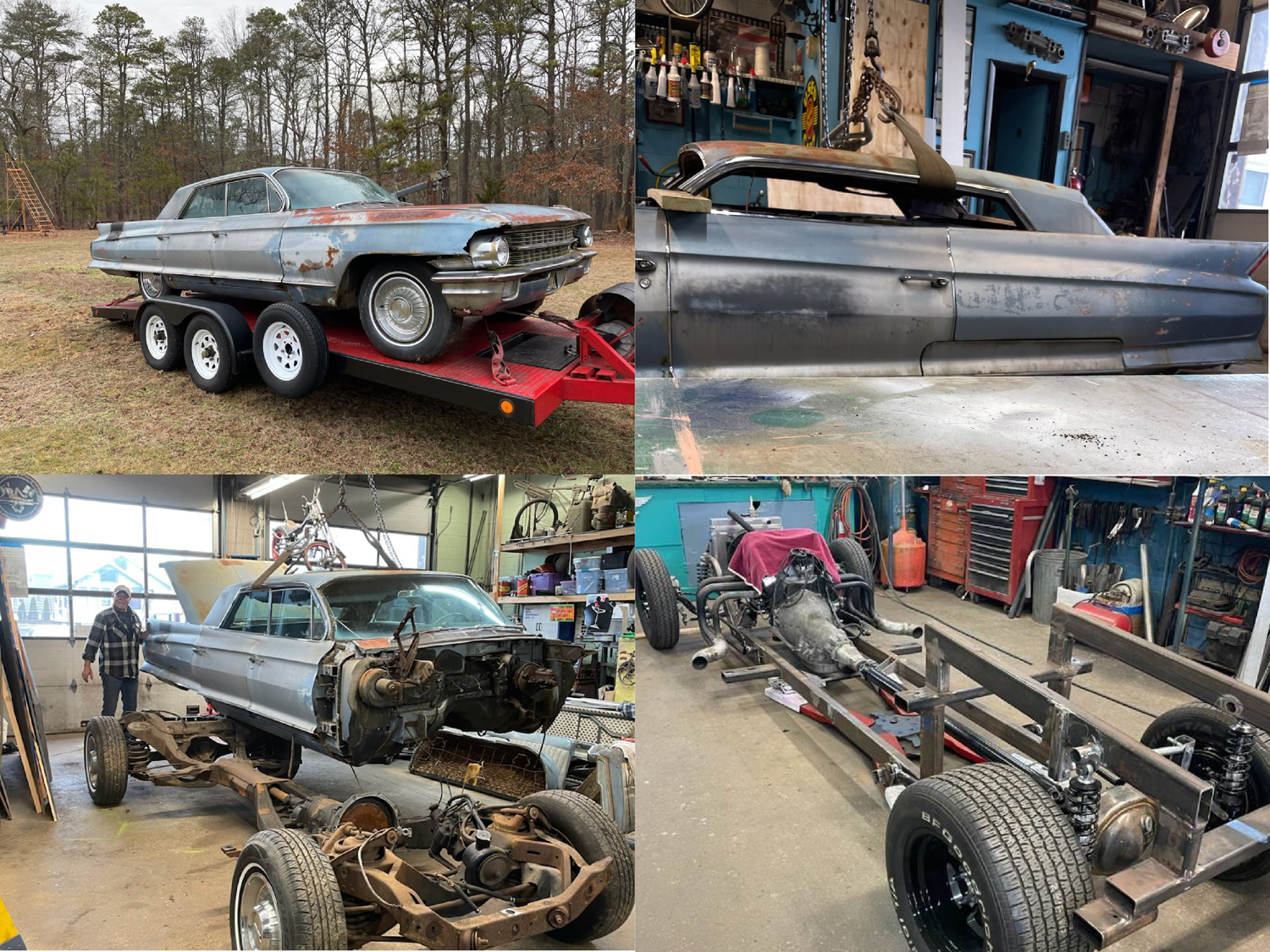
Jim’s 1962 Cadillac 4-dr. Sedan deVille

I found it inconceivable that of all the completed and striking one-off fabrications arrayed about the courtyard none had come to life with the benefit of so much as a sketch on a napkin. Yet, Jim Freda, in his 60s, retired and a full time artist with old cars as his medium, would have it no other way.

His most recent creation started as a 1962 Cadillac Sedan deVille. His initial vision centered on slicing off the roof and creating a full 180 degree Plexiglas bubble top concept. However, early on, with the roof freshly removed and hanging on straps above the Cadillac’s open cockpit, Jim lowered the roof onto the car to facilitate moving it to another part of his shop. The visual effect stunned him. The impact of the cut roof’s sinister slit-eyed glare sitting low upon the Cadillac’s lengthy swept fin body electrified Jim. With fluid ease, he pivoted to a completely new visual concept that would showcase the chopped Cadillac’s serendipitously discovered alluring menace. More about the 62 Cadillac will come later. This impromptu re-imagining reflects an intuitive genius that Jim employs as a matter of form in all of his creations. Unencumbered by any commitment to a predetermined outcome, Jim simply follows his muse to achieve a final design that pleased him.

As in Jim’s case, intuitive genius describes an innate ability to capture a desired solution in a manner that seemingly supersedes conscious reasoning. For Jim his application of this creative gift comes with the benefit of a personal build philosophy that demands that as Jim says, “If you make a mistake, you got to figure out how to cover it up and make it look, right.”


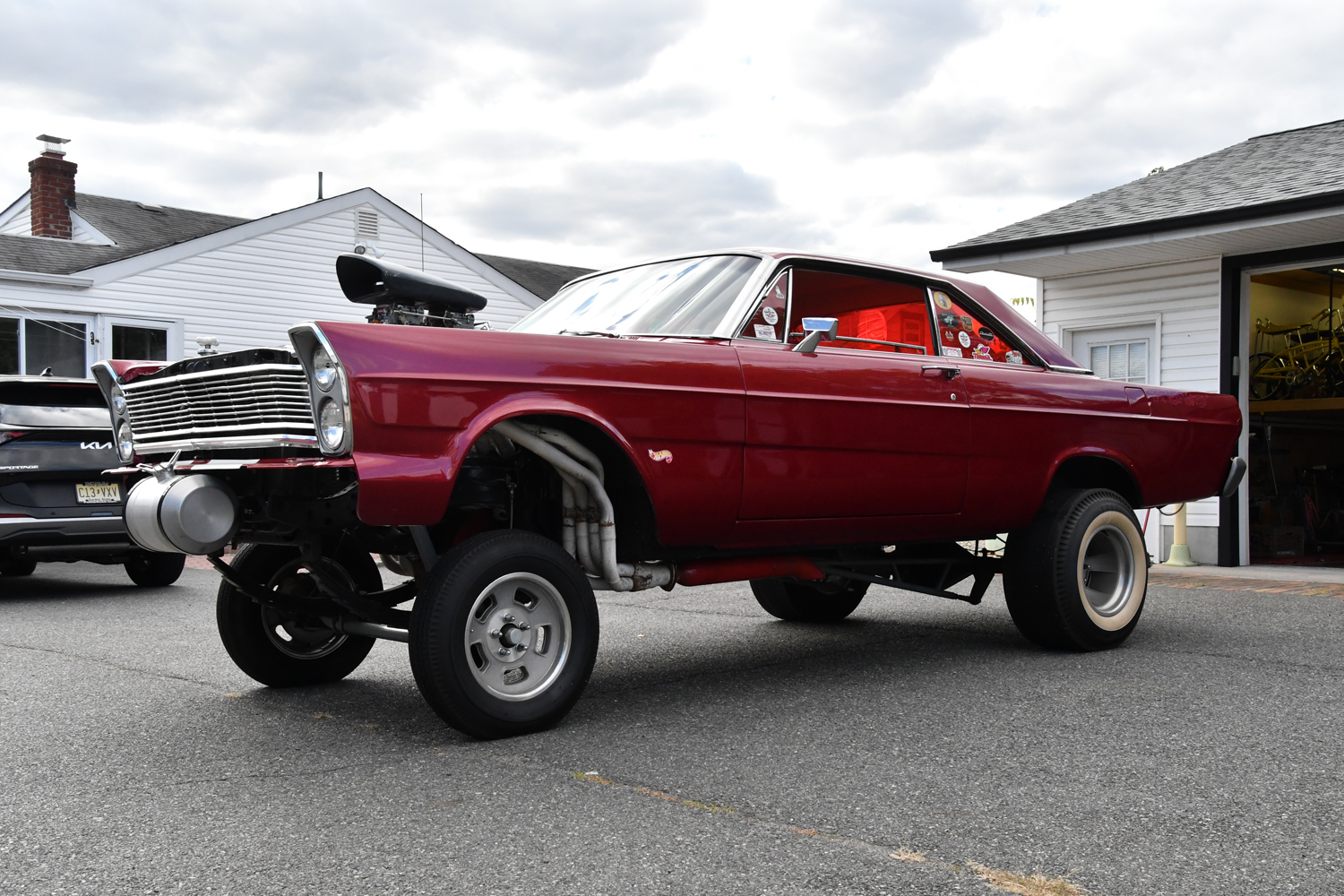
Jim’s 1965 Ford Galaxie Gasser

Born into a car family, Jim grew up in Lyndhurst, New Jersey where his father, Lou Freda, owned a used car lot next to the family home. While the car lot has passed into history the fully equipped two-bay workshop remains active in serving as the incubator for Jim’s unique creations. In his early years Jim and his pals had Camaros and Novas but it was not until Jim reached his 40s that he turned to building cars of his own design. He says, “It was not like I was 22 years old and ripping stuff apart.” He credits Richie Conklin owner of the famous Hot Rod Farm in Montville, New Jersey with seeding his fascination with fabrication. He says, “I went over to Richie’s Hot Rod Farm. It was filled with jacked up straight-axle gassers. It was the coolest place. I knew what you could do to a Camaro but everybody’s got that. But at Richie’s the gassers I saw were something very different.” And what exactly is a gasser? Primarily built around older production cars from before 1970, a gasser’s signature traits include high-raised front end, stripped-down body, and powerful engine. The distinctive high and downward sloping stance functions to more effectively transfer weight to the rear wheels for better traction during the launch from a standstill. Jim loved the look.

So about 20 years ago a motivated Jim Freda left the Hot Rod Farm went home, found a 1965 Ford Galaxie for $500 and started his first build. To guide his project Jim, for months to come, went back and forth to Richie’s farm just to get ideas and learn techniques.

In Jim’s transformation into an obsessed practitioner in the art of custom car creation; he set about turning the Galaxie into a gasser. Its reinforced chassis hiked up over the solid front axle cradled a supercharged 454 cu. in. Chevy big block stroked out to 496 cu. in.. Dyno tested at a thundering 710 horsepower, it delivered power through a 5-speed transmission to a rear end with 389 gears. For the following 20 years it provided effortless one elbow out the window, one hand on the wheel highway speed reliability in compiling significant miles around the Mid-Atlantic States. However, while a source of pride, Jim’s Galaxie gasser only whet his appetite for creating far more radical expressions of his very personal driving dreams. Over the ensuing decades of tear-down and fabrication adventures Jim’s friends anointed the fruits of his efforts “Hammer and Chizel” Kustoms. Now we will take a closer look at two Kustoms born of Jim’s sublimely radical expression of intuitive genius. We start with the 1962 Cadillac referenced earlier in this story.


This custom design started as a forlorn 1962 Cadillac Sedan de Ville left moldering in a field. Jim says, “I was just looking for something with fins. Then I was going to develop an idea around the fins.” Jim found and trailered his donor car home on January 30th 2023. Once in the shop Jim embarked on the major surgery that had resulted in the realization that his original bubble top concept referenced earlier had been supplanted by a far more compelling design. That the more striking concept had resulted not from Jim’s personal insight but from happenstance bothered Jim not a bit. Jim says, “That was fine with me.” With the visual solution revealed to him, Jim took another year and a half to bring it to fruition. Over those subsequent months Jim pursued every opportunity to refine the handsome malevolence of his Cadillac concept’s rebirth. He massaged design elements to enhance features contributing to the cars character such as its long low profile, sharp lines and muscular stance.

While the car looks a city block long, the body is actually six inches shorter than the donor Cadillac. Contributing to this lengthening effect is that Jim re-positioned the chopped roof a foot to the rear while transforming the design into a 2-door coupe. He accomplished this by integrating the front doors into the front fender panels. Even though six inches were removed from the door width, its repurposing significantly contributed to the impression of a lengthened car. An interesting rule of thumb in automotive design states that the greater the distance between the back of the front wheel opening and the fire wall increases the perception of greater stature. Jim, of course, did all of this by eye.

To further enhance the look, Jim cleverly integrated the rear fender skirts into the body while repositioning the rear wheels further back towards the rear bumper. He did this by extending the wheelbase. He extended the wheelbase by personally fabricating a new chassis. Jim says, “It’s not a real big deal. I’m not building a formula 1 car here. I use 2 inch by 4 inch, 3/16th inch rectangular tubing. Front and rear suspensions are available in the aftermarket.” For this Cadillac, the front suspension came from Speedway Motors. Jim went to Quick Performance for the rear suspension for the narrowed rear. Jim says, “You measure the dimensions of the rear you need and they make it for you.

Jim’s designs frequently feature the absence of a hood. His choice and presentation of an engine often elevates its presence from muscular power source to visual design feature. In this case the hood-less Cadillac features a Corvette 350 cu. with dual quads.

The finishing touch to complete the visual presentation of Jim’s creation came courtesy of his go-to pinstripe legend Mr. J from Paterson, New Jersey. And, now, for something completely different.

Jim’s 1963 Pontiac Bonneville 4-dr. hardtop

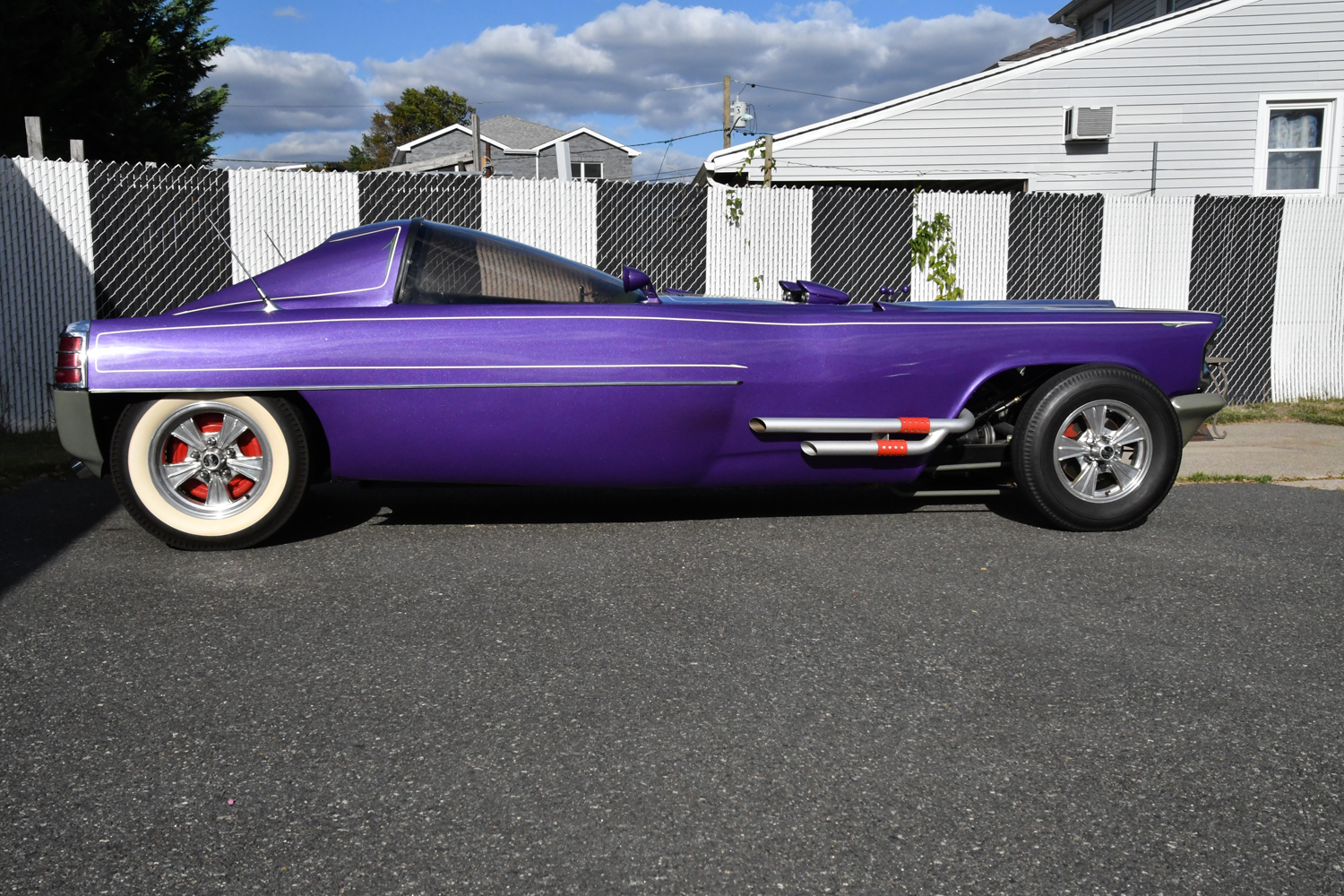
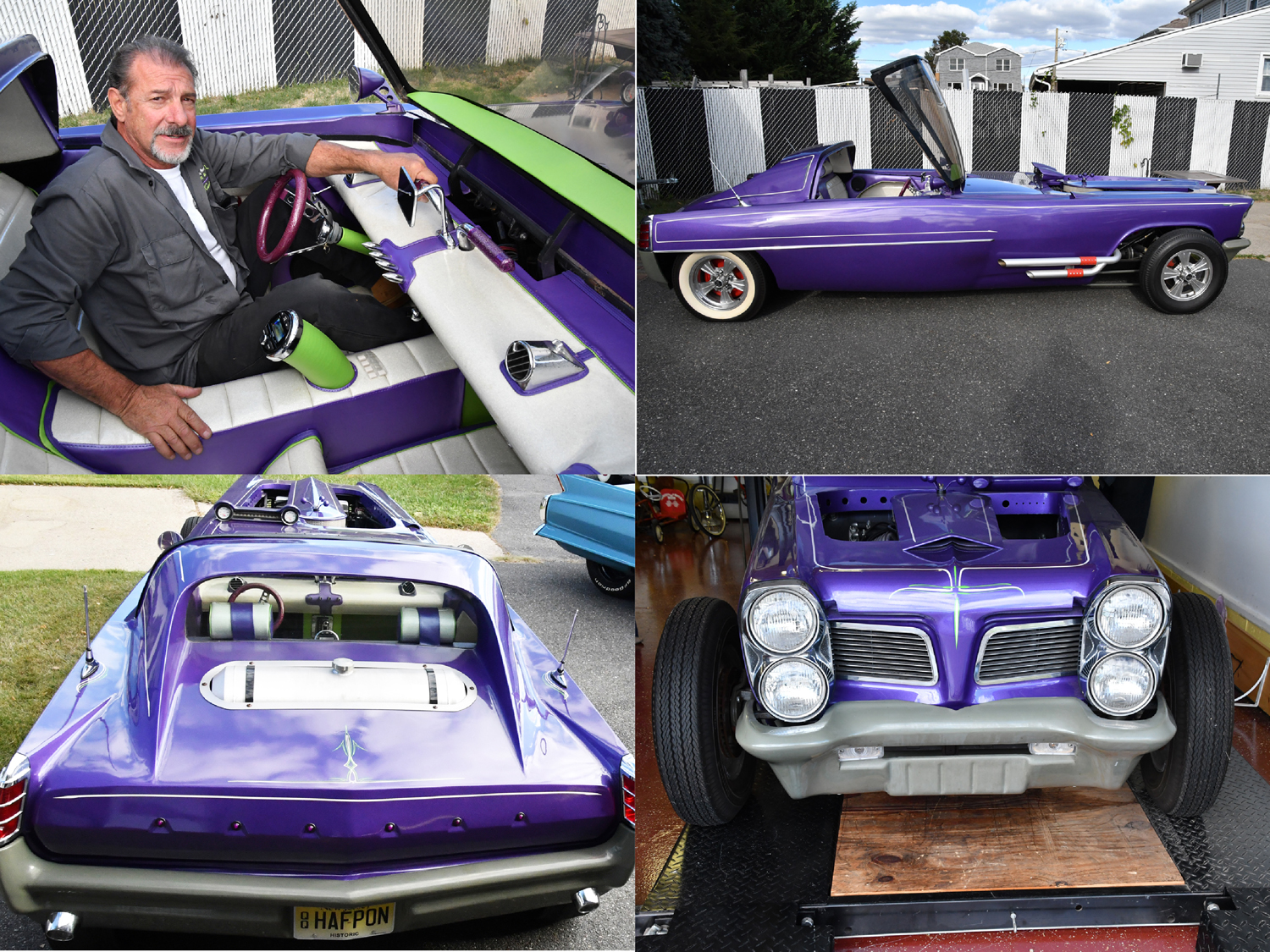
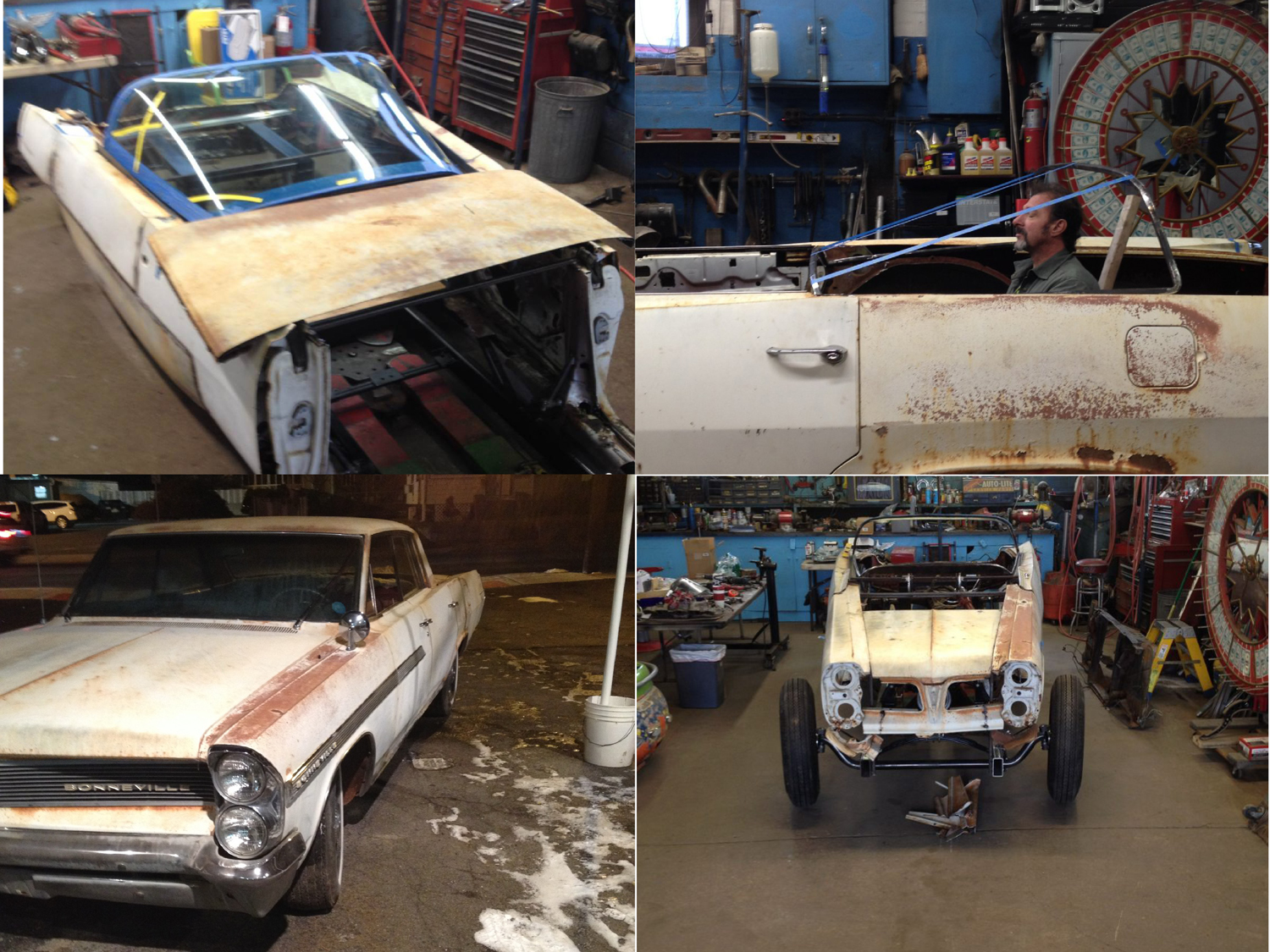
Six years before the 1962 Cadillac Coupe deVille, a 1963 Pontiac Bonneville 4-door hardtop captured Jim’s attention. Metamorphosis best describes Jim’s transformation of a classic 1960s Detroit iron land yacht into what best can be described as a sleek purple Star Wars 2-seat X-wing fighter sans wings that would stun the crowd at any Cars and Coffee. Standing before his creation Jim matter-of-factly explained the end result saying, “This was a 1963 Pontiac Bonneville four-door hardtop.

The side of the car now consists of the front fender, the rear door and the quarter panel. The front door has been eliminated. Seated inside you are technically sitting in the trunk below a Plymouth Barracuda rear window that functions as a windshield. The roof features a “flying buttress” from a 1970s Corvette. The vehicle’s width is full-size in the back narrowing to about three feet wide in the front.” Clearly this Hammer and Chizel Kustom enjoyed an ample dose of intuitive genius. When questioned about the car’s proportions Jim says, “Think of it as a slice of pie.”

It all started when Jim homed in on the rear window glass of an early 1970’s Buick “Boattail” Riviera. He says, “I decided to build a car using the rear window for a windshield.” While inquiring about a boattail window at an automotive glass store, the salesman told Jim he had something better. Jim says, “He steers me to a 1965 Plymouth Barracuda rear window, you know the “Hemi under glass” rear window. And he says it offers more side to work with. I was sold.”

Like the other Cadillac Jim fabricated a custom chassis with the axle for the half width front end from Speedway Motors. Power comes courtesy of a 350 cu. in. Chevy V8.

The custom interior features air conditioning, heat and stereo. The windshield/roof/exit employs gas struts for effortless operation. As with all of Jim’s creations, super pinstriper Mr. J got the call to place the special touches on the paint. That all of Jim’s builds enjoy street legal status pays tribute to the quality of Jim’s work.

In reflecting on his passion for hands-on car creation Jim says, “Most of my found happiness is probably through my father. He owned the used car lot that colored my early life experiences. He had the passion for cars. He is gone now but his spirit lives on through the life my work brings to his garage.” As an added bonus Jim says, “Ours is a neighborhood of close friendships. Even after my father passed, his old friends and, now, my old friends like Big Bill, Mike and Bob stop by the garage regularly to check in and maybe lend a hand on my latest project.” Jim has even continued hosting what was once his father’s annual Christmas party at the garage.”
In reflecting on what drives him Jim Says, “I have become aware that my work with cars is really about people and relationships.” Jim loves to create designs that fire people’s imagination. Jim says, “When going to car shows I have come to realize that it is more about the people I meet than the cars I see.” For Jim, each unique Hammer & Chizel Kustom car produces a vehicle (double meaning intended) that brings people together.

Jim smiles at the thought that it would make his father smile.


By |2025-11-12T16:40:27+00:00October 20th, 2025|4 Comments

Conversations With People We Value #58

You never know what good a new day will bring. On that day it came in the form of an email. Sent by my friend and fellow car guy Ira, it explained that he had recommended me to a facility that served the needs of young adults on the autism spectrum. Why me? Because they wanted to do a dedicated classic car event as an enhancement to their program for treating the needs of their clients. He included the organization’s contact information. I called.

Classic cars have always been recognized as a source of worth, pride, pleasure, excitement and entertainment. Could they, as well, be a source of healing? We were about to find out.

Classic Autos and Autism: Sharing a Journey to Betterment

Photos: Courtesy of Kayleigh Gorman, Good Talking People, LLC

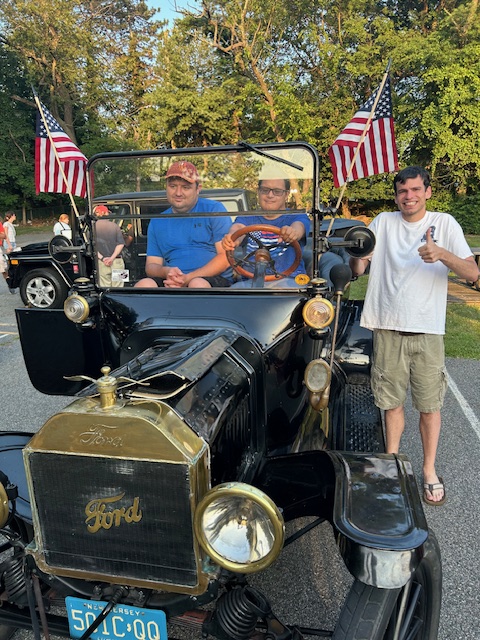
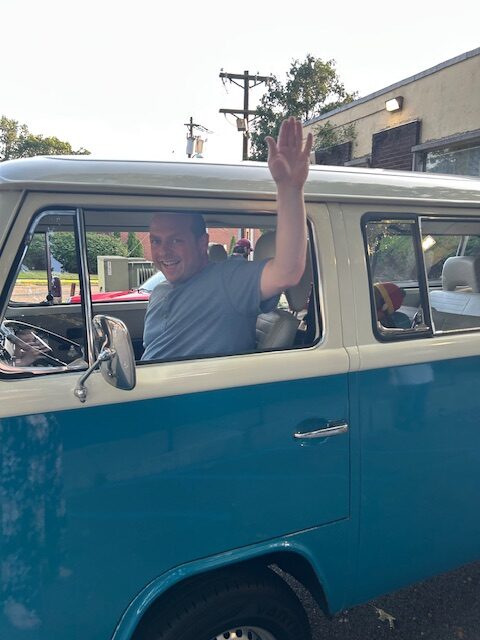
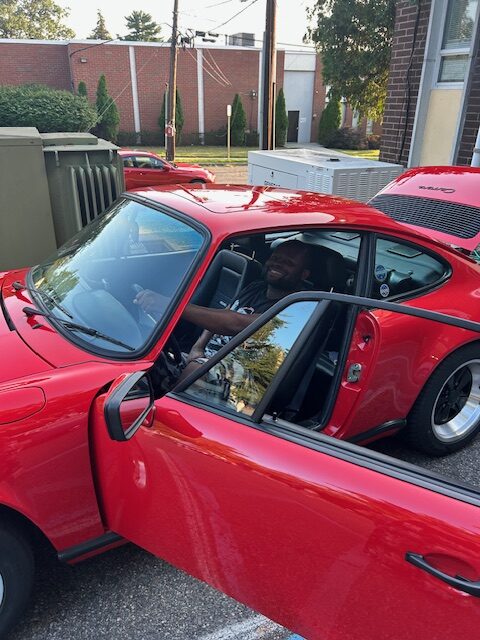
Three months after Ira’s email arrived, a 1915 Ford Model T rolled into the tree rimmed parking area of the “Good Talking People” care facility in Teaneck, NJ. Soon the early Ford would be followed by a 1986 Porsche 911, a 1976 VW bus, a 1967 Austin Healey 3000 and eight other classic cars, the event and the idea behind it had come to life. Good Talking People Owner/Director Arlene Rubin and Office Manager Kayleigh Gorman welcomed the car owners as the vehicles came to rest.

This Wednesday evening represented a new twist in the facility’s ongoing effort to promote comfort in social situations. At these monthly socials young adults on the spectrum can enjoy the opportunity to come together with their community of peers and practice their social skills. Arlene says, “They look forward to seeing the people that they have developed relationships with. It’s a comfortable place for them to be able to just be them.” Historically these events have included bowling, trivia night, dancing, costume parties, karaoke, crafts, etc.

The “Car Show” represented a unique activity in the ongoing effort to create engaging monthly social events. In this setting these young adults could engage with the classic cars and the owners in a social setting with familiar faces. In so doing they could develop the social skills necessary to improve their quality of life.
On this beautiful early evening in mid July a cluster of adults enveloped in a cloud of excited anticipation blended, hesitatingly at first, into the display of signature vehicles from the golden age of the automobile. The gathering’s predominantly male composition reflected the roughly 4 to 1 male to female ratio of the American autism population. According to the CDC, since 1970 the incidence of autism has increased from roughly 1 in 10,000 to 1 in 31 (Depending on the source these numbers vary significantly). As to why, many reasons come to the fore, not the least of which being a recent broader interpretation of what qualifies as autism as well as modified assessments and knowledge.

As the event came to life all the car owners chose to wait for the clients to initiate interest and then owners would gently enter into a social interaction. Much to the delight of Arlene, Kayleigh and the car owners the presence of the cars and the freedom to sit in each car generated a very positive dynamic that inspired even the less outgoing clients to engage.

As to the actual definition of autism, Arlene made clear that limitations in socialization skills towers as the defining criteria marker for autism. Arlene says, “You can have really very bright, strongly cognitive individuals who are very socially awkward. They don’t really read the room. They don’t really pick up on cues. They don’t understand the social world around them in the same way as others. Some very famous people that we view as highly intelligent believe they would have been diagnosed with autism spectrum disorder as a child. Bill Gates being one.”

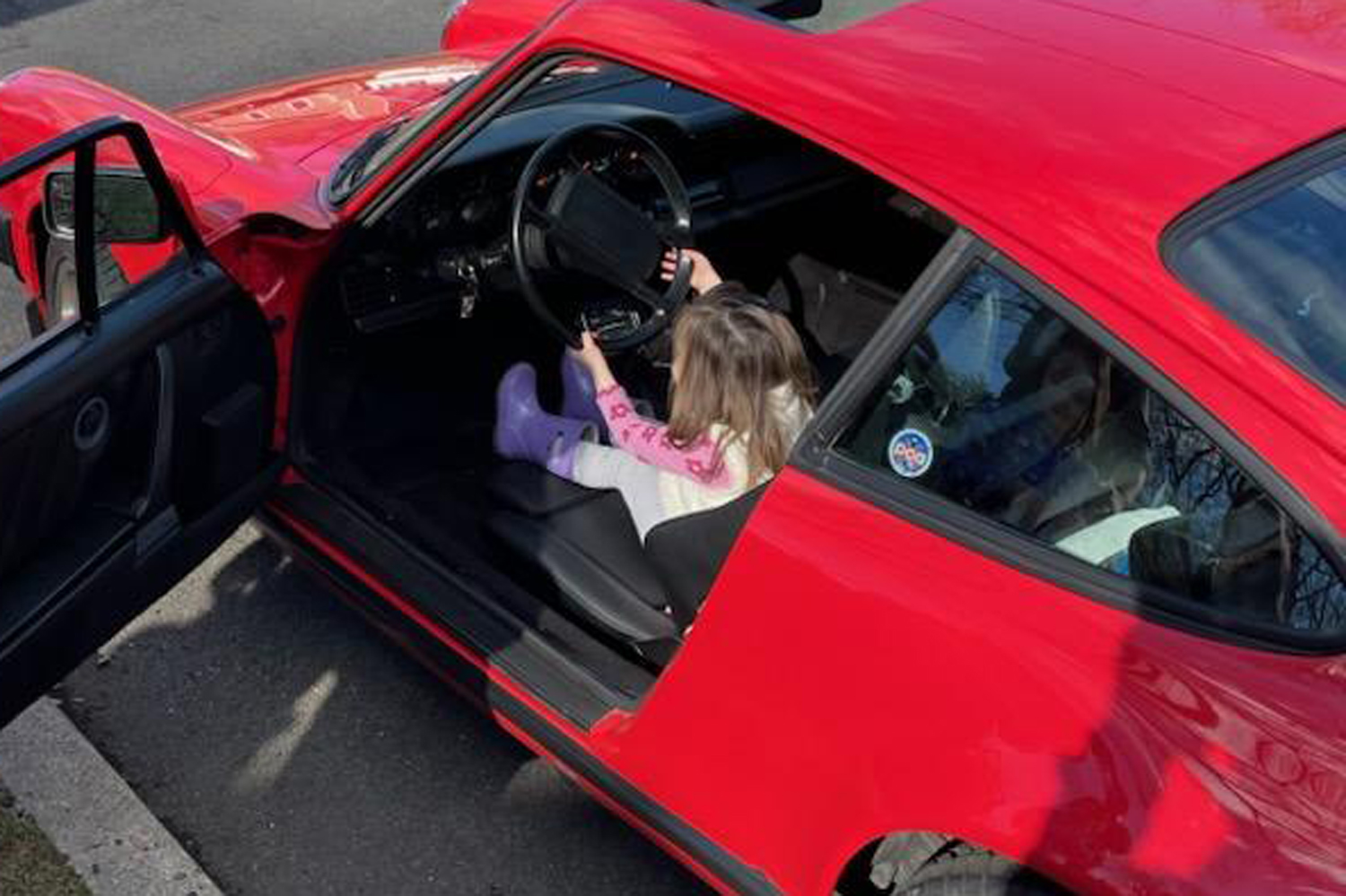
One great example of the conflicting cognitive versus social abilities of clients occurred with Peter, the owner of an especially nice 1986 Guards Red Porsche 911 Carrera and a knowledgeable car guy. One of the clients approached to view Peter’s Porsche. Peter invited the client to take a seat behind the wheel. “Oooohhh nooo,” the young man replied as he retreated from the interaction. A while later the young man returned to ask if he could, indeed, sit in the Porsche. Peter guided him behind the wheel while taking his place in the passenger seat. Peter in delightfully describing his shock says, “This young man spoke so knowledgeably about Porsches I was completely blown away. I never expected that.”
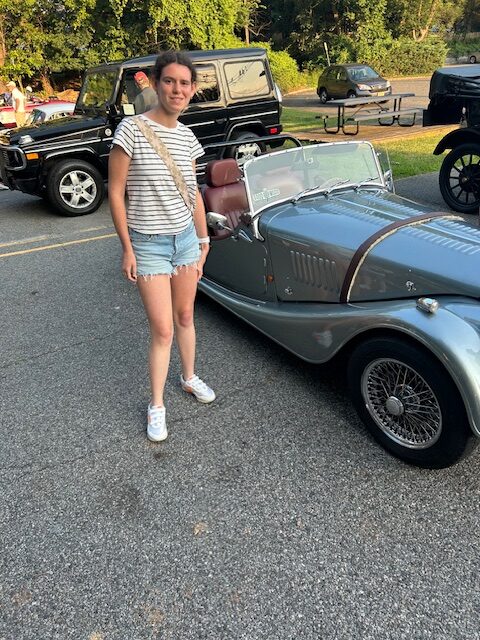
As the energy level of the event built fueled by clients asking questions and photographing cars and being photographed with cars and in cars, Arlene explained that autism cannot be cured or reversed; it is a lifelong neuro-developmental condition.  Instead the therapeutic goal focuses on helping clients manage challenges, develop skills and improve their quality of life. She explained that Good Talking People provides therapy to assist in the development of pragmatic language, social communication and social learning. Here they teach strategies for understanding social rules, what is expected in social situations, ways to increase social comfort and how to communicate and connect with others.

This evening’s “Car Show” represented a unique activity in an ongoing effort to create monthly social events. These gatherings provide a safe environment where clients can interact in a social setting with familiar faces to develop the social skills necessary to improve their quality of life.

With the event in full swing, hoods opened, horns blew, engines started and clients seemed more comfortable in their own skin. One young man approached me, looked me in the eye, presented an outstretched hand and stated confidently, “My name is Micah.” We shook as I gave my name. Apparently satisfied with the exchange Micah smiled and moved on.

Car-centric activities engaged the clients throughout the evening till the summer sun sank to the horizon. Long shadows signaled that the time had arrived for the show to end. Illuminated in the golden glow of the sweet light cast by a setting sun, the eclectic collection of classic cars individually departed to the cheers of the clients as they gathered to wave goodbye to their new friends.
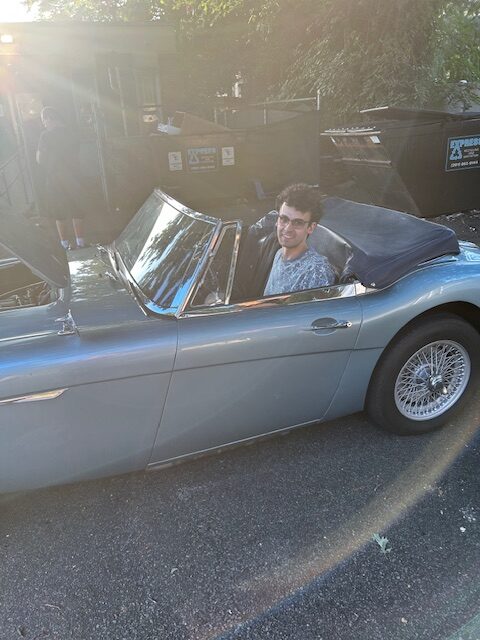
In reflecting on the success of the event Arlene said, “Our clients had a great time. When we spoke with the group directly after the event, they wanted to know if we could do it again the following week. There are some of them who I see for therapy; weeks later they were still talking about the classic car event.”

When asked if this event achieved her goals more effectively than other events, Arlene expressed the belief that indeed it did in the sense that it opened up a new experience for the clients. Arlene says, “When they came back inside after the event and, again, in later therapy sessions clients continued to ask questions about the classic car experience.” It clearly also promoted communication between clients. Both Arlene and Kayleigh witnessed clients asking questions among themselves. Arlene says, “They were discussing the different cars and having conversations among themselves about the cars.” The experience provided a focal point for them and it equipped them with a brand-new experience to explore. Arlene and her staff made it clear that the power of the event to make a difference extended well past the cars.

Both Arlene and Kayleigh praised the owners. Arlene said, “Your people were so patient. I watched and saw how some of them kind of stood back and observed. And when a client approached close enough to indicate interest that’s when the owner would slowly make his way over. He would casually go up and say, ‘Do you want to see it?’

If the client offered no questions but by his or her continued presence expressed interest, some of the gentlemen were so very intuitive they just started to talk about the car in a non-threatening way. When the owner started to talk, you could see the client listening. It was really beautiful to watch.” Kayleigh, who had organized the event said, “It was really wonderful for us to see. The owners were amazing.”

In reflecting on the total classic car event Arlene said, “This was just a brand new experience for them. It expanded their horizons. We at Good Talking People really believe in the healing power positive experiences possess. This was truly wonderful for them.” When asked if she would do it again Arlen answered without hesitation, “Absolutely!”

By |2025-09-05T00:09:20+00:00September 5th, 2025|4 Comments

Conversations With People We Value #57

Alfa Romeo 8C 2900B

No car is theft proof. A couple of good old boys in South Carolina proved that convincingly in 2022.  While these thieves may never have attended the prestigious Concorso d’Eleganza Villa d’Este by Lake Como in Italy, the 1938 Alfa Romeo 8C 2900B Lungo Spyder they stole had, and, while there, won Best of Show. Years later in July of 2022 while being transported to a restoration shop in New England, the Alfa sat parked at a Holiday Inn in Latta, South Carolina. There cosseted in a sealed trailer pulled by a Ford F-350 dually pickup the Alfa along with the truck and trailer disappeared. The stolen Alfa possessed an estimated value in excess of $20,000,000.

For a single stolen car that may be a record, however, more than a few organized car theft gangs operating in venues richly populated with highly desirable modern cars have stolen a sum total of vehicles with a value far in excess of $20 Million. Knowing that, it helps to understand what steps you can take to avoid being one of their victims.

Chris Connolly a recently retired 30-year NYPD veteran and past senior member of the New York City Auto Crimes Division has been part of the team that has brought such criminals to justice. In the past Chris has shared stories of his experiences with Drivin’ News readers in Part 1. He now shares more in Part 2.

Automotive Crimes and the Man Who Solved Many of Them, Talks AirTags, Fobs and Much More   Part 2

The story begins with a savvy and determined woman in the Bronx who had her Honda CRV stolen. Chris says, “Hondas rank high on the list of favorite theft targets in the Bronx.” He went on to explain that the woman had taken the precaution of secreting an Apple AirTag in her Honda. With her Honda now missing, she took another family car and went in search of her presumed stolen Honda. At this point in Chris’s story, I, being an Android user with no AirTag experience thought AirTags had a limited range of maybe three hundred feet. Thus, I reached out to two respected sources to confirm the claim of extended range.

AirTag

Adamantly, Bill, the Apple representative said, “Apple makes no claim that its AirTags function as an effective automotive anti-theft device.” My Apple team member did his very best to disabuse me of any belief that an AirTag had any value in tracking a stolen car. Having convinced him that I had no intention of marketing AirTags as discount LoJacks, our conversation relaxed. In broad terms we discussed how in some situations an AirTag’s range could hypothetically be significantly expanded. That afforded me sufficient motivation to reach out to my friend Jonathan, who works as a senior IT security maven for a global enterprise. I cannot be more specific or he will have to shoot me and possibly you. He cut to the chase. He said, “As long as there exists another Apple device within range to allow the information to anonymously leap frog from device to device to device and so on like stones across a pond the range expands as long as the string of devices connects.”  Once an AirTag switches from real-time tracking to periodic updates via the Find My Network, then functioning range can be unlimited. That said you have a much better chance of tracking something in an urban area with many Apple devices than, say, a hiking trail in the Mojave Desert. So, yes, the story rang true.

2002 Honda CRV

Now back to the stolen Honda. Chris says, “The Bronx resident successfully tracked her stolen Honda well across the Pennsylvania border.” Having located the car, she called the Pennsylvania State Police. With the NYPD contacted by the Pennsylvania authorities, Chris drove to the site. He says, “I am driving through Pennsylvania farmland. I make a right down some dirt road and pull up to a bunch of what looks like dairy barns.” His experience did not prepare him for what he found. Chris says, “I’ve been in auto crimes for 24 years, right? I’ve been to a lot of chop shops. I’ve never seen a chop shop like this. While not surgically clean, it smacked of surgical precision.” They only stole Honda CRVs. They dismantled each car in a like manner and inventoried the parts with exactitude. They stacked and segregated all like parts in designated areas. They further sorted the whole inventory, and where relevant, by color. They grouped hoods, doors, hatches, engines, interiors, etc. in rows of burgundy, white, blue, gray, for ease of parts picking. Chris says, “Everything came from late models and was spotless. No complete cars remained on site. They stripped every car to a shell.” Chris in describing a shell, says, “Starting with a complete car, the thieves remove everything even the rubber moldings.” The remaining carcass (shell) gets crushed or chopped up. He says, “This day a legit shell was there, totally stripped. We ran the VIN number. It had been stolen the day before.” The parts inventoried on site represented at least 20 fully disassembled late model cars. Unlike in this case, Chris cautions that AirTags may not always be your friend if you buy a stolen car.

Chris says, “I have one guy I was investigating. He worked off Facebook Marketplace.” Chris holds a very strong view of Facebook Marketplace as rife with crooked deals. Chris says, “The guy, using a fraudulently acquired duplicate key, stole a Honda CRV and created a fake title. The thief would get a bite on Facebook Marketplace and sell the car for a great price. Before delivering it to the unsuspecting buyer he would drop an AirTag in the stolen CRV being bought.

The thief would drop the car off and transact the sale with a faked title. When the buyer went to sleep that night, the seller would come back and steal the same CRV and bring it back home; then reload and repeat. He would create another fake title post on Facebook Marketplace and sell it to someone else biting on a deal too good to be true.

Stolen cars unloaded in Africa

Unlike the Facebook example above, many of the cars stolen that are not parted out simply depart America for distant shores. Chris explains, “For most of the stuff that I worked, the cars were going to Africa especially Senegal. Countries with bad roads provide a big market for stolen SUVs that can deal with the ruts and punishment.” However, other foreign markets for stolen cars have better roads and tastes for luxury cars. Chris recalls, “I had experience with a group specializing in sending cars to China.”

Years back a local auto-theft ring specialized in Audi A6s. As reported in the New York Post, the ringleader had a solid contact with an Asian syndicate eager to purchase every Audi A6 the ringleader could get. The syndicate had an arrangement to supply German luxury cars to the Chinese government. Chris says, “The ringleader and his cohort stole every single A6 not nailed down.” It got so bad that Audi dealers were blocking in their new A6s with other Audis. No problem for the thieves. The thieves would move the other Audis out of the way.

So how did the thieves get caught? Chris says, “This is when LoJack was pretty new on the scene. So an NYPD cop with a LoJack tracker cruising a neighborhood gets a pop on his LoJack. The signal leads him to a warehouse” Doing his job, the patrolman enters the warehouse. Chris says, “The warehouse is filled with cars, many A6s and what turns out to be numerous ring members. Everyone starts doing the moonwalk and stepping out.” At the same time Chris’s Auto Crimes colleagues are on a wire tap of the warehouse and hear the beat cop come in. The patrolman calls in and realizes that he has unintentionally blown the cover on a long time surveillance. Chris says, “My colleagues decided not to waste the effort. They swept in and grabbed everyone. Many of the ring caught had airline tickets in their pockets and were on their way to the airport.

The following is taken from a New York Post article from 2008 covering a court case involving the ringleader. It provides the denouement of the Audi A6 caper.

Audi A6

The ringleader told a Manhattan jury yesterday that he single-handedly stole some 500 autos. Most were ordered by an Asian syndicate that supplied German luxury cars to the Chinese government. “They were mostly Audi A6’s,” he told jurors. “They’d be black, chocolate, gray and dark blue,” He explained. “My main connection, all he wanted was dark-colored cars.” He said they wanted volume. He told jurors he’d pull up at an Audi dealership in Long Island or Westchester in the dead of night in a Dodge Caravan filled with burglary tools and accomplices. “I’d bring a LoJack scanner – a police scanner – a cordless drill, walkie-talkies, bolt cutters,” he said. That, plus enough fake license plates to cover what he’d be taking. Once at the dealership, he said, he’d proceed to break into and start up 10 vehicles, one after another, which his accomplices would then drive off to a Greenpoint, Brooklyn, warehouse. There, the cars would get loaded three at a time into shipping containers, and sent by rail from New Jersey to California. Cars would then take a boat to China.

So how to avoid buying a stolen car or having your car stolen. Chris has some suggestions:

GPS TRACKING DEVICES

Chris says, “Especially with classic cars, spring for the $25 to put a GPS tracker in your $100,000 car. It just amazes me when you see people bring their classic car to some big car show. They have 100, 150 Grand into the car: house it in an enclosed trailer worth 20 grand and pull it with a F-350 pickup worth 70, 80 grand. The story ends when they stop at diner and when they come out and the whole thing is gone.”

Chris continues, “How do you not put a GPS tracker at least in the car. Then when you see it’s missing you can locate that it’s going down Interstate 95 southbound or whatever. Now you’ve something to tell the police. Otherwise you can’t depend on the police to look for it. Depending where you are, the police are dealing with robberies, home invasions, shootings. You have a far better chance of recovering your car if you provide the police with useful locating information.”

CARFAX

A CarFax has value when it starts tracking from when a car is first sold. A CarFax that shows nothing for say the first 20,000 miles and then an oil change at a Jiffy Lube says a lot, all of it bad. Often it indicates some funny business with a bogus VIN number.

FACEBOOK MARKETPLACE

To repeat Chris’s warning, while not all ads on Facebook Marketplace offer stolen goods, Be careful. Crooks can be smarter than the “trusting” you because they do crime for a living. Online ads advertising a great deal that seems too good to be true should set off a warning.  A thief can offer a great deal on a great car when he has stolen the car. Any car offered without a title should be avoided no matter how good a deal.

FOBs

Stolen car packed in container

Chris says, “Keep the fob in your pocket at all times even if you are only going inside for 15 minutes.” Chris shares a very close relationship with his New Jersey counterparts.” He says, “The New Jersey Police describe whole crews of young kids from Newark and the Oranges maybe 15 or 16 years old. These kids drive around in the nice towns where nice cars reside, trying to scan every neighborhood, every block. They log who has what at the house, in the garage, in the driveway.” He continues saying, “They don’t necessarily take your car that day.” He says, “They take notes. Is it blocked in? What time of day is it? They keep track of targeted cars. They may come back another day. This time driving a stolen car and steal the car they have been watching. If the car has its mirrors folded when locked, they will wait till another time when the mirrors indicate it is unlocked. They’re not afraid to take your car in the middle of the day. They do it all the time. Nothing happens to these kids. They are minors.” Chris goes on to explain how much worse it is in New York. Chris says, “With the no cash bail reform laws, a car thief after being arrested, and with no priors, gets a desk appearance ticket and walks almost all the time. Someone can get arrested for stealing a car, get released and steal a car to drive home the same day. It’s gotten that bad.” So keep your fob in your pocket. Look at it this way, it would be unthinkable to leave your wallet lying on your driveway; so why leave your far more valuable car unlocked with its fob waiting to be taken.

It is never good for your car to visit a foreign country without you knowing it.


RETURNING NEXT ISSUE!

The  upcoming issues of Drivin’ News will bring new episodes continuing  the story of “In Search of the Lost 7th Royale.”

By |2025-01-10T01:09:04+00:00January 10th, 2025|2 Comments

Conversations With People We Value #56

On a spectacularly brilliant 1970s autumn day my trusty 1963 23-window VW van valiantly labored up Boston’s storied Beacon Hill. My van’s upgraded 40-hp Beetle engine’s twin exhausts saluted the stately townhomes of Boston’s Louisburg Square home to such luminaries as Edward Kennedy, John Kerry and Carly Simon.

Three nurses I knew had accepted positions at Mass General Hospital. I had volunteered to help them move. Now, conveniently parked by their building’s entrance I began shuttling their belongings from my open van into their apartment. Exiting the building for my next load, I did not remember having moved my van. I did remember the man on a ladder painting the trim on an adjoining building. Unfortunately in focusing on his painting, he had not seen the person(s) who had stolen my van. I was devastated.

In the ensuing 50 years automobile crime has done nothing but gain sophistication and grow. Personally experienced thefts still hurt just as much. Luckily law enforcement sophistication has grown as well. Chris Connolly a recently retired 30-year veteran of the New York City Police Department served as the senior member of the NYC Auto Crimes unit. This is one of his stories.

New York City Automotive Crimes and the Man Who Solved Many of Them   Part 1

Chris Connolly with his Hurst Olds

Twenty four-year old Chris Connolly joined the New York City Police force in 1993. As a lifelong car enthusiast it did not take him long to find a natural fit in the NYC Auto Crimes division. Stationed in the Bronx, Chris, over decades, built a reputation as the go-to guy for auto crime investigation and expert courtroom testimony. In 2023 Chris retired with a wealth of experience and a treasure trove of stories. We begin with the “cloning” scam.

Chris prefaces his story saying, “I tell people all the time don’t put your license plate or VIN online. When at a “Cars and Coffee” or such, if the VIN shows through the windshield, black out the last six digits of your VIN.”

With cloning, somebody locates a car they want to steal, in this case a new Mercedes-Benz CL55 sitting on a dealership lot. The thief then assumes the role of the car’s owner, by counterfeiting a fake title, and with faked documents goes to another M-B dealership and orders a duplicate key. Then using a VIN number taken from an identical model (CL55) attaches a fake VIN plate to the stolen CL55. Thus if stopped by police for any reason, the car comes up as clean. Chris at the top of his game encountered, doggedly pursued and ultimately apprehended the mastermind of an very crafty cloning scam.

Being a savvy detective Chris would frequent areas that might be prone to problems. Basically Chris scouted for trouble in high probability locations. The Bronx offered a rich supply. In one particular case Chris says, “I went to an area in the Bronx that had a lot of repair shops, one of which did a lot of work on Mercedes and BMWs. Late-model stuff. It served a lot of people who would buy salvage title Benzes or BMWs, cars out of warranty with owners who couldn’t afford going to a dealer.”

Mercedes-Benz CL55

Chris says, “So my partner and I cruised down the street and out front of this shop sat a Mercedes CL55 AMG. A gorgeous car. This happened around 2004. I recall the car was a 2003.” With a trained eye Chris noticed it had an odd out of state license plate. He says, “It’s one of the states with a lax DMV.” It struck him as curious. Such a relatively new car should have been under warranty and being serviced by a dealer. But Chris checked the VIN number and it did not send up any red flags. He simply left. But he did not forget. That night he went to a local Mercedes dealer.

Entering the service department Chris introduced himself as being from the NYC Auto Crimes Division. Chris says, I asked the guy at the desk to check the VIN number to see if it was a real car. The service writer checked the VIN and tells Chris, “Yeah, it’s a CL55.” Okay, check. He goes on to identify the car’s exterior color, silver. It matched. Check. Next came the interior color, Parchment. Red flag! Chris’s suspect car had a dark blue interior. Chris says, “It struck me as seriously odd.’ It then got much odder. The service guy tells Chris that the car has just been in for service. Chris says, “I asked where and the guy tells me, California.” Employing the benefit of the doubt, Chris assembled a scenario where an owner had replaced the interior of a year-old Mercedes and drove it across the country where he stopped off at an independent service point in the Bronx. Not likely. Then the service writer totally dispelled this benefit of the doubt by identifying the Californian who owned the Benz. The service writer pipes up and says, “The owner’s an anesthesiologist.” Chris placed a call to the doctor.

The doctor says, “I drove the car to work today. It’s in the parking lot outside my window. I can see it.” Considering the mismatched interior and the credibility of the California owner, Red flags started flapping all around the car parked in the Bronx. Chris returned with his partner to “sit” on the suspected bogus Benz. It had not moved. They would patiently wait for the owner, who hence forth will be called “scam man,” to appear. Their patience paid off. Scam man shows up.

Chris says, “This guy comes in. He sees me and my partner in the car and definitely ID’s us as the police. Then he kind of flashes a little smirk in our direction.” The smirk did not go over well with Chris’s partner.” Chris says, “It really pissed off my partner.” Chris as the experienced voice of reason calmed his partner saying, “Don’t worry, we’re good.” Having paid the bill, scam man departed the shop and hopped in the Mercedes. With that Chris and his partner introduced themselves. Chris observes that whenever police approach a person who knows they have a car with a “problem” the person immediately explains that the car belongs to someone else. When Chris questions scam man as to who owns the car scam man says, “This is my friend’s girl’s car.” Chris explains that there may be an issue with the out-of-state license plates. Chris directs scam man back to the precinct. Chris says he never wants to make an accusation of possible illegality until he can actually confirm it.

VIN tag

Back at the station Chris knows where to locate the CL55’s engine number. The number comes back as belonging to another Mercedes CL55 reported stolen out of New Jersey. Chris calls the police in New Jersey. At last the whole story unravels. Apparently scam man saw this CL55 sitting in a New Jersey Mercedes dealership lot and wrote down the VIN number and created a fake title. Scam man then went to another Mercedes dealer with a fake driver’s license bearing his photograph and ordered a key for the new CL55 sitting back in the other dealership’s lot. Is this beginning to sound like “Gone in 60 Seconds” or what? When the duplicate key came in, scam man waited for the Mercedes dealership with the targeted new CL55 to close. He then walked up with the key and drove the new CL55 off the dealer’s lot.

Interestingly, somehow the New Jersey police figured this out when they saw a replacement key was ordered by a guy with a fake license. Arrested and convicted, scam man served time. But the stolen CL55 could not be located. Chris says, “I just happened to lock him up in the Bronx with the actual car.

Chris notes that an important aspect of cloning requires changing the ID plate located by the base of the driver’s side windshield. In this case scam man changed the VIN plate on the stolen car to the VIN number of the anesthesiologist’s car that he had somehow acquired. Possibly online.

Chris says, “Cloners try to get the same font. They try to get the same, glossy Black or matte black finish. Cloners work hard to get it right or someone who knows what they are looking at will spot it right away.”

Interestingly, Chris says, “This guy had all kinds of summons. He’d been stopped multiple times in the car, but if police officers lack an auto crimes background or don’t really know the stolen car game they don’t catch it. This guy had that car for a year and a half. He’d even been locked up but he’s still driving it around.” He would not be driving it anymore.

In describing how he approaches auto crimes such as cloning, Chris says, “I look at a suspect car as a whole.” In this case Chris could tell the car had never been repainted. Chris says, “It clearly did not fit the mold of a salvage that somebody had bought, fixed cheaply and maybe had codes popping up that could be cleared through this independent in the Bronx.”

Chris says, “This Mercedes, to my eye, showed as a perfect one-year-old CL55 that shouldn’t be in a shop in the Bronx.” Clearly this situation glaringly screamed “What’s wrong with this picture?” To Chris’s trained eye the answer came back loud and clear, plenty.

From time to time we will visit with Chris to explore other auto crime topics like how best to protect your car, classic car scams, chop shops, wheels and tires and much more.

By |2024-11-21T22:20:27+00:00November 21st, 2024|4 Comments

Conversations With People We Value #55

So the friendly hostess at the Tom Quick Inn in Milford, PA says, “Oh yes, three blocks down, turn right and go a short ways. It’ll be on your left. Mr. Helms sells all kinds of real old cars there.” Her words possessed a genial warmth that clearly communicated this man’s position as a long time and respected member of the community.

With my penchant for exploring blue highways and back roads, a “Sure do” response when asking local folk about knowing any interesting neighborhood car people fires the passion I possess for the car culture and, certainly demands investigation.

Meet Mr. “T,” Dave Helms, a life-long vintage Ford enthusiast and the go-to guy for Germans looking to buy a Model T.

This Mr. “T” Sells 100-year Old Fords to German Car Enthusiasts

Dave Helms with his T Roadster pick-up

In a split second, mid-20th century memories of gas stations from my youth rushed to mind. In pulling into Dave Helms’ Gulf station in Milford, PA, I had crossed over the iconic pressurized black air hose of yesteryear. Its analog age purpose, to trigger a bell alerting a pump jockey that a new customer had pulled in. That bell alert, once a ubiquitous element of Americana, now found itself scarcer than a red, crank “Tireflator” dispensing free air.

Finding a space to park, I pulled up alongside a 1918 Ford Model T Runabout. Apparently in fighting trim, it appeared ready to confidently sputter down the country lane bordering the station.

Inside Dave’s Office

The station’s front glass door hung open propped by a kitchen chair. Positioned to its right stood the cage housing Dave’s prize chicken, Henrietta. I breezed through the open doorway. Henrietta a champion egg layer, pecking for food on her cage floor, seemed nonplussed by any human foot traffic. Through the door and no more than three steps in, I found myself immersed in a living archive recalling 100-years of American car culture.

Clean and organized though festooned with black and white photos of family and yesterday, the office of Helm’s Service Station and Antique Autos clearly reflected the man who built it all, Dave Helms. A spry 75-years of age, Dave’s workday at first appeared to me to alternate between doing paper work at his organized desk, chatting with his many friends and moving with a deliberate pace from behind his desk to pump gas for his mostly local clientele. I would soon come to learn that Dave’s life involved far more than first met my eye. Despite the fact that in Pennsylvania you can pump your own gas, it does not seem that Dave regularly affords many customers the chance to do so at his Gulf station. Dave with his genial nature, retains the personal service ethos acquired in his youth.

Dave’s Grandparents during WWII

Hesitant to speak at first, Dave warmed up to describing various photos displayed around the room. He explained the faded black and white photo of a couple posing by a 1940 White tanker truck. It showed his grandparents when they ran the station during WWII. Though a fuel delivery truck, tires hung draped all over the truck. Dave explained that during the war the scarcity of tires made tire repair critical for the civilian population. Starting in 1942 a civilian could keep just five tires. All others had to be surrendered to authorities. Civilians received stern warnings that no one could trade, buy, or even recap tires. Everyone took great care to routinely inspect tires twice a week or more. People checked air pressure and searched for small “cuts or bruises” in order to immediately repair them before a catastrophic failure. The fuel truck came draped with civilian tires needing repair. To emphasize the point of the photo, Dave’s grandfather has a tire hanging around his neck.

Dave tells the story how the station began in 1930 when a Scranton, PA coal company needed a fuel stop for its coal trucks making deliveries to New York City. Contracting with the coal company, Dave’s grandfather put in a gasoline storage tank to refuel the coal trucks. Diesel was not used as a truck fuel until after WWII. Any time of day or night a coal truck could pull up, toot its horn and Dave’s grandfather would come out to do the refueling. This arrangement lasted until 1932 when Dave’s grandfather after two years of steady requests from locals wanting to buy gas, opened as a retail gas station. Decades moved on until 1969 when, with the passing of first his grandparents and then his father, Dave took over the business. However, five years earlier, 1964 would have seen Dave buy and sell his first old Ford.

Industrious even as a teenager, Dave took on the family business started by his grandparents. In the ensuing years Dave developed two paint and body shops, expanded the gas station, built the used antique car business, bought real estate and worked 362 days a year. On what three days did he close? Thanksgiving, Christmas and New Years Day. Close, yes, but relax? Not so much.

Dave explains that every Thanksgiving he clears the warehouse storing his vintage car inventory. Once emptied he blows out the building and cleans the cars. New Years Day he picks a random project that needs doing. On Christmas he actually relaxes.

Interestingly only the last ten or fifteen years has seen his Model T business blossom. Even more surprising the driving force shaping his newfound market came from dedicated Model T enthusiasts located in Germany of all places. Dave says over the last decade or so he has sold hundreds of Model Ts, with most delivered to Germany. Now, before exploring the German affinity for Model Ts, a worthy first step begins with the vehicles Dave sells and where he finds them or in some cases how they find him. Keep in mind Dave stocks his inventory with clean vehicles in good running condition. One of Dave’s gifts resides in his ability to find those clean and mechanically sound examples. The Model Ts he buys do not need major restoration. Shortcomings Dave considers acceptable may call for minor mechanical or cosmetic work.

As we arrive at one of Dave’s storage facilities. Doors rumble open. And there it is. If I had a spare garage, this one would go in it. Standing front and center, a 1926 Model T Roadster Pickup simply screams, FUN! Understandably, limited by a comfortable top speed of 35 mph and an uncomfortable one of 38 mph this little gem has few places to call home on modern roadways, but still for $7,900? I move on.

So what other gems does Dave have in stock and where did he find them? Dave says, “For most of these Model Ts and some Model As, owners come to us. People with these cars know about us. For instance, let’s say you inherited a very clean Model T with your father’s estate and want to sell it. Many people don’t want to place an ad because they don’t know who’s going to come to their house. So they’d sooner come to us.”

Model T Tour in Utah

Dave’s inventory presently has 20 cars including ten Model T’s, four Model As, six mixed makes and one 1925 Model T snow mobile with skis and tank treads. A very cool feature for the ski chalet crowd. Dave also possesses a very large German fan base which includes a robust 350 member Model T club. Over the past decade Dave has shipped many Model Ts to enthusiastic club members. Membership enthusiasm reached a point where, four years ago, the club planned for what some might consider an insane transcontinental adventure. A group of Germans would come to America, buy five Model Ts on the east coast and drive them, without a chase car carrying spares, to California. They would begin their cross country Model T tour in, where else, Milford, PA. There they would buy the five model Ts from Dave Helms. Dave did all he could to get the seven men and three women (wives of three drivers) as prepared as possible to deal with the unexpected.

Map of tour path

For two years in advance, Dave had his regular good spot at the Fall Hershey show and, on his truck, he mounted a sign announcing the German Model T Club plan to cross America. Dave says, “We had a map of the route they intended to take. We asked if you or your car club would offer volunteer help for breakdowns in your area. After Hershey I started getting phone calls. So based on generous offers of help, the Germans re-routed as much as 100 miles off their first planned rout just to connect with the volunteers.” In one case the Tour re-routed to an airplane hangar in Michigan. There they met 30 members of a Model T Club. Some volunteers had taken days off from work. The volunteers changed oil and tires. Dave says, “We hooked up with Snyder’s Auto Parts in Ohio. The volunteers would call Snyder as they used a part and Snyder would over-night the part to the Tour’s next location. Everything worked fine. It was a beautiful thing”. It all ended well with the Germans reaching California and shipping their Model Ts back to Germany.

Now, what next for Dave as he enters the fourth quarter on life’s gridiron? Having come to know Dave, a safe bet would be more of the same with a caveat. Our interview reached a conclusion decided by Dave’s appointment with his mower and the large grounds that needed to be tended with him responsible for the tending. Dave acknowledges the inevitability of change looms. He noted that the market for his primarily century-old specialty is aging out of the culture.

Dave Helms

Dave says, “We used to sell almost 100 cars a year, you know back 20 years ago. Now it’s less every year. Last year we sold eight cars. People who like these cars are selling. They’re not buying. They’re going to nursing homes or moving to Florida.” He also attributes the decline of his market to the large television presence of live auctions. He sees them as a major force in promoting muscle cars and restomods. With a wry smile Dave says, “I think a lot of people pay too much for cars at those Mega-events. I’m sure they get home and get thinking about it.”

Clearly Dave recognizes the diminishing presence of his peer group. As a result he will reduce his inventory. Equally clear Dave has no intention of voluntarily succumbing to a diminished embrace of life’s labors and associated joy. With his two paint and body shops humming, he has a few projects on the burner.

If you have the itch for a worthy road trip, a good choice will have you hugging the Delaware River on Highway 209. It will take you through Milford on the way to Delaware Water Gap National Recreation Area. Small town Milford possesses a great vibe, live music and excellent dining. August 3rd they are having the Apple Valley Rock and Road Car and Music Festival. Spend a night at the Tom Quick Inn and stop by Helms Service Station and Antique Cars. Drive over the bell hose and meet Dave at the pump.

By |2024-06-20T19:28:23+00:00June 20th, 2024|Comments Off on Conversations With People We Value #55

Conversations With People We Value #54

A passionate car guy with a generous heart, my friend Bob never can seem capable of saying “no” when a friend needs a hand. Though he may not admit to it, I feel comfortable saying that Bob brings a wealth of knowledge and savvy to the table thanks to decades in automotive public relations, marketing and wrenching as well as years as a respected concours judge. Recently a friend reached out to Bob for help in creating an online listing for a vintage Jaguar. Being comfortable with the process as Bob had listed other cars before, he dove right in. Within 4 weeks of posting the ad on Hemmings Auctions the Jaguar had sold…but on eBay. Unfortunately Bob had never listed the car on eBay.

Bob’s distressing experience provides a painful cautionary tale for online sellers and buyers alike.


When Car Rustlers Stalk eBay, What Does eBay Do?

Bogus Jaguar Mark V listing on eBay

Striking in its subtle two-tone grey livery, this 1950 Jaguar Mark V Drophead Coupe did not project the conventional vintage Jaguar image of the lithe 2-seat English sports car proudly boasting seductive feminine curves that cloaked the power and speed of a jungle cat. Not so this Jaguar. Stately and elegant with seating for five, this finely finished Mark V screamed (Assuming one can scream with quiet dignity) high end motoring luxury ideally suited for cruising along country lanes in transit from the townhouse to the country manor. Powered by a 6-cylinder engine of pre-WWII design delivering 126 horsepower, its performance, though not spirited, could be described as adequate.

The Mark V’s handsome upright stature draped with voluptuous fender lines and rear fender spats would fit easily among spirits of ecstasy and flying Bs of the period. Its handsome presence would attract more than a few admiring glances.

Its three-position drophead convertible design allowed the car  to be driven with the top fully erect, fully stowed or partially retracted to expose the front seats like a sedanca. A lavishly trimmed interior featured a full gauge array set in a highly polished burled walnut dash. As well, burled walnut trim adorned a warm and inviting interior bedecked in rich Connolly leather and deep wool Wilton carpet.

Treasured for many years, the time had come for the Mark V to change hands.

Charged with the responsibility of its disposition, Bryan who had serviced the car had been called upon by the Mark V’s octogenarian owner to arrange its sale. Bryan, with decades of Jaguar experience operated of one of the most respected Jaguar restoration and repair shops in the country  While gifted with exceptional restoration and technical skills, Bryan did not claim the same mastery with the writing and photography skills necessary to properly market the vintage Jaguar. He wisely reached out to his long time friend and fellow car enthusiast Bob. With Bob’s extensive experience in photography, copy writing and sales, he gave Bryan a high level of comfort and rightfully so. October 2023 witnessed Bob enthusiastically embark on the requisite preparation to list the Jaguar.

Having enjoyed prior success with Hemmings Auctions, both felt comfortable in trusting the sale of the Jaguar to the online arm of America’s car bible, Hemmings Motor News. While a later entry in the online marketplace Hemmings with its legions of trusting followers built over decades quickly gained momentum and market share. With the car being shipped to Florida for its owner’s use over the winter, Bob and Bryan acted quickly to prep the Jaguar for creating a full battery of images to provide a comprehensive photo profile detailing all features of the Jaguar.

Bob says, “We selected carefully from the wealth of images taken.” He continues on saying, “Buying decisions are often made based on the high quality and comprehensive nature of the photography. A buyer may never see in person the car on which he is bidding.” As well as capturing the beauty and craftsmanship evident in the car, Bob made a great effort to highlight the sound nature of certain features under the car that serious prospects would want to see, would need to see, if they harbored intentions to buy this vehicle. Bob also points out that showing everything ranks high on the must do list. He says, “As well, showing deficiencies goes a long way towards ensuring a seamless sale.” Little did Bob suspect what lay ahead. How could he? Confidently he moved forward.

Bob says, “We wrote up all of the car’s critical specifications.” He actually wrote all the necessary copy right up to the ad itself.” By November everything needed to launch sat ready. Being pre-holiday November Bob decided to go live on Hemmings Auctions after the coming seasons collector car winter kick-off with the big auctions in Kissimmee, Florida and Scottsdale, Arizona. Bob’s ad would go live on March 1, 2024. With a time frame set they reached out to the good folks at Hemmings.

Impressed with Hemmings professionalism Bob moved deliberately through the listing process. With an established reserve agreeable to both parties and a document confirming the agreed upon reserve signed, Hemmings accepted the photography and copy. With materials in hand the Hemmings staff selected images, edited Bob’s copy and created the ad that would appear on the auction site. Bob felt comfortable thanks to their thoroughness. He said, “Hemmings even asked to see a copy of the title, both the front and the back to confirm it was clean

Mark V listing on Hemmings $63k

and to corroborate the name of the owner.” What could possibly go wrong? Indeed. March 1 the ad went live on Hemmings Auctions.

One of the benefits when listing with Hemmings Auctions comes with the provision that if your vehicle does not meet the reserve in the two weeks of bidding the seller can, at no cost, switch to the Hemmings “Make Offer” site. Over the two week auction listing the bidding got close but did not meet the reserve. Bob, then chose to list it on the “Make offer” site. After about a week or so with offers closing in on the reserve Bob heard from a Hemmings’ Auctions bidder.

In a private email a party interested in the Jaguar stated the following,

“I see your Hemmings ad and I think you have a lovely car. I could be interested in it. But I have a question for you. And the question is I saw a car that looked exactly like yours and had exactly the same photography on eBay. It was on eBay for like three days in March after your ad (in Hemmings)turned from an auction to a “make offer” around March 23rd. Now, I see that that car was sold on eBay. Is that your car? Was that your car? Is your car still for sale? And what’s the story on that eBay ad?”

Gobsmacked by the message, Bob knew nothing of an ad placed on eBay. He never placed it. But when he checked eBay he found his car, his photos and his copy and the car listed as “sold” for $35,677, a fraction of its legitimate Hemmings reserve. Something had gone wrong. Very wrong and potentially very damaging to the market value of the Mark V.

Very damaging because though no one had taken possession of the Jaguar Mark V, this bogus transaction with its false lowball sales price had been archived by eBay. This false data point presently stood as part of the Mark V sales history and would corrupt value estimates forever if it could not be removed.

Bob says, “At this point the next time anybody looks up the value of a 1950 Mark V Jaguar in the way people do when considering purchasing a similar car, this false data point will put downward pressure on the Mark V’s perceived value.” Equally disruptive for professional collectible car publications and sites that track pricing trends, this false data point corrupts the accuracy of their reporting.

Bob found it infuriatingly distressing that, unlike Hemmings, eBay posted the ad without any ownership paper work or authorization to sell the car. He now set about to contact eBay. A daunting task as Bob would soon find out.

Initial eBay response

In discussing his effort to contact eBay Bob says, “First of all, it’s not that easy. In trying to communicate to eBay that you have a problem realize that eBay avoids human contact at all costs. eBay has a system that basically connects you to a computer.” Completing the online form requires the transaction number, the ad number and so on. Bob says, “On the form you describe your problem. When you have finished, you hit submit.” Shortly thereafter a cheery computer message thanks you for submitting your claim. I found it less than comforting when receiving a quick response stating, “’We will review this and we will get back to you.”’ Not exactly a confidence building interaction. But Bob had faith and gave them time to respond. Two months to be exact.

When asked as to what Bob has heard after two months, Bob responds, “Crickets.” He has heard absolutely nothing. To say Bob calls eBay’s response, or lack thereof, disturbing does not scratch the surface. Bob says, “Due to their lack of due diligence there is now a documented history for a fraudulent transaction that can have a negative effect on the value not just of the car that I am trying to sell but of essentially all 1950 Mark V Jaguars because it shows that one sold for $35,677. Which it did not. But that uncorrected error will compromise the average value of everyone’s Jaguar Mark V. I find it personally shocking that eBay has such little regard for the people who trust it as a worthy means for offering large ticket items for sale.” That eBay clearly does not care became evident to Bob while subsequently teaching a class on collectible automobiles.

Bob says, “After this all came down my first assumption was how could I possibly be the only person in the world to be so unlucky and have a problem like this on eBay. I figured there could be no arguing considering eBay’s success. Then during a class that I teach on collectible automobiles I shared my eBay experience. Most people in attendance sat there slack-jawed, completely stunned by what had happened. Then one guy raised his hand and said the same thing happened to him.” The possibility that the only two guys in the world victimized by this eBay-based scam would be sitting in the same classroom stretches credulity beyond the breaking point. It seems clear eBay has a big problem that it refuses to address.

How does the scam work when the scammer has no car to sell? It seems hard to believe that a buyer would fork over $35,677 without proof of ownership, but you never know. For some trusting people being instructed to ship twenty pounds of CVS gift cards to Bucharest may not raise concerns. More likely a buyer may have responded to a request for a deposit or maybe the scam facilitates money laundering.  No matter, there clearly exists some scam-worthy payoff to be had.

Sadly eBay refused to respond to complaints much less do basic due diligence, such as confirming ownership by a seller. Apparently as eBay suffers no loss, it could not care less. eBay did not even respond when Hemmings reached out.

For now, the octogenarian Jaguar owner still wishes to sell the car. To this day Bob and Bryan have never heard from eBay. Interestingly though, while no follow-up response has ever come forth, the latest check of eBay “Sold Items” reveals that the record of the fictitious sale has disappeared. So in a quasi happy ending, Bob and Bryan have gotten what they wanted with removal of the scam eBay ad. However, eBay has done nothing to demonstrate that they have tightened up their listing requirements. Happily Bob will be relisting the Mark V on Hemmings Auctions this month. The striking British beauty will return to the marketplace unsullied by a false history.

In reflecting on his experience with eBay Bob says, “Will I ever do business with eBay? Probably, but you can be sure that I will limit it to low dollar items. I am changed forever as a result of this incident.” For Bob, when it comes to high ticket items eBay has poisoned its own well.

By |2024-06-06T13:23:00+00:00June 6th, 2024|8 Comments

Conversations With People We Value #53

I am part of a trio of experienced car enthusiasts that host an adult school class called “Collectible Automobiles as a Passion.” Now, in its twenty-first 9-week semester, it has created an ongoing and expanding community of car enthusiasts for more than a decade. Much like a pebble tossed in a pond, I have found its impact ripples far beyond its own existence.

It has attracted an extraordinary and thoughtful group of men and women of all stripes united in their shared fervor as automobile enthusiasts. Over the life of the class and for the broad spectrum of its many and varied participants one concern has risen above all others. This year the expression of that concern by the class has reached a crescendo that has given birth to a call for action. The concern? As the current population of automobile enthusiasts approach a time when they will begin to age out, to whom will they hand the reins? Who will continue the preservation and promotion of the art, culture, history and joy of the classic automobile? The obvious answer lies with the coming generations. At the heart of the expressed concern resides the fear that today’s youth have not been exposed to the experiences and attributes of classic automobile enthusiasm that fired our generation’s passion. Our class in some small way wanted to do something to address this disconnect. I have an idea for my class to consider. The idea is the:

“Collectible Car Fair for Kids and Teens.”

Collectible Car Fair for Kids & Teens


December 12th of 2009 saw the museum celebrating the once fabulously famous cowboy, Roy Rogers, close its doors for the last time. The museum shuttered for lack of enough fans to support it. So it was the end of the trail for “Happy Trails to you.” At a Christie’s auction Nellybelle, Roy’s 1946 Willys Jeep sold for $116,500. Trigger, Roy’s stuffed Golden Palomino stallion, went for $266,500. What could all this possibly have to do with today’s comfortable world of car enthusiasts’ multi-billion dollar passionate pursuit? The answer, plenty.

It serves as a cautionary tale deeply unsettling for those thoughtful enthusiasts peering across a radicalized cultural landscape populated with a seething hatred for fossil fuels, a governmental love affair with electric cars, futurists cheerleading neutered, self-driving transportation, school systems devoid of any education in technical skills in general and auto shop in particular and the cost of “collectible cars” far exceeding the means of today’s younger generation. Case in point I bought my six year old 1961 Corvette in 1967 for $1,300. Today a six-year old Corvette tips the money scales at around $60,000.

Once unthinkable but, today, many teenagers exhibit little interest in getting a driver’s license. Presently cultural tides offer a powerful array of currents diverting youthful interest away from classic cars. They cannot afford them. They do not drive them. The digital age has no place for printed car brochures. Few local dealerships exist where a kid can walk unchallenged across a showroom floor to admire a car he or she could not afford. A “stick” is something your dog chases.

Keep in mind that the original Concours d’Elegance (French: competition of elegance) came to life in 17th century France. There wealthy members of the French aristocracy paraded their finely crafted and exquisitely turned-out horse-drawn carriages through the Parisian parks on sunny summer weekends for the purpose of display and competitive judging. Today, outside of tourist centers in large cities, how frequently does one encounter a horse-drawn carriage?  Indeed, times do change. And change includes the avocations supported by the existing culture.

In today’s world, horse-drawn carriages still compete but rarely if ever in public. Save for the Budweiser Clydesdales, the general public has precious little interest and even less understanding of four-in-hand carriage dressage events. These  occur in the cloistered settings of equestrian centers for the well-to-do. Could this be the future that awaits today’s now vibrant collectible car culture? The answer could well be, yes, if viewed in some future society lacking green shoots of interest springing up among those destined to inherit tomorrow. What to do, then, today?

While organizations such as Hagarty have committed significant energy and resources for programs dedicated to cultivating collectible vehicle interest in today’s youth, I believe it is through local grass roots efforts to nurture youthful interest that green shoots will sprout.

I had an idea that brought me to the best source when searching for answers, the local library. There I sought out Dave the Library Director. Dave enjoys a well earned reputation for promoting energetic and creative engagement with the community, especially children. Dave, attentively listened as I pitched my idea for the “Collectible Car Fair for Kids and Teens.

The basis of my proposal called for activities where “Collectible Automobiles as a Passion” (henceforth referred to as the class) members and library staff would interact with the event’s youthful attendees and explore common interests that would be associated with the collectible car hobby.

His interest piqued, Dave listened intently as I described how the plan called for a special opening of his library during the warm weather on a Sunday when the library would normally be closed. Members of the class would populate the library parking lot with a curated array of their personally owned collectible vehicles. Each owner would be prepared to talk about his or her vehicle. Each owner would have a comprehensive knowledge of their car and, as well, would be conversant about the time period when their car was new to provide an historical perspective. Cars would be arrayed in a manner that offered easy access for children wishing to sit inside and have a parent or friend take a picture.

The class membership reflects a wide variety of professional pursuits including law enforcement, medicine, advertising, automotive technology, finance, education, automotive marketing and promotion, and many more. As well, they possess significant experience in the collectible vehicle hobby with interests including car collecting, racing, concours judging, hands-on restoration experience, art, journalism and collectible car sales. Many members have first-hand experience dealing with giants of the 20th century automotive world such as Carroll Shelby, Donald Healey, Nuccio Bertone, Bob Lutz, Brian Redman, Derek Bell, Nicola Bulgari and Dr. Fred Simeone to name a few.

The following suggestion stirred Dave’s creative juices as I suggested that the event would integrate library activities available to all children. This would include promoting a summer reading program that among other titles would feature books with automotive themes including art, history, driving, racing and travel. Dave commented that his library featured a highly developed “Makerspace” program, it could offer “maker” activities consistent with the event’s automotive theme. I had a good feeling that I might be sensing “buy in” from Dave.

Children interested in learning how to judge a car show could pre-register for a “how to judge” class (Possibly 2 groups broken down by age, 8 to 12 and 13 to 17). They would receive instruction before the event from class members who have judged at national events such as Amelia Concours d’Elegance and the Greenwich Concours d’Elegance. Children completing the training would then judge the cars at the event. All children participating as judges would receive a certificate of recognition.

Children attending the event who exhibit an interest in art and design could sketch any car they wished or create a design of their own. An effort could be made to publish the winner’s(s’) artwork in the local newspaper. Professional automotive artists have been class members over the years and we would seek to have them speak with students sharing their professional insights. Children with a flair for photography could have the opportunity to attend a library event featuring instruction from an experienced automotive photographer. The session could provide guidance on how to take a better photograph of a friend when seated in one of the cars on display whether using a camera or a phone. Dave smiled.

As class membership includes female car enthusiasts, a special effort would be made to address opportunities in the collectible automobile arena for women as well as men.

One of the younger class members recently earned a 4-year degree in automotive restoration technology from McPherson College, the only college in America offering a degree in Automotive Restoration. He possesses a wealth of information and experience to share with any child interested in pursuing a degreed  program.

A final feature, if allowable, would provide for a lottery with five winning tickets drawn. The winning youngsters would then get a ride in the collectible car of their choice.

As an extension of the event, if the local high school expressed interest, our class could use our relationships with institutions such as the NB Center for American Automotive Heritage in Allentown, PA or the Simeone Foundation Museum in Philadelphia, PA on a “Demo Day” when selected display cars come outside for driving demonstrations.

In describing the automobile, world renowned neurosurgeon, car collector and founder of the internationally revered Simeone Foundation Automotive Museum called the automobile, “the greatest gift of the Industrial age.” The automobile’s dynamic, ever changing story fills volumes with accounts of people and events replete with a relentless, no holds barred battle for performance supremacy and market advantage, breathtaking adventure, stunning design, breakthroughs that stand out in the telling of human history, personal tragedy and triumph, and a central role in war, wealth and global financial over the past 150 years. Stories rich with personal drama and historic significance await the children who will attend the Collectible Car Fair.

With the pitch completed, the focus turned to Library Director Dave. “What say you,” I asked.

Dave responded with an enthusiastic “Yes!”

Now, I will return to class bearing an idea that hopefully will be accepted as worthy of the labor necessary to plow a field that will yield green shoots.

By |2024-03-28T12:07:03+00:00March 28th, 2024|6 Comments

Conversations With People We Value #52

I view him as the poster child representing engineers who do not accept good enough as, well, good enough. I first met Dominick Carluccio a few years back in his capacity as a young engineer assigned to me as my technical liaison for a client. His role called for assisting my creative services agency in developing promotional and educational materials for a company specializing in cutting edge inhalation and particle exposure systems.

His clearly insatiable appetite to achieve mastery of what he already understood well impressed me. To his credit, he did so with a genial, unflappable confidence.

I recently learned that Dom had started his own company, Wurst Käse Engineering. You have got to love the name. I do. For his first product he directed his laser focus on what he considered to be the significant shortcomings of methanol injection systems available in the market.

Meet Dom and his kick-ass methanol injection system.

A sharp engineer’s insights inspires a quantum leap in methanol injection

Kelly and Dominick

Dom’s 2011 2-liter, 4-cylinder Volkswagen GTI came stock with 200 horsepower. Under his stewardship it presently pumps out a shade under 400 horsepower. It will easily plant your eyeballs against the back of your skull. Dom, however, has yet to be satisfied. Nonchalantly, he projects quiet confidence in his ability to extract even more power from his willing German 2-liter 4-banger. Methanol injection placed high on his list of intended upgrades.

An especially attractive upgrade for turbocharged And supercharged engines, methanol injection delivers a finely atomized mist of a water/methanol mixture to an engine’s cylinder fuel charge. The cooling effects of the mixture, lowers the temperature inside the combustion chamber. This reduces the likeliness of detonation (knocking) that can reduce performance, fuel economy and, worse, severely damage a high performance engine. As well, methanol provides the added bonus of increasing a fuel’s octane rating. This pays off with increased horsepower with proper tuning.

Wurst Käse  Water/Methanol Tank

Unfortunately, Dom experienced great dismay upon surveying the quality of the methanol injection systems available in the marketplace. Upon expressing his disappointment to his, then, girlfriend Kelly Moran, her response makes clear why they are about to, now, become man and wife. Kelly says, “’He’s the kind of person that’s always looking to change the world with his inventions and always looking for that kind of outlet. And he loves cars and he’s always trying to make his car the best it possibly can be. When this opportunity came about, he saw the need for a better system in the marketplace. We discussed the opportunity and I said ‘you could do it better.’ Like, there was no doubt in my mind that he could do it.”’

In naming his burgeoning automobile high performance tuner friendly company, Wurst Käse Engineering, Dom displays an elevated sense of humor, a welcome but uncommon attribute among engineers, not unlike finding pearls in oysters.

Wurst Käse Methanol Pump

As a gifted aerosol engineer, Dom possesses years of experience conducting research with applications including filtration, e-cigarettes, cigarette smoke, emissions, and environmental pollutants with particle sizes down to 2.5 nanometers in size. One nanometer equals one billionth of a meter (0.000000001 meter or .00000004 inches). You will not find either on your average ruler.

To be clear, an aerosol exists when tiny particles of a liquid or solid are suspended within a gas. When under pressure aerosols can be released in a fine mist as with a spray room deodorizer or exhaust emissions. Clearly Dom’s comfort in the micro particle aerosol

world uniquely qualified him to explore advanced solutions to aerosol applications like methanol injection.

When Dom’s aerosol engineer experience and tuner-skilled car guy interests collided with his disappointment in available methanol injection systems it produced a perfect storm. An inspired and revolutionary product ensued.

Ever the engineer, Dom says, “When I first started getting into methanol injection and thinking of actually implementing it, I inspected the nozzles of existing systems in regard to their performance and efficiency. I was not impressed.” Dom knew of the extensive research that had been performed on fuel injection nozzles. He says, The key to superior nozzle design is to facilitate creating the most surface area of the fuel being injected.” The logic being that the greater the surface area the more thorough and efficient the resulting combustion. Dom, knew that the best way to achieve that efficiency demanded a really good aerosol generator. In inspecting methanol injection kits on the market, the frequently crude designs surprised him. Dom says, “Not only did we see a lot of big droplets resulting in low use of available surface area but plenty of nozzle designs with all sorts of shortcomings.” Dom found nozzle designs relying on moving parts that could degrade resulting in wasted fluid and corrosion. Upon closer scrutiny Dom found systems relied on old nozzle designs used in home

Wurst Käse Throttle Pipe Injection

heating oil burners with modifications to support methanol injection. Aghast at his findings and confident in his abilities, Dom set about to create and market a superior system.

In a wise first step he enlisted his market savvy chemist girlfriend and soon to be wife Kelly. In addition to being a social media digital native, Kelly possessed significant experience in test bench analysis for product assessment.

Together Dom and Kelly embarked on a close to 2-year research journey exploring the fine details of systems presently being sold. Dom says, “We identified the best products currently available and bought their kits. We built a test bench that simulated intake air and how quickly that intake air could decrease in temperature when injecting various amounts of water with different methanol injection kits.” Over the 2-year research period they succeeded in developing a standard for assessing performance and quality and the target specifications for what would become their system. At last the time had arrived to design their own.

Dom says, “All testing was conducted using my Volkswagen GTI as a test mule. Under heavy load, I observed the presence of some knock and pre-ignition. It demonstrated to me that a lot of opportunity existed for a better system.” It became evident that technology he had previously employed in biomedical research offered significant promise for an automotive application. This early work gave birth to the Wurst Käse Engineering tagline, “Science Meets Performance.”

Wurst Käse Direct Port Injection Manifold

Dom says, “One such breakthrough courtesy of our bio-engineering  test bench experience came with regards to determining the right particle size and the right concentration to achieve the best cooling capability with the least amount of liquid injected.” In other words Dom had a tool to research how to maximize the cooling effect while using the least amount of methanol mix. It resulted in a uniquely precise and efficient nozzle design.


Kelly and Dom dedicated two years to developing, refining and perfecting a nozzle that significantly elevates the bar for system efficiency, durability and simplicity. Dom says, “Based on the science we had to create the nozzle that would support our findings.” To start, Dom modeled his concept on SolidWorks 3D CAD design software. Then he and Kelly spent countless hours machining brass prototypes, testing different hole sizes, depths and combinations until they found themselves going in the right direction. With a working prototype completed they sent it to a gifted machinist and placed an order for their prototype in stainless steel. If seeing the first prototype in stainless did not make all the years of work worth it, putting it on the test bench surely did.

Wurst Käse Variable Injection Controller

Dom says, “Our testing confirmed we had designed the best nozzle for optimizing methanol injection based on delivering small particles that cooled most efficiently.” However, with testing it became evident that different solutions and benefits had different types of performance gains.” Achieving the best performance demanded optimizing to deliver the right benefits, for example providing for more fuel, more air or both. Systems on the market with varying droplet size including some very big droplets lack the ability to provide the optimum cooling associated with homogeneous mixture ratio. Far surpassing the competition, Dom’s new methanol injection system possesses the ability to inject on and off very quickly combined with the capability to deliver consistent performance over a wide range of injection pressures. It does so by delivering a charge of consistent water/methanol solution to each of the runners feeding the cylinders. Dom, in thinking outside of the box, harnessed his scientific acumen in bio-technical aerosol engineering to advance automobile performance.

For the serious tuner or the serious car guy, the Wurst Käse methanol injection system delivers:

  • Quicker evaporation and efficient cooling
  • Better homogeneity of sprayed fuel resulting in equal delivery to different cylinders
  • Greater efficiency by delivering the same cooling characteristics while using half the methanol/water mix.
  • Greater cost effectiveness by spending less money on methanol
  • Greater range on the same tank or use of a smaller tank
  • Better atomization at low pressures to make the most of a variable flow system

Now, after almost three years Dom and Kelly stand ready to bring Wurst Käse Engineering’s methanol injection system to market. In reflecting on all that future newlyweds Kelly and Dom put into making the Wurst Käse methanol injection system a reality, Kelly laughs and says, “We have far more planning time in Dom’s system than our wedding, and that’s fine with me.”

Click to view very cool video of Wurst Käse bench testing

By |2024-03-14T17:20:33+00:00March 14th, 2024|Comments Off on Conversations With People We Value #52

Conversations With People We Value #51

Returning from a too long deferred journey to visit the hallowed grounds of the Gettysburg Battlefield, I found myself on the old Lincoln Highway and in the heart of Amish Country. In possessing no meaningful contact with the Anabaptist community, reliance on contemporarily derived depictions like Harrison Ford’s movie “Witness” shaped my life view. That void left me unsatisfied. I had increasingly desired a better understanding of their chosen path. Now, writing Drivin News afforded a context for me to explore the seemingly simpler path chosen by these gentle people.

Join me for a buggy ride in Amish country.

Amish Buggies, Where Worlds Collide but No One Crashes


The approaching rhythmic clop-clop sound of horse hooves created a calming sound track while triggering learned memories of a simpler time before our birth. Fittingly, a hunched, weathered, gray bearded man in dark trousers, white shirt and black, flat brimmed hat gently eased the wooden-spoke buggy to a halt in an open barn yard. Pulled by a handsome sweat glistened black Morgan cross breed, the Amish buggy presented a timeless image that, save for safety lights and a windshield wiper blade, would seem appropriate to any day over the last two-hundred years. As  tourists departed the buggy, a man of similar age and dress as the driver appeared at the opening of a nearby barn. Reserved but open, he introduced himself as the owner of this tourist buggy ride business. Hearing of my intention to write about driving an Amish buggy in the modern world, he willing agreed to the interview.

Before proceeding with the story, attention must be directed to what will prove to be the complete absence of names and/or photos of the Amish men and women who agreed to be interviewed. Their religious views and cultural imperatives precluded,, such perceived expressions of ego.

The unwavering Amish reliance on the horse drawn buggy serves as a perfect metaphor for the their culture’s steadfast commitment to a simpler life. As well, their favored mode of personal transportation stands emblematic of their passive and powerful resolve to defy the pressures of a modern world. One cannot help but be curious as to the nature of life lived by the Amish at the intersection of their chosen path and that of a frenetic modern world that compels the vast majority of its members headlong into an uncertain future.

Amish Buggies serve as the hood ornament for our modern society’s clichéd objectification of an Amish culture rich in tradition. Originally called Anabaptists (meaning to baptize again) the Amish embrace the practice of baptizing members as adults rather than children. Primarily an agrarian society, the Amish adhere to the teachings of Jesus Christ, particularly the Sermon on the Mount which calls for a rejection of violence and a commitment to mercy, forgiveness, and nonresistance.

These beliefs did not necessarily endear them to those of other Christian denominations who in 18th century Europe believed differently. To escape religious persecution, the Amish embraced William Penn’s holy experiment of religious freedom centered in Pennsylvania (Penn’s woods). The early 1700s saw them establish their roots in American soil. In understanding what some may view as their peculiar ways one Amish gentleman explained it this way saying, “Jesus’ words remind us that our good deeds should be done in an effort to glorify God, and that, through our conduct, people will see Him.” In that vein, the Amish believe that worldliness keeps one from being close to God. Thus, they choose to live without many modern conveniences and technologies such as automobiles, television, etc. Rather than using electricity, bottled gas stoves and refrigerators serve their needs.

Humility, a core attribute central to the Amish culture, gives substance to the Amish aversion to being photographed and certainly to having ones image used for promotion. One Amish gentleman explained saying, “The danger here is the exaltation of the person. The fear is that the photograph is an attempt to preserve and make permanent that which God has decreed shall pass away.” As Amish author, Elmo Stoll warns saying, “Let us beware lest we permit self to be exalted becoming unto us a graven image.”

So here we have a hard working, God loving society built around mercy and forgiveness conducting an alternate merge with a modern world that has spawned phrases like “Road Rage.” They name towns like “Bird-in-Hand.” Modern society coins phrases like “Flip the bird.” So Mr. Amish person, “How’s that merge working for you?” Apparently according to the Amish with whom I spoke, pretty well. But that said, confirmation demanded a road test.

Eli with Paul holding buggy “accelerator”

Luckily, I engaged a buggy driver named Paul, a Mennonite and good story teller who did not mind being photographed. Mennonites are also Anabaptists but more liberal, kind of Amish light.

Paul with a charming Pennsylvania Dutch flavor spicing his stories explained the different types of buggies with models that include the closed “family wagon”, open “spring wagon” , runabouts and pickups.

All Amish carriages derive their motive power from a one horsepower, well, horse. Handsome, powerful, sturdy and even tempered, crossbreeds of the versatile and athletic Morgan and the hard working Percheron draft horse seemed favored when observing the local Amish buggies. Paul explains the cross breeding saying, “We don’t need speed. We just need the power.” On the road, horse drawn buggies cruise at about 5 to 8 mph. A short sprint can produce a top speed of 20 mph.

Buggy specs include a braking system utilizing a 7-inch drum brake on a front or rear axle. The driver’s position has a single pedal, to apply the drum brake. Though infused with a certain church pew quality, buggies offer somewhat comfortable upholstered seating, though a Recaro upgrade would be welcomed. Concessions to modern technology have been made in the name of safety. Battery powered electric lights mounted front and rear, thanks to more efficient LED lighting, no longer demand a deep-cycle marine battery for power. Now, a single DeWalt 20-volt/6-amp battery, the type that powers a cordless electric drill can run the whole electrical system for two to three hours on a charge. Those traveling for longer periods carry spare batteries. Diesel generators at home take care of recharging. The Amish do not hook up to the grid.

Before hightailing it out on the highway (I could not resist. For the first time in my life my ride actually possessed the ability to hightail.) I had taken the opportunity to visit a nearby manufacturer of Amish buggies. My only disappointment came with my acceding to the gentle owner’s wishes. He requested that I not promote his company by name in my story. His world and mine, different, neither wrong, most important, both respected.

Used buggy lot

Outside the factory’s orderly paved courtyard fronting the clean brick two-story edifice stood an angled line of refurbished buggies. OMG, This new buggy factory offered CPO (Certified Pre-Owned) buggies as well. The austere product presentation spoke of an understanding that those in the market would know where to go. Apparently a reputation built on history and performance served as the only marketing effort necessary. Did this profoundly understated business model need an upgrade, considering the Amish value system, probably not. Tall flapping Gumby-like attention grabbing roadside promotional balloons with arms whipping in the air would have been terribly out of character.

Upon entering a side entrance, I encountered an Amish gentleman with an easy, engaging demeanor. I hoped to get a brief overview of the operation. Upon explaining my intention to write a story he, without skipping a beat, offered a complete tour. Exhibiting an encyclopedic knowledge of the manufacturing process, he wove a path from floor to floor that touched each work station. Once there, he explained the function in detail and introduced the gifted craftsman plying trades including metal working, paint, upholstery and wood working.

Clean, orderly and busy, the facility showed a fascinating amalgam of hand craftsmanship, functional technology and ingenuity. With no access to the grid, the operation displayed a fascinating application of compressed air and hydraulics. The factory seemed to be doing quite well. Confirmation came with learning that all new buggies built had confirmed buyers. Other than new buggy construction, the shop of Amish workers kept busy refurbishing used buggies for existing owners or for sale.

I understand that some city types exposed to this experience might view it through the lens of a tourist at a quaint Disney staged experience. If so, how unfortunate to deprive one’s self of an appreciation for the existence of true craftsmanship actively engaged in supporting daily lives in a productive society manifestly different from their own. Bidding my tour guide goodbye, my carriage and Paul awaited.

In a somewhat awkward fashion, I squeezed my long limbs into the confined buggy cab to be shared with Paul. Uttering a gentle chk-chk he alerted Eli our Chestnut Morgan crossbreed. We headed out onto Route 340 with its speeding tourists and rumbling truck traffic. Paul scanned the presently open road and guided Eli to carve a large arc defined by the big harnessed horse and the buggy he pulled. Main arteries in Amish country offer a buggy-width shoulder that serves Buggy drivers well. Off the main thoroughfares, however, unforgiving narrow roads abound.

To employ a very forgiving description, our buggy had now entered the traffic pattern. More to the point, sharing the road with Class 8 trucking felt like the tortoise racing an 80,000 pound GVW hare. This seemed like a good time to pop the question to Paul. His response when asked “How do other drivers react to sharing the road with an Amish buggy” came as a surprise. Paul said, “When it comes to the truckers, they respect who we are and they give us room. We have very few complaints if any.” When asked what advice he would give to someone unaccustomed to sharing the road with Amish buggies, Paul smiling reflectively, said, “It’s important to be mindful that compared to them we are going slow, really slow.” As long as room to pass exists, the law allows a driver to cross a double line.” The biggest problem for automobile drivers and thus for us comes when they do not watch their speed. Paul with a slight wince said, “When accidents do occur they often result from drivers not appreciating how fast they are going versus a buggy’s slow speed. Especially when climbing a hill when a driver does not pay attention then suddenly, POW, they are on top of a buggy. Luckily that does not happen often.”

In reflecting on driving manners especially of tourists, again a surprise. Paul says, “Basically we find people very respectful.” Amen to that.


Follow -up on Ford F100 sale on Facebook Marketplace


Earlier this month the Drivin’ News story “An old car guy goes face-to-face with Facebook Marketplace” described my decision on where to sell my 1953 Ford F100 Pickup truck. I am here to briefly describe the outcome. Rather than choosing one of the popular auction sites, I chose Facebook Marketplace, and because I am not a Facebook guy, I engaged Navarro Automotive Consulting (NAC) to assist me.

In a nutshell NAC:

  • Provided guidance in creating a four-paragraph vehicle description and appropriate photograph.
  • Provided masterly navigation with a site where I had no experience.
  • Shielded me from online tire kickers and hassles. NAC only sent me vetted prospects.
  • I had full control of the listing from creation to sale.
  • The listing offered the potential to be viewed by more eyes than other classic consignment sites. Granted Facebook delivers a much broader audience than a car-centric BaT or Hemming’s, etc.

The result:

  • Viewed 27,128 times
  • Saved by 631 people
  • Shared 135 times
  • Direct messages 70+
  • With an asking price of $23,500. It sold within the week.

If you are considering selling a vehicle and want a hands-off quality experience, I would highly recommend NAC. It translated a normally painful process into a smooth sale.

By |2023-11-30T16:26:26+00:00November 30th, 2023|2 Comments
Go to Top