Burton Hall

About Burton Hall

This author has not yet filled in any details.
So far Burton Hall has created 143 blog entries.

Conversations With People We Value #47

Classic car auctions can be enormously entertaining events featuring wild mano a mano jousts of dueling checkbooks, or not. Much depends on the person at the rostrum wielding the gavel. In the case of Gooding & Company, the auction rostrum is home to one of the most capable and entertaining auctioneers in the world.

Meet Charlie Ross.

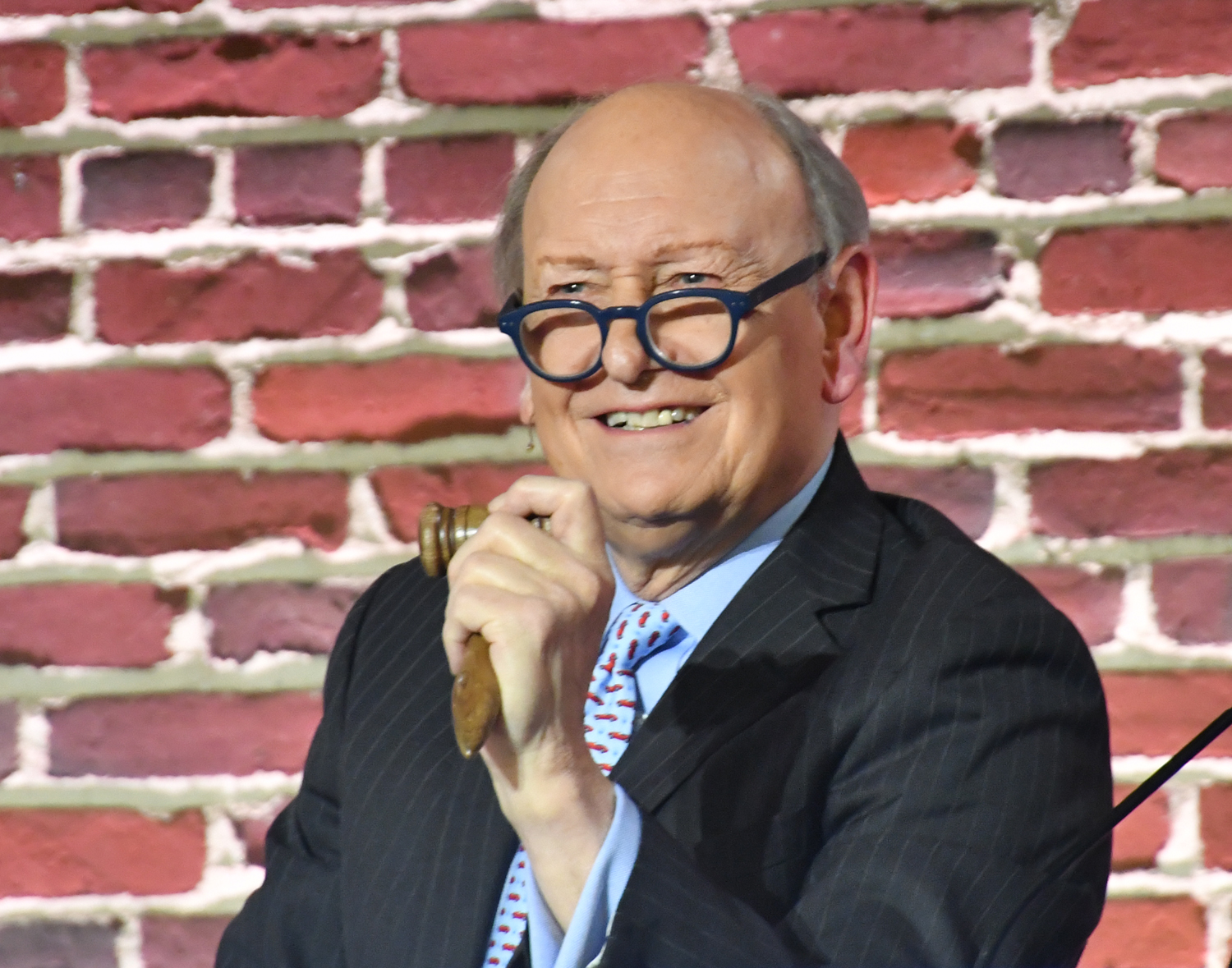
Charlie Ross, Gooding’s Master of the Auction Rostrum

Charlie Ross with David Gooding to his right

Clearly this auction presented an uncommon if not unique set of circumstances that played to my interests. While wiling away time in the Blue Ridge Mountains, I had learned of a Gooding & Company auction disposing of a local collection containing a diverse array of desirable and unrestored classic cars. Even better for me and quite unusual for Gooding, the auction would not be hosted in an expansive and elegant setting capable of accommodating an audience that could easily exceed a thousand.

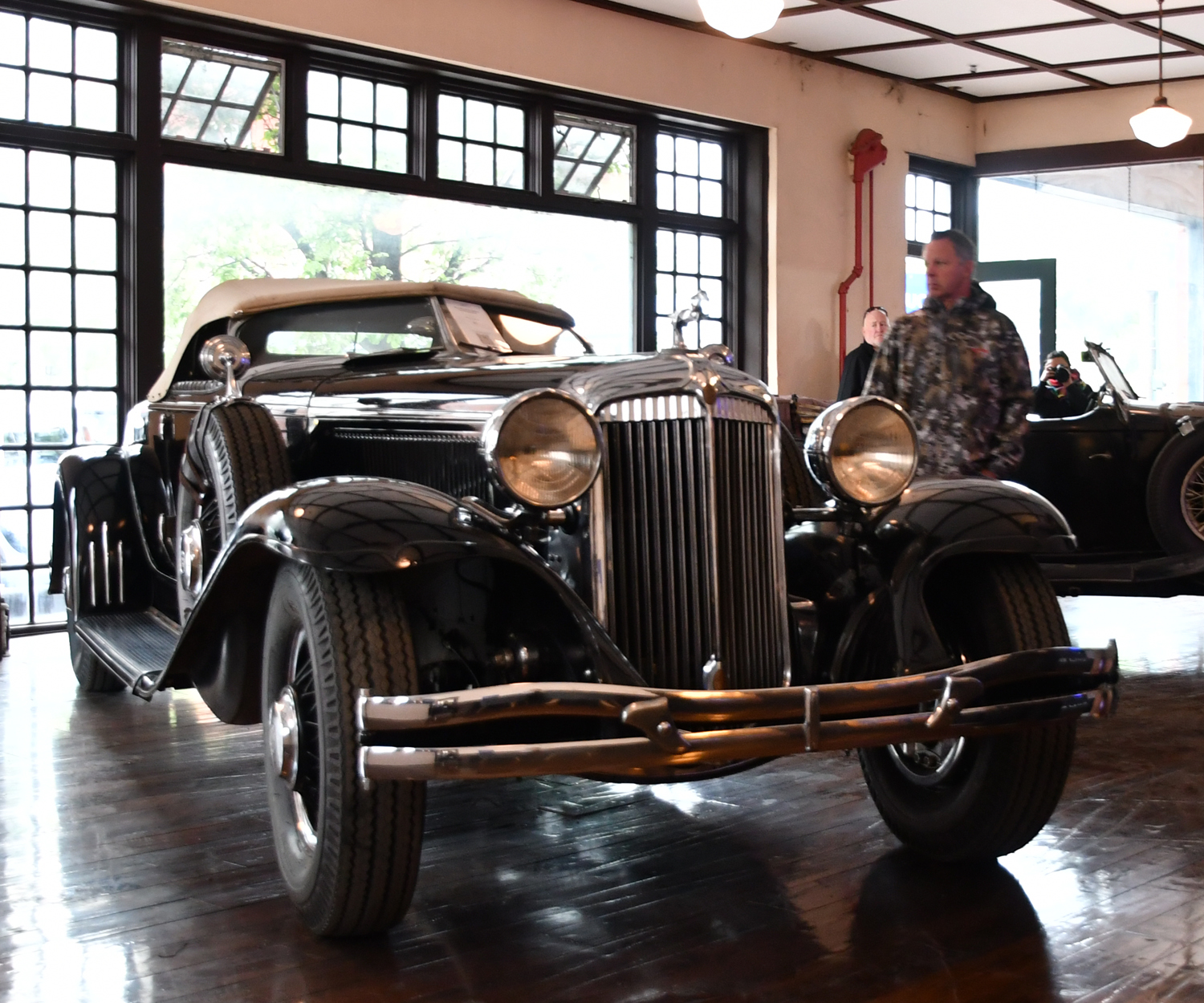
1932 Chrysler CG Imperial Custom Roadster at Lynchburg auction

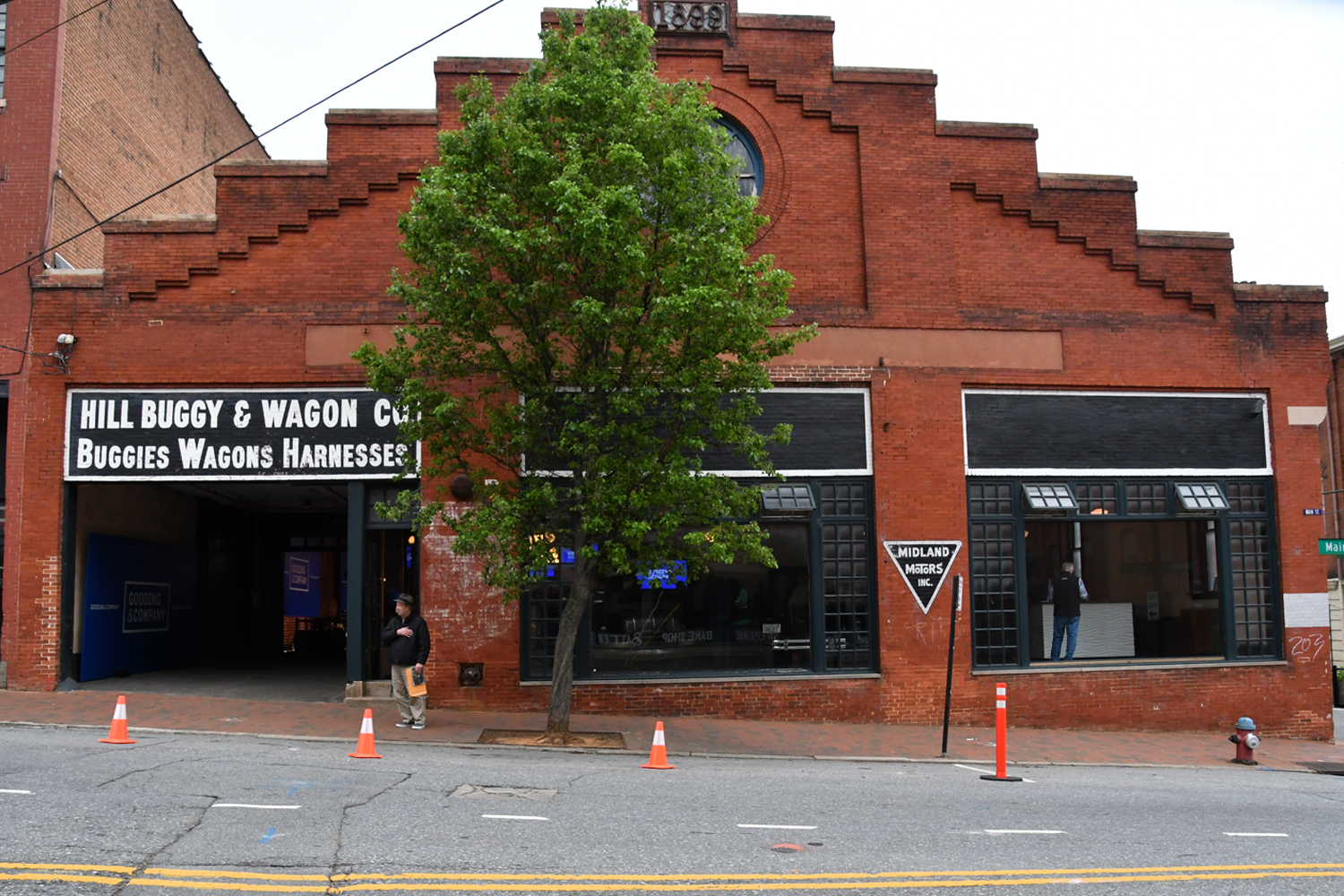
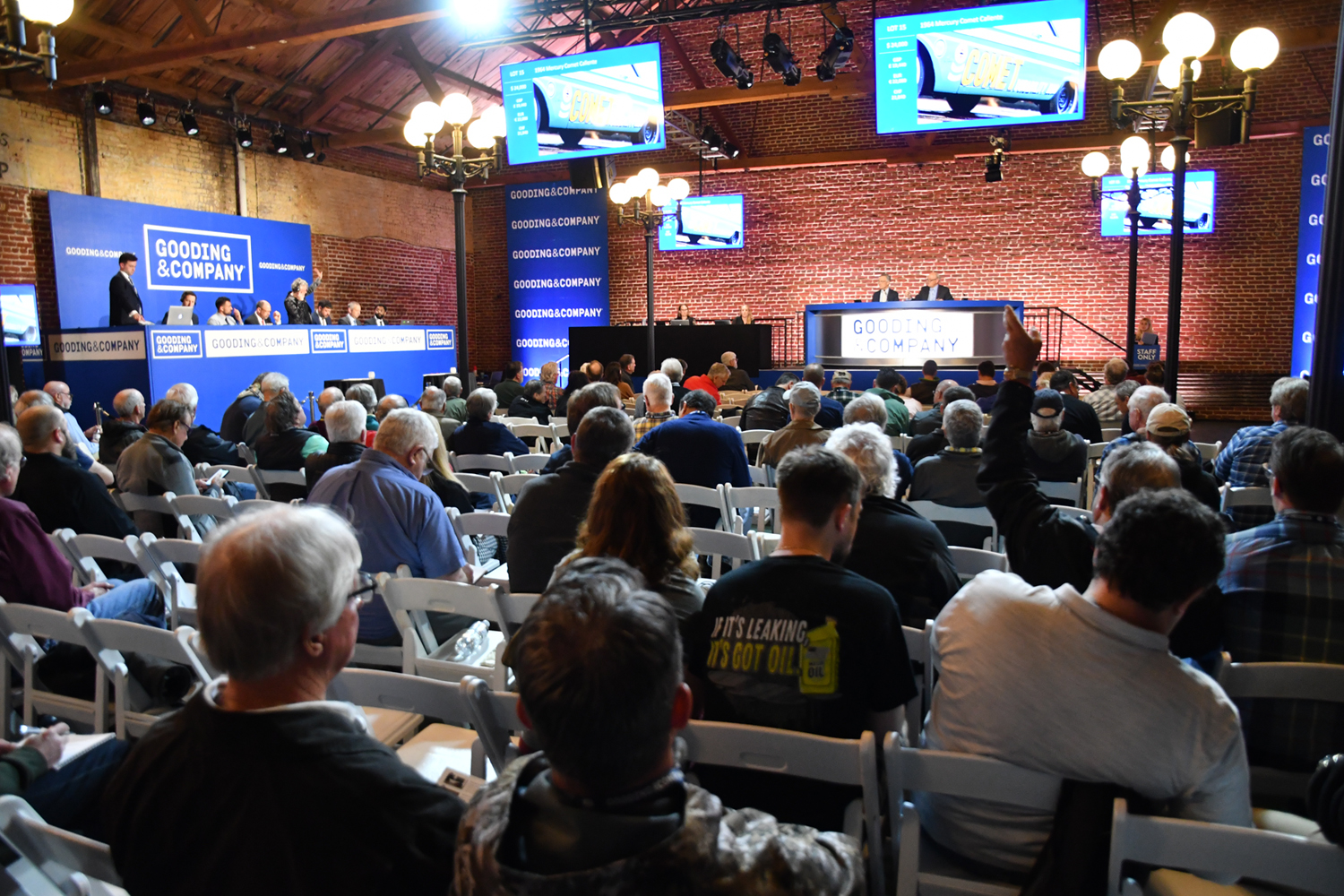
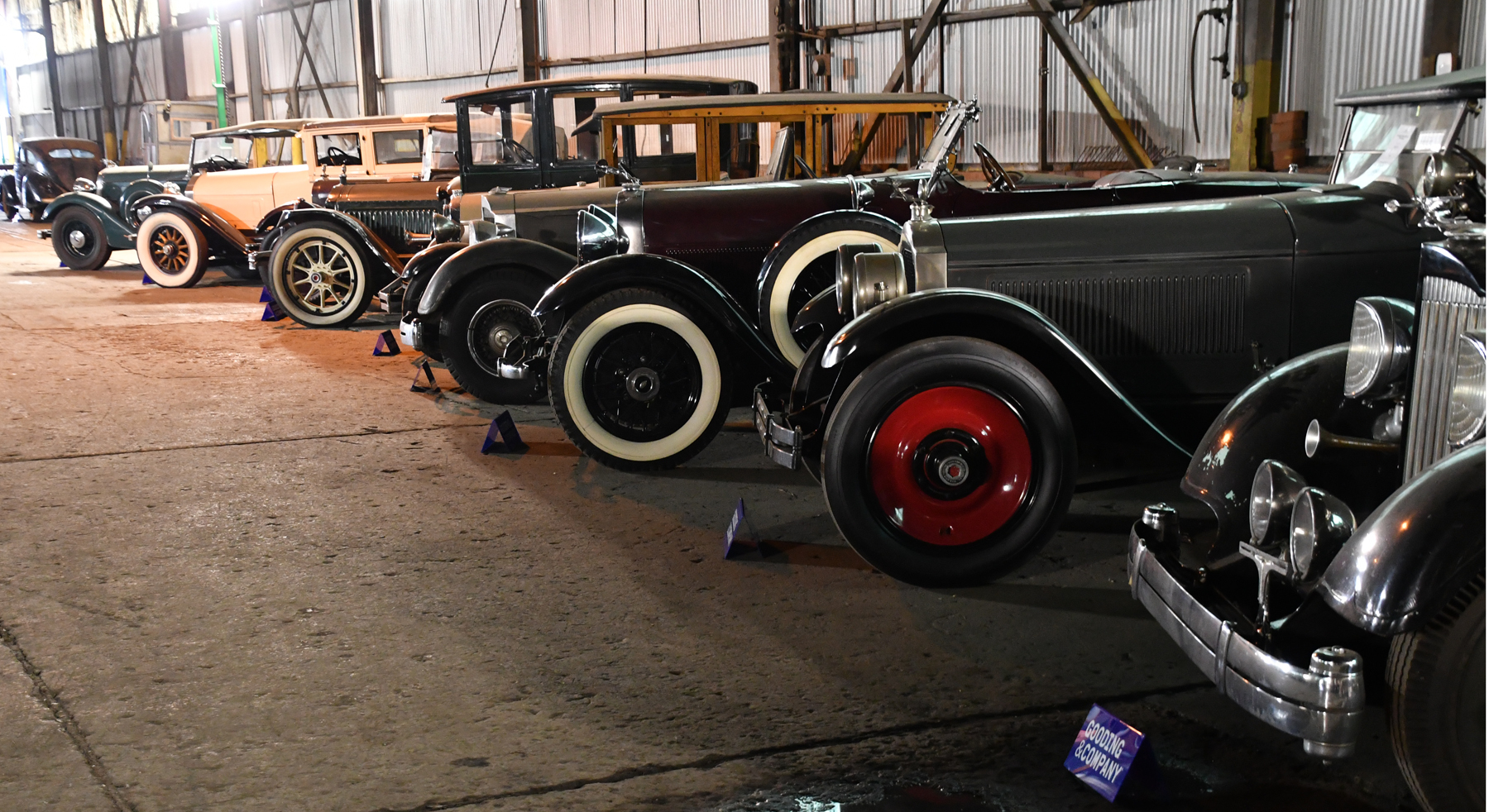
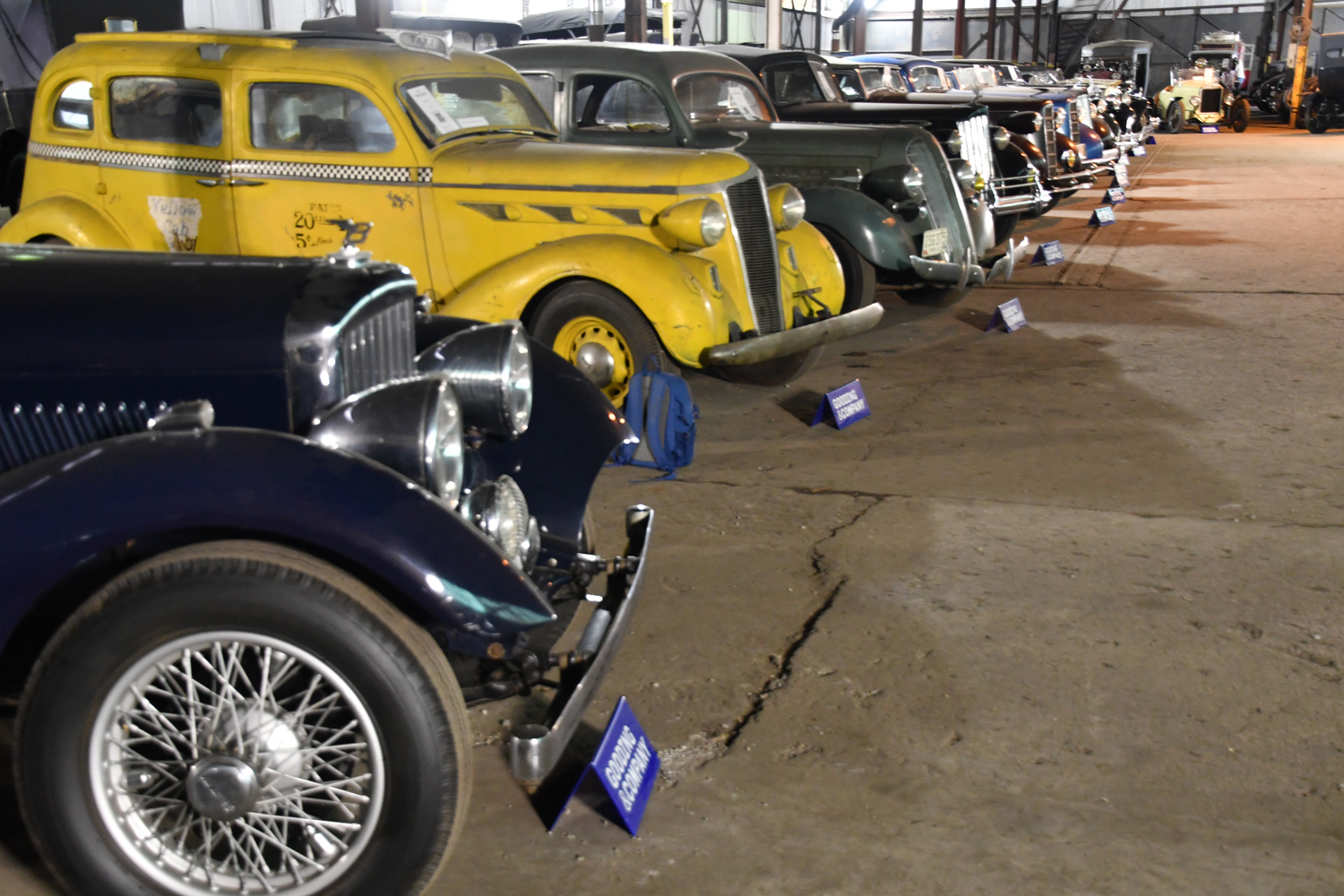
In this instance the feel would be decidedly boutique-like with the action taking place in a well preserved early 20th century Chrysler dealership that had housed part of the deceased owner’s collection. Rich with 1930s charm and character but sparing in space, there would be no elevated stage for displaying the car at bid in the flesh, so to speak. To accommodate the limited space photos of the vehicle being bid upon would be displayed on large screens flanking the rostrum. Up close and personal inspection of the vehicles prior to auction would take place in a nearby warehouse. Being set for April seventh in Lynchburg, Virginia it was only a short distance away for me and just a few days in the future. Best of all, it offered an excellent opportunity to interview the Gooding & Company auctioneer extraordinaire, Charlie Ross.

I had never personally met auctioneer and BBC antiques expert Charlie Ross but I had seen him in action and enjoyed and admired his work.  The following quote says it all:

        “Without doubt the finest auctioneer I have ever seen in action is Mr. Charlie Ross. Charlie’s vast experience and ease on the rostrum,
         combined with his charm and quick wit, enable him to engage and keep total control of a room that is sometimes as large as two
         thousand people.”

Quite the performance review indeed, especially from the man who owns the company. That quote comes from David Gooding, President and Founder of Gooding & Company. For those unfamiliar with Gooding & Company, it is recognized as one of the premier auction houses in the classic car market. One can measure Gooding’s success in the fact that, to date, Gooding holds the world sales records for 12 marques including Ferrari, Porsche, McLaren, Duesenberg and Bugatti. It is not a coincidence that since Gooding & Company’s inception in 2004 the auctioneer for every Gooding auction but one has been Charlie Ross. (A detached retina forced his one absence).

I jumped at the opportunity to request an interview with Charlie Ross. The Gooding staff could not have been more accommodating. Specific thanks go to Gooding Publicist Pauline Pechakjian.

Chrysler dealership (Location of Gooding Lynchburg auction)

Residing at the pinnacle in the field of auctioneering, Charlie Ross exudes the consummate professionalism of an astute English barrister and the awareness of a seasoned entertainer, all leavened with a dry, sly, quick and engaging wit. He puts all of it to work in orchestrating the sale of some of the world’s most prized articles to many of the world’s most wealthy and knowledgeable collectors. Wielding a seamless synergy of superior platform skills with a proper British tongue, Charlie consistently manages each auction in a supremely entertaining fashion while fairly serving the interests of both seller and bidder alike. Charlie’s path to success, however, did not come by way of childhood dreams realized, quite the contrary.

Early on Charlie dreamed of emulating his uncle Mac. Charlie recalls, “Uncle Mac was a dentist who lived at the absolute top of the tree so to speak.” His uncle Mac had a practice on prestigious Harley Street in London. Charlie says, “He was Winston Churchill’s dentist, Bob Hope’s dentist. The list of notables goes on and on.” In Charlie’s mind his future had been decided. He would be a dentist to the rich and famous just like his Uncle Mac. However, taking the entry exams required to pursue a career in dentistry quickly quashed Charlie’s dreams of a rich and fulfilling life fixing teeth. Apparently Charlie’s many gifts did not include those necessary for success in dentistry. However, his future held in store a vocation that would involve him with a cohort not unlike that of his Uncle Mac.

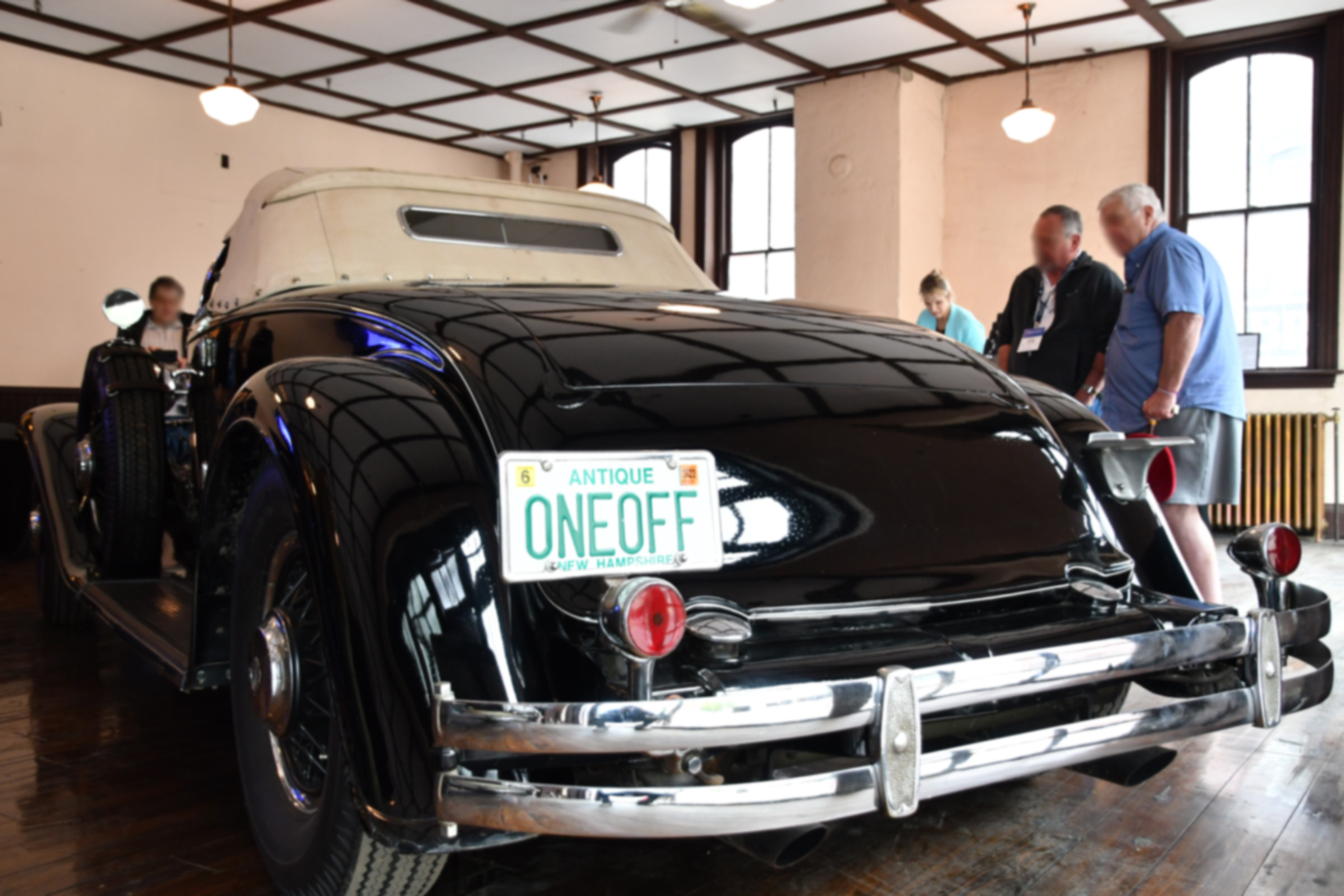
1932 Chrysler (rear)

Plan “B” commenced with a reversal in family fortunes that dictated that Charlie, then 18-years old, find work, Now! Two choices presented themselves. One dealt with processing fuels. The other offered an opportunity to join a firm of local auctioneers who Charlie says, “Sold your house, your farm, your chickens, your furniture and so on.” Charlie’s decision clearly favored poultry over petrol. He joined the auction firm of W.S. Johnson & Company in September of 1968.

By October first Charlie found himself auctioning pens of chickens in England’s open air Bletchley Market. As Charlie proudly relates, soon afterwards his auctioneering skill elevated his status to auctioneer of turkeys. Proudly recounting his success with turkeys, Charlie says. “In the week before Christmas in 1968 I sold 967 dead turkeys, individually. What a triumph that was for my career.” He began sensing the seeds of a future. Indeed, his vision proved out. As his employer had an auction room for antiques, Charlie quickly advanced from avian auctioning to gaveling antiques. In retrospect, no doubt could exist that this opportunity would set the course for the rest of Charlie’s life. And Charlie remembers the moment the die was cast.

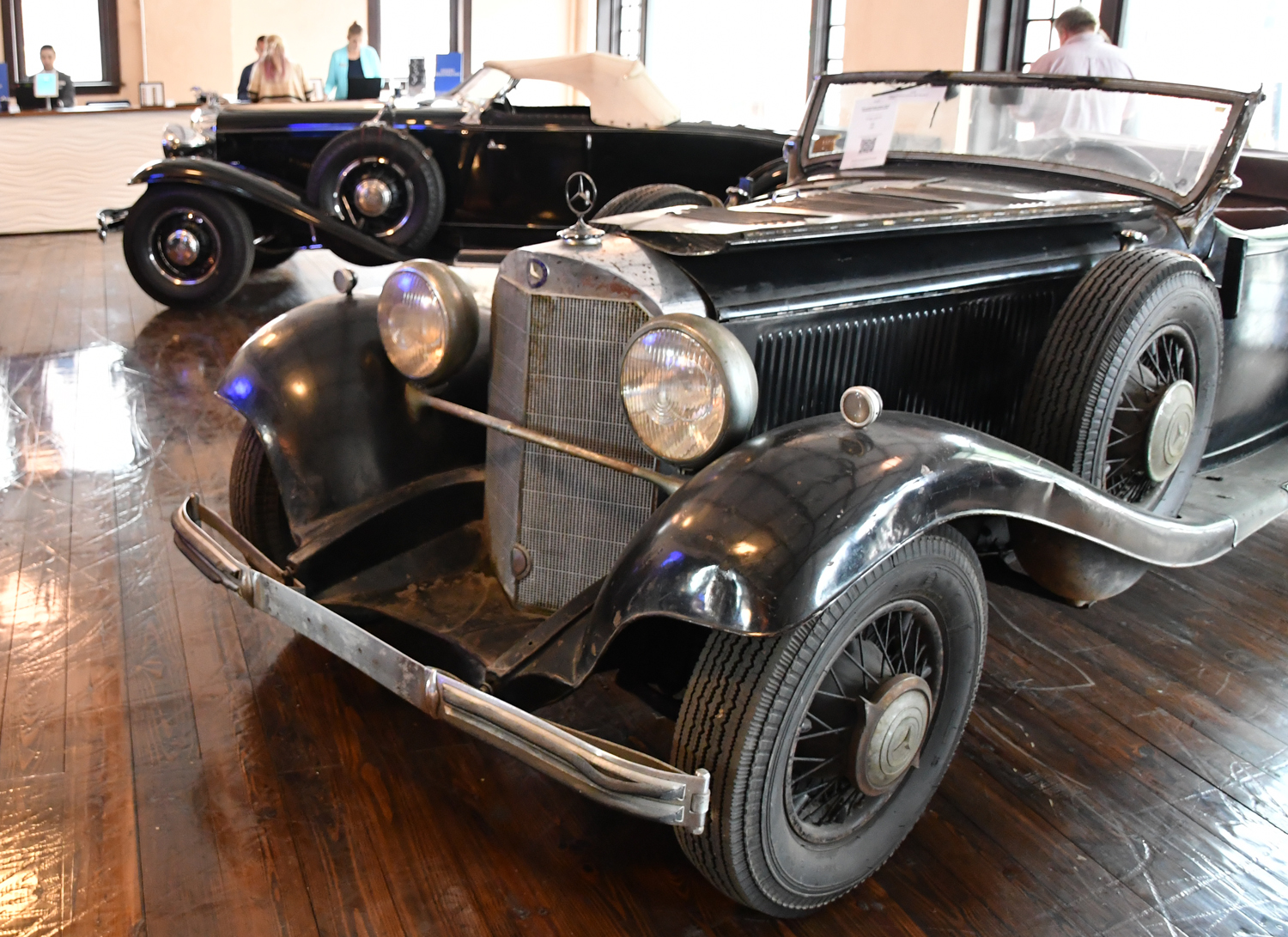
1934 Mercedes-Benz 500 K Offener Tourenwagen (in foreground) at Lynchburg auction

Charlie remembers clearly saying, “In the furniture auction room I was working for a fine man named John Collins who was a superb auctioneer. It was at that time, I was 19-years old, that I fell in love with antique furniture.” Charlie would stand in the back of the auction room and soak in the beauty, craftsmanship and history of the pieces that would cross the auction block.

The pivotal moment in Charlie’s life arrived when John Collins, in the middle of an auction, stopped the action to inform the audience, “Ladies and gentlemen Mr. Ross will now take over.” With that the wise John Collins surrendered the rostrum to the very young Charlie Ross who Collins knew was ready. Charlie says, “It was the best possible way to do it. It gave me no time to worry. Just do it.” Charlie did. Indeed there would be no stopping him. By 1983 he had his own saleroom. Then came the big break.

By the turn of the new century, Charlie, with his passion for antiques and a special love for Georgian furniture, had become somewhat of a BBC personality. His encyclopedic knowledge of antiques had him featured on BBC programs like Antiques Road Show, Flog It and Bargain Hunt.

Then around 2003, a dear friend of Charlie’s, Peter Bainbridge, an accomplished auctioneer working with RM Auctions (now RM Sotheby’s) told Charlie that he had recommended him to David Gooding who had been President of RM Auctions. Charlie says, Apparently David expressed to Peter his intention to launch his new venture, Gooding & Company, with its first classic car auction. It would be at the prestigious Pebble Beach Concours d’Elegance in 2004. David told Peter that he had the site and the cars but needed an auctioneer. Charlie fondly remembers saying, “Peter proving our close friendship advocated on my behalf saying, there’s this funny old chap in England. While he’s got no car experience, he’s got a saleroom in Wobern and he’s a good auctioneer. In my opinion you two would get on very well.” David and Charlie did and the rest is auction history. Charlie offers very forthright answers about what others describe as an incredibly successful career at the Gooding rostrum.

“No,” admits Charley, “I do not know vintage cars like I know antique furniture. Gooding & Company’s expertise equips me with a detailed knowledge base beyond what I need to successfully manage the auction of the kind of top tier vehicles that cross the Gooding block.”

When asked how he has earned his reputation as a master at maintaining control of a room Charlie says, “Achieving and maintaining control? Have a clear voice. Sound authoritative but flavor it with a certain light-hearted air.” Charlie believes strongly that if you get people on your side they will do what you want them to do. He also makes very clear the penalty exacted by being too domineering. He says, “If you get too dictatorial the audience will rebel. Most everyone likes to take the “Mickey” out of someone that’s a bit too full of themselves.”

Charlie benefits as well from the presence of one particular colleague working the phone lines. That would be his wife, Sally Ross, better known in auction circles as Lady Ross. One of Charlie’s great interactions with Lady Ross came during the 2018

Audience at Gooding Lynchburg Auction

Gooding auction of Miles Collier’s 1935 Duesenberg SSJ once owned by Gary Cooper. In a positively electric auction environment approaching a frenzy, bids had blown by the low estimate of $10 million. Charlie smiling at the recollection says, “It was quite apparent that there were two people who really wanted that car at almost any price.” Lady Ross was going strong representing one bidder on the phone. Then with the bid having reached $15 million on a phone bid from the other bidder that drew a gasp from the crowd all eyes turned to Lady Ross. With exquisite timing in a room positively rocking, Charlie paused the bidding, and turning to Lady Ross at the phones across the room, said, ”Ladies and gentlemen hold on for a moment please. Lady Ross, you’re not bidding on your own behalf are you?” She said no and the room burst into laughter. To complete the story, the bidding carried on with Lady Ross dropping out at $19 million. The winning bid plus buyer’s premium reached $22 million.

Charlie says, “What a wonderful experience. You could feel the warmth of the crowd coming with you, everybody’s on your side, they’re on the bidders side. The crowd pulsed with the intoxication of a special moment when expert estimates were cast aside by a passionate desire shared by two people of means intent on possessing something exceptional, whatever the cost. It was a very, very exciting moment.” The $22 million result set a standing sales record for all Duesenbergs and, in fact, all Pre-WWII cars.

When asked if he has any preference for audiences, Charlie clearly prefers a crowd. He says, “It’s very possible to create a good atmosphere with fifty or sixty people in attendance.” That said, Charlie’s style and energy delivers the power to drive the largest of rooms. He makes no bones when saying that a very small live audience with most of the bidding offsite leaves precious little kindling to heat the room.

Vehicles for inspection at warehouse

A Brit by birth, Charlie finds members of different cultures express distinct personalities when participating in an auction. Charlie says, “I have conducted auctions in Mumbai, India. The mood there clearly projected a greater seriousness than say in American. Though the bidding was not on cars but footballer contracts.” He does believe Americans are better audiences. He says with conviction, “They are more fun, you know. At a Pebble Beach or Amelia Island, there’s somewhat of a party atmosphere. Of course, there are people there prepared to spend $10 million, $20 million. There’s also a lot of people there who are there just for, what the Irish would call “the crack” you know, the fun and the jollity.” When it comes to the English, not as much fun.” Charlie says, “In England people that deal in cars at the top end, in my experience, take themselves a bit more seriously. Without any justification I might add. They can be a bit arrogant. And I am an Englishmen talking.”

Vehicles for inspection at warehouse

Clearly reading the audience demands a specific skill regardless the venue. When asked Charlie says, “Experience experience. I do think rooms differ depending on what you’re selling. You know, if you’re selling chickens to a bunch of farmers, they are a very different breed from car collectors with million pound bids

at the ready.” However, Charlie emphatically states, “Everybody is a human being and responds well to being understood. If you can relate to them, whether being serious, or having a laugh or appreciating the spectrum of emotions in between, meaningful communication will occur.” Charlie says, “That is where I would like to believe my skill lies.”

Clearly a most important skill at the rostrum stands as the ability to “tease” out a price. Charlie says, “A little humor bordering on flippancy can provide a hesitant bidder with an appropriately gentle nudge to action.”

An example used by Charlie describes a situation where bidder “A” bids $1.1 million and bidder “B” bids up to $1.15 million. Clearly the pressure rests on bidder “A” and Charlie would like to see him go to $1.2 million but the bidder has turned hesitant. Here Charlie remarks, “I might take the liberty to suggest that, well frankly, if you’ve got $1.1 million you must have $1.2 million. It can work but other times a bidder has established a hard line. Then he will just smile and hold firm with his “no.”

Nobody has enjoyed a better seat to view the evolution of the classic car market and value trends at auction than Charlie. From everything he has witnessed, He says, “ First and foremost, the top-end has always ruled.” Someone once asked Charlie what were the cheapest lots he had ever sold in his saleroom. He responded, “The most expensive lots were the cheapest because ultimately, the number one lot is what everybody wants now. And subsequently, when it comes on the market again, in 5 years, 10 years or 20 years, everybody will still want it.” He has seen that the best or most expensive items over time, almost as a rule, gain in price. For more run-of-the-mill items, that does not necessarily hold true. He says, “Buyers don’t necessarily want the second grade or the third grade but the best is always the best.”

As to the tastes prevailing in the current marketplace Charlie expressed a clear opinion saying, “Modern, modern, modern seems to be the way forward. Modern and low mileage.” In referencing the cars of the Mark Smith Collection that would be crossing the auction block the following day, Charlie offered some pointed comments. With a hint of concern He said, “Interest in modern seems to trump pre-war vehicles. I am hoping that assessment will be proven wrong tomorrow. I say that because a lot of these wonderful cars in the Mark Smith collection are pre-war cars.” He went on to reflect on the tilt toward modern in bidder interests saying, “We’ve seen an explosion of interest in Porsches and Ferraris from the last twenty years, low mileage examples.”

Charlie shared his perspective on the interest expressed in modern cars by younger bidders, those referred to as “Youngtimers.” He reflected with a nod to the reality that the wonderful old collectors in their 80s and 90s, like old auctioneers, will not be with us forever.

SOLD!

He observes that despite their glorious nature and head-turning beauty, pre-war Olympian cars such as Duesenbergs, Packards, Lincolns and Cadillacs do not deliver the enjoyable driving experience offered by the modern tier 1 collectible. Charlie says, “I don’t believe the younger car enthusiast wants to be worried about whether his prized car will start or stop. Many don’t want to deal with it. I question their desire to stick their heads under the bonnet. They desire a car that can be driven with ease and enjoyed with little concern for reliability.”

In considering the buying population he serves, Charlie says, “I would like to think that the person buying these best cars is  cut of the same cloth as a chap with a Ferrari 250 GTO who turned up at one of our auctions driving it. This is a car worth $30 million, $40 million. He parks it outside and the people, this happens to be in England, are shocked by his driving it. The owner’s response, ‘Of course I bloody well drive it. It’s a car.’”

In closing, Charlie, in considering the David Gooding quote, admits, “There are a lot of auctioneers in the world, David’s comment makes me feel very warm. It makes me think that, in life, there is one thing I can do well.”

Very well, indeed.

By |2023-04-27T13:57:37+00:00April 27th, 2023|2 Comments

Cars We Love & Who We Are # 36

Alone with my thoughts I cruised along quiet slender two-lanes. They meandered through the forests and cleared farmlands of the piedmont that connects the downslope of the Blue Ridge Mountains to the coastal plain. While nearly an hour of driving remained, having left the main highway behind, few cars would interrupt my peaceful reverie. Though launched on my journey by the tales shared by acquaintances, no words could have prepared me for what awaited.

Stories about vintage vehicles strewn about forests and festooned with vines and violated by trees tend to deliver far less than promised or hoped for. Not so this time, by a long shot.

Meet the man trapped by a forest of trucks.

Trapped by a forest of trucks

Speaking with me on the phone the day before, Glenn Duncan, President and majority owner of the well respected P.L. Duncan Trucking,  had responded to my request to photograph old trucks on his property by welcoming me in a most accommodating country manner. Now I found myself approaching ground zero for the “trucks in the forest” legend.

The soothing voice of my WAZE dashboard Sacajawea said I had arrived as she directed me to take a right onto a rutted dirt road leading to a sprawling farm. Where I am from, to be judged “huge” a field required the space to accommodate a regulation football game. The parcel surrounding this dirt road qualified as “country huge”. That meant it could accommodate a professional football stadium and much of the parking. Shortly I realized that this was one of Glenn’s fields, just not the one I sought.

Proceeding further along the main road brought into view an expansive woodland area to my left. A large clearing carved from the forest and populated with a number of huge sheds had at its center a sturdy brick building that had once been a country store. Encircled by a neatly arrayed necklace of rugged semi-tractors from bygone decades, the old store served as Glenn’s office and home to a decidedly personal automobilia collection.

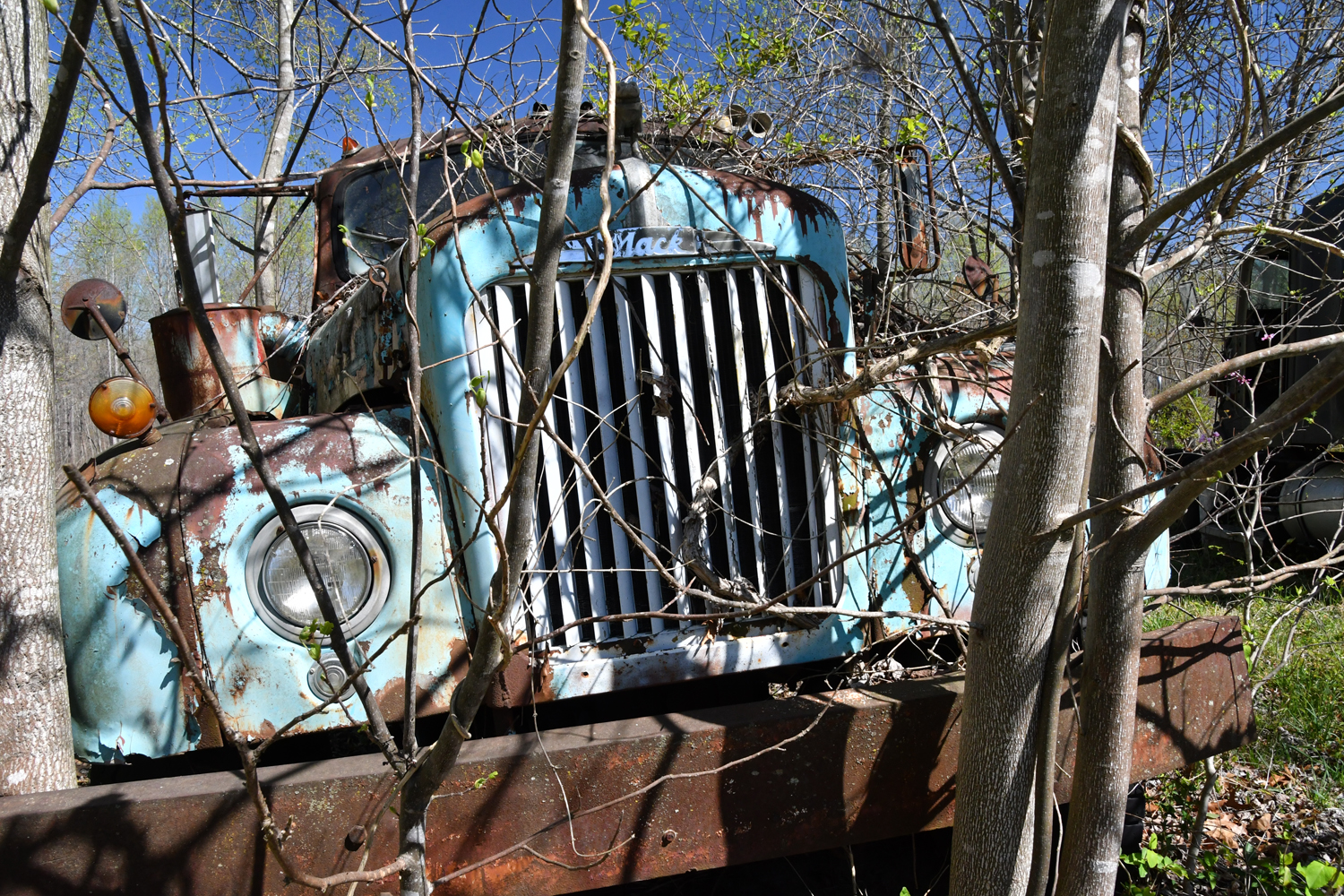
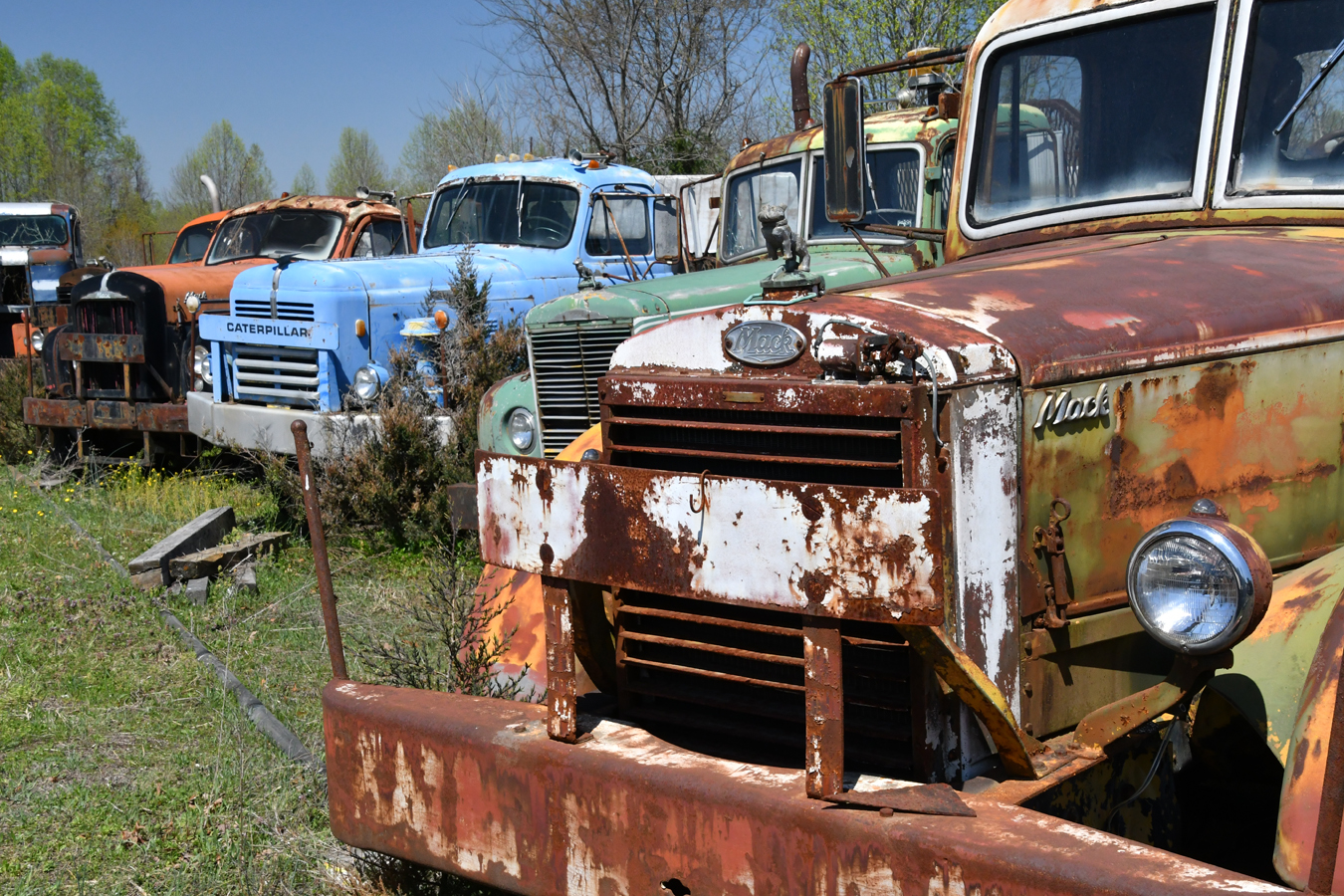
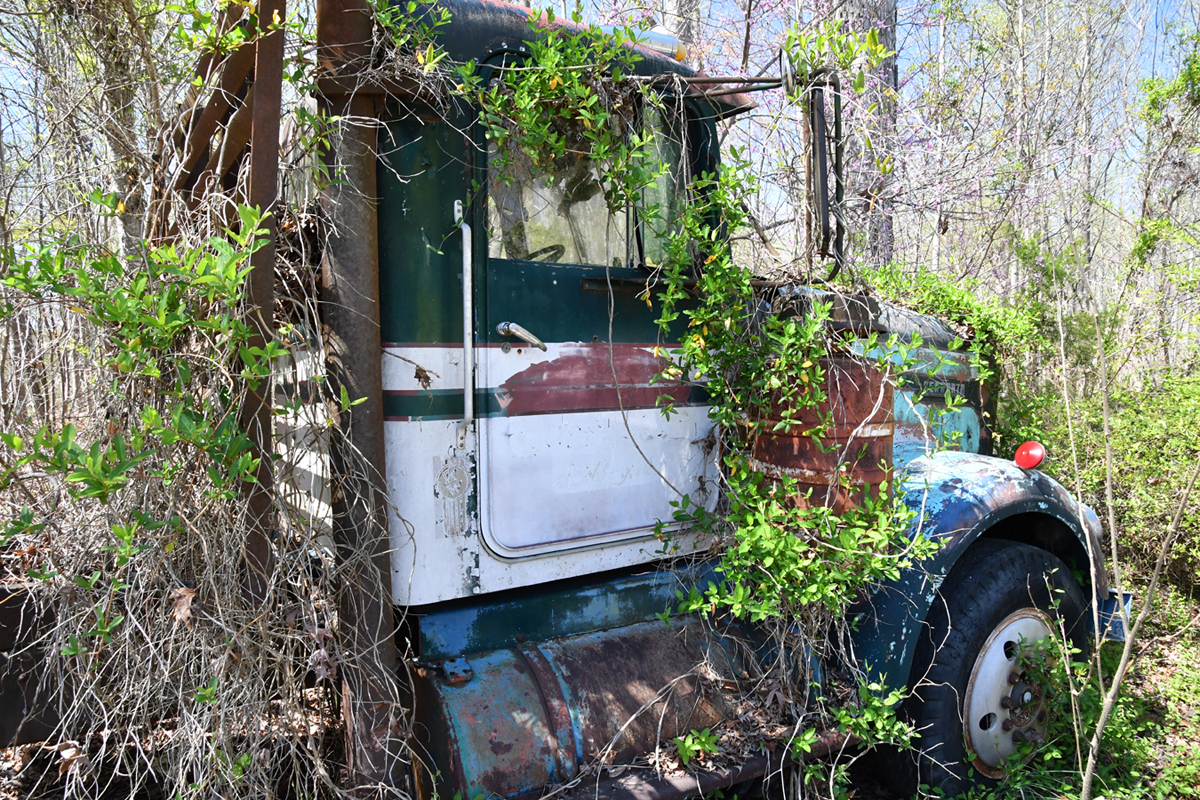
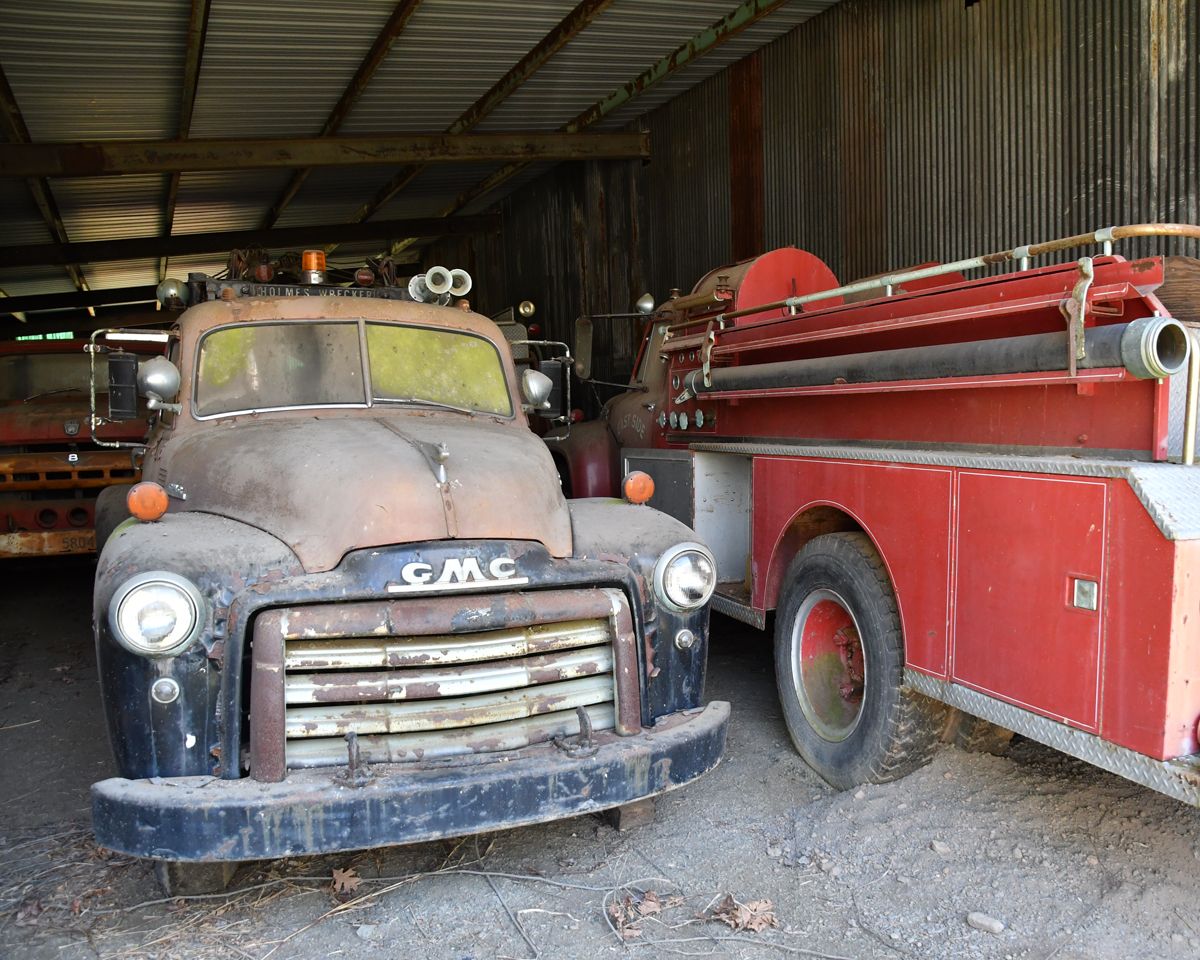
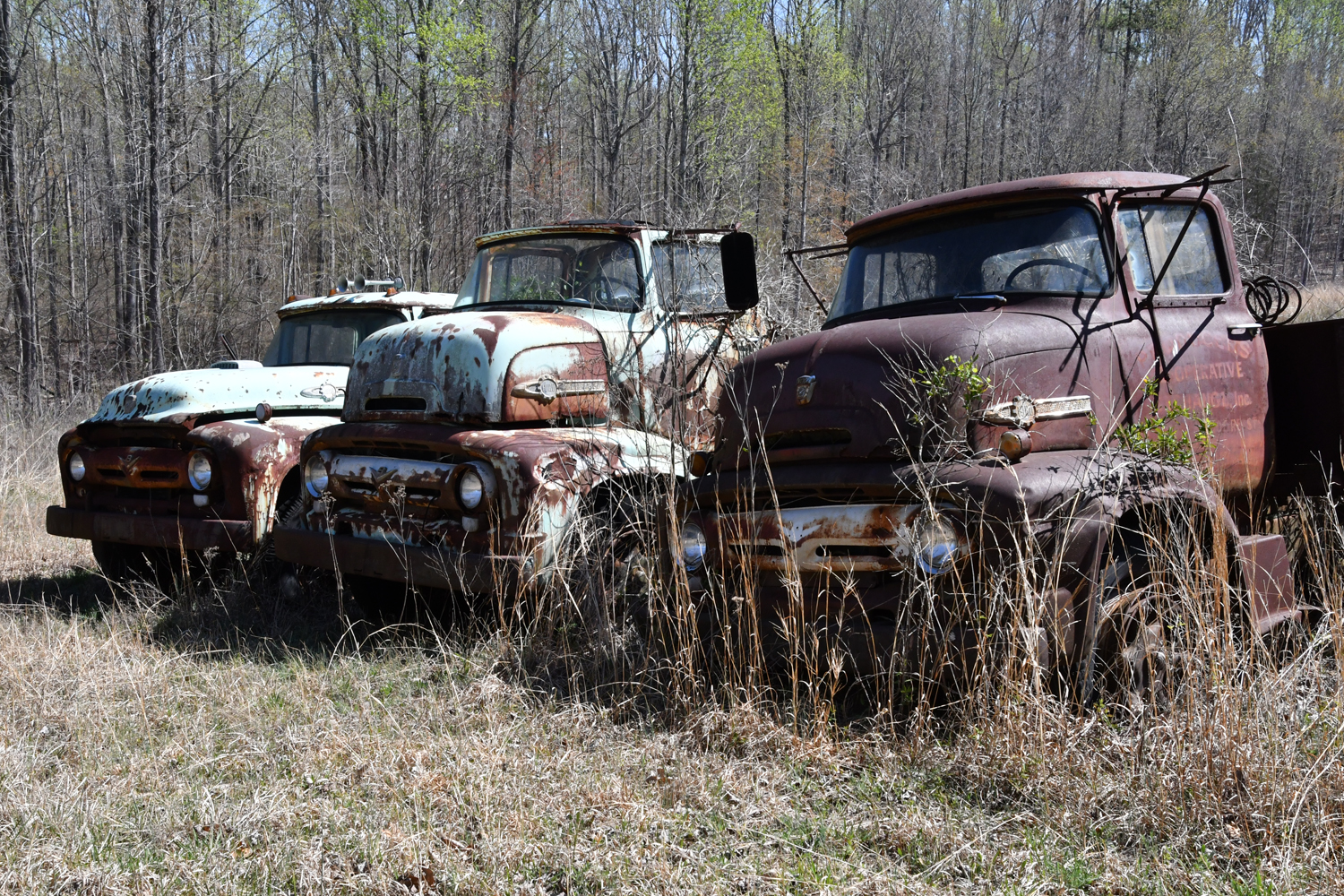
Walking across the dusty parking lot, ranks of rusted truck hulks in various states of decline faced out proudly standing shoulder to shoulder. Like a ghostly honor guard at attention for a military wedding, cab-overs, bullnoses, conventionals and sleepers with brands across a spectrum including Macks, Whites, Corbitts, Studebakers, Kenworths, Peterbilts and Fords held a silent vigil.

Of sturdy design and substance, the repurposed old brick store with its large display windows gave the feeling of a portal into the past as I approached its weathered front door.

Entering via the wooden doors to old stores seems accompanied by a comfortingly familiar soundtrack of creaking wood, squeaking hinges and, from somewhere, musical notes born of bells on a strap that lifts the spirits in a way that instills a brief heartening sense of “good old days.”

Welcoming me while cradling in her arms one of the happiest babies I have ever witnessed, Grandma Kim the part-time bookkeeper, informed me that Glenn would be back in an hour or two. Without diverting her attention from 8-month old grandson Levi, Grandma Kim said, “Glenn says you are welcome to explore to your hearts content.” I figured I had already seen pretty much all to see during my entrance. I could not have been more wrong. Much like the stone lions that serve as silent sentries at the entrance to the New York City Library, the row of historic over-the-road semi-tractors simply served as greeters to the extraordinary content that awaited a visitor with curiosity, good hiking boots and long pants.

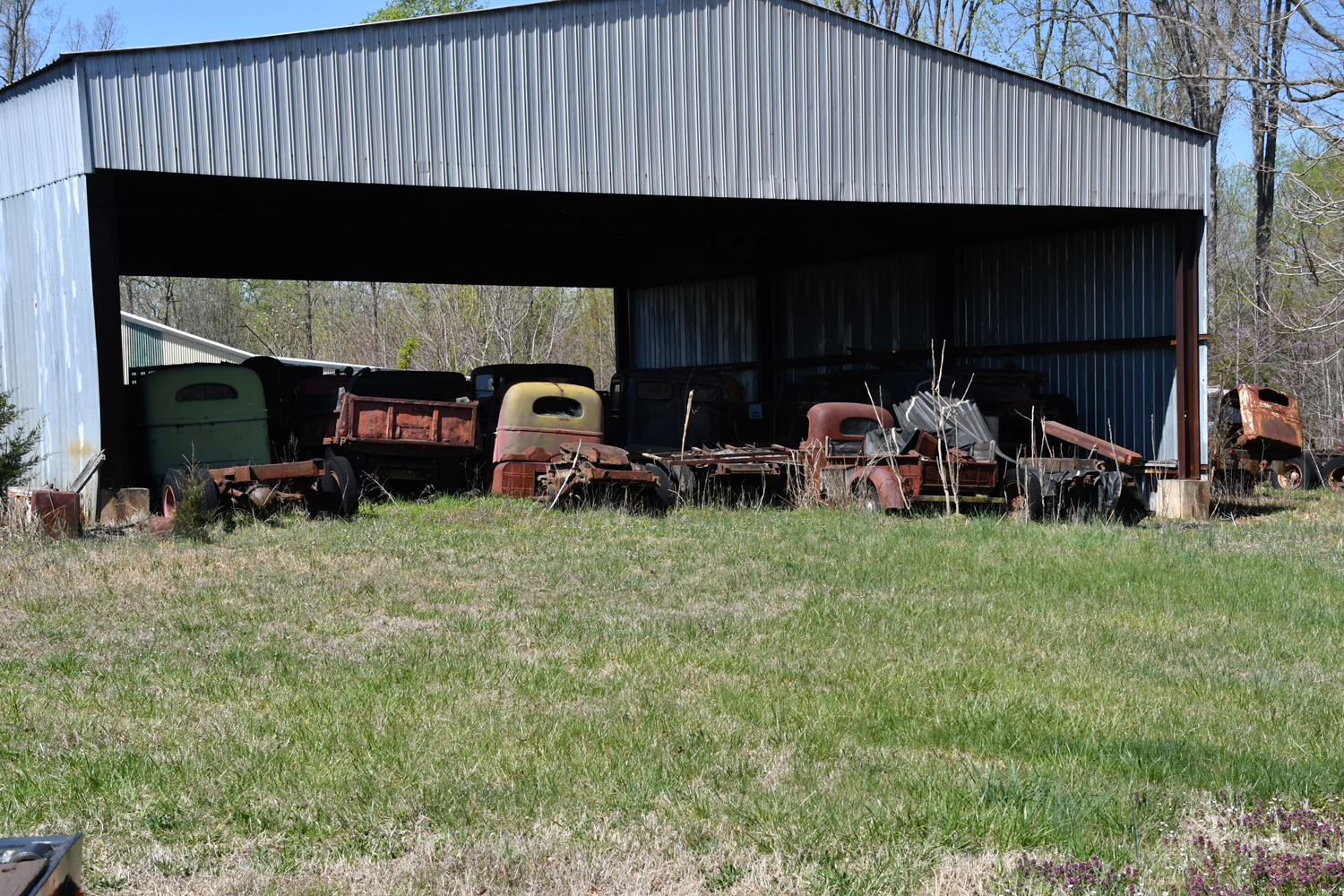
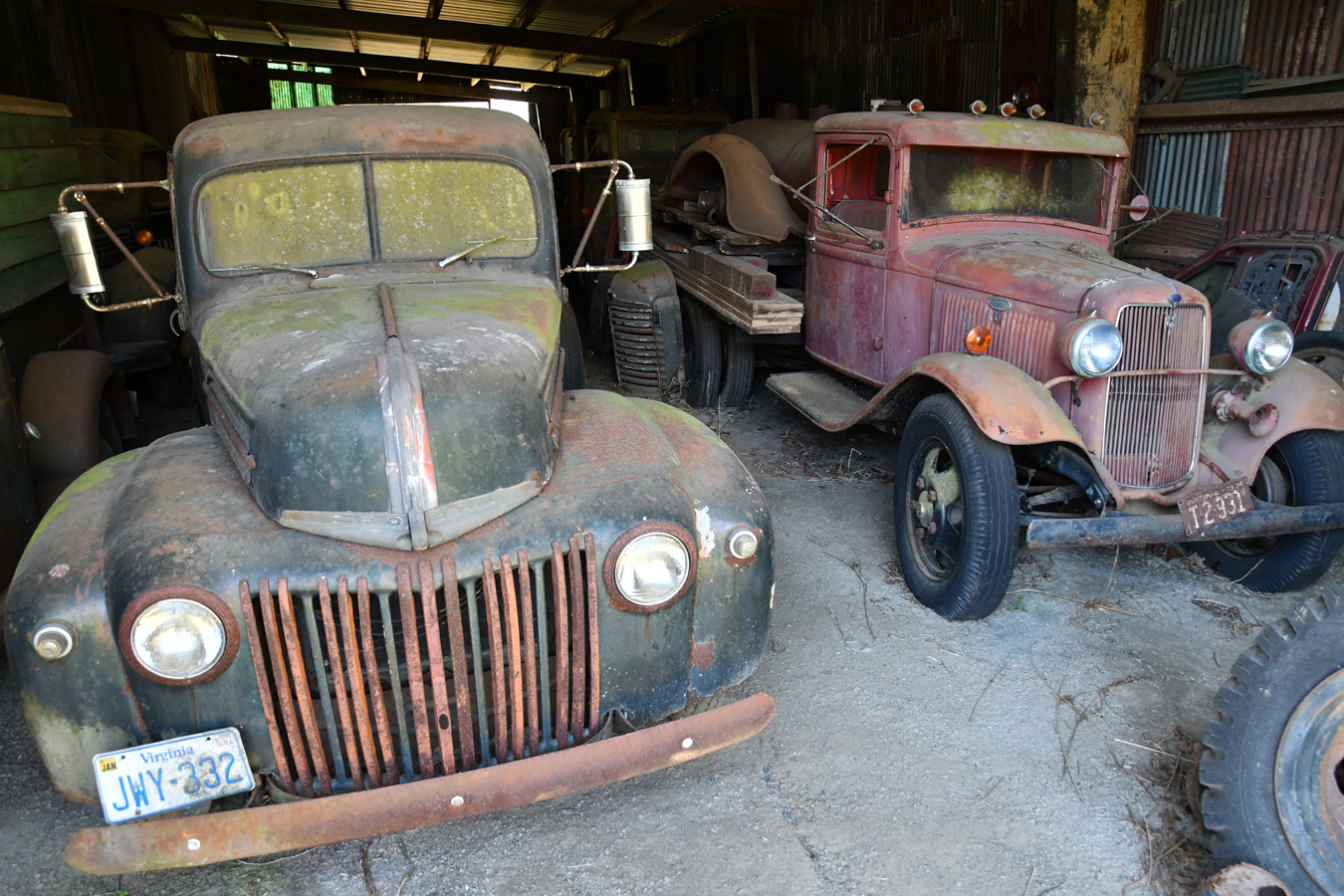
I walked across a broad hot flat expanse paved with white stone dust that kicked up at the slightest urging of any passing vehicle. I approached an open airplane hangar-like structure on the edge of the forest. Inside hidden in the shadows of a bright high noon sun sat an eclectic array of 1930s pick-up trucks to 1960s conventional Peterbilts. A light blanket of dust blanketed everything in view. To navigate among the entombed occupants for a closer look would be nearly impossible as the vehicles had been stored in a manner not unlike an overstuffed Manhattan parking garage. This impenetrability would be a challenge faced repeatedly during my exploration of this elephant burial ground for hard working vehicles with past productive lives spanning much of the 20th century. However, much of what awaited would be found bleaching naked in the sun.
Entering an expanse richly populated with thorny bushes and clusters of weathered mid-2oth century truck carcasses, the ever present barbed shrubs clung to me like clawed groupies at a rock star convention. I persevered.

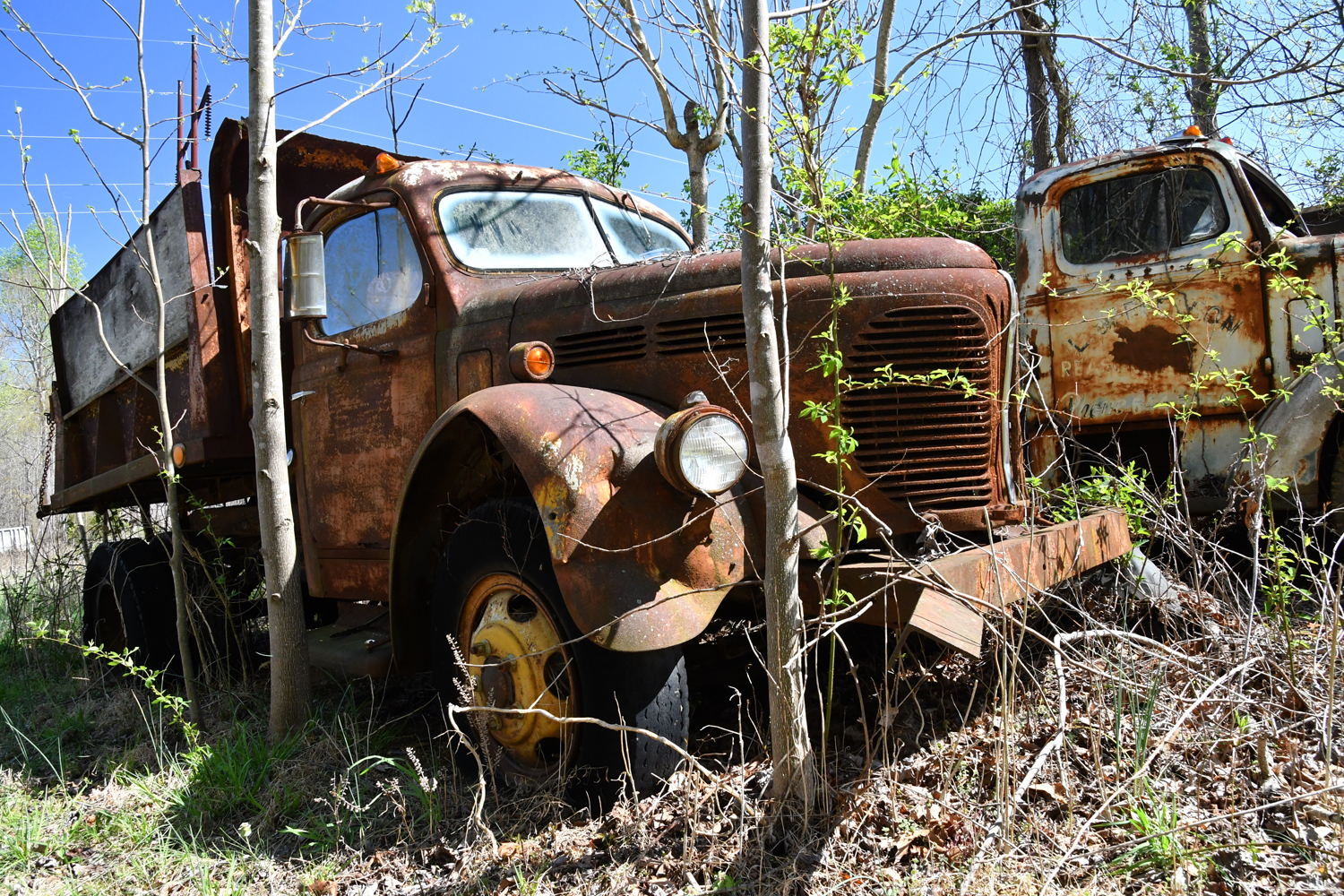
Approaching the surrounding forest served as an introduction to the immensity of what I had chosen to document. Intermingled with trees, and at times embedded in them, rows of medium and heavy duty trucks and semi-tractors populated the woods like ghosts in an abandoned graveyard. A phalanx of mid-fifties cab-over Fords led to a stand of trees that provided a resting place (final?) for a collection of late 1940s dump trucks, pickup trucks and semi-tractors. Big rigs cocooned in webs of vines could be seen in every direction. Vintage trucks of all makes and models languished ensnared in and bound by forest growth that would accelerate the inevitable dust to dust eventuality. Other trucks of all stripes baked in the sun. Burly tandem tractors sitting like great beached ships devoid of life, yet defiant, faced off against the ravages of time.

Another mammoth shed appeared chockablock with tow trucks, fire engines, stake bodies and more. Frustrated by how they had all been packed nose in from both sides rendering them un-viewable and, thus, impossible to photograph, I moved on.

I walked resigned to shredding my pants on the omnipresent barbed plant life. Big B Series Macks revealed themselves to be as common as pigeons in the park. L Series Macks enjoyed a large presence as well.  A wealth of 1930s, ‘40s and ‘50s pickup trucks in all states of condition could fully populate a Cars, Coffee and Conifers all their own. I hiked and photographed for hours consistently agog at this woodland museum’s historic contents. As I returned to the office in hopes of seeing Glenn, my experience in the woods can only be described as overwhelming. Oh yes, one other interesting fact, I only had the time to explore half of Glenn’s graveyard forest. OMG!

Unprepared for my walk in the sun (Raise your hand if you remember that Dane Clark movie) the clear bright 80-degree day had left me parched and fatigued as I dragged my weary butt back to the office and Grandma Kim. “Like a bottle of water?” she asked mercifully. She went on to say that Glenn had not yet returned and she could not be sure when he would. However I could wait in the air conditioned office if I wished. Yes, very much thank you.

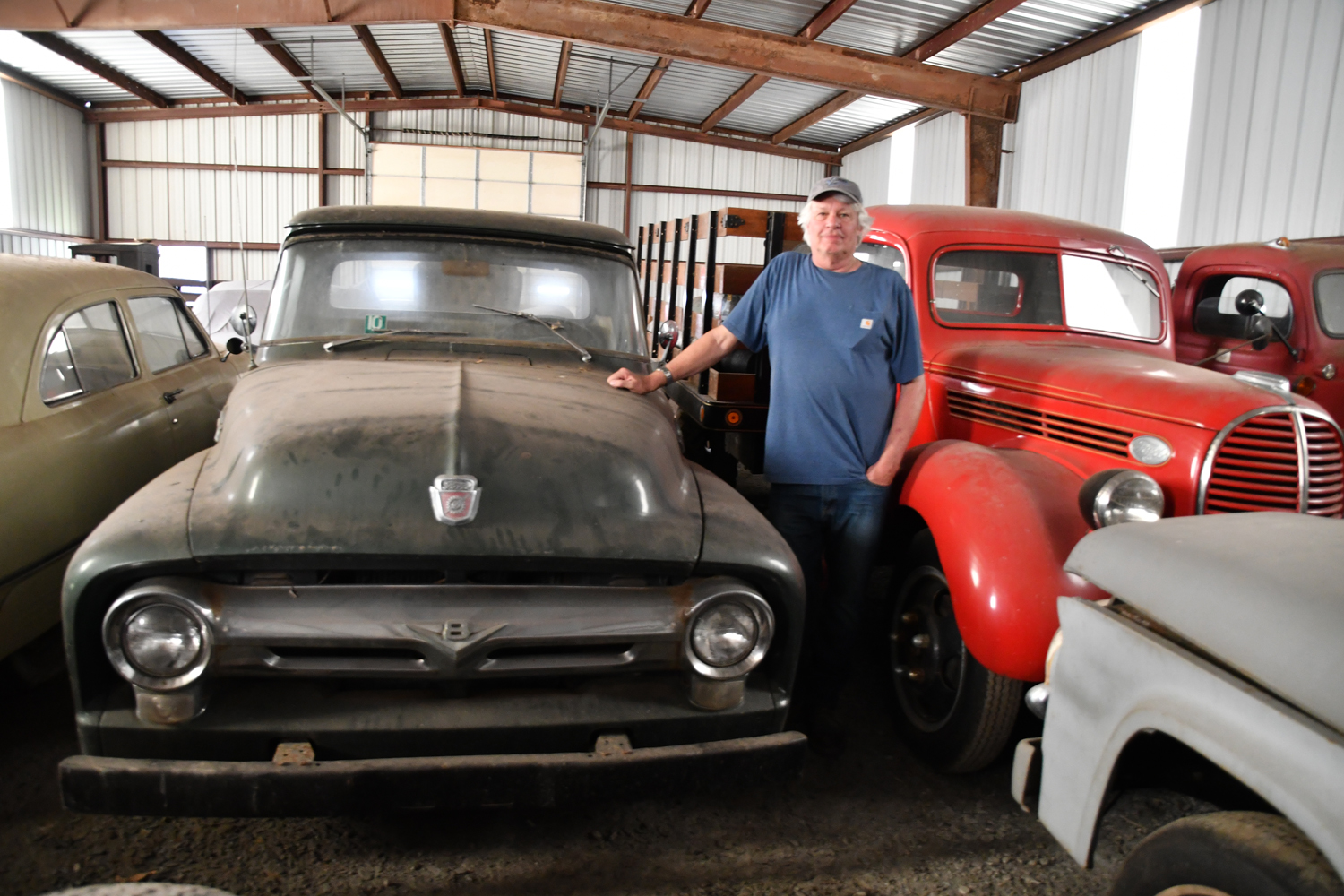
Glenn with the 1956 Ford F100 he drove in high school

Finally just as I got up to leave, a bright yellow Kenworth pulling a gleaming stainless steel tanker rumbled into the lot creating a swirling storm of stone dust. I was about to meet Glenn. In his early 60s, hard working, tall, in good shape with a mop of snow white hair spilling out all sides of his blue baseball cap, Glenn welcomed me with an easy neighborly manner. After first attending to his immediate business needs, Glenn said he would find fifteen minutes to spare. It somehow turned into two information rich hours.

Glenn’s grandfather had constructed the first building on this site as a general store and filling station in 1926. Standing totally restored in the corner one now finds the original towering hand crank glass top gas pump from that station.

In a short time our conversation fell into an easy rhythm. Glenn shared a bit of the local history. How his grandfather had started out as a dairy farmer. How his dad remembered that the first day he started milking, September 1, 1939, Hitler invaded Poland. The family dairy remained in operation until 1988. Transporting the milk from the dairy business evolved into the trucking business he runs today. With niceties concluded we got down to business. What about the forest of trucks Glenn?

Glenn sighed, dug deep and began saying, “The whole thing is my daddy’s doing. I and my two brothers inherited it. We never added to it.” For Drivin’ News readers Glenn’s experience closely echoes that of the “Cadillac Sisters” from an earlier Drivin’ News post “When the collection outlives the collector.” Considering the age and condition of so many of the trucks, I found it surprising that Glenn’s father started collecting trucks around 1990. Glenn says, “Some of the first trucks are ones we ran in the old says.” Glenn continues on describing when his dad really dialed up his collecting activity.

Glenn says, “When my dad got in his 60s, about 1990, he originally had a few nice old cars but then he got into the trucks which was more of what he really wanted to do. He was driven by his memory of what was running when he was young.”

With a kind of quiet resignation Glenn describes the perfect storm that fed his father’s passion for accumulating old trucks. Glenn says, “He was obsessed with getting them in here. So he would just go off if he had any free time and look. He would scour Hemmings Motor News or something like that. He would just go out and whatever he found, we would haul it back. It couldn’t be easier, we were in the trucking business. He would find a load going somewhere. Heck, we got some vintage trucks here brought back from Arizona and California.” The problem, so clearly evident today; his father didn’t have enough sheds to store them all inside. Glenn with a wistful smile says, “A lot of them aren’t inside. Fortunately most of the better ones are.”

Furthermore, the thought of keeping them running simply makes Glenn roll his eyes. He says, “We used to have a guy here that would help work on them, but my dad bought so many, no one person could keep this many vehicles running.”

When asked if he has every taken inventory of the collection Glenn says, “When my dad died in 2017, I just wanted to have an idea because we had to settle the estate. I walked this whole place and counted them.” Glenn’s count came to 245. In his desire to get the paperwork in order he says, “We had to get all the titles together. And we have all of them.”  I had to go to DMV three different times because they were just so overwhelmed with all the paperwork.”

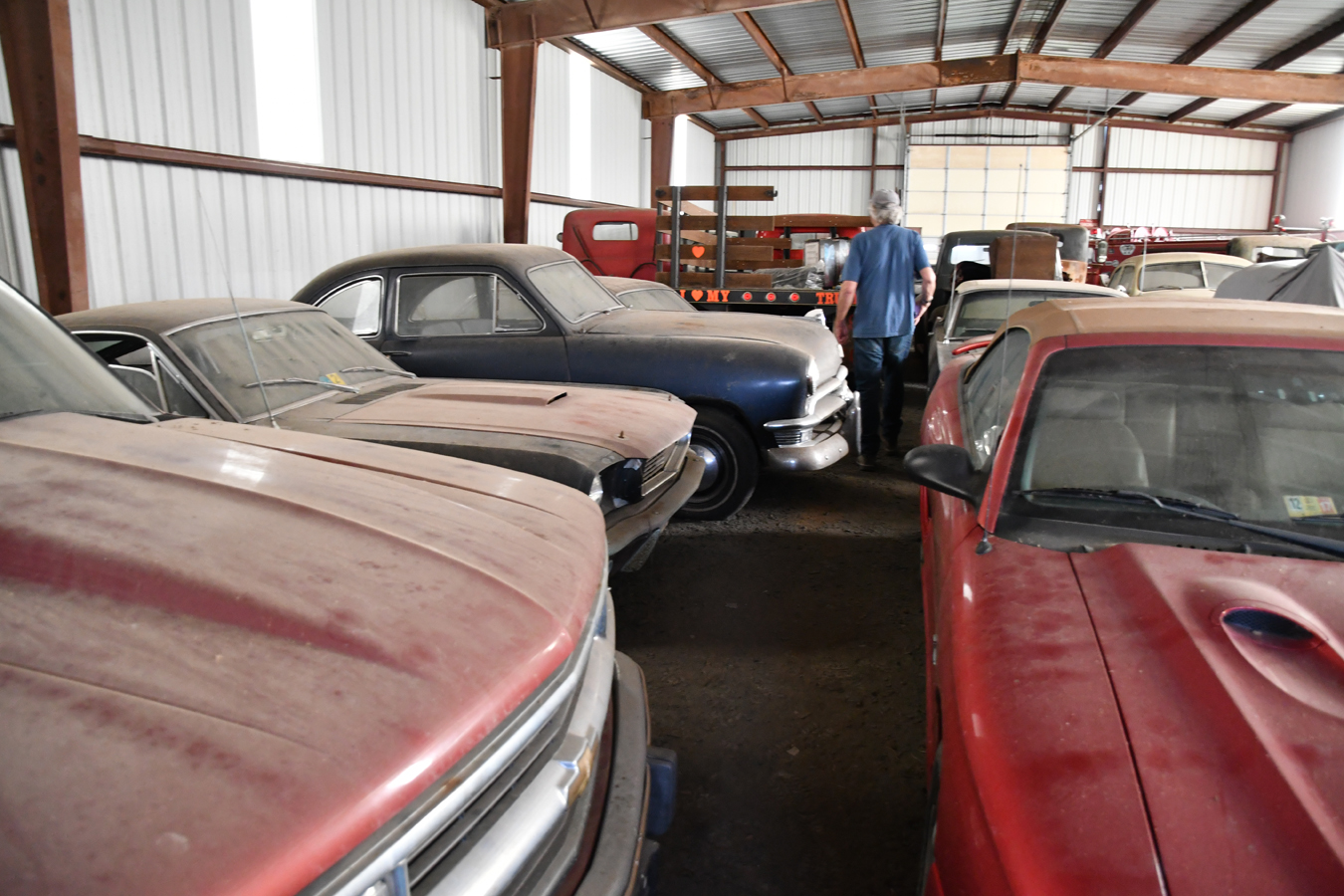
When asked what the future holds for his truck forest, Glenn adds the kicker saying that in addition to the trucks, there are the vintage cars he has stored in locked barns elsewhere. Indeed, Glenn takes me down the road to a locked warehouse containing a 1965 Hertz Shelby Mustang, light duty trucks and cars from the 1940s and ‘50s mixed in with more modern vehicles.

Clearly this 800-pound gorilla demands attention. Once again when asked his intentions for disposal of the collection Glenn, exhaling deeply, says, “We’re going to have to get rid of it all at some point. It’s just such a big undertaking that organizing the disposal of the collection and trying to run the company at the same time is really hard to do.” Glenn realistically acknowledges that he does not envision him ever having the energy to do what should be done.” Adding to the conundrum, Glenn confesses he does not have any idea as to the collections value.

Glenn says, “People come by pretty regularly, you know, But it’s so hard. Daddy never said what he paid for anything. So you don’t have a figure in your head as to what you want. And the people interested don’t know either.” Glenn recalls his mother telling him that the first truck the father bought to start the collection, a cab-over Peterbilt, cost as much as their house. Glenn cautions saying, “This was decades ago when houses were much cheaper.” So what to do?

This did not strike me as a collection suiting the style of auction houses like Gooding, RM Sothebys, Bonhams, Mecum or the like. However, one company came to mind that normally operates in the Midwest and displays a high level of comfort in staging rural events with large and varied collections. I suggested to Glenn that Yvette VanDerBrink’s VanDerBrink Auctions might fill the bill.

Interestingly Glenn said he had spoken to Yvette. While not her normal stomping grounds, she had actually come out to see Glenn’s collection during a trip back east to visit family. Glenn says, “She took a good look. My situation is definitely her thing. That’s what she does.” Glenn said he felt she had a real good feel for the challenges the collection presented. Then Covid came to town and they have not spoken since. And so it stands today.

Glenn and his father’s collection deserve to have their day. It just needs the right auction house to save both from being lost in the woods.

By |2023-04-13T12:07:00+00:00April 13th, 2023|4 Comments

Cars We Love & Who We Are #35

Amazingly, country roads exist even within sight of the Empire State Building which towers less than twenty miles from my home in Northern New Jersey. One Sunday, while meandering about with no particular place to go, I stumbled upon a surprisingly bucolic tangle of local wiggle roads. The driving delight they afforded momentarily sparked a gnawing distress at the joy to be lost with the coming age of automated cars. I quickly dismissed the thought opting for feigned ignorance and the associated bliss.

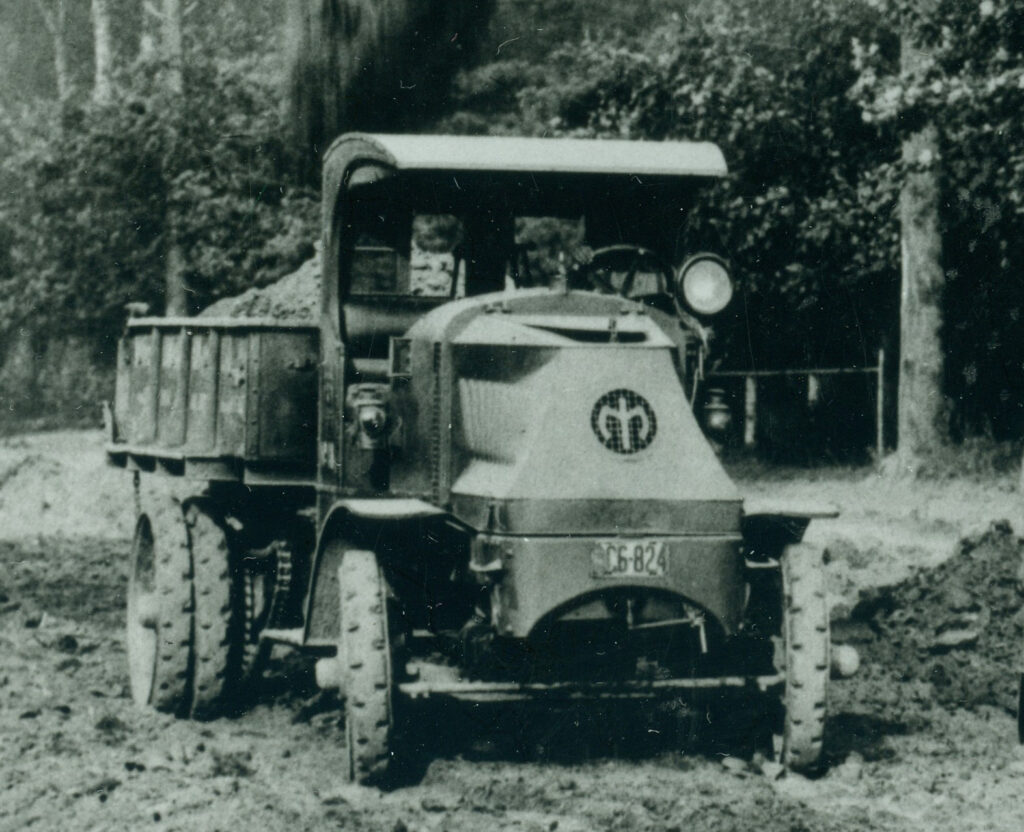
Navigating through a one-lane railroad underpass delivered me to a truly rural time capsule. Before me stood a farm with, what would prove to be, two centuries of history and the resting place for a century old chain-drive Mack truck.

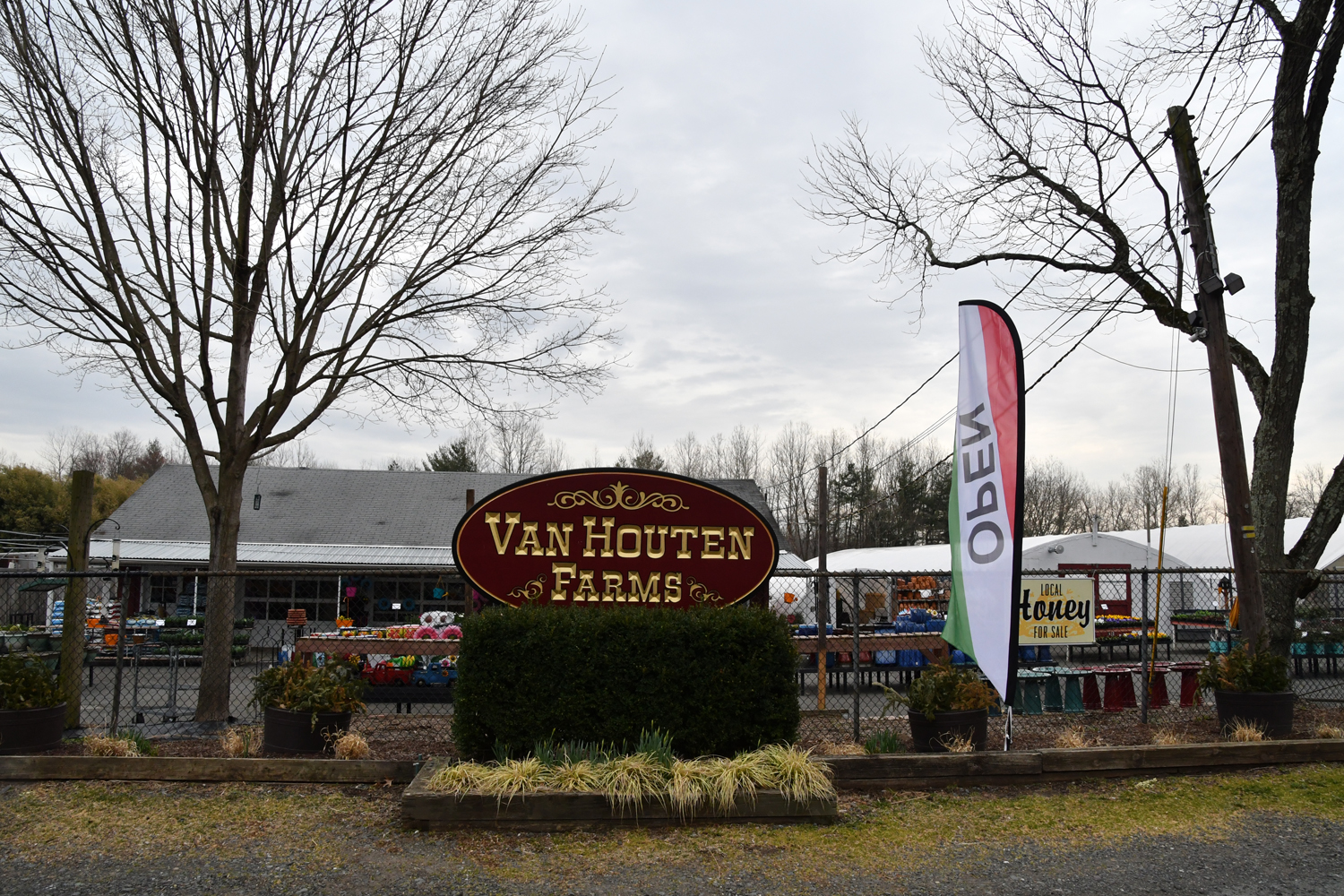
That is how I came to meet Jim Van Houten of  Van Houten Farms in Pearl River, New York.

Hundred-Year old Bulldog, Beloved but doomed?

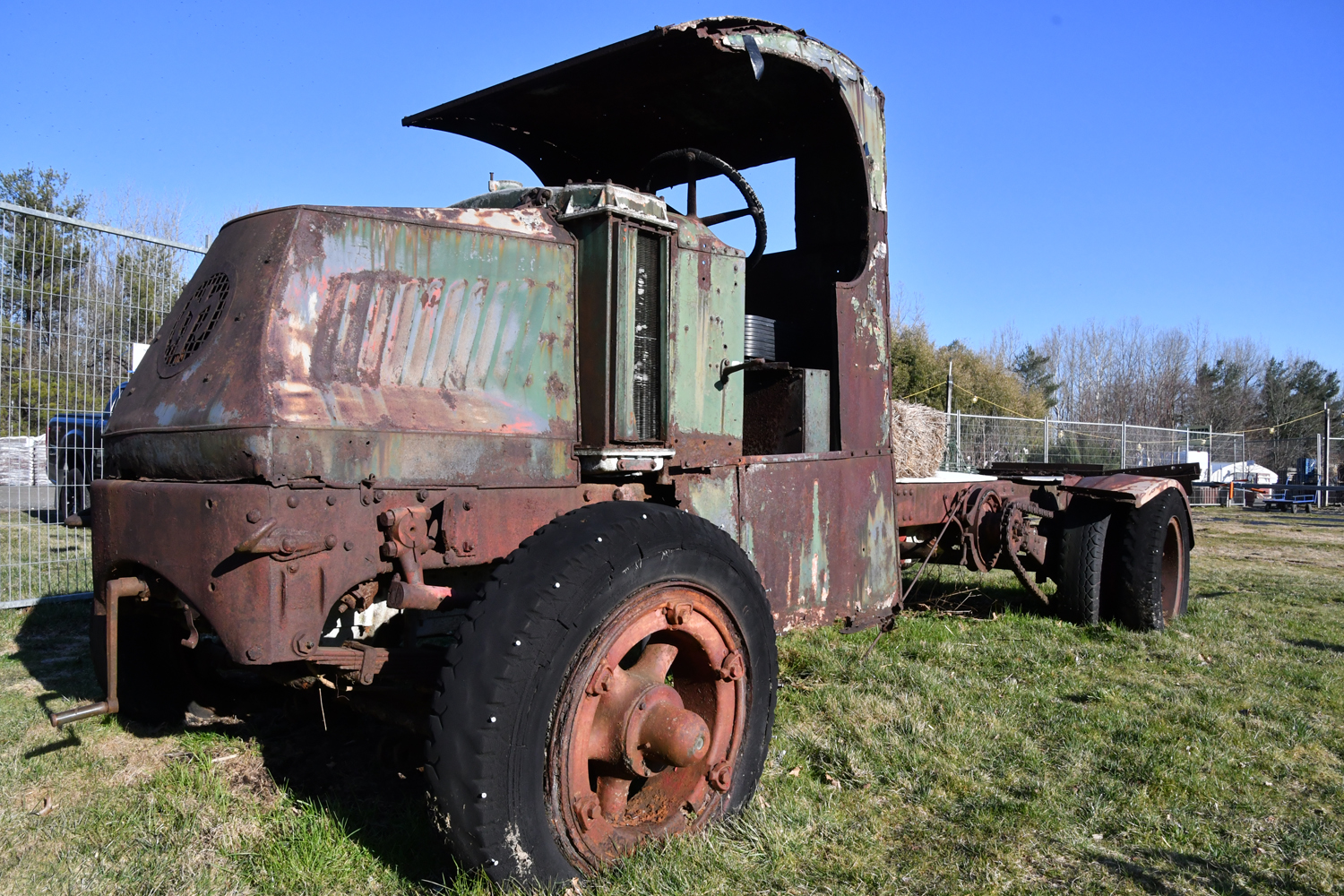
Van Houten’s 1925 Mack AC

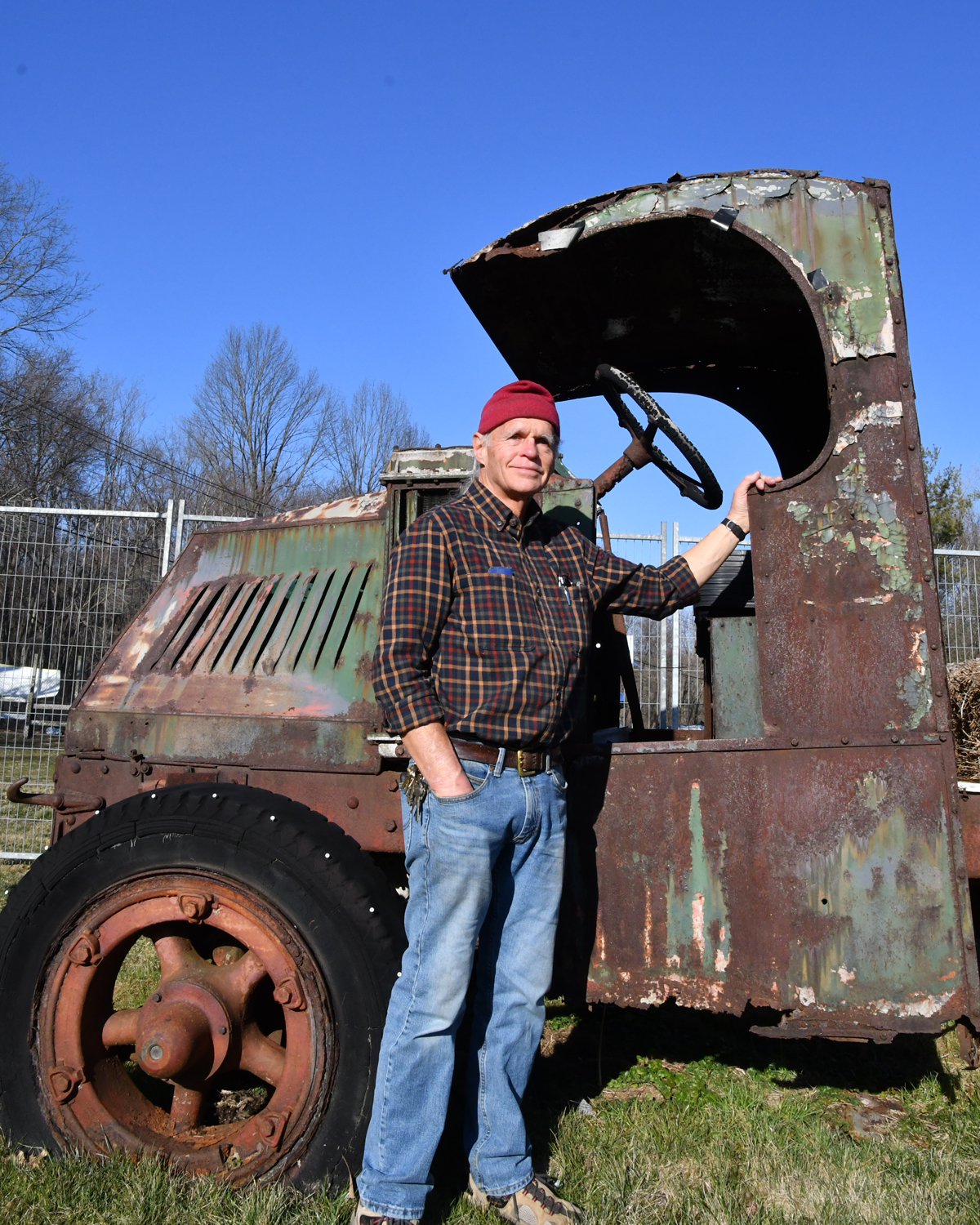
Jim Van Houten’s 1925 Mack AC, while standing tall and proud displays deep scars and brutal decay from the ravages of decades spent untended though not unloved. Certainly no one loves that truck more than Jim. As Jim gazes at the truck he radiates a sense of wistful resignation. An acknowledgement of forces at work and the meaning of dust to dust.

Jim Van Houten with 1925 Mack AC

Jim’s trim physique and forthright demeanor belie his 78-years. While every inch a farmer, Jim arrived at his life’s work on the farm following a few years spent in corporate America. His background includes a B.S. in agriculture and an MBA, both from Cornell.

Jim says, “Today there are only three farms left in this county. Ours is one of them.” However, the pressures to keep his farm alive offer an ever present challenge. Jim says, “While individuals seem to love visiting the local farm, local governments appear incapable of appreciating the farm’s value to a community.” Town bureaucrats frequently seem intent on turning the farm into a prize for some large developer to exploit.

Much of that which Jim holds dear seems under attack, often by what feels like inexorable forces. Maybe that 100-year old truck Jim loves stands as a metaphor for the 200-year old farm that he holds so dear.

Jim possesses a profound appreciation and respect for the farm and the land that holds much family history dating back to 1812. He considers that Mack as a part of that family saga. Its kind certainly represents a vehicle that played an important role in America’s success during the early 20th century in both peace and war.


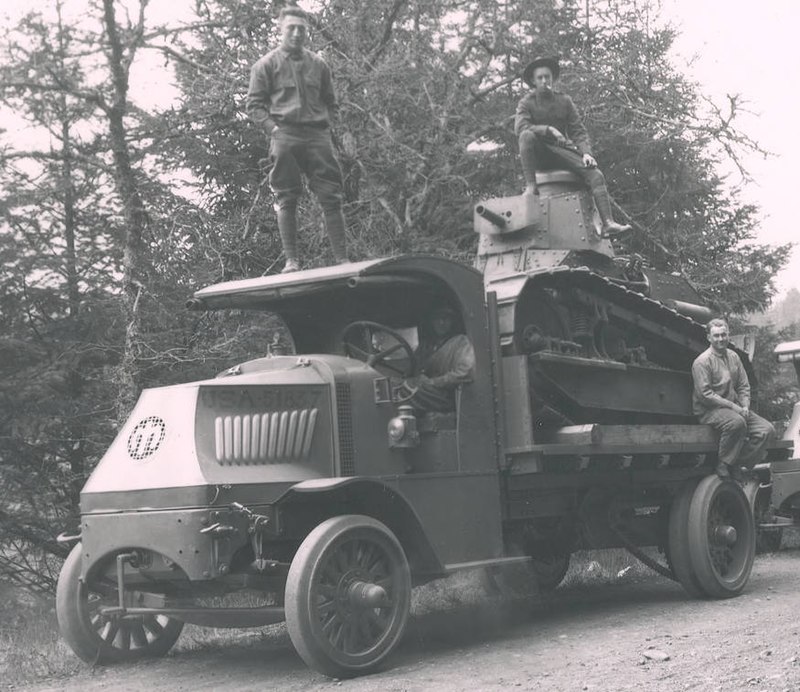
The Mack AC resides in the pantheon of important vehicles based on its decades of service as a rugged, reliable and tireless workhorse capable of successfully transporting loads and performing jobs where other trucks failed. It earned legendary respect on the WWI battlefields of Europe where it delivered medical aid, vital supplies and critical replacements despite deep mud, horribly rutted roads and shell-pocked battlefields that barred the efforts of other trucks.

According to the Mack Museum, during World War 1 Mack shipped over 2,000 trucks to Great Britain. The story goes that Mack got its “Bulldog” name from the British soldiers with whom the Mack trucks had earned enormous respect for their ability to do what other trucks could not. When the British troops faced a difficult truck challenge, the cry would be, “Aye, send in the Mack bulldogs.” Mack management loved the name and embraced it. The rest is marketing history. The Mack AC enjoys the respect and love of not just Jim but a global population who it loyally served for over a half-century.

Brought to the market in 1916, the Mack AC a two-wheel drive, two-axle truck had, for then, a husky 4-cylinder gasoline engine delivering 69-horsepower through a three-speed manual transmission. In an age of horses, a rugged vehicle that could dependably carry up to seven and one-half tons on solid rubber tires at speeds approaching 20 mph represented a quantum leap. The Mack AC’s legendary chassis earned its reputation for rugged endurance with a pressed chrome-nickel steel construction heat treated for durability. In the early 20th century the Mack AC reigned as the big dog. Out of production in the 1930s, Mack ACs could still be seen on the job in the 1950s, even the 1960s.

Jim’s truck began its service under the ownership of a fellow farmer and family friend of his grandfather. Back in the 1930s his grandfather would take the Mack loaded with corn into wholesale farmers markets in New York City much as Jim, today, still brings produce into the Union Square Farmers Market. Silent and still, the old Mack AC witnesses Jim in his 21st century truck whenever he departs for the city.

At some point in the 1940s the friend had bought property upstate. By the 1950s Jim’s dad began working the land the friend left behind. Jim says, “I remember going to that farm in the 1950s and seeing the Mack sitting in the old barn.”

Some years later in the 1960s Jim’s dad traded an old John Deere Model A tractor for the 1925 Mack AC and all the family history it contained. With quizzical reflection Jim says, “Then we let the Mack sit there unmoved for more years.” Finally in the early 70s Jim with college and his corporate experience behind him returned to run the Van Houten farm. With that, the resurrection of history and the old Mack AC appeared to commence.

At last Jim took charge and brought the Mack over to the Van Houten Farm Nursery and produce retail site. On staff Jim recalls a young employee adept at all things mechanical. Jim set him loose on the truck and recalls saying, “He got the darn thing running. I actually drove it around the neighborhood.” Being late in the season, the truck went behind the farm stand for the winter. Jim recalls saying, “With winter coming the mechanic drained everything.” Jim then winces saying, “At least we thought he did. It did not drain completely.” When spring came a big crack had developed at the bottom of the radiator. Jim says, “I do not believe the engine suffered any damage.”
Sadly, the truck then sat in back for more years. Finally as the 1970s came to a close Jim had the truck towed to the front of the farm stand to serve as a decoration. It has again performed its designated task without complaint for over 40 years. Jim says, “I feel terrible that I’ve just let it sit there and literally just rust away.” Over the years many people have offered to buy the truck. Jim says, “I feel bad that it has not gone to somebody who could restore it. Even today it is still restorable.”

During the interview Jim has reflected more than once saying, “The chronological clock is ticking.” Much of his considerable remaining energy has been focused on literally saving the Van Houten Farm. That said, his deep affection for his Mack AC tugs at his heart. When asked, “In the best of all possible worlds” what would you want to see happen to the truck? Jim says, “I would love to have it restored on site but this is the real world and I do not have the time.” Considering those limitations, the two real choices would seem to be either give it to someone who would restore it or let it slowly return to the earth on the family farm. When asked which fate would he chose for his beloved Mack AC, Jim pauses. Slowly with a resignation born of decency Jim whispers with an exhale, “Give it away.”

It is said, “If you love something let it go.” Love is a beautiful thing. Clearly, Jim hopes the future will see the same said of his then restored Mack AC.

By |2023-03-30T17:56:49+00:00March 30th, 2023|2 Comments

Cars We Love & Who We Are #34

Previously readers became acquainted with classic car restoration virtuoso Mike Gassman through stories he told about others. It would be a disservice to you dear reader if I neglected to share with you Mike’s own story.

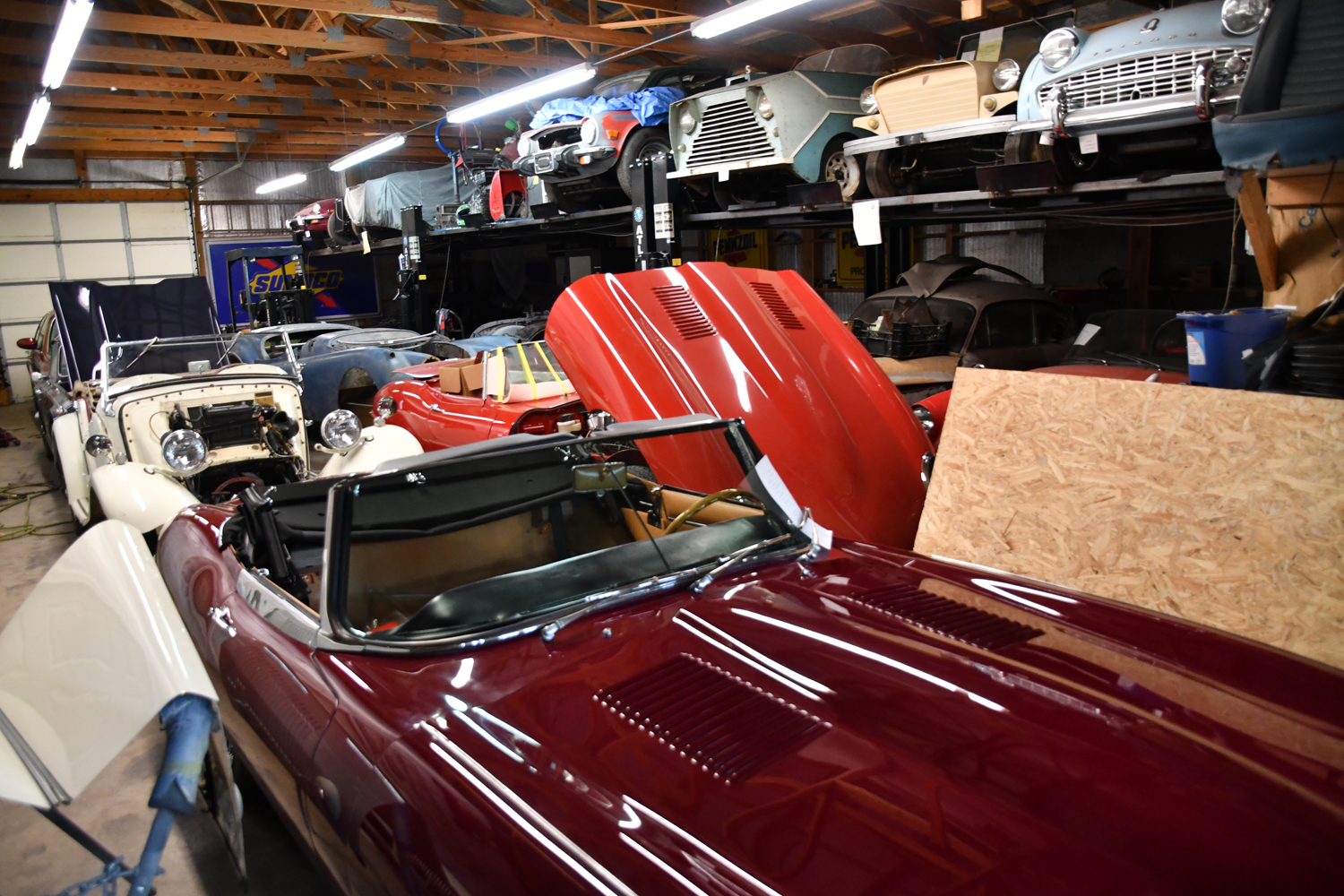
Descending once again through Rockfish Gap to the floor of the Shenandoah Valley and Waynesboro, Virginia, I weave through some back roads that hug a railroad siding. In making a right turn away from the tracks a row of low clean white adjoining structures come into view. They feature a spotless showroom recalling the modest (compared to today’s massive highway automotive cathedral) masonry structures with huge window panes typical of mid-20th century family owned dealerships. Eye candy for any passerby, the showroom features a tightly organized array of pristine restored 50’s and 60s vintage British sports cars. Their meticulous curation offers a hint of the passion for perfection that drives the robust beating heart of Mike Gassman’s restoration business, Gassman Automotive.

The story begins on a mountain top in Afton Virginia.

Read the car, not the book and other words of wisdom that pave a path to Pebble Beach


She opened her front door wearing a wedding dress. It is 1977. High atop Afton Mountain in Western Virginia a woman Mike recalls as Martha stands smiling down from the open doorway. Her wedding day preparation had been interrupted by a knock at the door. A boy of maybe thirteen years had come to inquire about a forlorn 1969 Triumph TR6 moldering out in the field by Martha’s house. Featuring a rose bush violating a structural integrity that could not cast a decent shadow, the TR6 could best be described as a heap. With his father visible in a car waiting on the country road, the boy asked if she wanted to sell it. “Yes I do,” responded the bride-to-be with a kind forthright demeanor exhibited by adults suddenly aware of their role in a teaching moment. “How much do you want?” the boy asked. “How much do you have?” asked Martha. “Forty five dollars,” offered the boy with the air of a question. “That is perfect. That is exactly what I want for it,” responded Martha and in so doing gave the young boy a wedding day gift that would continue to give for the rest of his life. Martha had sold thirteen year-old Mike Gassman his first car. Watching from the road, Mike’s dad witnessed a plan he had set in motion taking shape.

Mike says, “My 13th birthday present from my dad was a copy of a contract. And it stated, I Mike Gassman for the next two years, will devote every night and every weekend to restoring a car that I pay for and on which I do all the work. In return, my dad will stand next to me for two years and teach me how to restore a car. He will never physically touch it with his fingers, but he will teach me.” In looking back Mike calls it the most invaluable, the most incredible gift any young man could ever receive. Mike eagerly signed it. All of which quickly led to Mike knocking on Martha’s front door. In short order a tow truck dragged the “heap” to Mike’s house and the “fun” began.

With Mike’s dad conducting a comprehensive “hands off” restoration education, Mike dove in and never looked back. Mike says, “My dad showed me how to do a block and tackle. I pulled the body off the car. I sandblasted it. You could throw a rock through this car. It was so rusted. I made all the panels. I brazed them all in. I did all the bodywork and I painted the car one piece at a time over the next two years.” Mike’s dad had exceptional restoration skills and taught his son old school lessons about laying down lacquer paint. He went so far as to teach Mike leading techniques. Mike says, “His many years working with toxic lead is probably one of the reasons he is not here today.”

Mike finished the car at the age of 15 years and 7 months. He says, “In Virginia you had to be 15 years and 8 months old to get a learner’s permit.” Mike would sit in his TR6 for a month waiting for that day.

Mike Gassman and his 45-year old restoration of Martha’s “heap.”

Mike says, “I did every single aspect of that car between the ages of 13 and 15.” Standing in his showroom, now, Mike concludes by turning my attention to a pristine light beige TR6. Mike continues, “And here it is 45-years later. Unrestored since I finished it.”

Mike says, “It was my only car in college. It probably has 25,000 miles on it.” It retains the same paint he applied 45-years ago. With deserved pride Mike says, “It has taken multiple first place trophies.”

Over his 40-plus years in auto restoration Mike has developed a philosophy that informs all the automotive work he performs. Mike says, “I am as passionate about this work now as I ever was if not more so. I love this stuff. It is not just iron.” He believes that the culture and character defining the subjects of his passion will never happen again. For him, the 60s and early 70s stands as the greatest time for cars ever. He freely admits one could spend $500,000 on restoring a TR6 and it still would not be as quick as a new Nissan Sentra. Mike says, “That’s not the point. With my cars when you walk out of a Walmart you don’t have to figure out which one is yours.” He believes that anybody can buy a Miata that can outperform these half century old sports cars. However, Mike says, “Sadly, the new cars have no soul.”

Mike welcomes customers that want perfection. He builds to the desires of individuals that always wanted a certain car and finally have achieved a point where they can afford the best one. Mike says, “I have nothing here that anybody needs, nothing. What I strive to offer is a whole lot of what people want.”

Mike, and his experienced and gifted Gassman Automotive crew, over many years, have honed the ability to perform a superior restoration for those looking for the best. As well, he takes pride in focusing those same abilities on servicing customer cars ranging from bug-eye Sprites to Maseratis.

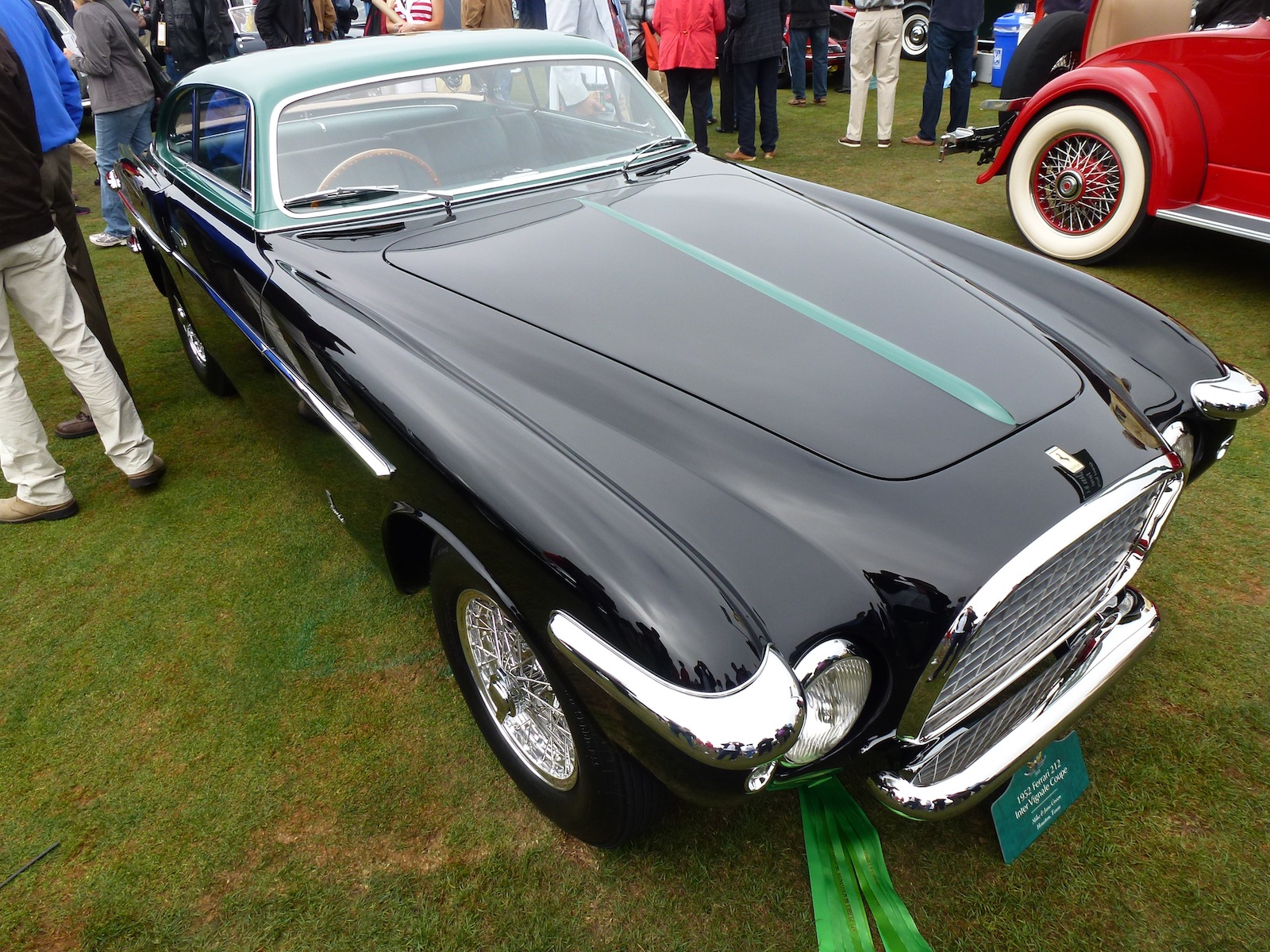
One man who has had a significant impact on shaping Mike’s philosophy would be Paul Russell. Internationally respected as a master restorer Paul presides over one of the world’s most respected restoration shops. Mike greatly admires Paul for the superior work, professionalism and generosity he has experienced in dealing with the man and the staff of Paul’s globally revered Paul Russell and Company. Mike says, “While Gassman Automotive was performing a total restoration on the first 1952 Ferrari 212 Inter Geneva Coupe by Vignale, Paul was restoring the sister car at the same time. It afforded me a priceless opportunity to share information with a master.” Two things that Paul told Mike made a profound impression.

Paul emphasized that in properly dealing with an important automobile restoration “read the car, not the book.” What did he mean by this? Mike says, “To me it meant, if there’s a hole in a fender, is it jagged. Did somebody drill it. If it was stamped, why do you think it was there? What would make sense? Why would you put a hole there? Ask, are there any other cars that have a hole there before you weld it shut? That was incredibly valuable advice, especially when doing a prototype like the 212, one of only six examples. Finding a hole could lead you down a road of inquiry searching for answers to why is it there and what’s missing? That was very helpful.”

Secondly, and what Mike considers the most valuable advice came when Paul shared the following as recalled by Mike, “Pretend that whatever you are working on whether it is a wiper motor or a complex quarter panel, it should be treated like it is the only thing you are taking to Pebble Beach where it will be presented on a mirrored table to represent the sum of your abilities.” Mike says, “If you take that advice to heart you have no choice but to build a 100-point car but without that mindset it is impossible to build a 100-point car.” Which raises the question, how did Mike get into the concours winning restoration business?

With a wife and two young children, the year 1990 found Mike working to make ends meet selling cars for a Nissan Subaru dealer during the day and working on Triumphs at his house from 9:00 at night until 2:00 in the morning. Mike says, “The new car market had fallen apart. I was getting paid $50 for every car I could sell. With this 24/7 grind I had reached my limit.”

So Mike took the little bit of money that they had saved and bought the first building, all 1500 square feet of it. He was all in. Over the next decade he developed a restoration shop focused primarily on British sports cars. Gassman Automotive differentiated and distinguished itself with its rare ability to perform everything in-house. Mike says, “We do all of our own motors, transmissions, overdrives, wiring, body fabrication, paintwork, upholstery and assembly. As well, Mike in prior years had exhibited great foresight that would prove to serve him well.

Through the 1980’s, with Triumph and MG going belly up, Mike bought out the NOS parts inventory of many shuttering British car dealerships. At the same time he aggressively prowled the swap meets at Carlisle, Hershey and any other event offering the possibility of NOS parts. Mike says, “Over the years I have made hundreds of trips bringing back trailer loads of NOS British car parts.”

Focused with his determination to be a go-to place for those seeking superior quality, Gassman Automotive started to get noticed. People realized Mike and his shop meant business. Attention came their way even as they restored lower-end cars at first. Gassman Automotive became recognized for producing the high-end restorations of cars such as TR6s and MGBs. They gained a recognition for quality panel beating and their dexterity with aluminum.

Ferrari in early stages of restoration

Interestingly at that point while Jaguar and Healey restoration work seemed a step above his client base, the quality of the work coming out of his shop stood at a Ferrari level. It was just a matter of time.

It occurred when a client sent Mike a TR250 for a full restoration. At the same time the TR250 owner sent another of his Triumphs which had been subjected to a very expensive restoration by another restorer to the National show. At the event the Triumph restored by the other shop received a sound beating at the hands of a participating car that Mike had restored. Learning his lesson the client sent his losing car back to Mike to “fix it.” Mike says, “We did our job to our standard and sent it back. He took it to the Nationals and won first place as well as a Vintage Triumph Register National “Best of Show.” A few years later in around 2010 the same client returned with a new project that would be the breakout opportunity for Mike and Gassman Automotive.

The client had purchased a 1952 Ferrari, the first of six prototype 212 Inter Geneva Coupes by Vignale and wanted Mike to restore it. Mike says, “I flew to Indiana to look at it. I’ll admit it was extremely intimidating to me. So many pieces were missing or broken. Worse there was never a spare part made for that car. Everything would have to be handmade. Of course, I said yes.” It would be Mike’s first “right at a million dollar” restoration. After two years the finished Ferrari went to Cavallino where it received a Platinum Award. It then went to Pebble Beach followed by a trip to Arizona for the 2014 Gooding Auction in Scottsdale.

Mike, pointing out for those that do not appreciate the significance of an invitation to Pebble Beach, says, “Even the “worst” car at Pebble beach rates as an incredible automobile. There are no “also-rans.”

The Gooding catalogue promoting the 2014 auction described the Gassman Automotive restored Ferrari 212 as follows:

  • A Spectacular Example of Italian Custom Coachwork
  • The First of Six Such Vignale- Bodied Coupes
  • Displayed at the 1954 San Remo Concours d’Elegance
  • Fascinating, Well-Documented Provenance
  • Exquisite Restoration to Original Appearance
  • Retains Original, Matching-Numbers Engine
  • FCA Platinum Award Winner at the 2013 Cavallino Classic
  • Displayed at the 2013 Pebble Beach Concours d’Elegance

Mike says, “At the time it set a world’s record for that car by selling for a total of $1,787,500.”

The masterful craftsmanship that distinguished that rare Vignale-bodied Coupe put Mike and Gassman Automotive of little Waynesboro, Virginia on the international map of people with whom you could trust your Pebble Beach worthy car’s restoration.

Mike says he hopes Martha would be pleased.

By |2023-03-16T15:45:44+00:00March 16th, 2023|6 Comments

Conversations With People We Value #46

Spending time as I do in the Blue Ridge Mountains offers a great opportunity to commune with the beauty of nature. However, where I stay, being at the end of a serpentine dirt road snaking its way deep into the forest, affords a level of social connection just north of Neil Armstrong’s solitary stroll on the moon. Jeremiah Johnson I am not. So to break the spell of the woods, I often go in search of stories. The other day my friend Eddie, mentions a local restoration specialist. Game on.

Escaping from my forest sanctuary, I head out to meet a man who I would come to respect as an artisan. He works in the shadow of the Blue Ridge Mountains where he produces Amelia Island, Pebble Beach and Cavallino quality work with a special place in his heart for British cars.

Meet Mike Gassman.

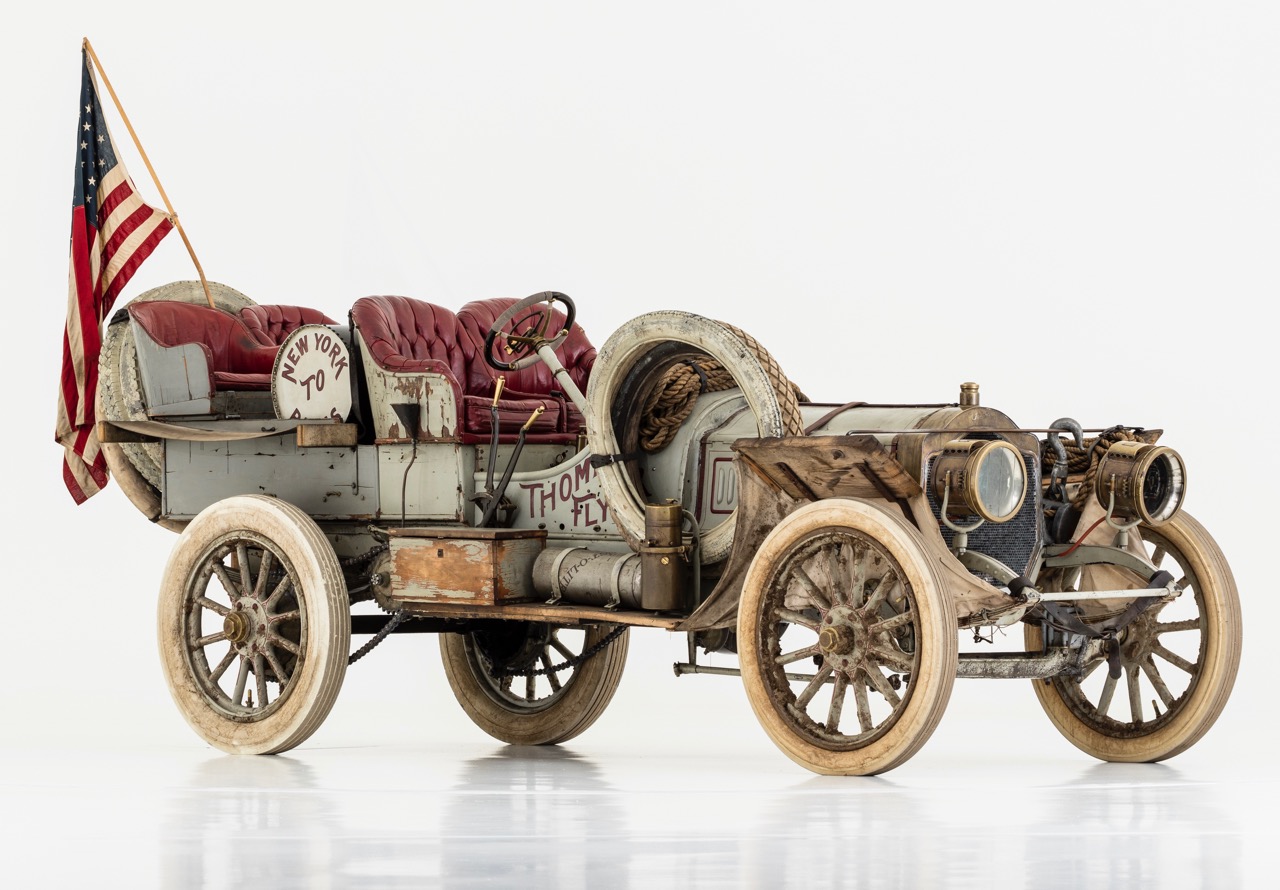
Woulda, Shoulda, Coulda with One of America’s Most Important Cars

1907 Thomas Flyer

Heading north, the Rockfish Valley Turnpike passes beneath the terminus of the Virginia Skyline and the entrance to the Blue Ridge Parkway. We are talking God’s country. Clinging to the western side of the mountain above the Shenandoah Valley this old blue highway cuts through the Rockfish Gap before descending to the valley floor below where my destination awaits.

Clean and white with a garnish of distressed old British sports cars from the 50s and 60s dressing the side lot of the shop, Gassman Automotive presents itself as a buttoned downed source of high end restoration services, NOS parts and restored vehicles for sale.

Mike Gassman welcomes me with the warm humor of an old friend. In his mid-50s, he possesses a forthright country geniality reflecting his farm family upbringing. Mike converses with the intensity of a high energy, engaging storyteller. Conversations reflect the technical acumen of a master restorer delivered with the flavor of comedian Ron White.

Time spent at Gassman Automotive offers rich servings of eye candy and good information. Mike’s business offers a great story. However, that story will have to wait to be told another day. Why? Because before I interviewed Mike he told a couple of great stories that I had to share, now.

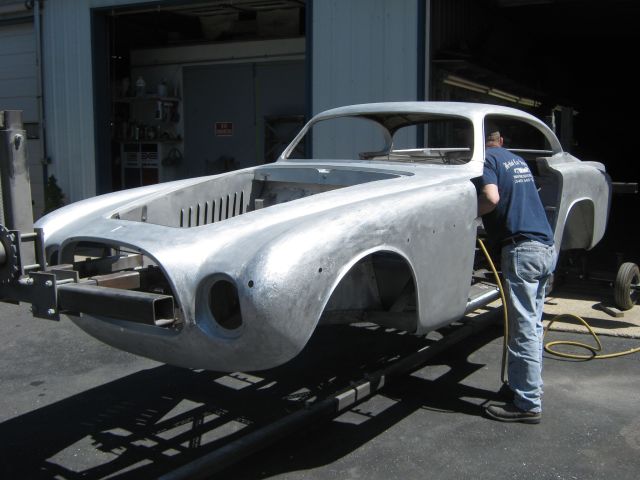
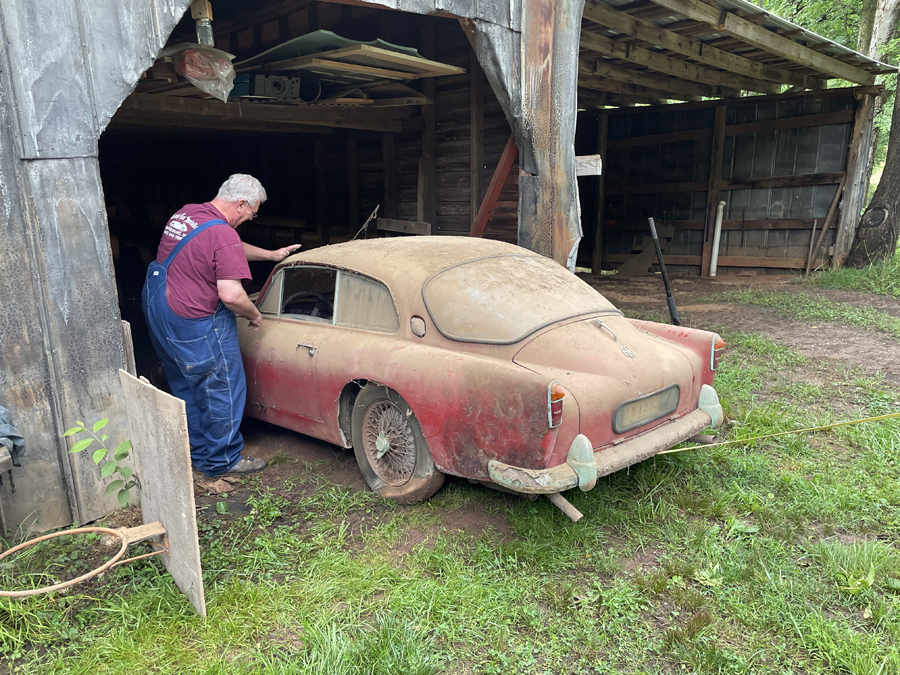
As we walked through his fabrication shop, Mike motioned to a bare metal shell mounted on a rotisserie. It appeared to be a smaller mid-century coupe of European breeding. Indeed, it turned out to be an early 1960s AC Greyhound. It actually represented a very rare find considering the total production numbered just 83 with only three having left-hand drive with this being one of the three.

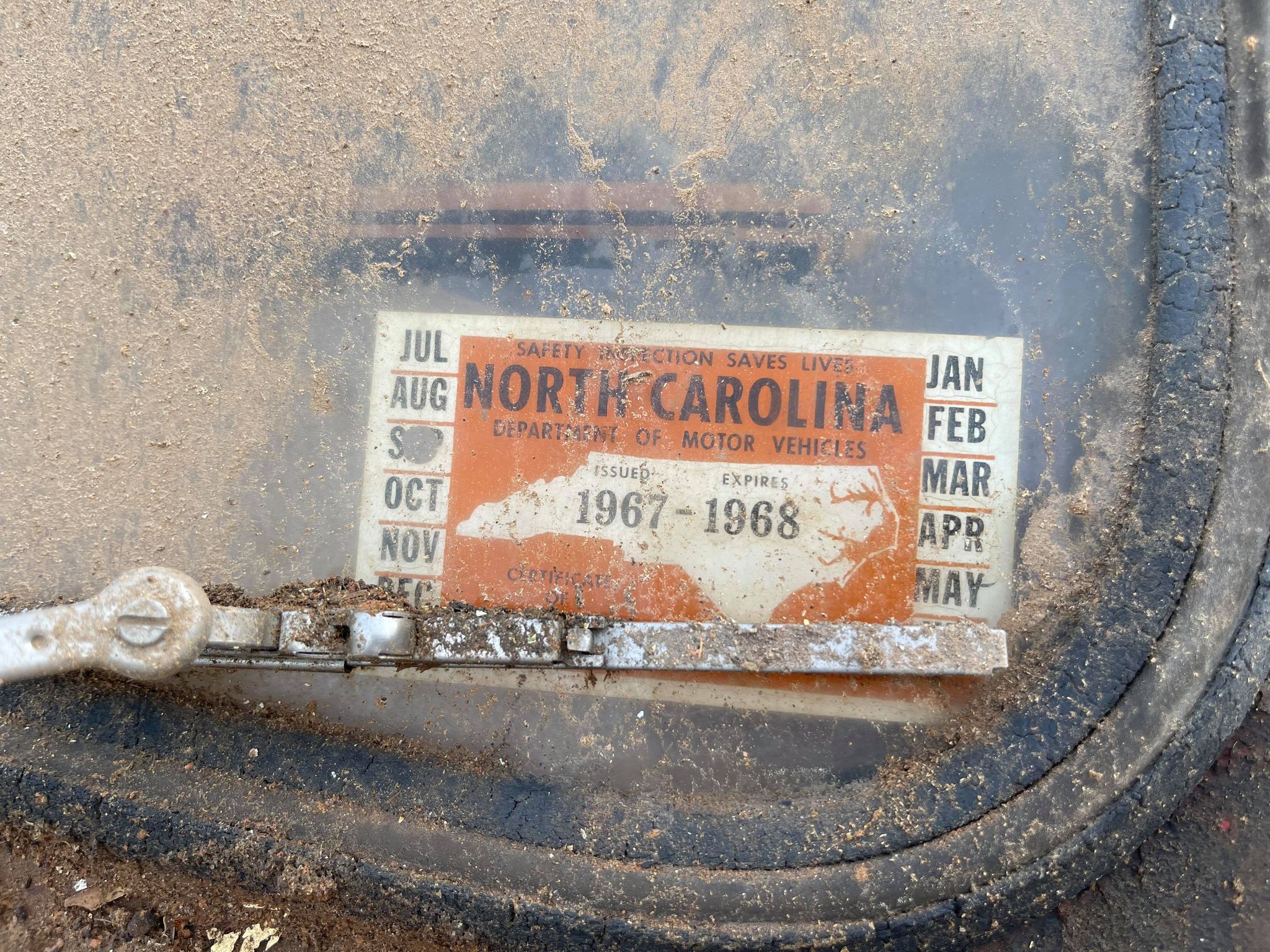
It had been off the road since 1968 and left untouched in a barn in North Carolina. It would spend the next year undergoing a full restoration at Gassman. As Mike told it, the really funny part of the story resided in the fact that it had sat quietly for over fifty years under a thick layer of dust in a barn within sight of Tom Cotter’s home. Yes, that Tom Cotter “The barn find hunter.”  As Cotter says, “They are out there, sometimes right under your nose.” Cotter must have laughed at this find.

With that story told and well received, it triggered Mike to bust out saying, “If you like barn find stories I have got one for you.” As told to me by Mike, it actually starts well before Mike was born in 1964.

Mike says, “My family ran a dairy farm in Alden, NY east of Buffalo. A widow lived on the farm next to ours.” Apparently the widow’s deceased husband had been good friends with Mike’s grandfather, so Mike’s father would farm her field for her. Before Mike’s birth his dad had a real thing for brass era cars. Mike says he heard his dad probably had 20 of them at one time. In the course of tending the widow’s farm Mike’s dad discovered her barn contained a terribly distressed but very interesting car from the brass era. Mike’s dad had his eye on it with intentions to buy. With that in mind Mike’s dad would take every opportunity to squirt a little oil in the cylinders and turn the engine.

At that time Mike’s dad supplemented his income of $45 a month from farming with money he could make flipping cars. Mike says, “He would buy a car for $5 get it running and sell it.” Though the widow’s car was in terrible shape she wanted $500. Mike’s dad felt the $500 price outrageously steep especially considering its condition.

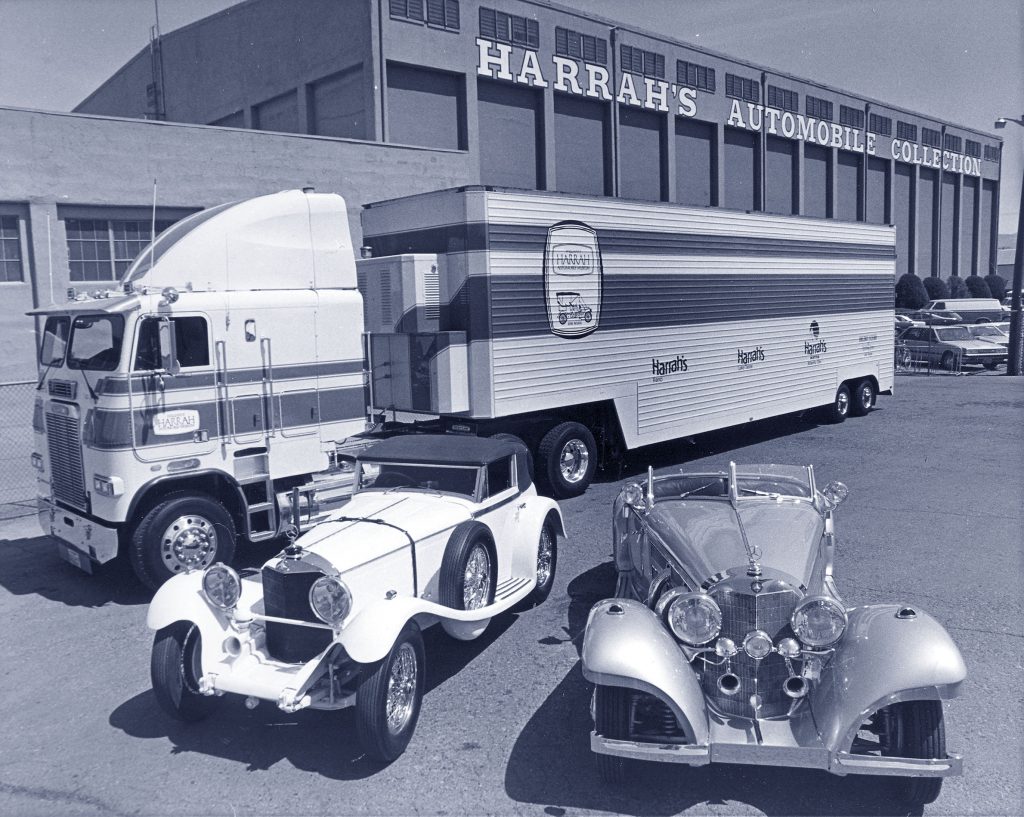
Mike says, “I have heard this story a million times. One day in the 1950s as my dad rides over to the widow’s farm he sees a tractor-trailer backing its stainless steel trailer up to the barn. On the side it reads “Harrah’s.” Ken Gross writing in Hagerty/Insider quotes David Gooding recalling Harrah’s trucks saying, “There were semi-trailer trucks bringing cars that they’d picked up around the country, every few days – both cars that were pulled out of barns and new purchases. They had different car spotters in different parts of the country.”

While Mike’s dad had made offers for the car, they never approached the $500 asking price. He accepted the reality and helped load the car onto the truck. He watched the loading of two straw filled crates that contained the vehicle’s brass head lamps. Lastly he witnessed the loading of what would prove to be a very important old bicycle. And that, was that, until.

Over a half century later young Mike, born in 1964, had grown into a master restorer fine classic automobiles. In 2008 he had brought one of his restorations to the Amelia Island Concours d’Elegance. On the day of the judging, in the early morning hours, he went to the underground garage where cars had been stored to detail his car. Right next to his entry stood the car that he recognized as the “wreck” his father recalled pushing onto Harrah’s trailer.

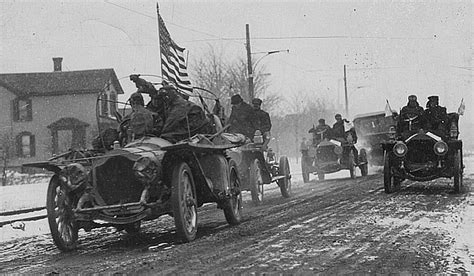
Michael knew more details than most about the 1907 Thomas Flyer that had won the 1908 “New York to Paris Great Race” and its grand prize of $1,000. (An interesting sidebar to history is that, at the time, the race sponsors The New York Times neglected to present the prize money to the winning Thomas Flyer team. It would be another 60-years, in 1968, that The Times awarded the money to driver George Schuster the only team member still alive.)

Michael knew that the Thomas Flyer finished first in 169 days beating the German Protos in second place by 26 Days. He also knew the significance of the headlights and the bicycle.

While the German entry, the Protos, had arrived first to Paris, the Germans had been penalized for cheating (The Germans had put their car on a train between Ogden, Utah and San Francisco) so the American had the race in hand until a gendarme refused them access to Paris and victory. Why? Parisian law required two headlights and the Thomas Flyer only had one. Unfortunately the Thomas flyers lost a headlight during a misadventures along the route. Just as things seemed poised on a pin head and ready to tilt towards ugly, a gentleman offered the team his bicycle which had a carbide lamp. After numerous failed attempts to attach the headlight, the team simply lifted the bicycle onto the hood of the car and held it there by hand allowing the Thomas Flyer to enter Paris and claim victory.

Now standing next to the Thomas Flyer he just stared as a man came over and began wiping the car down. Mike says, “I told the guy, my dad had a chance to buy this car in 1952 for $500. He looked at me like I was an idiot. I said believe it or not. He said I find it hard to believe.” The man then asked Mike where his dad lived and Mike said Alden, NY. Mike says, “His eyes lit up.” Mike then told him that his dad had pushed the bicycle next to it and carried the two crates with the headlights into the Harrah’s truck. Mike says, “Now the guy was listening. That I knew about the bicycle flipped him out. I learned later that day that he was the grandson of Ernie Schuster who drove the Thomas Flyer in the Great Race.” Mike says, “If you ever want to read a great book about it all get a copy of Race of the Century by Julie Fenster

Today, the 1907 Thomas Flyer that won the 1908 New York to Paris Great Race has been recognized for its historic importance by its inclusion in The National Historic Vehicle Registry. It now resides in the pantheon of most significant cars in American automobile history, treasured by the National Auto Museum where it resides and a priceless icon, which, Mike acknowledges, his dad passed on for $500.

By |2023-03-02T16:36:23+00:00March 2nd, 2023|4 Comments

Conversations With People We Value #45

“Maurice, come join us,” they called to him as he passed. Friends with whom I sat beckoned him to our table. Clearly, he recognized them and enjoyed their respect and warm feelings. A slight man with white whiskers and genteel manner, his charming and proper English accent left no doubt as to his British roots and breeding. A youthful 88-years of age, no dodderer he. With an exchange of pleasantries he begged off claiming weariness at day’s end and with goodbyes completed his after dinner departure.

My friends explained that he possessed a wealth of knowledge concerning fine art and antiques. His business focused on the purchase and sale of both. They marveled at the stories he shared. And, oh yes, during his early years in post-WWII England he refurbished and brokered vintage Rolls-Royce automobiles. They affectionately boasted of his encyclopedic knowledge of early Rolls models. Indeed his expertise with the iconic British marquee had earned recognition on both sides of the Atlantic. So much so that by the beginning of the 1970s his renown had drawn the attention of the Rockefeller Estate. Now living in America, Maurice accepted their offer to oversee the vintage car collection of, the now departed, past New York Governor and Vice President Nelson A. Rockefeller.

Shortly after our dinner time introduction, I reached out to Maurice. Indeed he had great stories to tell and this one is a doozy.

Meet Maurice de Montfalcon.

A Silver Ghost story. Real or Fake? You decide.

Portrait of the real 60553 by Stephen Salmieri

Upon entering a small but tasteful antique shop in a tony New Jersey suburb, I see owner Maurice de Montfalcon. Exhibiting a frenetic blend of determination and confusion he moves about a room strewn with rare historic documents. All will prove to address the iconic 1907 Rolls-Royce Silver Ghost in general and one specific 1907 Silver Ghost in particular. More about that in a bit. The shop presents itself in a sort of discordant integration of neatly arrayed upmarket collectibles and antiques overlaid by a blizzard of pictures, magazines and papers blanketing every flat surface. The scene recalls photos of Einstein’s office.

Maurice standing in front of 60553/565, with son (Sam Stevens Jr.) of original owner according to Maurice

Exuding warmth delivered with an air of preoccupation, Maurice, after the briefest of formalities, launches into a breathless description detailing the subject of his apparent obsession. In short order I am grappling with a torrent of historic, legal, and personal detail flooding my brain courtesy of Maurice. It focuses on one 1907 Silver Ghost in particular. Very possibly the first Rolls-Royce to come to America, one once owned by the Rockefeller Estate, as well, once a car for which Maurice had personally cared.

Much the self made man, Maurice, born in 1935, lived through WWII as one of those children shipped en masse on trains departing from London for the countryside to spare them from the relentless Nazi Blitz firebombing. By his early 20s he had been employed in the repair of complex surgical instruments and then sophisticated cameras such as Rolleiflex. Maurice, with classic  British reserve recalls saying, “I had a natural ability with mechanical things.” About this time his penchant for Rolls-Royce automobiles blossomed and he began purchasing and refurbishing early 20th century models. Over the next twenty years he worked his way through the labyrinth of the British automotive agency hierarchy to the point that he had achieved a high level of success and recognition from his work associated with Vintage Rolls-Royce models. Quite the stickler for accuracy, his conversations would be sprinkled with the specific chassis numbers of vehicles he would be discussing. Letters he submitted to publications such as MotorSport, would politely school writers on nuanced inaccuracies in their stories involving vintage Rolls-Royces. Self-confident in his knowledge, Maurice prided himself on the accuracy of his professional opinions. He took strong offense at those who challenged his knowledge, honesty and motives.

As the 20th century moved on, the 1970s found Maurice in America. It was at that time that the Rockefeller Estate had reached out to contacts in Britain in search of a person qualified to oversee the classic car collection of Nelson A. Rockefeller with its pre-WWI Rolls-Royces. Maurice came back as the answer. During the period spent overseeing the Rockefeller collection he developed a special affection for a 1907 Silver Ghost, #60553/565, recognized as the first Rolls-Royce delivered to America and a special vehicle of historic importance. He respected it. He cared for it. He drove it. And when the time came in the late 1970s to liquidate the collection he oversaw its sale.

To appreciate the manifest significance of Maurice’s story, if true, requires an appreciation for the importance of provenance, a vehicle’s history. As relates to authenticity, provenance can have a profound impact on a specific vehicle’s historic significance and, thus, its value. A perfect example illustrating the importance and often the difficulty in establishing provenance occurred with the 1952 Cunningham C4R displayed in the prestigious “Winner’s Circle” at the Simeone Museum. Identified as the winner of Sebring in 1953 and a 3rd at LeMans its accomplishments made this specific car historically significant and very valuable. For over sixty-years this car had been recognized by the cognoscenti of automotive racing history as the car that won Sebring, until. Until one day Dr. Fred Simeone, a man of unquestioned integrity and automotive knowledge, noticed that his C4R on display had one more louver on the side than the Sebring winning Cunningham in an old photograph. He recognized that his C4R no longer enjoyed the significance or the value it had before his discovery. Dr. Simeone, though the only person in the world who knew this truth, chose to changed the sign on the display to reflect the discovered truth of its lesser provenance.

If as told to me by Maurice, his story holds water, it would dwarf Dr. Simeone’s discovery and have a far greater impact on the automotive community. It could mean that a Rolls-Royce displayed as an historically important original model could indeed be a replica.

Maurice driving 60553/565 in London early 1980s according to Maurice

Maurice’s story tracks a convoluted tale of provenance. To best understand it requires an appreciation for a few 1907 Rolls-Royce Silver Ghost chassis numbers. Chassis number 60553 belongs to a standard side entrance, Barker bodied Silver Ghost recognized as the first Rolls-Royce delivered to the United States. This makes it a very important and valuable car. Chassis number 60565 belongs to a Rolls-Royce body-less rolling chassis delivered to the same buyer a few months later. In the subsequent telling of Maurice’s story, the first Rolls (the one in the Rockefeller Collection) had its 60553 chassis plate removed during its ownership by the original buyer. Years later the owner affixed the chassis plate from 60565 to 60553 before the sale of 60553. In an attempt to avoid confusion in the telling of Maurice’s story, the chassis number 60553/565 will be used to describe the original 60553 vehicle which in later years would bear the 60565 identification plate from the other car.

As Maurice tells the story, he cared for 60553/565 as part of the Rockefeller Collection knowing its true provenance. In 1979 Maurice placed ads in car magazines promoting the liquidation of the collection. He says, “Then bad things started to happen.” He felt savaged by a letter published in the magazine Old Cars concerning the provenance of the Rockefeller Collection’s 60553/565 by a man, Millard Newman, who claimed that he owned the original 60553. Maurice felt his integrity, knowledge and character had been impugned by a very personal attack. Maurice says, “Newman’s letter took the shape of a personal attack. He wrote ‘”This is a deliberate lie only to enhance the value of the Rockefeller car.” “(Maurice) certainly does not know his Rolls-Royces. I doubt if he has ever seen my car and if he did he apparently did not know what he was looking at.’”

According to Maurice he responded to the letter stating in no uncertain terms that Newman’s car was a fraud. Maurice recalls saying, “That is when the attorney’s letters started coming in promising all types of hell about to rain down on me.” Maurice continues, “They sent all kinds of documents that I was directed to sign recanting my description of the Newman car as a replica.”  Actually Maurice emphasizes that he returned every letter basically having written that he would recant nothing.” All hell did not drizzle much less rain. He says, “They did nothing because I was right.” Maurice says, “I had the documentation, letters and photography to prove it.

During that turbulent period Maurice turned his attention away from vintage automobiles as a business to brokering art and antiques as a living. He would do so for the next forty years. Over decades the sting of the Silver Ghost kerfuffle subsided though never vanished. So why now?

What after all these years and at the age of 88 has brought the pain back with such intensity that he wants to write a book to defend his honor, integrity and reputation?

Pain from such events never totally disappears. It resides inside where the body keeps the score. It lurks poised and patiently waiting for a trigger to unleash its fury. Two months ago, after all those years, the discovery of an old letter tripped the trigger. The righteousness of Maurice’s fight for the integrity of the Rockefeller Silver Ghost “his Silver Ghost” returned with a hot vengeance. The letter authored in the 1990s by Samuel B. Stevens the son of the man who originally bought 60553, gave full color clarity to Maurice’s memories and brought bitter indignation to this still unresolved attack on his integrity. Maurice with a nod to inevitability says, “At this point if I die no one will ever know the truth.”

The following provides select pieces of the trail of evidence upon which Maurice stakes his claim to the true fate of 60553.

EARLY AND LATER PHOTOS OF CAR THAT MAURICE SAYS IS A FAKE

Newman car in restoration. According to Maurice, notice the incorrect distance between rear running board bracket and spring shackle. It is incorrect.
Maurice claims it is a proof of fraud.

According to Maurice a later photo of Newman car with repositioning of rear running board bracket to proper location closer to shackle.
Maurice describes it as the same fraud with new paint.

1979 NEWMAN LETTER

First page of Millard Newman letter to Old Cars in 1979 challenging Maurice’s opinion of Newman’ car

1964 ARTICLE WRITTEN BY WILLARD NEWMAN ON CREATING A REPLICA

Page 1. Story from 1964 explaining how Willard Newman built a replica.


Page 2. Story by Millard Newman from 1964 explaining how he built a replica from a chopped down racing chassis.

LETTER FROM KIRKLAND GIBSON

Letter from Kirkland Gibson confirming his sale of a Rolls-Royce to Millard Newman and that it lacked any identification markings and debunks Newman’s story of finding the car in hay-filled barn. As well, Gibson states he had no doubt that the car he sold to Newman was newer than 1907.

LETTER FROM JONATHAN HARLEY

1982 Letter from Jonathon Harley, British Vintage car expert, as explained by Maurice, seriously questioning the authenticity of the chassis sold by Gibson to Newman .

1986 LETTER FROM SAM STEVENS (SON OF ORIGINAL OWNER)

Page 1 of 1986 Letter from original owner’s family confirming early history of 60553 and debunking idea of it as a chopped up race car and suggesting 60565 was scrapped.


Page 2 of 1986 letter from original owner’s family confirming early history of 60553 and debunking idea of it as a chopped up race car and suggesting 60565 was scrapped.

1996 LETTER FROM SAM STEVENS EXPLAINING WRONG 60565 CHASSIS PLATE ON 60553

1996 letter (fully legible in person) from family of original owner explaining 60565 ID tag on 60553

RETYPED 1996 SAM STEVENS LETTER FOR READABILITY


1990 SOTHEBY’S CATALOG

1990 Sotheby’s catalogue, which according to Maurice, misidentified 60553 and 60565. Maurice states that the red car is a fake and that the white car is the actual 60533 with the wrong chassis plate

Interestingly in 1990 Sotheby’s auctioned two 1907 Rolls- Royce Silver Ghosts believed to be 60553 and 60565. One identified as 60565 went for $2.8 million the most for a Rolls-Royce up to that time and the alleged 60533, depending on whether you believe Maurice or not, went for $2.05 million

So you decide. Which is the real 60553?

If you believe that Millard Newman found the real 60553 in a hay-filled barn, then the car sold at Sotheby’s in 1990 is 60553 and the first new Rolls-Royce delivered to America. Today, that Silver Ghost stands on display at the respected Peterson Museum.

But what if the case presented by Maurice is true? Then the car sitting in the Petersen would be a replica and whoever owns 60565 would actually own the first Rolls-Royce in America wearing the wrong chassis plate.

Who thought provenance could be so dramatic, suspenseful and exciting? Other than Maurice that is.

By |2023-02-16T14:44:38+00:00February 16th, 2023|6 Comments

Conversations With People We Value #44

Sometimes life taps our shoulder to remind us of the sacrifices others have made so that we have the opportunity to have so much. The recent passing of my friend James (Jimmy) Anagnost at age 98 did so for me.

In his later years Jimmy belonged to an ensemble of dedicated morning workout-aholics at a local gym. Though one of the older members, he showed up on schedule with a Cal Ripkin-like consistency for years without fail even into his 90s. An old soul imbued with values recalling a simpler time, Jimmy sported a sprightly elfin humor and laughing eyed geniality that earned him the love and affection of his gym buddies, men and women alike. Only in his later years did Jimmy honor me by breaking his good-natured smiling silence and share with me elements of his history. I found him both uniquely special as an individual and, again, representative of a generation. Jimmy’s story rightfully honors both him and his peers.

His story begins before the WWII Battle of the Bulge in 1944.

Fanfare for an uncommon man. A decorated soldier passes at 98

Jimmy Anagnost at MetLife Stadium

Born in July of 1924, little in his early years would prepare Jimmy Anagnost for the future that awaited him and millions of others like him. While that cataclysmic future bringing WWII awaited all, some, when finding themselves in fate’s crosshairs, forced to face cruel choices chose to respond to a higher calling. Such was young Jimmy of Nashua, New Hampshire.

“As a high school senior seeing the war in full swing, I figured knowing a little German might come in handy,” Jimmy said with a “did not need to be a rocket scientist” gesture. Jimmy would find his intuition about the benefit of speaking some German to be oh so true.

Jimmy in uniform

The following year after completing his freshman year at Springfield College on a Friday in June of 1943 Jimmy received his draft notice the next Monday. By November Jimmy found himself aboard Britain’s original HMS Queen Elizabeth. No pleasure cruise this. Being berthed five hammocks high in tight quarters together with wicked rough seas reduced the crossing to a six-day barf fest. A further wrenching of the ship’s collective stomach came with rumors that the QE1 had a Nazi U-boat in pursuit. The only stress relief resided in the belief that no U-boat had the speed to catch Britain’s queen of the sea.

Jimmy recalled, “Our destination would be Belgium. The Battle of the Bulge had broken out.”

For those unfamiliar with the “WWII Battle of the Bulge” It stands as the Nazi’s last major offensive of WWII and an all out effort in the dead of winter to split allied forces along the Western Front. It got its name from the large sag or “bulge” in the Allied line resulting from the German surprise attack.

It resulted in a frozen six-week blood bath in the dense Ardennes Forest of Belgium. Winston Churchill called it “the greatest American battle of the war with a deployment of over 500,000 troops. Adding to the frozen horror, a deep snow, freezing rain and record breaking cold temperatures brutally assaulted the troops with over 15,000 injuries resulting from the severe cold alone. Many of the soldiers were young men barely out of high school, just like Jimmy. In the end, the American forces prevailed and threw back the Nazi offensive though paying a terrible price in the process. According to the National WWII Museum, in what would be the costliest battle ever fought by the U.S. Army, American troops suffered over 80,000 dead and wounded.

All units in the frozen Ardennes meat grinder needed replacements, young Jimmy with the rank of corporal would be a replacement with a battered infantry division. His first exposure to death came with witnessing dead American soldiers being loaded like uncut cord wood into a truck. Jimmy said, “To this day, every time I see a truck loaded with cord wood it brings that sight back to life for me.”

Battle of the Bulge,  Ardennes Forest

Life came at Jimmy with increasing speed. A following morning  found Jimmy and his fellow replacements being stocked with supplies, ammunition and fed a breakfast of pancakes with chocolate syrup. Jimmy said, “A veteran from D-Day informed me that that breakfast was tradition before heading into battle.” He remembered the day being bitter cold and snow depths made it difficult to walk. Jimmy said, “Marching to battle I was scared. No conversations filled the air. A deathly quiet seemed to choke life itself. Not knowing what to expect fed my fear. In all my time in combat that was the most fear I ever had.” Once action started, Jimmy said, “I fired my gun. Yelled for my men to move forward and basically acted like a leader.” It helped eliminate his fear. It did not free him of experiences that would haunt his memories for the rest of his life.

Jimmy recalled coming under intense German fire. His friend Sergeant Joe Vosek hugged the ground next to him firing in the direction of the German attack. Jimmy heard a gulping sound. Jimmy said, “I turned and blood was flying everywhere. Joe had been machine gunned in the throat. Joe died. I was ordered to advance which I did but I will never forget Joe Vosek.”

One especially bitter day in this frozen hell Jimmy faced decisions that would forever impact the lives of his men and lives of those who depended upon them.

The following comes directly from Jimmy’s Commanding Officer’s recommendation of Jimmy for the Silver Star.

On 2 March 1945 as Company K 23rd Infantry (Jimmy’s unit) crossed the Urft River the enemy opened fire from 18 pillboxes trapping the company in a small open pocket. Strongly prepared enemy positions poured a hail of fire from three sides. The company found itself unable to withdraw because of enemy mortar and machine gun fire.

When 2nd platoon was ordered to withdraw Corporal James Anagnost volunteered to remain in position to keep in radio contact while the platoon leader reconnoitered a favorable withdrawal route to safety. Although it meant being dangerously exposed to enemy fire, Cpl. Anagnost with high devotion to duty took up the exposed position.

Upon receiving word to withdraw the 2nd Platoon he utterly disregarded his own safety to crawl from position to position to contact each man to order him to pull back. All the while Cpl. Anagnost was dangerously exposed to the hail of enemy small arms fire, automatic fire and mortar fire as he moved over the open and fire swept field. Only when he was sure that every man was withdrawn from the area did Cpl. Anagnost dash through enemy fire to reach the cover of a brick wall. There, with a handful of riflemen Cpl. Anagnost directed a rear-guard fight to cover the withdrawal of 3rd Platoon and other elements of Company K in the area.

Just as Cpl. Anagnost received a radio message to withdraw from his position, he heard a wounded man calling for aid from the open field in front of the wall. Aware that the platoon aid man was busy treating and evacuating several wounded men under cover of the brick wall, Cpl. Anagnost called for a volunteer to try to reach the wounded man. When no one responded he declared that he would make the perilous journey himself. Despite the advice and arguments of the other men that it was suicidal to leave the cover of the wall Cpl. Anagnost moved into the enemy fire crawling some thirty-five yards over the fire swept ground to reach the wounded man. Discovering that the man was wounded in the leg and arm and unable to help himself in withdrawing, Cpl. Anagnost dragged the man through the snow to the cover of the wall where he treated the leg wound and applied a tourniquet to the arm. Cpl. Anagnost then directed the men to withdraw to the rear and cross the river. He was the last man to leave the area and withdraw across the river.

By his high devotion to duty, courage and utter disregard for his own safety, Cpl. Anagnost was highly responsible for the successful withdrawal of Company K from its perilous position without staggering casualties and for the rescue of a wounded man who otherwise would have been killed or captured.

Two months later, Jimmy, now Staff Sergeant Anagnost and his men, after clearing two villages of snipers, moved on to neutralize several heavy gun placements targeting Allied troops at point blank range. After calling in a punishing heavy artillery barrage on the enemy position, Jimmy, surveying the scene from a location on high ground, realized that the enemy was surrounded. Clearly it would be in the Germans best interests to surrender and prevent the terrible loss of life assured by the impending withering fire awaiting to pound their inescapable position. Jimmy armed with his high school German, amazing chutzpa and basic decency volunteered to go forward alone into a clearing and facing the enemy line attempt to talk the Germans into surrendering. As described in the Army account:

S/Sgt Anagnost went forward to the enemy position and was met by a German with a bazooka pointed at him. At that time S/Sgt Anagnost was joined by Sgt Ray Legg, Albany, NY who whispered to Anagnost to hit the ground while Legg would shoot the German.

Jimmy in recalling the incident said, “My German was not that great. I was not getting through to the Germans that they were surrounded and basically faced annihilation. Ray kept whispering, almost imploring me, saying Jimmmmyyyy. I told Ray just one more chance.” According to the Army report, on this final effort “Another German soldier jumped out of a gun emplacement and yelled, ‘I’m from New Jersey we can make this work.’” Apparently the German soldier’s father, before the war, had come with the family to work for a German company in Edison New Jersey. Returning to Germany before the war, the son, still a German citizen, was conscripted. Jimmy said, “If you saw this in a movie you would say what a load of B.S. I guess what they say is true in war you see things that you just couldn’t make up.”

Jimmy as Shulton Rep judging for Miss Nebraska 1958

Jimmy’s actions resulted in the capture of over 50 flak guns that would no longer jeopardize allied planes, many 88mm heavy guns that would no longer kill allied troops and 250 prisoners who could no longer take allied lives and had been given the opportunity to live out their lives after the war.

In returning home after the war Jimmy finished his degree at Springfield College and set about building a good life after surviving a terrible war. Jimmy began a career with the Shulton Company best known for its Old Spice products. Jimmy represented Shulton products to military bases around the world. Interesting Jimmy once acknowledged to me that the most fear he ever experienced in his life occurred when going to Vietnam for Shulton in the mid 1960’s. Jimmy said, “You never knew who was the enemy nor how close they were. There was no enemy line. It scared me.”

In 1953 Jimmy married the love of his life Katharine (Kitty) Anagnost and raised a family with 3 sons and a daughter. Jimmy and Kitty’s marriage lasted 68 loving years. Kitty passed in 2021.

Jimmy’s later years had found him spending summers in Maine and when at his home in River Vale NJ attending a health club in Westwood, New Jersey. It was at that gym where Jimmy established himself as a beloved member of the health club family. Into his 90s Jimmy would work out diligently. He amazed his fellow gym rats with his vigor and by his sheer genuine joie de vivre and decency charmed

Happy 90th Birthday Kiss

the women and was beloved by “the guys.” That said, one friendship in particular stands out for both its apparent incompatibility and depth.

Over the years a deep, strong almost familial bond developed between Jimmy and fellow gym member New York Giants Pro Football Hall of Fame Linebacker Harry Carson. This friendship defied a phalanx of possible divisions from age, physical stature, regional roots, race, profession, celebrity and more. And in so doing, made a profound and universal statement about the deep transcendent nature of true friendship.

Jimmy roughly five feet seven inches tall and 150 pounds and Harry at six feet two inches and 255 pounds (He retired in 1988 and still maintains his playing weight) were so different yet so comfortable together. Harry deferred to Jimmy like a respected and beloved favorite uncle. Harry remained in constant contact with Jimmy right through Covid and during Jimmy’s time in assisted living right till his passing. Simply a joy to see them together. Watching Harry a bright, famous, revered, giving and personable man defer to Jimmy seemed a moving expression of a hero’s joy when focusing the spotlight on another.

Jimmy and Harry Carson celebrating Jimmy’s 90th Birthday

Harry’s deep affection and respect for Jimmy evidenced itself in 2015 when at Harry’s urging, the New York Giants honored 91-year old Jimmy during the NFL’s salute to veterans before a packed Metlife Stadium.

Announced to the full house by Harry, Jimmy walked on the field with a deliberate stride (all his gym friends told him to confidently stride out on the field and snap off a salute). Mission accomplished. Rising with a thundering roar from a single voice shared by the 83,000 fans, all in attendance celebrated the life of an uncommon man.

At 98 Jimmy has passed. Our lives are better because of the life he and his peers lived. Long live Jimmy.

Jimmy Anagnost will be buried at Arlington National Cemetery.

By |2023-02-16T14:33:21+00:00February 2nd, 2023|20 Comments

Cars We Love & Who We Are #33

Like a blue ribbon bloodhound tracking a scent, Dr. Fred Simeone possessed a remarkable ability to sniff out a trail of ownership regardless of how faint the trace. He employed the brilliance, tenacity and ferreting instincts that distinguished history’s great sleuths in his unearthing of long lost historically important car provenance.

Clearly, Dr. Simeone’s love and passion for meaningful classic cars did not stop at the mechanical and aesthetic wonder of the automobiles he owned and cherished, as well, he passionately embraced the pursuit of their accurate and detailed backstory.

He focused not only on the history of significant automobiles in his collection but extended his laser-like forensic curiosity to historically significant cars owned by others that suffered from gaps in time that demanded authentication.

What follows provides some of the detailed backstories unearthed for cars in the Simeone Museum.

Dr. Fred Simeone’s Mona Lisa car legacy, Part 2, Fascinating backstories of cars he preserved.

Dr. Simeone conducting a class on researching provenance

In authoring the preface to a wonderful book called The Stewardship of Historically Important Automobiles Dr. Fred Simeone wrote, “To those who believe an owner has the right to do whatever he wishes with his car in terms of use or modification, there is no need to follow another precedent. But to those who acknowledge that their preserved car has special significance as an example of the industrial age’s greatest gift, we suggest that you pass it on to future generations as it left the hands of its creators.”

In creating what many consider to be the finest automobile museum in the world, Dr. Simeone amassed and curated a pantheon of historically significant vehicles from the 20th century and cared for each with a brilliant consistency faithful to his written words. History in general and the automobile culture in particular are far better for it. As shared by Simeone Museum Director of Programs Harry Hurst, the following stories illustrate the value as an historic record and teaching tool afforded future generations by Dr. Simeone’s unwavering dedication to preservation.

1909 American Underslung

One of the Simeone Museum’s oldest cars on display, a 1909 American Underslung visually distanced itself from the constellation of new automobile marques fighting for life in the frantic automobile market of the early 20th century. Even though it belonged to the early iteration of “new car” offerings it stood out, even to this day, for a decidedly sporty stance. Its intention to be a worthy competitor in racing events demanded the ability to traverse high crowned rutted roads, ford streams and successfully face obstacles like tree stumps. Such were the challenges commonly encountered in its day because race tracks had yet to be built. Courses for races instead extended from city to city.

By positioning the chassis below the axles for a performance oriented lowered center of gravity, it gained superior handling, a sporty visual signature and its product name. Use of tall 40-inch tires afforded ample road clearance by compensating for the lowered center of gravity.

The Simeone model features a 571 cubic inch engine producing 60 horsepower. When new, it sold for around $4,000 at a time when the average American worker earned roughly $400 a year. Its comprehensive backstory comes courtesy of the work of Walter Seeley an Underslung enthusiast who starting in 1960 dedicated over a decade of his life to fleshing out this cars history going back to its original owner Mr. F.C Deemer a coal baron from Brookville, Pennsylvania.

As an early milestone in competition design, Harry Hurst compares it to the Ford GT40 as marking one hundred years of progress saying, “the Underslung had 40-inch tires, a century later the Ford GT40 barely stood 40-inches tall, period.”

1921 Duesenberg 183 Grand Prix

Sometimes life places something so close that you do not recognize what stands before you. Such was the case with the Simeone 1921 Duesenberg. Originally purchased off a Philadelphia used car lot by Dr. Simeone’s father and “car guy,” Dr. Anthony Simeone, neither father nor son considered anything about the race car as representing something uniquely special. It had been painted yellow and raced locally years back before being pushed into a corner of the dimly lit downtown parking garage where Simeone cars had been stored well before the museum became a reality. Hurst says, “Years back Dr. Simeone had invited Jay Leno to visit the parking garage to see the collection. Accompanying Leno happened to be Randy Ema, probably the world’s foremost expert on the Duesenberg. As they passed by the dimly lit resting place of the ’21 Duesenberg Ema says, “Well Fred you might want to rethink this car.”

Surprised at Ema’s comment about a car that had languished in his own garage, Dr. Simeone quickly drilled down. Hurst says, “Ema expertly applied his jeweler’s eye to the seemingly unremarkable Duesenberg.”

According to Hurst, Ema called out a number of things that distinguished this Duesenberg in significant ways. Right off the bat Ema flagged the existence of a cutout on the passenger side of the cowl being extraordinarily rare, its purpose to afford a riding mechanic a place on which to hold. Furthermore this car featured four-wheel brakes, a feature not found on cars raced on American tracks. Cars racing in America only had rear-wheel brakes because in America drivers only used brakes when coming in for a pit stop not when racing. Adding to its rarity, this Duesenberg had hydraulic brakes and no Duesenberg in 1921 came equipped this way except…the four Duesenbergs entered in the 1921 French Grand Prix. While not the Grand Prix winning car, the Simeone Duesenberg stands alone as the only original Duesenberg remaining of the four entered in 1921 French Grand Prix. Very special after al1.

1963 Corvette Grand Sport

It smoked engineers at GM that Shelby’s 289 Cobras ruled the roost on GT world championship race courses aroundthe world and at home while GM management had a strict ban on racing. Burning brightest with frustration Corvette godfather Zora Arkus-Duntov would have none of it and built an internal skunk works that raced cars though private teams. As well, with some backdoor funding support from pro-racing Chevrolet General Manager, Bunkie Knudson, Arkus-Duntov assembled the “Project Lightweight Program” that would spawn the legendary 1963 Grand Sport Corvette. Over 1000 pounds lighter than a stock Corvette, fitted with a 377 cu. in. 480 horsepower aluminum Chevy small block and just about every performance tweak on Arkus-Duntov’s Christmas list the Grand Sport was born a beast. And quickly died one. December 1963 in Nassau, Bahamas proved to be a hot time for Carroll Shelby’s Cobras, too hot. Too hot, as well, for the Corvette Grand Sport. In the only time when the Grand Sport and Cobras competed directly, the Grand Sports crushed the Cobras and everything else including Ferrari’s GTOs. Everyone noticed including GM management who, now aware of Arkus–Duntov’s sidestepping their racing ban, shut down the Project Lightweight Program for good. All Grand Sports quickly went to private owners.

GM sold Grand Sport 002 to Roger Penske. Penske sold it to his friend George Wintersteen. As an interesting side bar for all car enthusiasts who wished they had not sold “that” car years back. You know, the one that in recent years has sharply appreciated. Well, Wintersteen recalls selling 002 in 1967 for the princely sum of $6700. Grand Sport 002 then passed through the hands of a number of respectful owners until being purchased by Jim Jaeger, the co-creator of the Escort Radar Detector, in 1990. In 2008 002 became part of the Simeone collection. Today 002 stands as the only 1963 Corvette Grand Sport never to have been restored and, as such, contains a wealth of unique historic information.

Interestingly it has been conventional wisdom that a total of five Grand Sports existed. But wait. Apparently even world renowned museums can be in for a surprise. Hurst said that recently he had been in contact with John Mecom who owned the Grand Sports that raced at Nassau in 1963. Hurst says, “Mecom confirmed to me that the total stable of Grand Sports numbered six and he had a photograph of the six 1963 Corvette Grand Sports.

1964 Shelby Cobra Daytona Coupe

“Mona Lisa car”, the phrase honors a special vehicle for its unique achievement as a one-of-a-kind automobile. The Simeone Cobra Daytona Coupe CSX2287 merits the honor as the Cobra Daytona Coupe prototype, the only one built in the United States, the first to race at Daytona where it earned its name, the last to race in competition and in 1965 owner of 23 land speed records. Today, it ranks as the first automobile listed on the National Historic Vehicle Registry. It also had, for a period of thirty years, been lost.

After being retired by Ford when it turned Carroll Shelby’s attention to the GT40, the effort to sell these “old used” race cars met with little interest. They sat unloved in a corner of Shelby’s shop for years. CSX2287 finally found a buyer Jim Russell. Sale price $4,500. Ownership then passed on to “Wall of Sound” music produced Phil Spector. Advertised price $12,500. Spector became dissatisfied with its race track personality and manners but put off by the cost to “civilize” CSX2287. Now, as a disenchanted owner with a fistful of speeding tickets, he sold the Cobra to George Brand his body guard in 1971. Word had the purchase price at around $1000.

Later on Brand gave the car to his daughter, Donna O’Hara. In 1982 O’Hara and her husband divorced with Donna O’Hara getting the Cobra. At that point O’Hara went off the radar as did CSX2287. Stories told include many offers including one from Carroll Shelby being ignored or rejected. At times O’Hara gave mixed signals as to the existence of the car. In 2000, still possessing the Cobra and without leaving a will, O’Hara died. Through the courts ownership passed on to her still living mother Dorothy Brand. Without the space or interest in untangling the subsequent decade of convoluted legal wrangling leave it to say that CSX2287 entered the Simeone collection where it sits on display today.

1927 Mercedes-Benz Sportswagen S-Type

In 1927 Mercedes-Benz built eight Sportswagen S-Type sports cars produced under the direction of Ferdinand Porsche. Powered by a 6.8-liter, overhead cam, and supercharged inline-6 engine delivering 180 horsepower and with four-wheel brakes, this, then, state-of-the-art sports car dominated the track at its introduction. Entered in the first German Grand Prix in 1927 at the newly completed Nurburgring Race Track, these works cars finished first, second and third. Today, only one of the eight Sportswagen S-Types still exists. That sole remaining car, driven by race winner Otto Merz, now resides in its original race condition at the Simeone museum. An interesting piece of historic trivia, Race winner Otto Merz had been a chauffeur driving in Archduke Ferdinand’s motorcade when the archduke was assassinated sparking World War I.

A cash-strapped Mercedes-Benz’s earmarked the Nurburgring winning Sportswagen (33679) for sale in the United States. After the sale to a New York buyer fell through, it shipped 33679 to Mercedes-Benz Motor Company, 6063 Sunset Boulevard in Los Angeles for a quick sale to a Mr. Baldwin in 1928. An information gap then occurs with the trail being picked up around 1934 with confirmation of its ownership by a Mr. Robert Day of Beverly Hills. Day sold the car to Mr. Fred Torsen from whom it was purchased by Mr. Bayard Sheldon. Sheldon a long time owner drove the car extensively including a coast to coast cross country adventure. In 1973 Mr. Ben Moser purchased 33679. Despite intending to enjoy long term ownership in 1975 life got in the way for Moser and 33679 entered the Simeone Collection.

1952 Cunningham C4R Roadster

A story, both humorous and telling, as recalled by Director of Programs Hurst evidences Dr. Simeone as a man of scrupulous integrity and honesty. It involves the Cunningham C4R displayed as the winner of the 1953 Pillar of integrity and honesty

Prior to Ford’s 1960s GT40 program, Briggs Cunningham stood as the driving force behind the post war effort to win as an American builder racing at LeMans. The handsome Briggs Weaver designed, 325 horsepower Chrysler hemi V8 powered C4R proved to be the pinnacle of Cunningham’s effort to win Lemans. Cunningham produced three C4R cars. In all the events they entered the three cars they won 74% of the races entered and finished 84% of the races they started. Their success convinced Cunningham the C4R would be his ticket to victory at Lemans. It would not be so with Cunningham’s highest finish at LeMans believed to be 3rd.

The Simeone collection’s Cunningham C4R offers compelling   proof that provenance can never be assumed no matter how sound the supporting evidence. The following information comes from Dr. Simeone’s writings on the Simeone Museum website describing his research confirming the authenticity of his Cunningham C4R.

Dr. Simeone possessed the ad from the October 1954 Road and Track magazine placed by Alfred Momo the race preparer for Cunningham advertising for sale the C4R, now in the Simeone Collection. The ad represented the car as both the 1953 Sebring winner and the third place finisher in the 1954 LeMans. Purchased by noted driver Charles Moran Jr., it participated in 1955 and 1956 SCCA events with both Moran and Fred Wacker driving. With the passing of Moran the car sold at an April 25, 1970 Parke-Benet auction. The auction catalog described the car as the 1953 Sebring winner. In subsequent years the C4R raced in vintage events frequently bearing the number 57 worn by the 1953 Sebring winner.

Tiny Gould, a dealer, placed the winning bid at the Parke-Benet auction before passing the car along to Warren Collins. The subsequent string of ownership included Henry Faulkner and in 1983 Robert Williams. During William’s period of ownership he drove in 1984, 1986, 1987 and 1988 Mille Miglia retrospectives. During these events co-drivers included renowned drivers Augie Pabst and John Fitch. Following the 1988 Mille Miglia event a restoration was performed with intense vigilance over authenticity. Subsequently after appearing in racing and show events the C4R joined the Simeone Collection.  This brings us to one day when years later Dr. Simeone walked into Hurst’s office with a fuzzy black and white photo.

Hurst says, “Fred asks can you blow this up?” Hurst scans the photo, blows it up, performs a little Photoshop clean up and delivers the enhanced photo. It’s clear enough to make out that it’s the Sebring C4R.” It has number 57 on the side in masking tape. Hurst remembers Dr. Simeone asking him to count the number of side louvers on each car. Hurst says, “I count the two rows of louvers on the car in the photo. 1,2,3,4,5,6,7,8,9 and 1,2,3,4,5,6,7,8. We are standing by the museum’s C4R. I count both rows. 1,2,3,4,5,6,7,8,9 and 1,2,3,4,5,6,7,8 – 9. WOW!” Now both start looking at other little things, differences that nobody ever noticed over the last half century. It becomes clear the Simeone car did not win Sebring. Hurst says, “Fred and I are the only two people on earth that have this realization. Do you realize what happens to the value of a car when it goes from being a winner at a major race like Sebring to only having a class win at ’54 LeMans? It is significant. And Fred looks at me and simply says, I guess we‘re going to have to change the sign.” Hurst says, I swear to God that was Fred in a nut shell. He was rigorously honest.”

1938 Alfa Romeo 8C2900B

When asked to name his favorite car, Dr. Simeone would not hesitate. The 1938 Alfa Romeo 8C 2900B owned his very enthusiastic heart.

Hurst tells a story on himself. Walking through the old downtown garage that housed the Simeone Collection before the creation of the museum, Hurst remembers walking with someone possibly Ken Gross, if not Gross then someone very knowledgeable. Hurst says, “As we pass the Alfa Romeo 8C2900B sitting in the shadows my walking companion comments that this may be the most valuable car in the world.” Hurst continues saying, “Now considering that the Mercedes-Benz Uhlenhaut Coupe went for $140 million I have no idea what the Alfa would bring.”

Winner of the 1938 Mille Miglia, Alfa Romeo’s 8C2900B towered as a technological and aesthetic wonder for its time. It wrapped the beautiful body by Carrozzeria Touring around an engineering tour-de-force including a 180 horsepower 2.9-liter inline 8-cylinder with double overhead valves, double overhead cams, twin superchargers, independent four-wheel suspension, a transaxle, and suspension dampers that were adjustable from the driver’s seat!

Alfa Romeo entered four 8C2900Bs in the 1938 Mille Miglia. Simeone Museum’s Chassis number 412031 driven by Clemente Biondetti won with a record setting time that lasted for 15 years.

In 1986 Dr. Simeone had his heart set on driving his 8C2900B in the Mille Miglia. Technicians worked feverishly to get the automotive love of his life ready on time. With his beloved classic Alfa prepared to perfection Dr. Simeone proceeded to arrange shipping. Hurst relates the story saying, “Because of its value Fred sought insurance for its transportation. The insurer responded with a breathtakingly steep premium. Fred then asked how the car would be shipped. It will be flown over came the response. Fred asked if it would be a commercial jet. The answer came back, yes. Fred responded by declining the insurance and booking a seat on the same flight saying if it crashes, I won’t care.”

By |2023-01-19T16:41:44+00:00January 19th, 2023|6 Comments

Cars We Love & Who We Are #32

It was a few years back. I had no idea what to expect. But I had to try to get in. The Simeone Museum’s archive possessed a motherlode of historically significant automotive art and literature dating back to the birth of the automobile. Having committed to presenting at the Historic Vehicle Association International Drive Conference, gaining access to the Simeone Archive meant everything. I never anticipated it would mean benefitting from the personal attention, warmth and insights of museum founder Dr. Fred Simeone himself.

In our contemporary age of celebrity worship, vapid personalities who, without merit, condescendingly distance themselves behind digital walls act as if, with apologies to F. Scott Fitzgerald, they are not like the rest of us. In such times, encountering ready accessibility to a man of profound accomplishment challenges accepted convention.

Yet, Dr. Simeone, a gifted and accomplished neurosurgeon of global renown, joyfully embraced engaging the public in a passionate effort to promote and preserve automotive racing history. With Dr. Simeone’s passing in June of 2022, his museum now lives on by embodying his same genius and desire for engaging the public to make a century of meaningful racing history available to all.

The following affords a look at the man behind the amazing living history Dr. Simeone spent his life building for the benefit of future generations and why visiting the Simeone Museum merits a high position on any car guy’s life list.

Now, join Drivin’ News in exploring the soul of the Simeone Museum guided by longtime friend of Dr. Simeone and Simeone Museum Director of Programs Mr. Harry Hurst.

Dr. Fred Simeone’s love, vision and priceless racing legacy   Part 1

Dr. Fred Simeone behind the wheel of a 1933 Alfa Romeo on a Demonstration Day

Harry Hurst’s love of cars and racing dates back to his teenage years spent as track photographer at Sebring in the 1960s. Decades later as an accomplished photographer, author, technical writer and racing mechanic, the inevitability of Hurst meeting Dr. Fred Simeone seemed a given. Indeed, 1995 witnessed their paths cross at a vintage car event in Philadelphia where Hurst and a friend stared at what appeared to be a breathtaking Aston Martin DBR1. Both questioned how it could possibly be an original here in Philadelphia.

Harry Hurst

Within earshot of their conversation, famous photographer and friend of Simeone, Michael Furman confirmed its authenticity as the Nurburgring race winning 1958 DBR1 and that it belonged to Simeone. The twains were about to meet. Like Furman, Hurst would become a dedicated supporter of Simeone’s vision for an automotive racing museum founded on the Spirit of Competition. Today, Hurst who conceived of the museum’s unique “Demo Days” focuses his 35-years of technical and marketing expertise in support of Simeone’s vision of creating the world’s premier automobile racing museum.

Starting as a dimly lit parking garage in Philadelphia the Simeone Museum came into its own with a freshly constructed and dedicated space in 2008. Since then it has been ranked annually as either the number 1 or number 2 automotive collection in the world with Miles Collier’s Revs Institute occupying the other slot.

Simeone grew up in the decidedly blue-collar neighborhood of Kensington in Philadelphia, where his father, a family doctor, served the surrounding neighborhood. Though not wealthy, his father had a great love for cars, a love he passed on to his son. To this day some of his father’s cars remain in the Simeone collection. Fired by his acquired love for cars, Simeone at an early age began collecting sales literature. As a teenager he would go to Hershey to build onto a budding collection that in the coming century would blossom into one of the finest and most comprehensive automotive literature and art collections in the world.

1958 Aston Martin DBR1

In those early years Simeone’s passion for collecting literature would bring him to the Philadelphia Free Public Library with its extensive collection of automotive literature. His continued presence moved the library staff to present Fred with a card that said, “This is to introduce Frederick A. Simeone. He is our representative, please extend any courtesy to him to support his acquisition of automotive literature.”  His passion drove him to do everything he could to ensure that the history of the automobile in general and extraordinary automobiles in particular would be properly told.

Simeone diligently pursued his automotive preservation goals while at the same time attending Temple Medical School, then residences at Harvard University and The Mayo Clinic before returning to Philadelphia to serve for 25 years as Chair of the Department of Neurology at the University of Pennsylvania’s Pennsylvania Hospital. As one of the world’s foremost neurosurgeons he was also considered the busiest. During his tenure his peers voted him the busiest physician in the United States. Hurst with enormous admiration says, “He would perform up to eight or ten surgical procedures every day that he was on. And realize that we are talking spinal and brain surgery.” At the same time Simeone co-authored “The Spine” the seminal text on spinal surgery that continues to be used to train new surgeons today. Hurst says, “It’s incredible to consider what he achieved in promoting the preservation of automotive history in light of his accomplishments as a neurosurgeon.” Remarkable indeed and achieved through a clearly held vision.

Fred Simeone as a boy

In describing Simeone’s vision Hurst says, “Fred envisioned not just the collection and preservation of these significant cars. It was to display these cars in a manner that interpreted their meaning. It’s the only automotive museum I’ve ever seen where the cars on display are used to emphasize the importance of the spirit of competition. How competition is used to improve the cars that you and I now drive.” Hurst points to the disc brakes that set Jaguar’s race cars above and apart from the competition in the 1950s.

Simeone believed strongly in the value of competition. Hurst says, “The belief that there can be no progress without competition stood as a real driving force with Fred. He especially felt it important to communicate that fact, especially to young kids. He loved talking with young kids.”

Of equal importance as a defining principle of the collection, preservation ranked way above restoration in the mind and vision of Simeone. Hurst says, “As you view most cars on display here, the thing that immediately strikes you is, oh my God, why don’t they take that apart and repaint it?” Hurst continues, “The concept of preservation? That is one of the most important legacies of Fred’s vision.”

When Simeone started collecting back in the early 1970s, nobody cared about old race cars. Vintage racing did not yet exist, so without anyplace to race obsolete race cars their value quickly approached nil. Hurst says, “Fred’s passion for racing drove him to start collecting these “worthless” old pieces of history.” Back then anybody interested in possessing such old cars would acquire one and immediately dismantle, rebuild and refinish it to sparkling “new.” Simeone, with collecting tastes that extended beyond old cars, also had an interest in other vintage collectibles including antique furniture. With antique furniture, anything that alters the original finish seriously degrades its value. Simeone applied that same aesthetic to his managing his car collection.

Dr. Simeone’s 300SL

The worth of an authentic vehicle as a valuable historic document is evidenced by the 1955 300SL in the Simeone Collection. Originally purchased by Simeone’s father Dr. Anthony Simeone in the 1950s (for somewhere around $7,000 to $8,000). It was his father’s pride and joy. Today that 300SL stands fundamentally just as it rolled out of the showroom. With both paint and interior original. Hurst says, “It is one hundred percent original to the extent that I just arranged for a gentleman to fly up to see the car to confirm the originality of his 1955 300SL. That man spent all day referencing the Simeone 300SL to determine his 300SL’s authenticity.” In today’s collector car world, the Simeone 300SL serves as the standard for determining the accuracy of paint finish, original upholstery stitching and so on. Hurst says, “So much can be lost if you replace something. If someone says I’m just replacing the carpeting…, NO! The carpeting may be a certain type. The backing, the stitching, the edging, all of that is only original once and sometimes it’s very hard to replicate.  Hurst goes on to say, “Fred would always say, something can only be original once.”

That belief now serves as the guiding principle for the presentation of his collection. With that said, Hurst says, “We do make sure that mechanically all cars are in excellent condition. Only, where absolutely necessary would we do any repainting or replacement.” Hurst went on to say, “That’s also why we don’t vintage race any of the cars, though all of the cars in the collection do run. We take them out twice a month for demonstrations on the 3-acre back lot beside the museum where we drive them around so visitors can see, hear, smell what these cars were like. However, mindful of their frailty, we do not push them to racing speeds. We run them. We do not abuse them.”

Simeone chose to direct his focus on acquiring racing cars that typically possessed headlights and fenders. Such cars could conceivably be driven on the road and, thus, entered in LeMans, Sebring and Daytona endurance races up to a certain point in time. Later years found this not necessarily the case. And indeed the period of cars represented in the museum skews to the early and mid-20th century. Hurst says, “That is our real concentration. Fred did not favor Formula 1 cars as he felt they had no relationship to production vehicles. Fred clearly felt that for a car to be worthy for inclusion in his collection he preferred production-based vehicles. That’s where Fred’s interest rested. He focused on how competition improved the breed and how that improved the cars that the public would drive.”

An important lesson learned by Simeone in creating his legacy came by way of his association with another famous car collector, Bill Harrah, legendary owner of Harrah’s Casino in Las Vegas. The lesson arrived by way of Harrah’s death in 1978 and the realization that Harrah had made no plans in his will for his collection. As a result, Holiday Inn took over the Harrah assets and started selling off a lot of the cars. Fred actually bought a Stutz, a Squire and the Ford GT40 Mark IV, from Holiday Inn.

With Harrah’s lesson learned, plans were well in place when time arrived for Simeone’s Museum dreams to come to fruition. By 2008 and the museum’s opening Simeone had donated his entire collection to the Simeone Automotive Foundation. He had taken the lessons of Harrah’s passing to heart and recognized the problems museums experience when the founder dies. Simeone had thoughtfully acted to ensure a stabile future where in his absence his legacy would be supported by a strong financial foundation and a dedicated and knowledgeable staff.

The story of what is widely considered the world’s preeminent automobile racing museum began with the passing, in 1972, of Dr. Anthony Simeone a family doctor in the blue-collar Kensington neighborhood of Philadelphia. Seeding his brilliant son Frederick’s future with a bequest of $8,000, four old cars and an inherited passion for automobiles, the father set the stage for his son’s brilliant medical career and a realized passion to preserve the priceless history of automobile racing in the 20th century.


A future Drivin’ News will feature Part 2, Fascinating backstories of Simeone Museum’s Mona Lisa cars

By |2023-01-05T13:21:29+00:00January 5th, 2023|4 Comments

Conversations With People We Value #43

A recent crisp and bright December day delivered conditions that brought the big cat heart of my XK120 Jaguar to full roar. With the Jaguar feasting on the cool air and eager to run, Elaine and I had set out to visit an amazing and still thriving remnant of American Revolutionary War history, a three-century old Public House and America’s oldest tavern, “The Old 76 House.” I found it amusingly ironic to be behind the wheel of a very much alive piece of later day British automotive history. Once again the British were coming. My journey would travel routes once traversed by General George Washington at a pivotal time in American history when the battle for independence hung uneasily in the balance.

Now, join Elaine and me as we break bread with ghosts of the American Revolution.

Driving to history, Visiting America’s oldest tavern and the man who saved it

During the later colonial period, taverns served as the powerful pumping heart of Revolutionary fervor leading up to and during America’s War of Independence. Two of the most famous of these taverns, Fraunces Tavern in New York City and The Old 76 House in Tappan, New York, remain in operation today. Both have been operated by members of the Norden family. For a number of years Robert Norden oversaw Fraunces Tavern and for the past 37-years his son, Robb has owned and operated The Old 76 House.

The significance of the tavern or “public house” in colonial American history evidences itself in the central role it played in community formation. For a land patent (think of today’s incorporation) to be granted for the formation of a new town, e.g. Tappan, New York in 1686, the town actually had to have pre-existed as a town for one generation. The existence of a public house stood as a requisite feature central to a town’s formation, much like the role a grain of sand plays in the formation of a pearl. Colonial Tappan like its Mid-Hudson Valley brethren of communities featured a predominately Dutch and German population. Decidedly anti-British, they rejected the idea of using the British term public house or pub in their new community. Tavern instead would be their choice. And across America that tradition lives on today. In 1686 the site that would become the Old 76 House three centuries later came into existence as part of the newly created town of Tappan. By the time of the American Revolution the tavern bore the name of its, then, keeper, Casparus Mabie (Pronounced like the word “maybe”). Mabie’s tavern lived at the center of the gathering storm that would engulf the 13 colonies and ultimately change the world. Here, George Washington, Lafayette, Von Steuben, Lord Stirling, Anthony Wayne, Generals Green, Knox, Talmadge, Grover, and Alexander Hamilton, who actually lived in a room upstairs, ate drank and charted a future that would see the birth of the United States of America.

On July 4th 1774, two years to the day before the signing of the Declaration of Independence, the New York Committee met at the site of the Old ’76 House and adopted the Orangetown Resolutions. With language foretelling what would come two-years later, voices emanated from Mabie’s Tavern that would join with others from across the colonies in a united call for relief from the oppression imposed by the British Parliament’s passage of the Intolerable Acts.

Located a short walk from the historic DeWint House that served as General George Washington’s headquarters four-times during the Revolution, Mabie’s tavern sat front and center to witness  events that would change the world.

With the war in full stride came an event that would indelibly mark Mabie’s Tavern on history’s ledger. In September of 1780 Colonial soldiers captured British Major John Andre who served as head of the British Secret Service in America during the Revolutionary War. After meeting with, soon to be reviled Colonial General Benedict Arnold, Major Andre had with him documents detailing General Arnold’s plan to surrender West Point to the British. Forced by failed efforts to return by boat to British controlled territory, Andre had to make his way through Colonial held territory by land. He did not make it past Tarrytown, NY.

The bar at Old 76 House

General Washington’s availability at Mabie’s Tavern, assured that Major Andre would be tried as a spy in Tappan, NY. There Andre could be confined at Mabie’s during his trial. The door to his holding cell remains in place at the Old 76 House to this day. Despite the high regard in which Andre was held by many Colonial officers including Alexander Hamilton and Marquis de Lafayette, Andre, being found guilty as a spy, faced the gallows in Tappan on October 2, 1780 before a crowd estimated at 2,000.

Hearing of Andre’s capture, Benedict Arnold deserted West Point and, reaching the British warship, Vulture, fled for the protection of the British. Given a Brigadier General’s commission, Arnold would lead British troops against Colonial forces in Virginia. Retiring to England and infamy, Arnold avoided any punishment for his treachery. He died in 1801.

Letter written by Benedict Arnold found on Major John Andre

Fast forwarding to 2022, Drivin’ News has come to speak with Robb Norden the man who researched, restored and, now, owns and operates The Old 76 House. Warm, welcoming, exuberantly gracious with a ready laugh, Norden offers a high energy mix of menu recommendations leavened with a docent’s feel for sharing the stories this grand old building has to tell.

Though educated as an architect, life as a chef seemed a hard wired given for Robb Norden since early childhood. His grooming in the fine art of culinary excellence started at a young age. Robb says, “I never experienced a Thanksgiving sitting down. As a five-year old my family would put me in some crazy little costume and I would walk around the Fraunces Tavern dining room with apple juice refreshing everybody’s glass.” Not that he did not fight his family’s apparent predetermination of his future as a restaurateur. Despite the grooming by a father who operated Fraunces Tavern, Robb went back to college to be an architect. His father, believing that his son would not follow in the father’s footsteps cut Robb off. With a shrug of resignation Robb says, “Since I needed to support myself through school, I fell back on what I knew. Since the age of eleven Robb had been working in kitchens with a broad spectrum of culinary professionals. Conveying deep respect, Robb says, “The last kitchen in which I trained was the Union Square Café where I worked with Ali Barker a culinary pioneer and a master chef extraordinaire.”

Talking with Robb one finds his interests range far and wide.  His appreciation for preserving and enjoying items with a history extend well beyond the Old 76 House. A pilot, he enjoys flying his restored 1962 Piper PA-28. As well, as a hobby he updates vintage airplanes with modern avionics. A car enthusiast, he finds his pleasure in bringing old Porsche 911s and BMW 2002tiis back to factory spec. While also a diver, recreational chef and collector of artifacts associated with his interests nothing surpasses his passion for the living museum he brings to life each day when he turns on the lights of the Old 76 House.

Robb Norden at home in the Old 76 House kitchen

What triggered this perfect fusion of talent and passion? Robb explains saying, “In my 20s I worked as the preservationist overseeing the restoration. This took more than a year. During that time the owner’s involved me in discussions about the character of the dining experience they had in mind.” Robb responded by adamantly protesting their vision. Robb says, “Their vision was completely wrong.” He told them that they needed to embrace the fact that this is a tavern. The prior owners did not see it that way. He says, “They wanted to make it a very high-end restaurant. They wanted a poissonnier, saucier, two pastry chefs, their plan had more people in the kitchen than they would have had in the dining room. They would have been billing meals at $100 per person. In the 1980s it would have been as well received as billing a thousand dollars a person today.”

Not long after the discussion, Robb received a call. He had won over the owners with the wisdom of his vision. They conceded the site perfectly suited housing a restaurant that celebrated its rough hewn historic charm with a refined dining experience free of ostentation but oh so rich in character. That said, they had no interest in implementing it themselves. Robb says, “They went on to say that I had invested so much of my life into this building and my passion for it was so evident that they would sell me everything for $1…and…and for that $1 I would also be buying their restaurant corporation and their real estate corporation, both of which had crazy debt.” In considering this “opportunity” Robb explains his reasoning saying, “I was in my 20s. At this time in the 1980s a 20-year old couldn’t get a loan for five bucks. So now I would own the business. I would know how to run it better than they did. I would pay it all off.” Now, 37 years later as 2023 appears on the horizon, Robb acknowledges that he is still paying it off. While Bob clearly exhibits qualities associated with the classic Renaissance man, he acknowledges that while he has great acumen for certain things he possesses no acumen for others and he says, “Making money clearly resides in the no acumen column.”

His love affair with this proud old colonial lady from a distant past runs deep and strong. A few years back a physical exam revealed tumors that demanded immediate attention and removal. One of the attending physicians projected that Robb might have less than two years to live. With a grateful nod of the head, Robb offers a tight lipped smile and says, “It has been more than two years now. I feel fine. I feel free. But all that being said, it forces you to re-evaluate.” Inspired by that self directed  challenge Robb faced the question “What have I done with my entire life?”

Party in the house, The Old 76 House with Mark Sganga ensemble (Jen Heaney , Mark Sganga, Larry Eagle (obscured), Freddie Pastore, Candyce Giaquinto)

Robb pauses and notes that he has been here, in the room where we both now stand, for 37 years. He says, “I honestly believe I could have done great things in other areas.” He continues saying, “Did I waste this time?” He slowly looks about capturing and savoring all he sees, he leaves a silence hanging in the air and quietly says, “No.” Again pausing he then continues, “This is not a business. For me it is almost like a living breathing fine art project, like the David or the Sistine Chapel. I feel it is a great accomplishment because I don’t serve food here. I serve an experience and try and make those who are receptive to the fact that they in a building that has grown with our country and is still doing that self same thing. Equally impressive nothing here is artificial. There’s nothing fake. What we have as ornaments for lack of a better word are real, from start to finish, there’s no false cheesy prints. The armaments hanging around are real and were used in battle. When the floor deteriorates in a certain area, I don’t replace it with something that looks fake. I replace it with something that is obviously of fine quality. Now these floors are pine. And if I have to repair it, I use a fine piece of Oak so that people can say, well, that’s the older stuff. And that’s the repair, and the repair should be evident because this is the true place that remains. If you go to Williamsburg, which is great. It’s super for propagating that kind of American History idea. However, it’s Disneyland. Here is where everybody actually sat where they actually caused, so many important things to happen. And these are the actual beams and building and so on. And it’s been not only preserved but protected for years to come.”

Old 76 House, good spirits fill the room

In honest reflection Robb explains to people that his ownership of the Old 76 House is not so much a “living” as it is a life style. He agrees with the old adage that “you do not own a restaurant, the restaurant owns you. Clearly Robb loves his Old 76 House and he shares that affection with the customers he cares for through the camaraderie he promotes. Enjoying an eclectic taste in music, Robb promotes a musician friendly climate with music most every night that attracts a level of talent rarely encountered outside of premium music venues. Wednesday nights belong to an ensemble cast of respected musicians and session players who have played with the best and rank among the best and invite friends who are the best.

Some say the Old 76 House harbors ghosts, if so, then when the band starts, good spirits fill the room.


Drivin’ News will be taking a break for the holidays. 

Merry Christmas and Happy New Year.

May 2023 bring you joy and abundance.

By |2022-12-08T14:50:33+00:00December 8th, 2022|7 Comments
Go to Top