Conversations With People We Value #61
Friend of Drivin’ News Bob Austin derives great pleasure and success in mining estate sales for interesting things automotive, preferably that of the vintage variety. Once he stumbled upon an old Rolls-Royce “out back” at a garage sale. The other day, clutching a stack of vintage magazines to his chest like a school kid carrying books, Bob proudly displayed his latest find. He spread across a table, like-new copies of Hemmings Motor News from the 1970s.
With Hemmings respected as “The Bible” preaching the gospel of classic car enthusiasm, I was drawn to the mid-20th century publications pages. I found myself time traveling back 50 years to the fertile ground that would spawn the explosive growth producing today’s billion dollar global vintage car community.
So, join me in returning to a time when a Mercedes-Benz 300SL Roadster could be bought for under $10,000 and a Ferrari 275GTB-4 for under $20,000.
Revisiting Old Writings from the Hemmings Bible
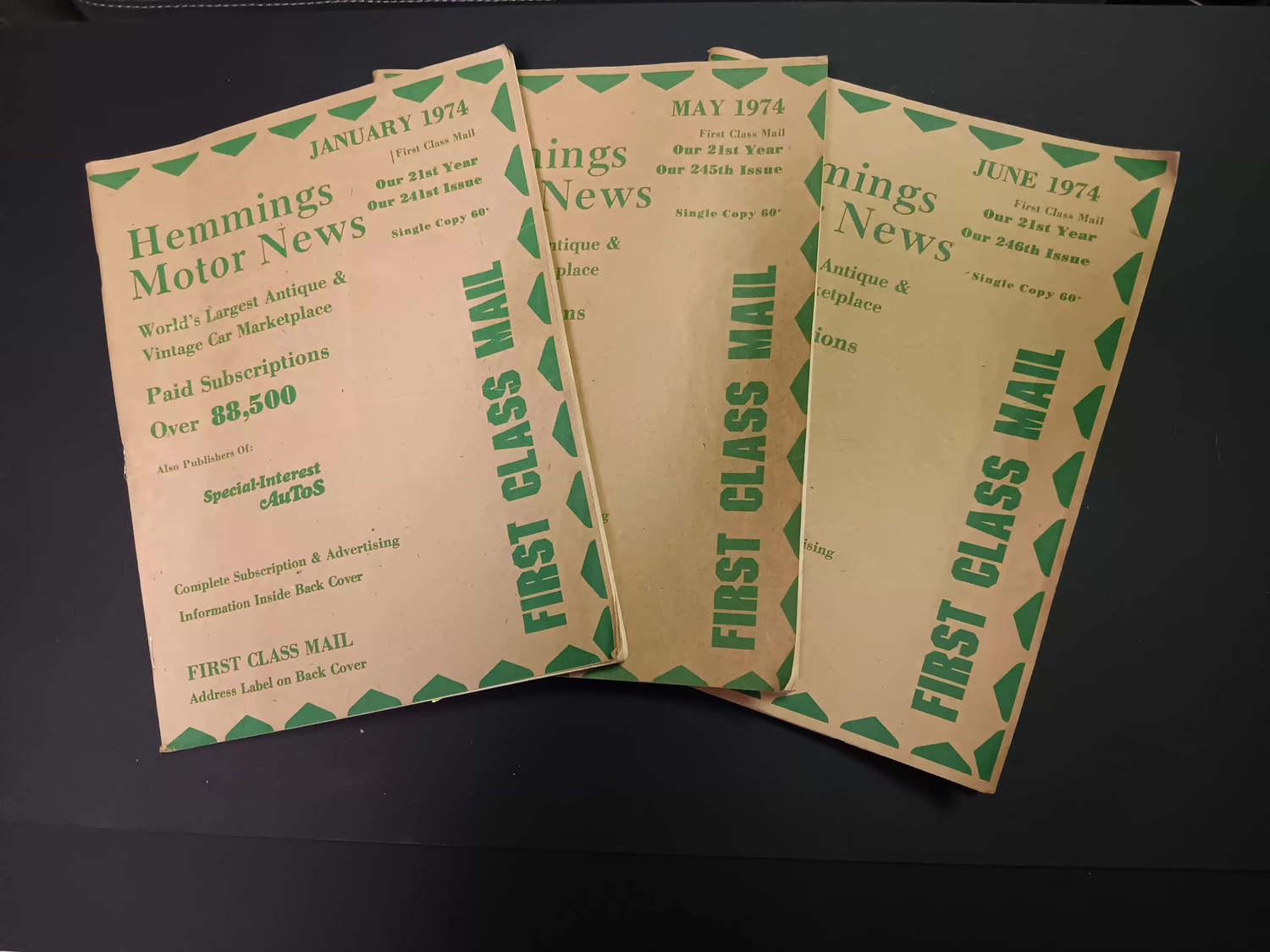
In January of 1954 Ernest Hemmings launched the first issue of his eponymous Hemmings Motor News. In introducing his, then, mimeographed magazine he stated its purpose writing, “I hope it will be of real interest to the person interested in older models. I hope that this magazine will grow bigger and better as time goes on and in the future I hope to secure a better printing for it.”
Twenty years later, America found itself hammered by the 1973 to 1974 Arab oil embargo. The price of a barrel of oil had quadrupled to $12 from $3. Gas prices skyrocketed with the price per gallon increasing 35%. Simultaneously new car performance plummeted. Reeling from emissions control choked engines and awkward exterior safety designs, the 1970s inflicted a powerful jolt to enthusiasts bred in the muscle car era. The simplicity of cars produced prior to the wave of government imposed safety and emissions regulations made older cars with their high performance and good looks fertile ground for the do-it-your-self classic car enthusiast. These enthusiasts formed the audience Ernest Hemmings had in mind. By 1974 the Hemmings subscriber base had climbed to 88,100.
While high end European cars such as Ferraris, Lamborghinis and Aston Martins had a following among wealthy “collectors” as did American Olympian cars such as Duesenbergs, Packards and Cadillacs, none had yet begun to climb to the heady values witnessed in later decades. Individuals acquiring such vehicles could best be viewed as knowledgeable connoisseurs possessing a deep appreciation for respected works of automotive art, an appreciation mostly confined to a relatively few like-minded individuals. Certainly they did not view themselves as in it for the money. However, history would show that collecting desirable classic cars would, over time, prove to be an exceptionally wise investment. In the early 1970s a 1962 Ferrari 250 GTO that, today, has fetched up to $70,000,000 rated as an outdated old race car. Prices fell well below $20,000 on a good day. With that in mind one dollar in 1974 would, in 2025, be worth about $6.57, meaning that that Ferrari would have sold for roughly $130,000 when adjusted for inflation.
In 1974 the Hemmings readership found itself mired in an American economy suffering high inflation and recession. It was not the best of times. President Nixon resigned as part of the Watergate scandal. The stock market crashed dropping by over 30%, economic output (GDP) dropped by 5% and unemployment hovered around 7% on the way to 9%. Yet the classic car grew. An editorial note in the June 1974 Hemmings would indicate that the classic car enthusiast culture “shone as s bright spot in these dark times.” It’s “Notes from H.M.N.” editorial stated, “Over the years the Antique Automobile Club of America sponsored Hershey Meet has grown tremendously. Most of the growth has been in the Flea Market area, and we doubt if anyone would argue that it has become the world’s largest old auto Flea Market.”
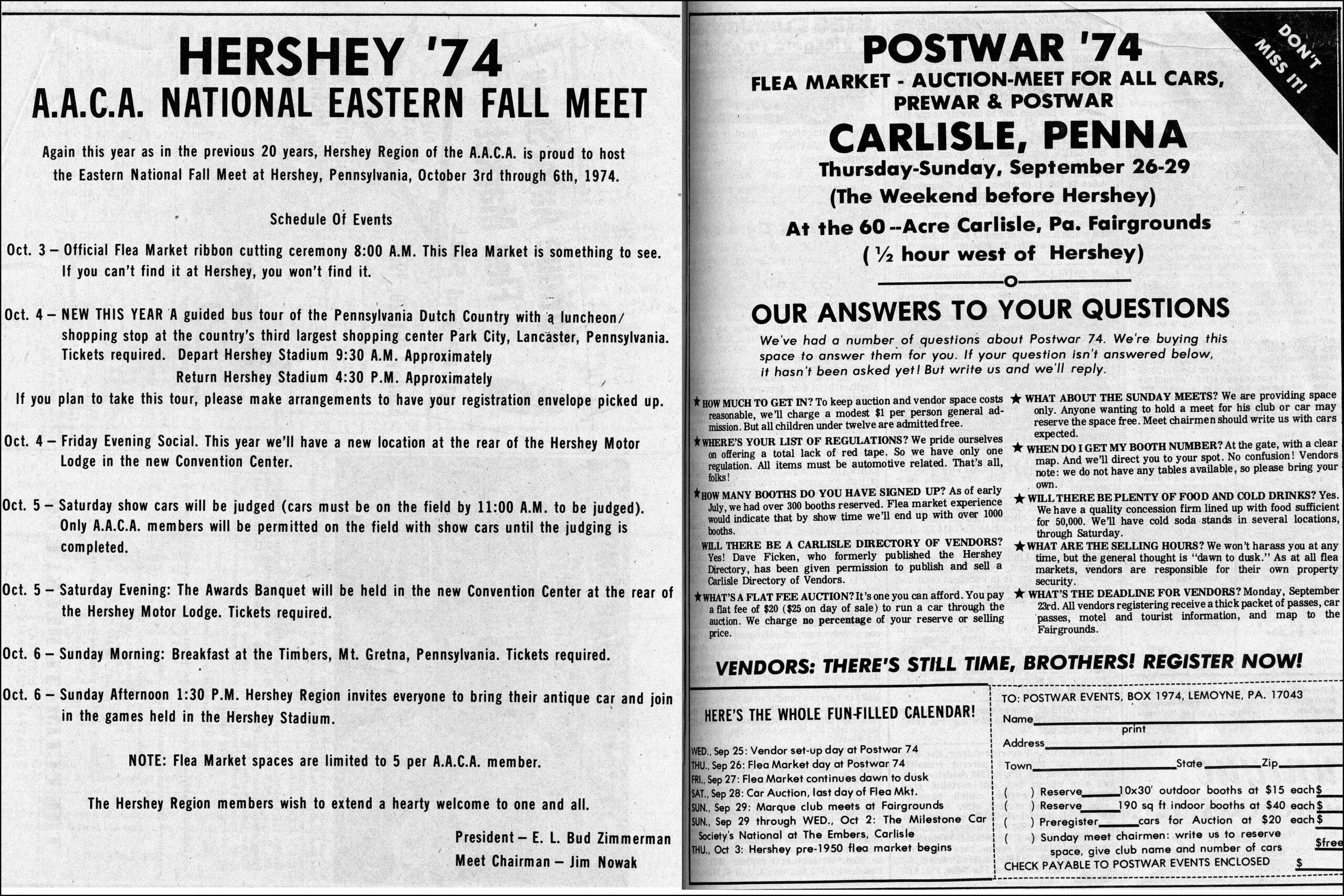
As reported in the June 1974 Hemmings it had become clear that Hershey’s Flea Market, in the eyes of the gray eminences of the AACA, had become too successful. Thus, the AACA leadership decided the time had come to tighten event regulations. The changes centered on the year 1939. New regulations intended to be strongly enforced included; No post 1939 model parts, no apparel in other than time appropriate styles and no toys or model kits for cars newer than 1939. Clearly the AACA intended to circle the wagons around what would become an ever graying pool of prewar enthusiasts. Interestingly the Hemmings editorial commented, “We’ve heard rumors already that immediately preceding the 1974 Hershey Meet there may be another Flea Market organized not far from Hershey to take in a broader range of vendors.”
Not surprisingly, shortly thereafter, the September 1974 issue featured a full page ad introducing the new “Postwar 74” Flea Market at Carlisle, PA. It would welcome all cars, prewar and postwar. It would run the week before Hershey. This set the stage for the double barreled autumn classic car experience that for decades had become the Mecca drawing car enthusiasts from east of the Mississippi River and beyond. Winds of change had begun to build and they blew in many directions.
 As a harbinger of coming change early 1974 saw a new company called “Computerized Antique Car and Parts Service” advertise in Hemmings. Like some ancient aquatic denizen in an early but unsuccessful attempt to venture onto land, this business sought to apply computerized search techniques to marketing vintage cars and parts. It failed. However, decades later that business’ basic idea, empowered by 21stt century e-commerce tools, resurfaced as a powerful global entity energizing the collectible car culture. It had evolved into the online auction site Bring a Trailer and its kin. Indeed, the winds of change spurred on by profound advancements in digital commerce have expanded the enjoyment and associated business opportunities associated with a global collectible car culture to heights unthinkable fifty years ago. Such changes clearly demanded adjustments in the content and character of an evolving Hemmings.
Interestingly, while over the last half century the publication has remained faithful to the founder’s goal of serving the needs of the vintage car enthusiast, the targeted market has morphed and mushroomed. The early 1970s saw Hemmings’ content display green shoots signaling the nascent beginnings of interests and enterprises that would coalesce into the juggernaut that towers as today’s collectible car universe. Looking back at the stark pages of Hemmings in 1974 reveals a much simpler world for the publication to serve. In that world purchasing a collectible car most often involved a personal interaction of buyer and seller. Any professionals involved usually operated on the higher end of the market. Individual enterprises such as Ed Jurist’s Vintage Car Store in Nyack, New York dealt with wealthy collectors on a personal basis. Auctions did not operate as national much less global enterprises. The late 1960s and early 70s collectible car world found itself at the threshold of a world that would significantly differentiate collectible cars from simple used cars. At this point in time Hemmings stood inextricably lashed to a primarily American pastime poised to blossom into a global phenomenon.
From the start in 1954, Hemmimgs focused on domestic brands with a mindset that heavily favored Ford products. This preference evidenced itself in the publication’s initial system for categorizing cars and parts for sale. Only two categories existed, Fords and non-Fords. Rolls-Royce represented the only foreign make with a significant presence. As a reflection of the changing and broadening of the collectible car culture, Hemmimgs before the end of the 1970s categorized all makes alphabetically.
Ads in Hemmings in 1974 offered tier one cars that today would startle with mind numbing prices. (Current prices are very rough approximations based on the December 2025 Hagerty Price Guide). They include:
1974 TODAY
1930 Mercedes-Benz SS supercharged, $60,000……………….$6,000,000
1936 Bugatti Type 57 supercharged, $50,000……………………$9,900,000
1953 Siata 208S, concours condition, $7,500…………………….$3,000,000
1955 Mercedes-Benz 300SL Gullwing, mint $15,000………….$1,600,000
1955 Chevy Nomad, gorgeous, $1,740……………………………….$ 150,000
1959 Porsche Carrera Speedster, $10,000 OBO…………………$1,200,000
1959 Mercedes-Benz 300SL roadster, $8,500……………………$1,200,000
1963 Corvette split window coupe, $3,250………………………..$ 143,000
1964 Aston Martin DB4, like new, $4,150………………………….$ 700,000
1965 AC Cobra 289, flawless, $7,800………………………………..$1,000,000
1967 Ferrari Dino, $8,500………………………………………………..$ 550,000
1967 Ferrari 275 GTB-4, $16,500……………………………………..$2,150,000
1968 Corvette, factory L88, $5,700…………………………………..$ 345,000
 It would be into this fertile yet largely untapped realm of classic car culture that a few visionaries would initiate a sea change.Nurtured by a Hemmings advertiser, Leo Gephart, an Ohio classic car dealer, the seeds of change had shown green shoots by the early 1970s. Gephart, whom many consider the father of the modern large-volume classic car auction, had an idea. His experience had shown that car collectors would travel from state to state looking for old cars at estate sales. Based on this he believed that a lot of collectors could be expected to gather if a huge number of cars had been assembled for sale in one place. Gephart, a long time member of the Auburn-Cord-Duesenberg Club, approached a friend Russell Kruse with the idea. Till then Kruse had specialized in the auctioning of Construction equipment. Both men like the idea. On Labor Day in 1971 Kruse Auctions in collaboration with the Auburn-Cord-Duesenberg Museum hosted the Auburn Labor Day Auction.
Based on the Auburn auctions significant success Gephart approached car enthusiasts Tom Barrett and Russ Jackson with the idea of a winter auction in Scottsdale, Arizona in 1972. The rest they say is history. A big part of that history came with Gephart’s realization that classic cars purchased in the Arizona desert by buyers from all over the country had to be taken back to purchasers’ homes all over the country. Gephart co-founded a specialty trucking line to serve that unique need and later sold it to collector Robert Pass, who renamed it Passport Transport.
Over the next 50 years, the pages of Hemmings, monitored, reported on and supported the evolution and meteoric rise of the collectible car hobby that it had nurtured from birth.
For the seasoned adult collectible car enthusiast, leafing through the pages of a Hemmings from the past creates an experience not unlike flipping through a family album that captures your life.
By 1969 the demands of writing, producing and managing “Hemmings Motor News” exceeded the capabilities of any one person. Ernest Hemmings chose to sell his Hemmings so that it could continue on adapting to and serving the collectible car community that he so valued and respected.
In living on to 2015 Ernest Hemmings’ wish for better printing had been realized. Today’s Hemmings, while keeping faith with its role as “The Bible” of the collector car hobby, now comes richly photographed and in living color.