Conversations With People We Value #60
Herb Benkel loves cars. Herb loves driving. Herb loves Susan whom he married on November 9, 1968. All would be impacted one week after the wedding when he was diagnosed with cancer. Though ultimately losing his right leg to osteonecrosis Herb never wavered in his commitment to leading a full life that would include a highly successful career as an endodontist, mentoring for the Amputee Coalition and an undiminished enthusiasm for driving.
Meet Herb Benkel
A Car Guy Offers Life Lessons in Taking Misfortune in Stride
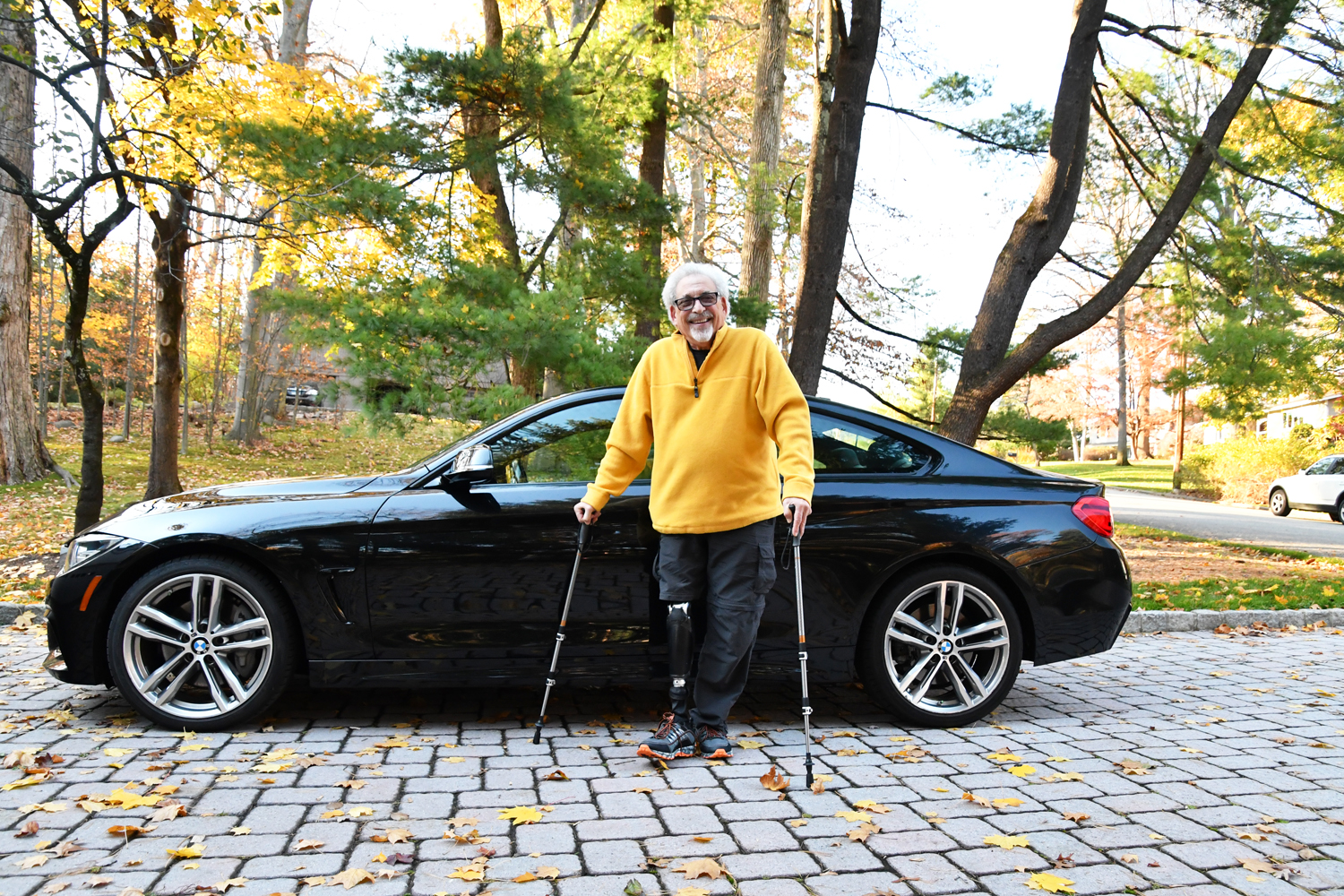
His handsome and immaculate triple black BMW 440i pulls into the parking lot. The driver’s door swings open filling the added space available in the handicap parking spot. Slowly and deliberately Herb Benkel swings his left leg out of the car. With his left leg firmly planted on the ground, he spins his body to the left and manually guides his prosthetic right leg from the car. A marvel of medical technology, it features the world’s first motor-powered microprocessor knee and cobalt chrome construction. It boasts a level of technical advancement on a par with the BMW he drives.
Using two canes for stability as he stands, Herb greets me with a broad smile and laughing eyes. He authentically projects the visage of a man who never has a bad day. In this case the day offers a festival of autumn glory.
Herb’s prosthesis leaves Long John Silver far in the dust with a mobility solution sporting a heavy dose of Schwarzenegger’s Terminator cyborg. He says, “You can hear the device when I am approaching. If you watch the original Terminator movie with Arnold Schwarzenegger, you hear the Terminator machinery going Zip, Zip, Zip, Er, Er, Er. Now that’s me. You can hear the motor when I walk. At first, it was really annoying but then I got used to it.”
The leg’s microprocessor delivers a powered motion to actively replicate lost muscle function. State-of-the-art sensors detect his movement thus equipping the knee to anticipate his needs. A powerful motor delivers active extension when standing and controlled resistance when rising. Herb says, “The sophistication of the Ossur Prosthetic is a blessing.” With the Ossur unit, a motor responds to provide active bending and straightening of the leg when walking. Thus the unit automatically returns the lower leg to the natural stance position to promote a more natural gait. Herb explains the challenge faced with his leg amputated up to just below the hip saying, “Without the motor facilitating the normal motion of the lower leg it would be hell for me to try to move just with the small stump. It would be like, trying to write your name with a full-sized pencil, just holding the eraser.” Just like other electric conveyances the leg needs to be charges every night. Because of Herb’s needs, his driving experience demands a greater integration of man and machine. Yet for the most part a simple solution provides an ideal interface connecting Herb and his BMW.
Herb says, “I discovered that there are companies that do adaptations for 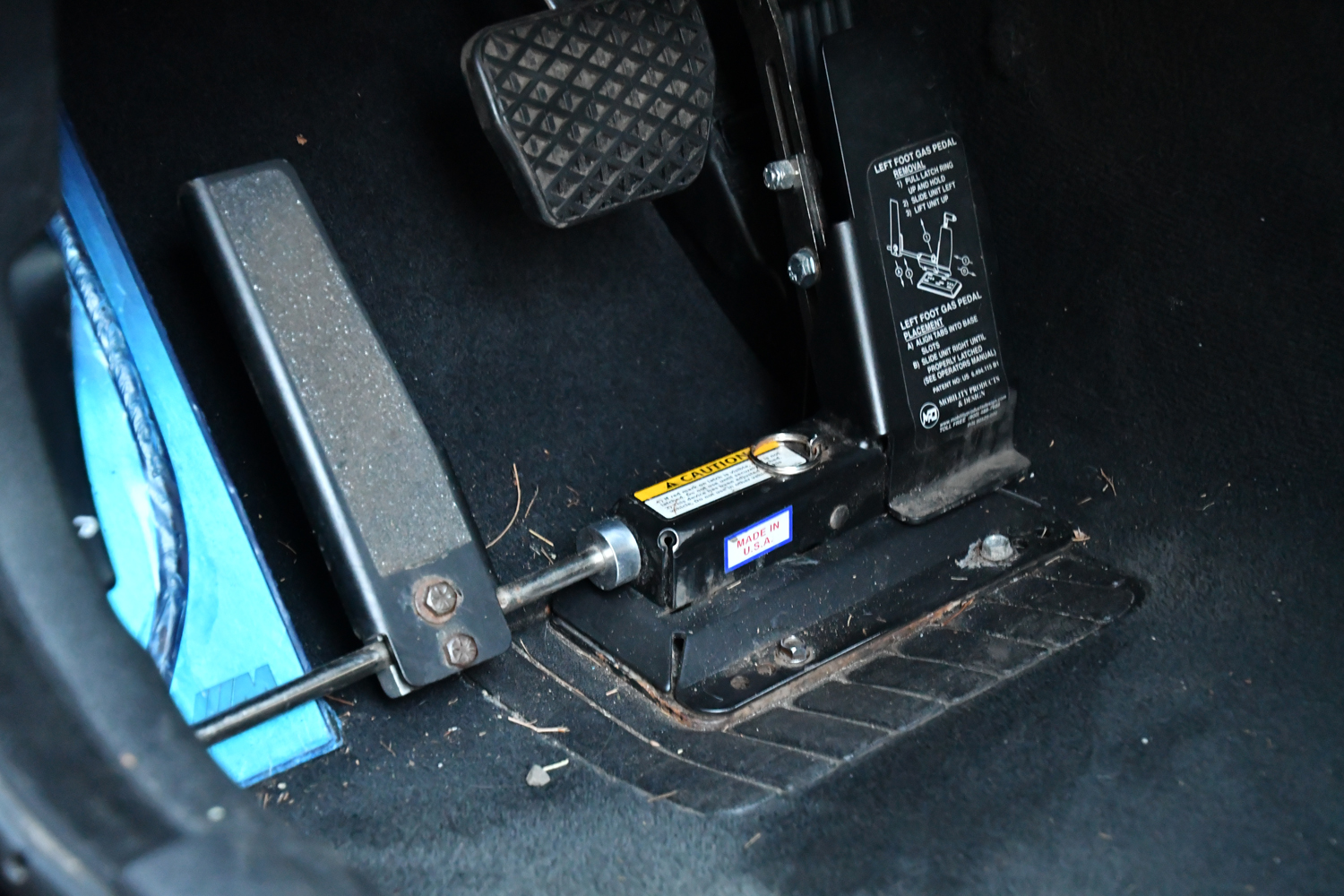 amputees. When they took off my leg I had first intended to get rid of my 440i and buy something else. But then, I learned I could drive my BMW using my left foot with a device available locally. What a great device.
Herb says, “My right leg is amputated and the gas pedal is on the right. That is a problem demanding a solution.” The solution starts with a shield that covers the gas pedal. Herb rests the right foot of his prosthetic leg against the shield thus rendering the right leg immobile. A roller assembly affixed to the back of the shield and connected to the gas pedal attaches by way of a rod to a gas pedal on the left side of the foot well. Motion initiated on the left gas pedal translates by way of the connecting rod to motion on the real gas pedal on the right. Herb says, “My left leg has no problem reaching the relocated gas pedal and I can easily move my foot to the right to get to the brake.” Herb took three classes at Kessler Rehabilitation to become comfortable, He says, “Now it is second nature just like the way everybody else drives with the right foot. History has shown that Herb has significant experience with the go-pedal. He has earned tickets for doing 120 mph on both coasts: Highway 1 in California and Route 17 in New Jersey. With a glint in his eye Herb says, “Those tickets were before the amputation. I don’t speed like that anymore. If they took me to court I wouldn’t have a leg to stand on.” A final and important consideration concerns the car that Herb prefers to drive. For the last 40 years the answer has always been the same, a BMW.” With the amputation the choice is more specific.
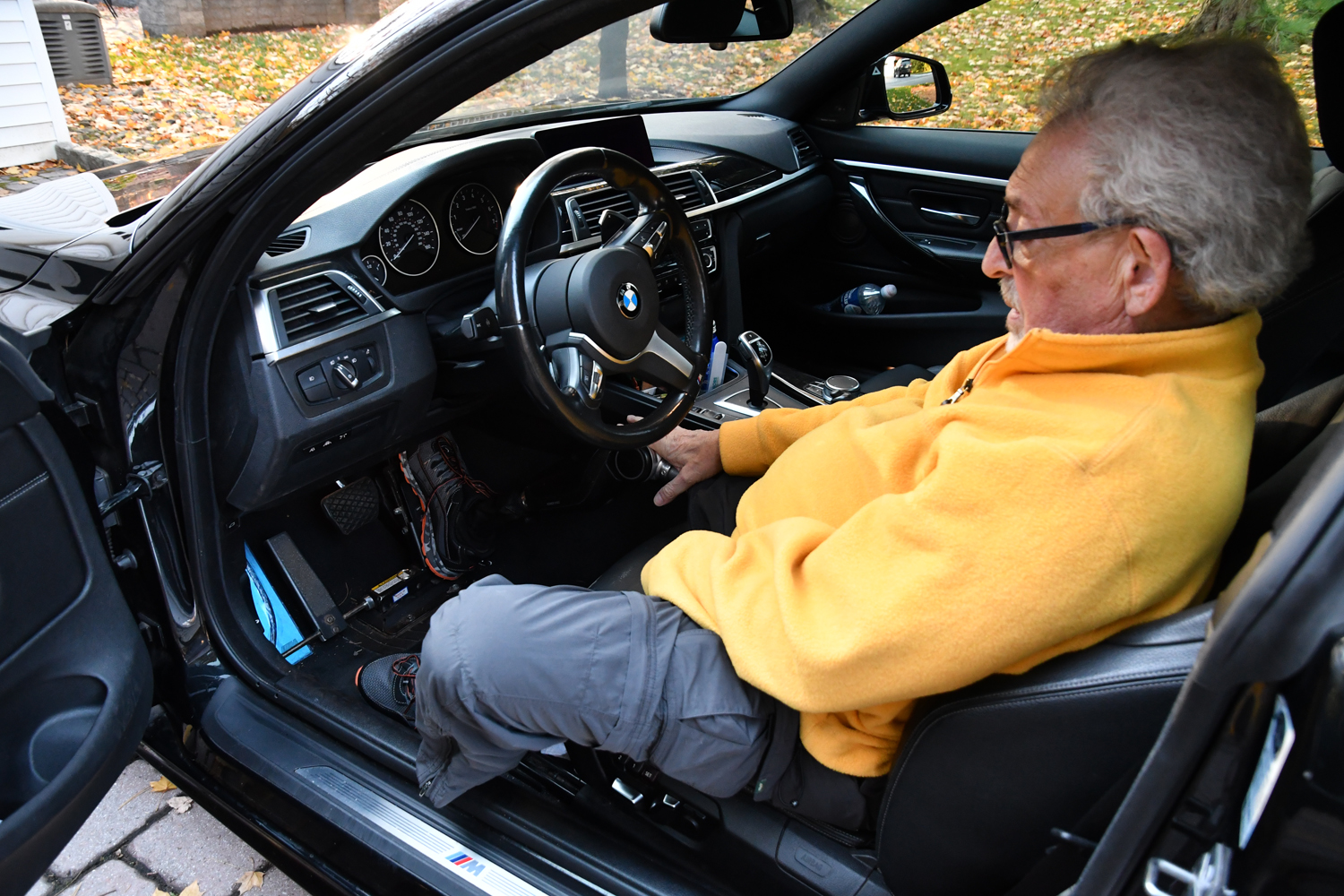 “I have to have a 2-door coupe, like my 440i,” says Herb. He explains why saying, “You need a big door when you have a prosthetic leg. In my case, it’s my right leg, and I’m sitting on the left side of the car. I have to lift my right leg with my hand, slide it out and then slide my body. In order to do that, I need a big door and automatic seat settings.” To exit the car requires Herb to have the seat all the way back. Herb says, “I couldn’t drive a car that didn’t have electric seats because without a memory seat, it would be a nightmare every time I got in and out of the car.”
While a stretch of 50 years spanned the period between Herb’s bout with cancer and the amputation of his right leg, an extricable link connected the two events.
Herb says, “One of first things I gave my wife after a week of marriage was a diagnosis that I had osteosarcoma, bone cancer.” In the 1960s the choice of treatments consisted of radiation or amputation. Chemotherapy did not exist. They made the decision to treat it with radiation. Herb says, “Unfortunately in those days radiation treatment was poorly delivered.”
Decades later, on the coldest day in New Jersey in 35 years, while walking up his driveway, Herb’s right leg simply crumbled. He collapsed in a heap. No one could see him from the street. He feared freezing to death. Luckily, he could find his cell phone and called Sue. She placed the 911 call. The ambulance took him to the hospital. While the damage had had its roots in 1968, 2019 saw him lose his leg up to the hip.
In reflecting on this difficult time Herb says, “The job of getting through an amputation is the job of taking one moment at a time and trying to find something decent in that one moment and then starting to link those individual moments together. It’s easier said than done, but it’s the only way I got through it when I was in the hospital and I lost the leg before they made the prosthetic, I found Exercise bands. And I started doing exercises in the bed that gave me a sense that I had some control over my body; with everything else that was going wrong. I had control.”
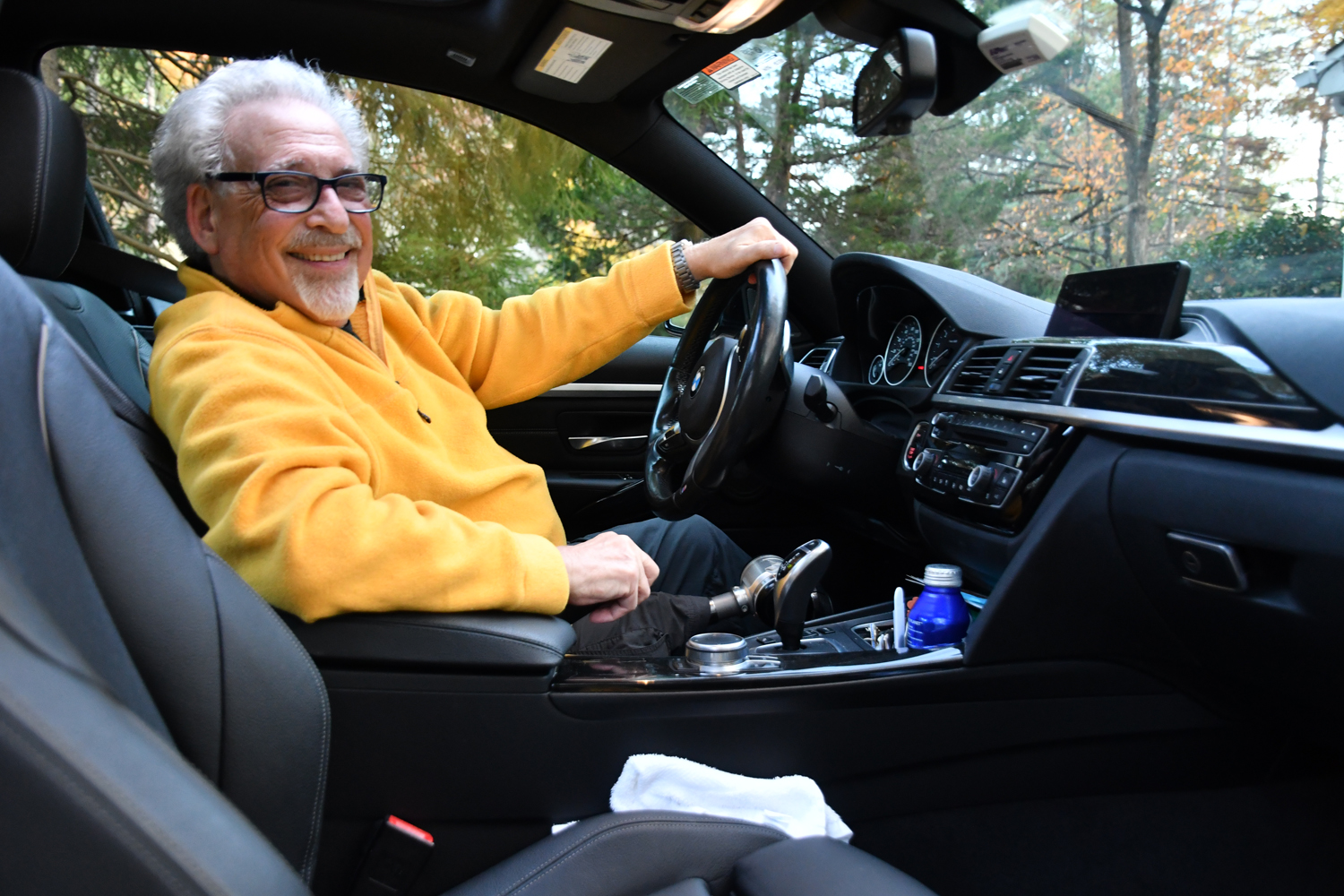 When asked if the driving experience changed with the prosthetic device, Herb says, “Yes and no. I have always loved driving, however, all my cars had been stick. However, because of what happened I can no longer drive stick. But considering that pretty much all brands have stopped making them, it seems an inevitability. I don’t like the paddles. Not the same, not even close. So that’s where it’s changed. But I got used to it and I still love to drive. I mean, I get relaxation. I love being surrounded by my music. I love the quickness and toss-ability of my BMW. I rejoice in tracking on a serpentine back road. Yeah, I still take exit ramps at 60 miles an hour, you know, just to feel how the car holds the road.”
In discussing driving as an amputee Herb notes that one terrible problem plagues all amputees to some degree. That problem is phantom pain. He says, “Phantom Pain can attack you at any time and that’s a little nerve-racking. No one can really explain it adequately, that’s why they can’t treat it, but phantom pain is your body feeling that your foot is still there and sending pain signals to that foot.” In describing phantom pain Herb says, “So I don’t feel the pain in any part of my body. My stump is not irritated. Nothing is irritated, but there’s a horrific burning feeling and shocks of electricity that go to my toes and my foot. The sensation makes me feel like that foot is fully there and being tortured or ripped apart or burnt. Sometimes it feels like it is being put in hot oil. Phantom pain attacks can last between four hours and four days.”
I asked Herb what role Susan, his wife, played in dealing with his misfortune. Herb with hesitation says, “I would never have gotten through this without her. This goes all the way back to when we married in 1968 and I was diagnosed with bone cancer. She could have stayed, she could have left. I mean, the marriage could have been annulled in a minute but she didn’t do that. She stuck through it all. It was a crazy time, but we did it together.
When asked his greatest challenge Herb’s says, “To make the best of the one life God gave me.”